Recognition: no theorem link
Astrophysical signatures of Kerr-Bertotti-Robinson black holes in a cloud of strings: ISCO, microquasar QPOs, and Bondi-Hoyle-Lyttleton accretion
Pith reviewed 2026-05-12 04:11 UTC · model grok-4.3
The pith
Kerr-Bertotti-Robinson black holes in a cloud of strings shift the innermost stable orbit outward, raise accretion efficiency, and produce QPO patterns that fit observations in three microquasars when the string parameter stays below 0.13.
A machine-rendered reading of the paper's core claim, the machinery that carries it, and where it could break.
Core claim
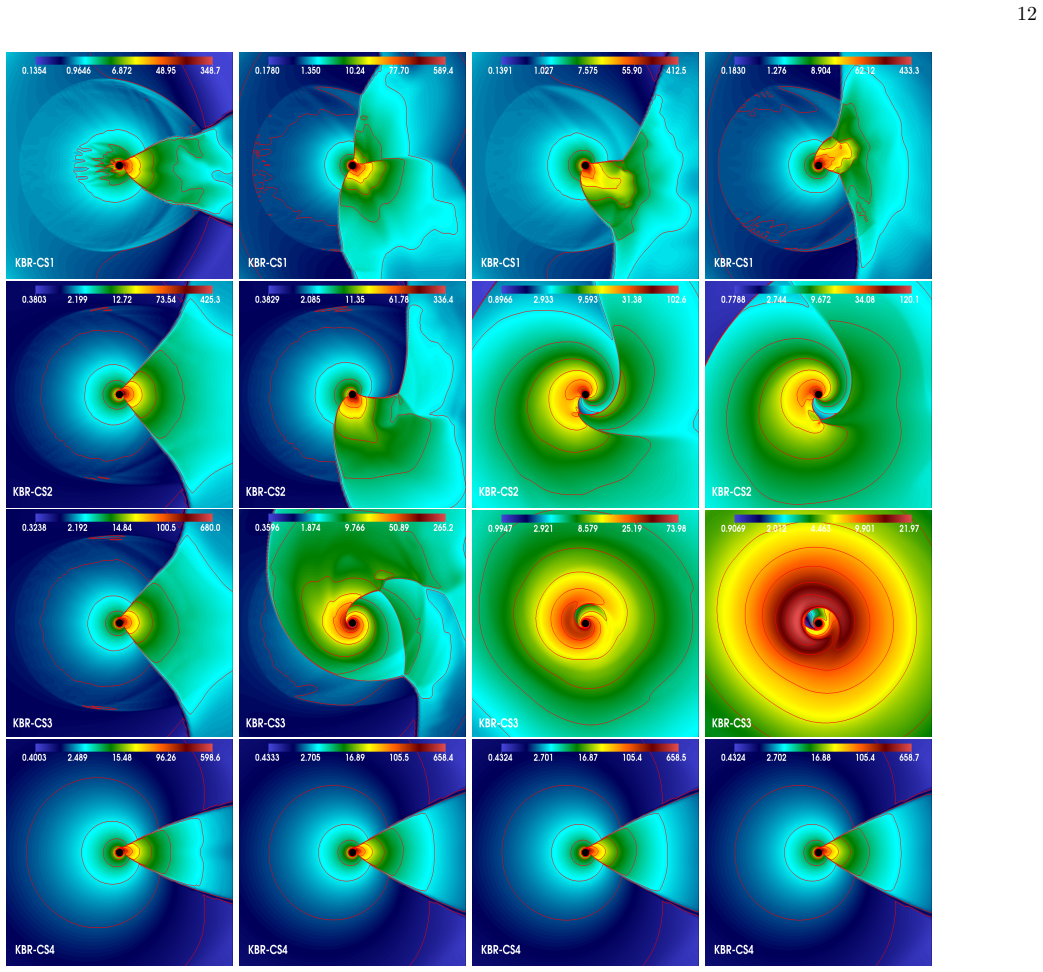
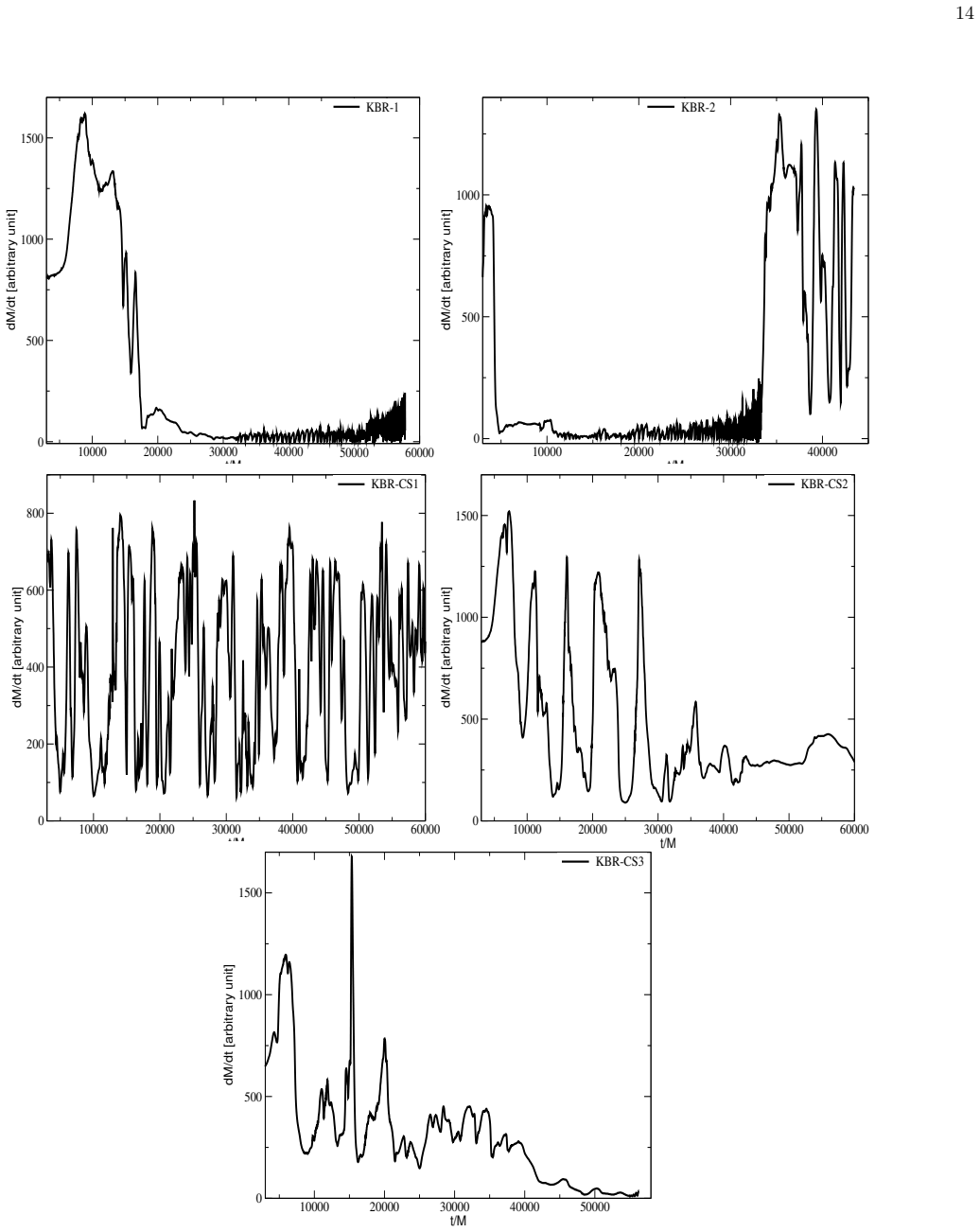
Using the Hamilton formalism, the effective potential for equatorial motion is derived, yielding specific energy, angular momentum, and epicyclic frequencies. Numerical evaluation across parameter space reveals that the string parameter α increases the ISCO radius for both prograde and retrograde orbits while boosting accretion efficiency from 0.057 in Schwarzschild to over 0.25 at high spin and α=0.3. Fitting the relativistic precession model to QPO data from three microquasars constrains α below 0.13, and general-relativistic hydrodynamics of Bondi-Hoyle-Lyttleton accretion demonstrates that the cloud sustains shock-cone instabilities, shifts power spectral density peaks, and generates low
What carries the argument
The string parameter α in the KBR+CS metric, which modifies the effective potential for test-particle motion and the density-velocity structure of Bondi-Hoyle-Lyttleton accretion flows.
If this is right
- The ISCO radius grows with α, lifting accretion efficiency η above 0.25 for α = 0.30 at spin a = 0.9.
- Twin high-frequency QPOs in microquasars are reproduced by the radial and vertical epicyclic frequencies only when α remains below 0.13.
- Bondi-Hoyle-Lyttleton accretion develops persistent shock-cone instabilities and extra low-frequency power-spectrum peaks that do not appear in pure Kerr or KBR cases.
Where Pith is reading between the lines
- Future X-ray timing observations with higher sensitivity could independently test the low-frequency QPO components predicted by the cloud of strings.
- The outward ISCO shift may change the inner-disk temperature profile enough to appear in broadband X-ray spectra of accreting sources.
- Applying the same GR hydrodynamical setup to thin-disk accretion could expose further observable differences between KBR+CS and standard Kerr flows.
Load-bearing premise
The relativistic precession model correctly identifies observed twin-peak QPOs as the radial and vertical epicyclic frequencies computed in the KBR+CS metric.
What would settle it
High-precision timing data from a microquasar whose measured high-frequency QPO pair cannot be reproduced by any combination of spin, magnetic parameter, and string density below 0.13 in the epicyclic-frequency expressions.
Figures





read the original abstract
We study test-particle dynamics in the equatorial plane of a Kerr-Bertotti-Robinson black hole (BH) immersed in a cloud of strings (CS), with mass M , rotation a, magnetic parameter B, and string parameter {\alpha}. Using the Hamilton formalism we recover the effective potential Ueff and the conditions for circular motion, and we compute the specific energy E and specific angular momentum L together with the radial, vertical, and azimuthal epicyclic frequencies {\nu}r , {\nu}{\theta} , {\nu}{\phi}. Going beyond the analytic setup, we provide the first numerical mapping of the innermost stable circular orbit (ISCO) for this background and tabulate rISCO, EISCO, LISCO, and the accretion efficiency {\eta} = 1 - EISCO for both co- and counter-rotating motion across a wide (a, B, {\alpha}) grid. The CS parameter pushes the ISCO outward and raises {\eta} from 0.057 in Schwarzschild to above 0.25 for {\alpha} = 0.30 at a = 0.9. We then connect the model with observed twin-peak high-frequency quasi-periodic oscillations (QPOs) in three microquasars (GRO J1655-40, XTE J1550-564, GRS 1915+105) using the relativistic-precession (RP) model and find \{chi}^2-minimum fits with {\alpha} < 0.13. A general-relativistic hydrodynamical (GRH) study of Bondi-Hoyle-Lyttleton (BHL) accretion completes the picture: the CS contribution sustains shock-cone instabilities, redistributes power-spectral-density (PSD) peaks, and produces low-frequency QPO-like components that distinguish KBR+CS from pure Kerr or KBR.
Editorial analysis
A structured set of objections, weighed in public.
Referee Report
Summary. The manuscript studies test-particle motion in the equatorial plane of a Kerr-Bertotti-Robinson black hole immersed in a cloud of strings, deriving the effective potential, specific energy and angular momentum, and epicyclic frequencies analytically. It supplies the first numerical tabulation of ISCO locations, energies, angular momenta, and accretion efficiencies over a grid in (a, B, α). The string parameter is then constrained to α < 0.13 by χ²-minimization against twin-peak HFQPOs in three microquasars under the relativistic-precession model, and GRH simulations of BHL accretion are used to argue that the cloud sustains shock-cone instabilities, shifts PSD peaks, and generates distinguishing low-frequency QPO-like features.
Significance. If the results hold, the work supplies concrete numerical ISCO data and hydrodynamical diagnostics for a non-vacuum spacetime that could be used to bound the string-cloud parameter observationally. The tabulated ISCO quantities and the GRH treatment of shock cones constitute reusable, metric-internal contributions.
major comments (2)
- [QPO analysis and RP-model fits] The χ²-minimum fits that produce the central constraint α < 0.13 rest on the external assumption that the observed twin-peak frequencies are precisely the radial and vertical epicyclic frequencies ν_r and ν_θ. The manuscript should quantify how the allowed α interval and the claimed distinction in low-frequency QPO-like components shift when alternative identifications (resonance conditions or vertical-azimuthal pairs) are adopted.
- [GRH BHL accretion simulations] The assertion that the cloud of strings sustains shock-cone instabilities and redistributes PSD peaks is load-bearing for the distinction claim, yet the GRH section provides only qualitative statements; quantitative measures (growth rates, integrated PSD differences, or direct side-by-side comparisons with pure Kerr and KBR runs) are needed to substantiate the effect.
minor comments (2)
- [ISCO mapping] The abstract states that the ISCO mapping is 'first numerical'; the methods section should explicitly document the root-finding algorithm, convergence criteria, and grid resolution used to locate the ISCO so that the tabulated values can be reproduced.
- [Effective potential and frequencies] Notation for the three epicyclic frequencies should be introduced with their explicit definitions (including any 2π normalization) at the first appearance rather than only in the abstract.
Simulated Author's Rebuttal
We thank the referee for the constructive and detailed comments. These have prompted us to clarify the scope of our results and to strengthen the quantitative support for the hydrodynamical claims. We respond to each major comment below.
read point-by-point responses
-
Referee: [QPO analysis and RP-model fits] The χ²-minimum fits that produce the central constraint α < 0.13 rest on the external assumption that the observed twin-peak frequencies are precisely the radial and vertical epicyclic frequencies ν_r and ν_θ. The manuscript should quantify how the allowed α interval and the claimed distinction in low-frequency QPO-like components shift when alternative identifications (resonance conditions or vertical-azimuthal pairs) are adopted.
Authors: We acknowledge that the reported bound α < 0.13 is obtained exclusively within the relativistic-precession (RP) model, identifying the upper and lower HFQPO peaks with ν_θ and ν_r. This choice follows the standard application of the RP framework to microquasar data in the literature. Alternative identifications (e.g., 3:2 resonance or vertical-azimuthal pairs) would produce different χ² minima and therefore different α intervals. A full re-derivation of the χ² surfaces for every alternative model requires new, extensive fitting that exceeds the present scope. In the revised manuscript we will add a concise subsection that (i) states the model-specific character of the α < 0.13 constraint, (ii) provides a qualitative estimate of the shift in the allowed α range based on the monotonic dependence of the epicyclic frequencies on α, and (iii) notes that the low-frequency QPO-like features discussed in the GRH section remain independent of the HFQPO identification. This revision makes the model dependence explicit without claiming universality. revision: partial
-
Referee: [GRH BHL accretion simulations] The assertion that the cloud of strings sustains shock-cone instabilities and redistributes PSD peaks is load-bearing for the distinction claim, yet the GRH section provides only qualitative statements; quantitative measures (growth rates, integrated PSD differences, or direct side-by-side comparisons with pure Kerr and KBR runs) are needed to substantiate the effect.
Authors: We agree that quantitative diagnostics are required to substantiate the claimed distinctions. The original GRH section relied on visual inspection of shock-cone morphology and PSD shapes. In the revision we will re-analyze the existing simulation outputs to supply: (i) growth-rate estimates obtained from exponential fits to the time evolution of density and radial-velocity perturbations within the shock cone, (ii) integrated PSD power ratios (0–50 Hz band) between KBR+CS, pure KBR, and Kerr runs for representative (a, B, α) values, and (iii) overlaid PSD plots that directly compare the three spacetimes. These additions will be presented in a new figure and accompanying table, thereby converting the qualitative statements into measurable differences. revision: yes
Circularity Check
No significant circularity; derivations are metric-internal or use external RP model
full rationale
The paper derives the effective potential, circular-orbit conditions, specific energy/angular momentum, and epicyclic frequencies directly from the Hamilton formalism on the KBR+CS metric (first-principles from the line element). ISCO values are obtained by numerical root-finding on the effective potential across a parameter grid, independent of observations. The α < 0.13 bound is a standard χ² fit of the computed ν_r and ν_θ to published microquasar HFQPO data under the externally cited relativistic-precession model; this constrains a parameter but does not redefine any derived quantity. The GRH BHL accretion simulations are separate numerical hydrodynamics runs that evolve the flow on the same metric and exhibit shock-cone and PSD features as dynamical output, not as a re-expression of the QPO fit. No step reduces to its input by construction, and no load-bearing premise rests solely on self-citation.
Axiom & Free-Parameter Ledger
free parameters (2)
- α (string-cloud parameter)
- B (magnetic parameter)
axioms (2)
- domain assumption Test-particle motion follows geodesics of the KBR+CS metric
- domain assumption The relativistic precession model correctly maps observed QPO frequencies to epicyclic frequencies
invented entities (1)
-
Cloud of strings
no independent evidence
Reference graph
Works this paper leans on
-
[1]
However, this condition alone is not sufficient to determine whether causality is preserved or violated. To investigate this 4 issue, we consider the behavior of the metric component gϕϕ near the equatorial plane, θ = π/2. In this case, the denominator reduces to (1 + B2r2) r2 > 0, and therefore the sign of gϕϕ is entirely determined by the nu- merator, (r...
work page 1977
-
[2]
C. V. Borm and M. Spaans, Astron. Astrophys. 553, L9 (2013)
work page 2013
-
[3]
V. P. Frolov, in The Galactic Black Hole , edited by H. Falcke and F. H. Hehl (IoP Publishing, 2003)
work page 2003
-
[4]
J. C. McKinney and R. Narayan, Mon. Not. R. Astron. Soc. 375, 513 (2007)
work page 2007
-
[5]
J. C. McKinney and R. Narayan, Mon. Not. R. Astron. Soc. 375, 531 (2007)
work page 2007
-
[6]
P. B. Dobbie, Z. Kuncic, G. V. Bicknell, and R. Salmeron, in Cosmic Magnetic Fields: from Planets, to Stars and Galaxies, IAU Symposium 259 (Tenerife, Spain, 2008)
work page 2008
- [7]
- [8]
-
[9]
C. M. Will, Living Rev. Relativ. 17, 4 (2014)
work page 2014
- [10]
- [11]
-
[12]
B. P. Abbott et al. , Phys. Rev. Lett. 116, 061102 (2016)
work page 2016
- [13]
- [14]
- [15]
- [16]
- [17]
-
[18]
A. Vachher, A. Kumar, and S. G. Ghosh, J. Cosmol. Astropart. Phys. 2026 (11), 021
work page 2026
- [19]
-
[20]
P. S. Letelier, Phys. Rev. D 20, 1294 (1979)
work page 1979
-
[21]
H. Hoshimov, O. Yunusov, F. Atamurotov, M. Jamil, and A. Ab- dujabbarov, Astropart. Phys. 165, 103056 (2025)
work page 2025
- [22]
-
[23]
A. A. Tursunov and M. Kolos, Phys. At. Nucl. 81, 279 (2018)
work page 2018
-
[24]
I. Banerjee, S. Chakraborty, and S. SenGupta, J. Cosmol. As- tropart. Phys. (9), 037 . 18
-
[25]
M. Y. Guo, M. H. Wu, X. M. Kuang, and H. Guo, Eur. Phys. J. C 85, 95 (2025)
work page 2025
-
[26]
Y. Feng, A. Ashraf, S. Mumtaz, S. K. Maurya, G. Mustafa, and F. Atamurotov, J. High Energy Astrophys. 43, 158 (2024)
work page 2024
- [27]
- [28]
-
[29]
G. Mustafa, O. Donmez, D. J. Gogoi, S. G. Ghosh, I. Hussain, and C. Yuan, (2026), arXiv:2602.08911 [gr-qc]
- [30]
-
[31]
S. Chandrasekhar and S. Detweiler, Proc. R. Soc. Lond. A 344, 441 (1975)
work page 1975
-
[32]
A. M. A. Zahrani, Astrophys. J. 937, 50 (2022)
work page 2022
- [33]
-
[34]
J. M. Bardeen, W. H. Press, and S. A. Teukolsky, Astrophys. J. 178, 347 (1972)
work page 1972
-
[35]
R. P. Brent, Algorithms for Minimization without Derivatives , dover reprint ed. (Dover Publications, Mineola, NY, 2013) orig- inal edition: Prentice-Hall, Englewood Cliffs, NJ, 1973
work page 2013
- [36]
-
[37]
S. E. Motta, T. Belloni, L. Stella, G. Pappas, J. Casares, A. T. Munoz-Darias, M. A. P. Torres, and V. I. Yanes-Rizo, Mon. Not. R. Astron. Soc. 517, 1469 (2022)
work page 2022
-
[38]
J. Zhu, A. B. Abdikamalov, D. Ayzenberg, M. Azreg-Ainou, C. Bambi, M. Jamil, S. Nampalliwar, A. Tripathi, and M. Zhou, Eur. Phys. J. C 80, 622 (2020)
work page 2020
- [39]
- [40]
- [41]
-
[42]
A. Maselli, L. Gualtieri, P. Pani, L. Stella, and V. Ferrari, As- trophys. J. 801, 115 (2015)
work page 2015
-
[43]
F. Abdulkhamidov, B. Narzilloev, I. Hussain, A. Abdujabbarov, and B. Ahmedov, Eur. Phys. J. C 84, 420 (2024)
work page 2024
-
[44]
Z. Wang, S. Chen, and J. Jing, Eur. Phys. J. C 82, 528 (2022)
work page 2022
-
[45]
A. Al-Badawi, F. Ahmed, O. Donmez, F. Dogan, B. Pourhas- san, Z. Sakalli, and Y. Sekhmani, Phys. Dark Univ. 51, 102206 (2026)
work page 2026
- [46]
- [47]
- [48]
- [49]
- [50]
- [51]
- [53]
- [54]
- [55]
-
[56]
J. Zhou, J. Huang, X. Chang, T. Okuda, and C. B. Singh, J. High Energy Astrophys. 47, 100395 (2025)
work page 2025
discussion (0)
Sign in with ORCID, Apple, or X to comment. Anyone can read and Pith papers without signing in.