Recognition: 2 theorem links
· Lean TheoremStatistical Analysis for Energy-Efficient Satellite Edge Computing with Latency Guarantees
Pith reviewed 2026-05-12 04:05 UTC · model grok-4.3
The pith
Parametric estimation and quantile regression enable optimal GPU frequency selection in satellite edge computing to meet 500 ms latency with 95% probability and over 50% energy savings.
A machine-rendered reading of the paper's core claim, the machinery that carries it, and where it could break.
Core claim
Parametric estimation and quantile regression for the execution time of the image processing algorithms can be effectively combined with models for the communication latency to select an optimal GPU clock frequency. This achieves a 95% probability of meeting a 500 ms end-to-end deadline while reducing energy consumption by more than 50% compared to a baseline that relies on a Chebyshev-Cantelli inequality to bound execution-time quantiles. The proposed framework is generalizable across satellite edge computing workloads and hardware platforms.
What carries the argument
quantile regression and parametric estimation of execution times combined with communication latency models to select optimal GPU clock frequency
If this is right
- Satellite operators can select GPU frequencies that cut energy use by more than half while still meeting end-to-end latency targets 95 percent of the time.
- Data-driven quantile methods outperform conservative inequality bounds for estimating execution time tails in this setting.
- The trade-off between training data volume and estimation uncertainty can be managed to improve optimization outcomes.
- The same modeling approach supports latency guarantees across varied satellite edge computing tasks and hardware.
- Integration of orbital computing into 5G and 6G networks becomes practical when statistical guarantees replace worst-case assumptions.
Where Pith is reading between the lines
- The same statistical latency modeling could extend to optimizing other satellite resources such as task allocation across multiple orbital nodes.
- Validation on real orbital traces rather than simulated communication delays would test whether the energy and reliability gains persist under actual constellation dynamics.
- Similar quantile-regression techniques may apply to terrestrial edge computing scenarios that face comparable variability in compute and link performance.
Load-bearing premise
The statistical model fitted to one hardware platform and one object detection algorithm on a satellite image dataset generalizes to other workloads and platforms, while the communication latency models accurately reflect real network dynamics.
What would settle it
Measuring the fraction of 500 ms deadline violations when applying the optimized GPU frequency to a different GPU platform or image processing algorithm; if violations exceed 5% by a statistically significant margin, the performance claim does not hold.
Figures


read the original abstract
Being able to provide latency guarantees for orbital edge computing applications through Low Earth Orbit (LEO) satellite constellations is a major milestone for their integration into 5G and 6G networks. However, achieving this is fundamentally challenged by the inherent randomness in both communication and computing latency, driven by complex network dynamics, satellite motion, and hardware variability. In this paper, we perform a statistical analysis of the latency of satellite edge computing using representative computing hardware and an object detection algorithm running on a satellite image dataset. The resulting model captures the trade-off between data availability and estimation uncertainty, enabling data-driven optimization methods to meet latency targets with statistical guarantees while minimizing energy consumption. Our results show that parametric estimation and quantile regression for the execution time of the image processing algorithms can be effectively combined with models for the communication latency to select an optimal GPU clock frequency. This achieves a 95% probability of meeting a $500$ ms end-to-end deadline while reducing energy consumption by more than 50% compared to a baseline that relies on a Chebyshev-Cantelli inequality to bound execution-time quantiles. The proposed framework is generalizable across satellite edge computing workloads and hardware platforms.
Editorial analysis
A structured set of objections, weighed in public.
Referee Report
Summary. The paper performs a statistical analysis of end-to-end latency in LEO satellite edge computing, using execution-time measurements from representative hardware running an object-detection algorithm on a satellite-image dataset. Parametric estimation combined with quantile regression is used to model compute latency; these are fused with communication-latency models to select an optimal GPU clock frequency. The resulting policy is reported to deliver a 95 % probability of meeting a 500 ms deadline while cutting energy consumption by more than 50 % relative to a Chebyshev-Cantelli baseline. The framework is asserted to be generalizable across workloads and platforms.
Significance. If the empirical claims hold, the work supplies a concrete, data-driven method for trading off statistical latency guarantees against energy in orbital edge nodes—an important step toward reliable integration of satellite computing into 5G/6G systems. The explicit comparison against an inequality-based bound and the emphasis on the data-availability versus uncertainty trade-off are constructive contributions.
major comments (1)
- [Abstract] Abstract (final sentence) and the optimization result: the assertion that the framework 'is generalizable across satellite edge computing workloads and hardware platforms' is load-bearing for the 95 % deadline guarantee and the >50 % energy reduction, yet the manuscript supplies no cross-validation, sensitivity analysis to alternative algorithms or image distributions, or empirical checks under changed satellite motion or network conditions. Because the reported optimum is obtained by fitting quantiles on a single platform/algorithm/dataset, any material shift in those quantiles would invalidate both the probabilistic guarantee and the energy saving relative to the baseline.
minor comments (1)
- [Abstract] The abstract refers to 'representative computing hardware' and 'a satellite image dataset' without naming the platform, GPU model, dataset size, or number of experimental runs; these details are needed for reproducibility even if they appear later in the text.
Simulated Author's Rebuttal
We thank the referee for the constructive feedback and for recognizing the potential value of our statistical framework for satellite edge computing. We address the major comment below and will revise the manuscript to better align claims with the presented evidence.
read point-by-point responses
-
Referee: [Abstract] Abstract (final sentence) and the optimization result: the assertion that the framework 'is generalizable across satellite edge computing workloads and hardware platforms' is load-bearing for the 95 % deadline guarantee and the >50 % energy reduction, yet the manuscript supplies no cross-validation, sensitivity analysis to alternative algorithms or image distributions, or empirical checks under changed satellite motion or network conditions. Because the reported optimum is obtained by fitting quantiles on a single platform/algorithm/dataset, any material shift in those quantiles would invalidate both the probabilistic guarantee and the energy saving relative to the baseline.
Authors: We agree that the generalizability statement requires qualification. The framework relies on standard parametric estimation and quantile regression techniques that are in principle applicable to other workloads and platforms once new execution-time samples are collected; the communication-latency component is also modular with respect to orbital parameters. However, the specific numerical results (95 % deadline compliance and >50 % energy reduction) are derived from the single NVIDIA Jetson-based platform, YOLOv5 object detector, and satellite-image dataset described in the paper. No cross-validation or sensitivity experiments on alternative algorithms, image distributions, or altered satellite-motion/network conditions are reported. We will revise the abstract to state that the framework 'can be applied to other satellite edge computing workloads and hardware platforms by re-estimating the relevant latency distributions from new measurements' and will add a dedicated limitations subsection that explicitly discusses the data requirements and the need for re-calibration. If feasible within page limits, we will also include a brief sensitivity study that perturbs the fitted distribution parameters to illustrate robustness to moderate shifts in execution-time statistics. revision: yes
Circularity Check
No circularity: standard empirical fitting followed by optimization on independent latency models.
full rationale
The paper fits parametric distributions and quantile regression models directly to measured execution times on representative hardware and a satellite image dataset, then combines the resulting quantiles with separately modeled communication latencies to optimize GPU frequency. No equation reduces a claimed prediction to a fitted parameter by construction, no self-citation is invoked to justify uniqueness or an ansatz, and the baseline comparison uses an external Chebyshev-Cantelli bound. The derivation chain is therefore self-contained against external benchmarks; any concern about generalization to new workloads is a question of empirical validity rather than circularity.
Axiom & Free-Parameter Ledger
Lean theorems connected to this paper
-
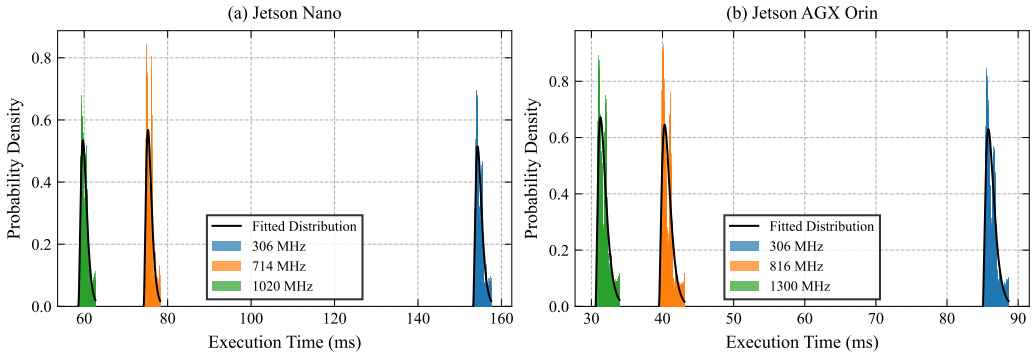
IndisputableMonolith/Cost/FunctionalEquation.leanwashburn_uniqueness_aczel unclearparametric estimation and quantile regression for the execution time of the image processing algorithms... Gamma-distributed random variable with frequency-dependent shape and scale parameters... F_Gamma(Tproc; N_img α(f_p), θ(f_p)) ≥ ρ_th
-
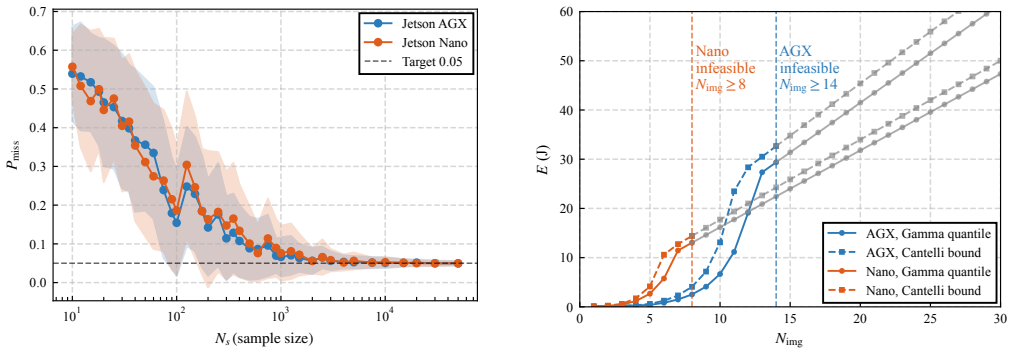
IndisputableMonolith/Foundation/RealityFromDistinction.leanreality_from_one_distinction unclearChebyshev-Cantelli inequality... Pr(Texec ≥ t) ≤ N_img σ² / (N_img σ² + (t - N_img E[Texec])²)
Reference graph
Works this paper leans on
-
[1]
and Jurado-Navas, Antonio and Lyholm, Nicolai D
Soret, Beatriz and Mercado-Martínez, Antonio M. and Jurado-Navas, Antonio and Lyholm, Nicolai D. and Moretti, Marco and Popovski, Petar and Leyva-Mayorga, Israel , month = apr, year =. Edge
-
[2]
IEEE Computer Architecture Letters , author =
Orbital. IEEE Computer Architecture Letters , author =. 2019 , pages =
work page 2019
-
[3]
S.K., Prashanthi and Hegde, Vinayaka and Patchava, Keerthana and Das, Ankita and Simmhan, Yogesh , month = dec, year =. Performance. Proc. 30th
-
[4]
Chinese Journal of Aeronautics , author =
A comprehensive survey of orbital edge computing:. Chinese Journal of Aeronautics , author =. 2025 , pages =. doi:10.1016/j.cja.2024.11.026 , number =
-
[5]
Vincent and Verdu, Sergio , journal=
Polyanskiy, Yury and Poor, H. Vincent and Verdu, Sergio , journal=. Channel Coding Rate in the Finite Blocklength Regime , year=
- [6]
-
[7]
K. Stavrakakis , howpublished=. Roboflow Universe , publisher =. 2022 , month =
work page 2022
-
[8]
Suman, Suraj and Stefanovic, Cedomir and Došen, Strahinja and Popovski, Petar , month = may, year =. Analysis and. Proc
- [9]
-
[10]
Lorch, Jacob R. and Smith, Alan Jay , title =. 2001 , issue_date =. doi:10.1145/384268.378429 , journal =
-
[11]
Lorch, Jacob R. and Smith, Alan Jay , title =. 2001 , address =. doi:10.1145/378420.378429 , booktitle =
-
[12]
On Error Probability Analysis of Short-Packet Communications in Massive
Devaja, Tijana and Petkovic, Milica and Wang, Chao and Beko, Marko and Vukobratovic, Dejan , journal=. On Error Probability Analysis of Short-Packet Communications in Massive. 2024 , volume=
work page 2024
discussion (0)
Sign in with ORCID, Apple, or X to comment. Anyone can read and Pith papers without signing in.