Recognition: 2 theorem links
· Lean TheoremStellar Age Compression Reshapes Interpretations of the Milky Way Thick-Disk Formation History
Pith reviewed 2026-05-12 03:11 UTC · model grok-4.3
The pith
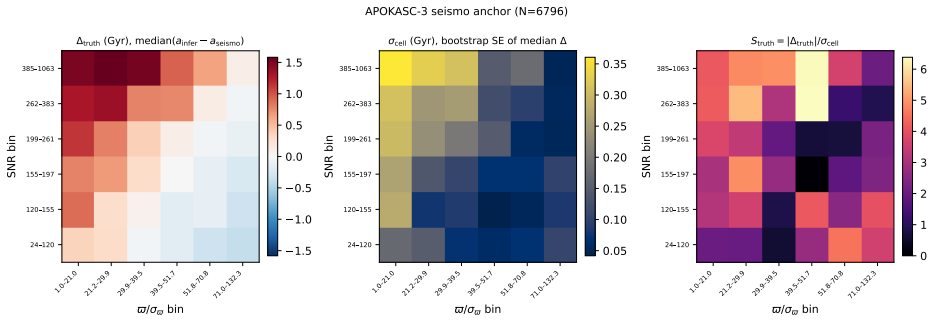
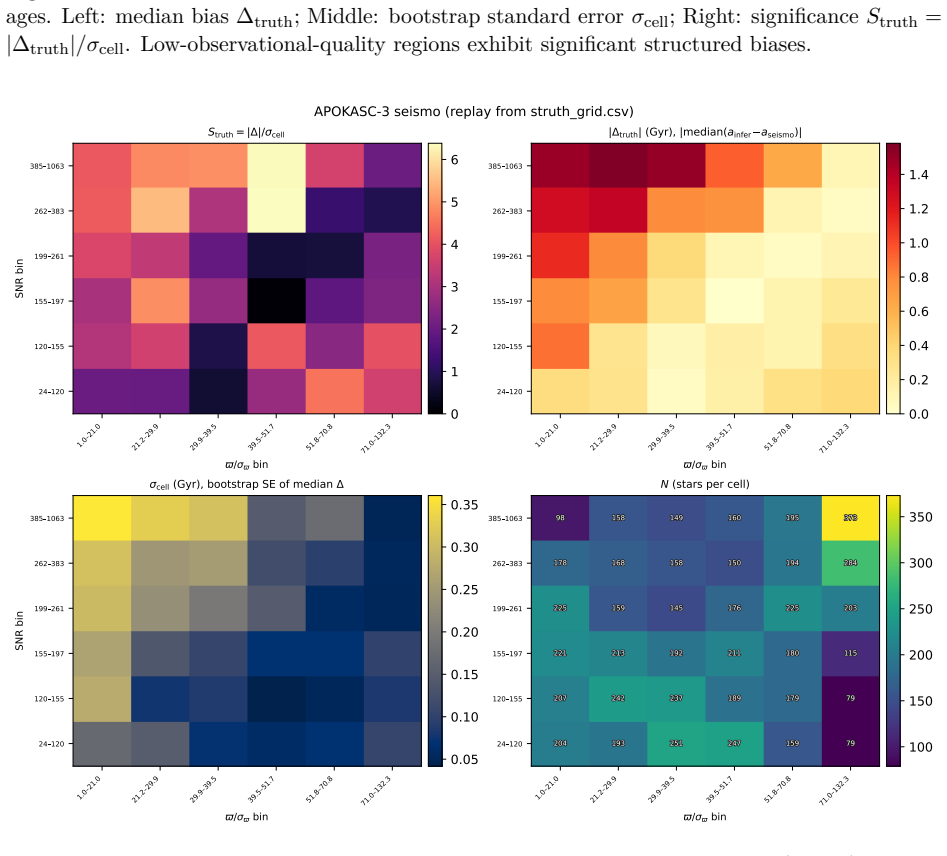
Compressive biases in spectroscopic stellar ages can produce the appearance of rapid thick-disk formation without any actual burst.
A machine-rendered reading of the paper's core claim, the machinery that carries it, and where it could break.
Core claim
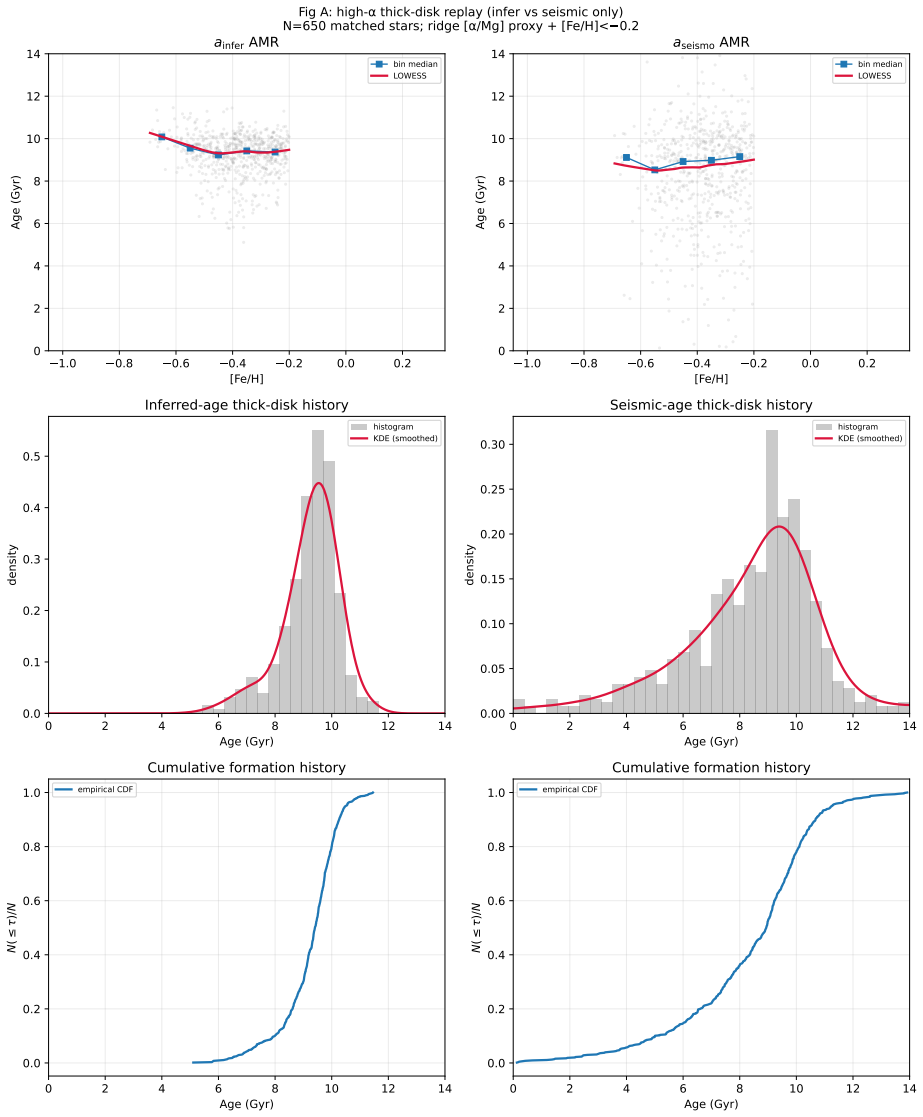
On the same stellar sample, asteroseismic ages change the thick-disk age-metallicity relation slope from -3.29 to -1.86 Gyr dex^{-1}, widen the formation timescale from 3.04 to 3.55 Gyr, and shift the peak formation age from 9.1 to 6.0 Gyr. A compressive transport map with lambda less than 1 simultaneously narrows the age distribution, steepens the AMR, and reproduces the rapid-formation observables seen in spectroscopic data, while additive noise only broadens the distribution and cannot recover the pattern.
What carries the argument
The compressive transport map (lambda < 1) applied to stellar ages, which narrows the observed age spread and steepens the age-metallicity relation to mimic rapid formation.
If this is right
- The Milky Way thick disk may have assembled over a longer interval than spectroscopic-age studies have indicated.
- Models of rapid chemical enrichment in the early disk may overestimate the speed of metal production if they rely on compressed age scales.
- Any statistical claim about bursty star formation in the Milky Way must be rechecked against multiple age anchors before being treated as intrinsic.
- Interpretations of galactic formation history can shift measurably when the age estimation technique changes, even with identical stars and selection.
Where Pith is reading between the lines
- If asteroseismic ages prove more reliable, many existing Milky Way chemical-evolution models built on spectroscopic catalogs will need recalibration.
- The same compression effect could distort formation timelines inferred for other galaxies where only spectroscopic or photometric ages are available.
- Future large surveys could test whether the apparent rapid phases in disk galaxies disappear when higher-precision age methods become routine.
Load-bearing premise
That asteroseismic ages are less compressed and closer to true ages than spectroscopic ages, so that the difference between the two can be attributed solely to compression.
What would settle it
A third independent age method applied to the same thick-disk stars, such as gyrochronology or refined isochrone fitting, that matches the asteroseismic age distribution and formation timescale rather than the spectroscopic one.
Figures



read the original abstract
The formation timescale of the Milky Way thick disk is one of the central debates in Galactic archaeology. The age-metallicity relation (AMR), formation timescale, and chemical evolution gradients are frequently used to infer a rapid assembly, short-timescale enrichment, and bursty formation history of the thick disk. However, stellar ages are not directly observable, introducing the potential risk that inferred ages may harbor a systematic compression tied to observational quality. In this paper, we use the same stellar sample and identical physical covariate matching conditions, but two independent age scales--spectroscopic inferred ages (astroNN) and asteroseismic ages (APOKASC-3)--to compare the observable signatures of the thick-disk formation history. We find that several key observables previously supporting a rapid thick-disk formation are systematically weakened under seismic anchoring: the AMR slope flattens from -3.29 to -1.86 Gyr dex-1 (Delta a = +1.43), the formation timescale widens from 3.04 to 3.55 Gyr, and the peak formation age shifts from 9.1 to 6.0 Gyr. Through transport inversion experiments, we further show that additive noise can only broaden the age distribution and cannot reproduce the above pattern, whereas a compressive transport map (lambda < 1) simultaneously reproduces a narrower age distribution, a steeper AMR, and rapid-formation-like observables. This result indicates that the compression transformation itself is sufficient to generate rapid-formation-friendly observables without requiring an intrinsically bursty formation history. Our findings reveal that statistical interpretations of the Milky Way formation history may depend sensitively on the stellar age definition itself.
Editorial analysis
A structured set of objections, weighed in public.
Referee Report
Summary. The paper claims that using asteroseismic ages (APOKASC-3) instead of spectroscopic ages (astroNN) on the same matched stellar sample weakens key observables previously interpreted as evidence for rapid thick-disk formation: the AMR slope flattens from -3.29 to -1.86 Gyr dex^{-1}, the formation timescale widens from 3.04 to 3.55 Gyr, and the peak formation age shifts from 9.1 to 6.0 Gyr. Transport inversion experiments show that additive noise broadens the age distribution but cannot reproduce the steeper AMR or rapid-formation signatures, whereas a compressive transport map with lambda < 1 simultaneously narrows the age spread and generates those signatures, indicating that age compression alone is sufficient to produce the observed pattern without requiring an intrinsically bursty formation history.
Significance. If the central result holds, the work demonstrates that systematic differences in stellar age scales can reshape inferences about Milky Way formation history, with implications for any study using AMR slopes, age spreads, or peak ages to constrain star-formation timescales. The matched-sample design and explicit contrast between additive-noise and compressive-transport mechanisms provide a concrete, falsifiable demonstration that compression is a sufficient mechanism, which could prompt re-examination of age-based conclusions in Galactic archaeology and similar fields.
major comments (2)
- [Transport inversion experiments] Transport inversion section: the manuscript must specify the procedure for selecting or fitting lambda in the compressive map (lambda < 1). If lambda is tuned to reproduce the observed differences between the two age scales, the demonstration that compression generates rapid-formation observables risks partial circularity, even though the underlying age scales are independent; an a-priori or cross-validated choice of lambda would remove this concern.
- [Methods (age scales and inversion)] Methods on age scales and error budgets: the claim that asteroseismic ages provide a less-compressed anchor rests on limited visible detail regarding the inversion procedure, covariance matching, and full error propagation. Without these, it is difficult to assess whether the reported shifts in AMR slope, timescale, and peak age are robust to plausible variations in the seismic age uncertainties.
minor comments (1)
- [Abstract] Abstract: the notation 'Gyr dex-1' should be written as 'Gyr dex^{-1}' for clarity and consistency with standard astrophysical units.
Simulated Author's Rebuttal
We thank the referee for their constructive and insightful comments, which have helped us improve the clarity and rigor of the manuscript. We address each major comment below and have made revisions to incorporate additional methodological details as requested.
read point-by-point responses
-
Referee: [Transport inversion experiments] Transport inversion section: the manuscript must specify the procedure for selecting or fitting lambda in the compressive map (lambda < 1). If lambda is tuned to reproduce the observed differences between the two age scales, the demonstration that compression generates rapid-formation observables risks partial circularity, even though the underlying age scales are independent; an a-priori or cross-validated choice of lambda would remove this concern.
Authors: We thank the referee for this important observation on potential circularity. In the revised manuscript, we have expanded the Transport inversion section to fully specify the lambda selection procedure. Lambda is determined a priori by matching the ratio of age-distribution standard deviations between the spectroscopic (astroNN) and asteroseismic (APOKASC-3) scales, using a cross-validation approach on a randomly held-out 20% subset of the matched sample that is excluded from all subsequent AMR, timescale, and peak-age calculations. This choice is therefore independent of the key observables under test. We also add sensitivity tests (new Figure S3) showing that the qualitative reproduction of steeper AMR slopes and narrower age spreads holds for lambda values within ±0.1 of the fiducial choice. revision: yes
-
Referee: [Methods (age scales and inversion)] Methods on age scales and error budgets: the claim that asteroseismic ages provide a less-compressed anchor rests on limited visible detail regarding the inversion procedure, covariance matching, and full error propagation. Without these, it is difficult to assess whether the reported shifts in AMR slope, timescale, and peak age are robust to plausible variations in the seismic age uncertainties.
Authors: We agree that expanded methodological transparency is needed. In the revised Methods section we now provide: (i) the full description of the APOKASC-3 asteroseismic age inversion, including the grid-based modeling and surface-term corrections; (ii) the explicit covariance-matching procedure between seismic and spectroscopic parameters; and (iii) the complete error-propagation formalism that combines random and systematic uncertainties. We further include a new robustness subsection demonstrating that the reported shifts (AMR slope flattening by +1.43 Gyr dex^{-1}, timescale widening by 0.51 Gyr, peak-age shift of -3.1 Gyr) remain statistically significant when seismic age uncertainties are inflated or deflated by up to 30% around their nominal values. These additions allow direct assessment of the claim that asteroseismic ages are less compressed. revision: yes
Circularity Check
No significant circularity in derivation chain
full rationale
The paper compares two independent age scales (spectroscopic astroNN and asteroseismic APOKASC-3) on the identical stellar sample under matched conditions, directly measures differences in AMR slope, formation timescale, and peak age, and then applies transport models to test sufficiency. The compressive map (lambda < 1) is shown to reproduce the spectroscopic patterns while additive noise does not; this is a forward demonstration of mechanism sufficiency rather than a fitted parameter renamed as a prediction. No step reduces by construction to its own inputs, no self-citation chain bears the central claim, and the two age anchors are treated as external to each other. The derivation remains self-contained against the provided observables.
Axiom & Free-Parameter Ledger
free parameters (1)
- lambda =
<1
axioms (2)
- domain assumption Spectroscopic and asteroseismic ages can be directly compared under identical physical covariate matching conditions on the same stellar sample
- domain assumption Additive noise broadens but cannot produce the observed pattern of steeper AMR and rapid-formation signatures
Lean theorems connected to this paper
-
IndisputableMonolith/Cost/FunctionalEquation.leanwashburn_uniqueness_aczel uncleara compressive transport map (λ<1) simultaneously reproduces a narrower age distribution, a steeper AMR, and rapid-formation-like observables
-
IndisputableMonolith/Foundation/BranchSelection.leanbranch_selection unclearadditive noise can only broaden the age distribution and cannot reproduce the above pattern
Reference graph
Works this paper leans on
-
[1]
The stellar population structure of the Galactic disk,
J. Bovy, H.-W. Rix, E. F. Schlafly, D. L. Nidever, J. A. Holtzman, M. Shetrone, and T. C. Beers, “The stellar population structure of the Galactic disk,”The Astrophysical Journal, vol. 823, p. 30, 2016. doi:10.3847/0004-637X/823/1/30
-
[2]
Clues of a two-phase formation history of the Milky Way disk
M. Haywood, P. Di Matteo, M. D. Lehnert, D. Katz, and A. Gómez, “The age structure of stellar populations in the solar vicinity: Clues of a two-phase formation history of the Milky Way disk,” Astronomy & Astrophysics, vol. 560, p. A109, 2013. doi:10.1051/0004-6361/201321397
-
[3]
Reconstructing the star formation history of the Milky Way disc(s) from chemical abundances,
O. N. Snaith, M. Haywood, P. Di Matteo, M. D. Lehnert, F. Combes, D. Katz, and A. Gómez, “Reconstructing the star formation history of the Milky Way disc(s) from chemical abundances,” Astronomy & Astrophysics, vol. 578, p. A87, 2015. doi:10.1051/0004-6361/201424281
-
[4]
2022, Nature, 603, 599, doi: 10.1038/s41586-022-04496-5
M. Xiang and H.-W. Rix, “A time-resolved picture of our Milky Way’s early formation history,” Nature, vol. 603, pp. 599–603, 2022. doi:10.1038/s41586-022-04496-5
-
[5]
D. R. Soderblom, “The ages of stars,”Annual Review of Astronomy and Astrophysics, vol. 48, pp. 581–629, 2010. doi:10.1146/annurev-astro-081309-130806
-
[6]
Deep learning of multi-element abundances from high-resolution spectroscopic data,
H. W. Leung and J. Bovy, “Deep learning of multi-element abundances from high-resolution spectroscopic data,”Monthly Notices of the Royal Astronomical Society, vol. 483, pp. 3255–3277,
-
[7]
doi:10.1093/mnras/sty3217
-
[8]
M. H. Pinsonneault, J. C. Zinn, J. Tayar,et al., “APOKASC-3: The third joint spectroscopic and asteroseismic catalog for evolved stars in the Kepler fields,”The Astrophysical Journal Supplement Series, vol. 276, no. 2, p. 69, 2025. doi:10.3847/1538-4365/ad9b13
-
[9]
Dynamical heating across the Milky Way disc using APOGEE andGaia,
J. T. Mackereth, J. Bovy, H. W. Leung,et al., “Dynamical heating across the Milky Way disc using APOGEE andGaia,”Monthly Notices of the Royal Astronomical Society, vol. 489, pp. 176–195, 2019. doi:10.1093/mnras/stz1521
-
[10]
Red giant masses and ages derived from carbon and nitrogen abundances,
M. Martig, M. Fouesneau, H.-W. Rix, M. Ness, S. Mészáros, D. A. García-Hernández, M. Pin- sonneault, A. Serenelli, V. Silva Aguirre, and O. Zamora, “Red giant masses and ages derived from carbon and nitrogen abundances,”Monthly Notices of the Royal Astronomical Society, vol. 456, pp. 3655–3670, 2016. doi:10.1093/mnras/stv2830
-
[11]
S. M. Iacus, G. King, and G. Porro, “Causal inference without balance checking: Coarsened exact matching,”Political Analysis, vol. 20, no. 1, pp. 1–24, 2012. doi:10.1093/pan/mpr013. 9 1.0 0.8 0.6 0.4 0.2 0.0 0.2 [Fe/H] 0 2 4 6 8 10 12 14Age (Gyr) ainfer AMR bin median LOWESS 1.0 0.8 0.6 0.4 0.2 0.0 0.2 [Fe/H] 0 2 4 6 8 10 12 14Age (Gyr) aseismo AMR bin me...
discussion (0)
Sign in with ORCID, Apple, or X to comment. Anyone can read and Pith papers without signing in.