Recognition: 2 theorem links
· Lean TheoremHypothesis-Driven Deep Research with Large Language Models: A Structured Methodology for Automated Knowledge Discovery
Pith reviewed 2026-05-12 03:36 UTC · model grok-4.3
The pith
Hypotheses organize the full research process in large language models rather than serving only as final outputs.
A machine-rendered reading of the paper's core claim, the machinery that carries it, and where it could break.
Core claim
The paper claims that the Hypothesis-Driven Deep Research (HDRI) methodology is the first framework to employ hypotheses as the central organizing instrument for general-purpose deep research in large language models across arbitrary domains. It formalizes this with six core principles and an eight-stage pipeline that incorporates a gap-driven iterative research mechanism to detect and fill informational and logical gaps, a fact reasoning framework with traceable chains and quantified confidence propagation, a subject locking mechanism, and a multi-dimensional quality assessment scheme. The approach is implemented in the INFOMINER system and validated through quantitative metrics and five in
What carries the argument
The gap-driven iterative research mechanism, a closed-loop system that identifies informational and logical gaps during the eight-stage pipeline and automatically triggers supplementary investigation.
If this is right
- Research shifts from reactive retrieval to proactive, iterative, and verifiable knowledge building.
- Outputs gain higher fact density and completeness through automatic gap supplementation.
- Reasoning becomes traceable with explicit confidence scores propagated across steps.
- Subject locking prevents entity confusion in multi-topic investigations.
- Multi-dimensional quality scoring provides consistent evaluation of research results.
Where Pith is reading between the lines
- The same hypothesis-guided structure might extend to non-research LLM tasks such as long-term planning or multi-step problem solving.
- Integration with external search APIs or databases could further strengthen the gap-filling step beyond current model-internal knowledge.
- Measuring how often the gap mechanism triggers across different domains would give a practical gauge of the pipeline's robustness.
Load-bearing premise
Large language models can reliably run the eight-stage pipeline, detect gaps correctly, and maintain accurate confidence scores without introducing errors that the gap mechanism fails to catch.
What would settle it
A controlled test query where the system outputs a research summary that omits a known critical fact or logical inconsistency that the gap-detection step should have flagged and supplemented.
Figures



read the original abstract
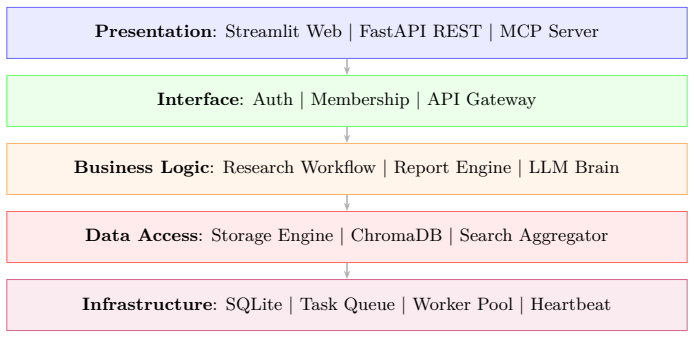
Current AI-powered research systems adopt a direct search-then-summarize paradigm that treats hypotheses as end products of scientific discovery. We argue this leaves a critical gap: hypotheses can serve a far more powerful role as organizational instruments that structure the research process itself. We propose the Hypothesis-Driven Deep Research (HDRI) methodology - the first framework using hypotheses to organize general-purpose deep research across arbitrary domains, rather than merely validating claims within specific domains. This transforms research from reactive information retrieval into proactive, verifiable, and iterative knowledge discovery. HDRI is formalized with six core principles and an eight-stage pipeline. A central innovation is the gap-driven iterative research mechanism - a closed-loop quality assurance system that automatically identifies informational and logical gaps, triggering targeted supplementary investigation. We further introduce a fact reasoning framework with traceable reasoning chains and quantified confidence propagation, a subject locking mechanism to prevent entity confusion, and a multi-dimensional quality assessment scheme. The methodology is realized in the INFOMINER system. Experiments demonstrate improvements of 22.4% in fact density, 90% subject matching accuracy, 0.92 multi-source verification confidence, and 14% completeness gain from gap-driven supplementation. Five case studies validate its practical applicability, achieving an average quality rating of 4.46/5.0.
Editorial analysis
A structured set of objections, weighed in public.
Referee Report
Summary. The manuscript proposes the Hypothesis-Driven Deep Research (HDRI) methodology as the first framework to use hypotheses as organizational instruments for structuring general-purpose deep research with LLMs across arbitrary domains, rather than as end-products of discovery. It formalizes six core principles and an eight-stage pipeline centered on a gap-driven iterative research mechanism that identifies informational and logical gaps to trigger supplementary investigation, along with traceable fact reasoning chains, quantified confidence propagation, a subject locking mechanism to avoid entity confusion, and a multi-dimensional quality assessment scheme. The approach is implemented in the INFOMINER system, which reports experimental gains of 22.4% in fact density, 90% subject matching accuracy, 0.92 multi-source verification confidence, and 14% completeness improvement from gap supplementation, plus an average 4.46/5 quality rating across five case studies.
Significance. If the empirical claims hold under rigorous controls, HDRI could meaningfully advance automated research tools by enabling proactive, verifiable knowledge discovery instead of reactive summarization. The gap-driven closed-loop mechanism and confidence propagation represent potentially load-bearing innovations for robustness, and the provision of a structured pipeline with explicit quality metrics is a constructive contribution to the field of LLM-based scientific assistance.
major comments (3)
- [Abstract] Abstract: The reported quantitative gains (22.4% fact density, 90% subject matching, 0.92 verification confidence, 14% completeness) are presented without any description of baselines, control conditions, statistical tests, or the precise operational definitions and computation procedures for the metrics; this absence directly undermines evaluation of whether the gains are attributable to the HDRI components.
- [Evaluation] Evaluation section: Metrics such as fact density and completeness are defined internally to the HDRI pipeline (via the gap-driven mechanism and quality assessment scheme), creating a circularity risk where reported improvements may partly reflect the system's own scoring rules rather than independent external validation; no cross-benchmarking against established factuality or completeness datasets is described.
- [Pipeline description] Pipeline and mechanism description: The central robustness claim depends on the gap-driven iterative mechanism plus confidence propagation reliably detecting gaps and correcting LLM hallucinations across domains, yet no error analysis, false-negative rates for gap detection, ablation isolating the mechanism from baseline LLM performance, or failure-case enumeration is supplied.
minor comments (2)
- [Methods] The subject locking mechanism and multi-dimensional quality assessment scheme are introduced without accompanying pseudocode, formal definitions, or illustrative examples that would allow replication or precise understanding of their implementation.
- [Introduction] The abstract and introduction assert that HDRI is 'the first' such framework, but the related-work discussion does not systematically compare against prior iterative or hypothesis-guided LLM research systems, leaving the novelty claim difficult to assess.
Simulated Author's Rebuttal
We thank the referee for the thoughtful and constructive report, which highlights important areas for strengthening the evaluation of HDRI. We address each major comment below and commit to revisions that enhance the manuscript's rigor without altering its core claims.
read point-by-point responses
-
Referee: [Abstract] Abstract: The reported quantitative gains (22.4% fact density, 90% subject matching, 0.92 verification confidence, 14% completeness) are presented without any description of baselines, control conditions, statistical tests, or the precise operational definitions and computation procedures for the metrics; this absence directly undermines evaluation of whether the gains are attributable to the HDRI components.
Authors: We agree that the abstract and evaluation lack sufficient methodological detail. In the revised manuscript we will expand both the abstract and a new 'Experimental Setup' subsection to specify: the baselines (standard direct LLM summarization and retrieval-augmented generation without HDRI components), control conditions (single-pass versus iterative runs), statistical tests performed (paired t-tests with reported p-values), and exact metric definitions (fact density as verified unique facts per 1,000 tokens; subject matching accuracy via blinded expert annotation; completeness as the fraction of gaps closed by the iterative mechanism). These additions will make clear how gains are attributable to the framework. revision: yes
-
Referee: [Evaluation] Evaluation section: Metrics such as fact density and completeness are defined internally to the HDRI pipeline (via the gap-driven mechanism and quality assessment scheme), creating a circularity risk where reported improvements may partly reflect the system's own scoring rules rather than independent external validation; no cross-benchmarking against established factuality or completeness datasets is described.
Authors: This concern is well-founded. While the metrics are intentionally aligned with the framework's principles, we will revise the Evaluation section to include independent cross-benchmarking against FactScore and similar established factuality datasets, plus separate human ratings on a held-out subset of outputs. We will also explicitly distinguish internal quality-assessment scores from the externally validated performance numbers to reduce any appearance of circularity. revision: yes
-
Referee: [Pipeline description] Pipeline and mechanism description: The central robustness claim depends on the gap-driven iterative research mechanism plus confidence propagation reliably detecting gaps and correcting LLM hallucinations across domains, yet no error analysis, false-negative rates for gap detection, ablation isolating the mechanism from baseline LLM performance, or failure-case enumeration is supplied.
Authors: We accept that a dedicated robustness analysis is required. The revised manuscript will add an 'Error Analysis and Ablation' subsection that reports: an ablation isolating the gap-driven iteration (comparing full HDRI against a non-iterative variant), false-negative rates for gap detection derived from post-hoc review of the five case studies, and an enumerated list of observed failure modes (e.g., domain-specific hallucination persistence). These will be based on re-examination of existing experimental logs supplemented by targeted additional runs where necessary. revision: partial
Circularity Check
No significant circularity in HDRI derivation or evaluation
full rationale
The paper introduces the HDRI methodology via six principles and an eight-stage pipeline with a gap-driven mechanism, then reports experimental gains in fact density, completeness, and verification confidence. No equations, definitions, or self-citations appear in the text that reduce any claimed prediction or metric back to the pipeline inputs by construction. Metrics are presented as outcomes of experiments and case studies rather than tautological redefinitions of the system itself. The central claim of being the first general-purpose hypothesis-organized framework stands on descriptive and empirical grounds without load-bearing self-referential loops or imported uniqueness results. The derivation chain remains self-contained against external benchmarks.
Axiom & Free-Parameter Ledger
axioms (1)
- domain assumption Large language models can follow complex multi-stage structured pipelines with sufficient fidelity for research tasks
invented entities (2)
-
gap-driven iterative research mechanism
no independent evidence
-
subject locking mechanism
no independent evidence
Lean theorems connected to this paper
-
IndisputableMonolith/Foundation/AlexanderDuality.leanalexander_duality_circle_linking (D=3 forcing from 8-tick period) echoes?
echoesECHOES: this paper passage has the same mathematical shape or conceptual pattern as the Recognition theorem, but is not a direct formal dependency.
We implement this methodology as an eight-stage research pipeline... gap-driven iterative research mechanism
-
IndisputableMonolith/Cost/FunctionalEquation.leanwashburn_uniqueness_aczel (J-cost uniqueness) unclear?
unclearRelation between the paper passage and the cited Recognition theorem.
conf(f3) = r · min(conf(f1), conf(f2)) (Eq. 4)
What do these tags mean?
- matches
- The paper's claim is directly supported by a theorem in the formal canon.
- supports
- The theorem supports part of the paper's argument, but the paper may add assumptions or extra steps.
- extends
- The paper goes beyond the formal theorem; the theorem is a base layer rather than the whole result.
- uses
- The paper appears to rely on the theorem as machinery.
- contradicts
- The paper's claim conflicts with a theorem or certificate in the canon.
- unclear
- Pith found a possible connection, but the passage is too broad, indirect, or ambiguous to say the theorem truly supports the claim.
Reference graph
Works this paper leans on
- [1]
-
[2]
University of Chicago Press, 1962
Thomas S Kuhn.The Structure of Scientific Revolutions. University of Chicago Press, 1962
work page 1962
-
[3]
POPPER: Agentic fal- sification of free-form hypotheses.arXiv preprint arXiv:2502.09858, 2025
Baohao Huang, Han Liao, Kostas Chris- takopoulou, et al. POPPER: Agentic fal- sification of free-form hypotheses.arXiv preprint arXiv:2502.09858, 2025
-
[4]
Yibo Zhang, Zheyuan Chen, Shijie Liu, et al. HypoAgents: A bayesian-entropy multi-agent framework for automated hy- pothesis generation and refinement.arXiv preprint arXiv:2508.01746, 2025
-
[5]
Stuart Russell and Peter Norvig.Artificial Intelligence: A Modern Approach. Pearson, 4th edition, 2020
work page 2020
-
[6]
React: Synergizing reason- ing and acting in language models
Shunyu Yao, Jeffrey Zhao, Dian Yu, Nan Du, Izhak Shafran, Karthik Narasimhan, and Yuan Cao. React: Synergizing reason- ing and acting in language models. InIn- ternational Conference on Learning Repre- sentations (ICLR), 2023
work page 2023
-
[7]
Chain-of- thought prompting elicits reasoning in large language models
Jason Wei, Xuezhi Wang, Dale Schuur- mans, Maarten Bosma, Fei Xia, Ed Chi, Quoc V Le, and Denny Zhou. Chain-of- thought prompting elicits reasoning in large language models. InAdvances in Neural Information Processing Systems (NeurIPS), 2022
work page 2022
-
[8]
Reflexion: Language agents with verbal reinforcement learning
Noah Shinn, Federico Cassano, Ash- win Gopinath, Karthik Narasimhan, and Shunyu Yao. Reflexion: Language agents with verbal reinforcement learning. InAd- vances in Neural Information Processing Systems (NeurIPS), 2023
work page 2023
-
[9]
Model context protocol specifi- cation.https://modelcontextprotocol
Anthropic. Model context protocol specifi- cation.https://modelcontextprotocol. io, 2024
work page 2024
-
[10]
Nesyona. BestAIforresearch: Perplexityvs ChatGPT (2026).https://nesyona.com/ articles/best-ai-for-research, 2026
work page 2026
-
[11]
Google deep research vs perplexity vs ChatGPT (2026)
FreeAcademy. Google deep research vs perplexity vs ChatGPT (2026). https://freeacademy.ai/blog/ google-deep-research-vs-perplexity-vs-chatgpt-comparison-2026, 2026
work page 2026
-
[12]
FutureFactors. AI deep research 2026: Perplexity vs ChatGPT vs gemini.https://futurefactors.ai/ ai-deep-research-tools-comparison-2026/, 2026
work page 2026
-
[13]
Pat Langley, Herbert A Simon, Gary L Bradshaw, and Jan M Zytkow.Scientific Discovery: Computational Explorations of the Creative Processes. MIT Press, 1987
work page 1987
-
[14]
Highly accurate protein structure prediction with AlphaFold.Na- ture, 596(7873):583–589, 2021
John Jumper, Richard Evans, Alexander Pritzel, Tim Green, Michael Figurnov, Olaf Ronneberger, Kathryn Tunyasuvu- nakool, Russ Bates, Augustin Žídek, Anna Potapenko, et al. Highly accurate protein structure prediction with AlphaFold.Na- ture, 596(7873):583–589, 2021
work page 2021
-
[15]
Large language models for automated scientific discovery
Haoyang Qi, Zhi Wang, Zifeng Wang, Jiant- ing Zhang, Qiang Jin, et al. Large language models for automated scientific discovery. arXiv preprint arXiv:2404.11720, 2024. 23
-
[16]
Automated experimental design with large language models.arXiv preprint arXiv:2402.00964, 2024
Zilong Wang, Zhi Zhang, Zifeng Wang, et al. Automated experimental design with large language models.arXiv preprint arXiv:2402.00964, 2024
-
[17]
The AI Scientist: Towards Fully Automated Open-Ended Scientific Discovery
Chris Lu, Cong Lu, Robert Tjarko Lange, Jakub Foerster, Jeff Clune, and David Ha. The AI scientist: Towards fully automated open-ended scientific discovery. arXiv preprint arXiv:2408.06292, 2024
work page internal anchor Pith review Pith/arXiv arXiv 2024
-
[18]
Yunfan Gao et al. Deepresearch: Iterative retrieval-reasoning for complex question an- swering.arXiv preprint arXiv:2405.15104, 2024
-
[19]
Yixuan Tian et al. Curie: Toward rig- orous and automated scientific experimen- tation with AI agents.arXiv preprint arXiv:2502.16069, 2025
-
[20]
Bodhisattwa Prasad Majumder et al. AUTODISCOVERY: Open-ended scientific discovery with bayesian surprise.arXiv preprint arXiv:2507.00310, 2025
-
[21]
FEVER: A large-scale dataset for fact ex- traction and VERification
James Thorne, Andreas Vlachos, Chris- tos Christodoulopoulos, and Arpit Mittal. FEVER: A large-scale dataset for fact ex- traction and VERification. InProceedings of the 56th Annual Meeting of the Associa- tion for Computational Linguistics (ACL), 2018
work page 2018
-
[22]
HotpotQA: A dataset for diverse, ex- plainable multi-hop question answering
Zhilin Yang, Peng Qi, Saizheng Zhang, Yoshua Bengio, William Cohen, Ruslan Salakhutdinov, and Christopher D Man- ning. HotpotQA: A dataset for diverse, ex- plainable multi-hop question answering. In Proceedings of the 2018 Conference on Em- pirical Methods in Natural Language Pro- cessing (EMNLP), 2018
work page 2018
-
[23]
Shaoxiong Ji, Shirui Pan, Erik Cambria, Pekka Marttinen, and Philip S Yu. A sur- vey on knowledge graphs: Representation, acquisition, and applications.IEEE Trans- actions on Neural Networks and Learning Systems, 33(2):494–514, 2021
work page 2021
-
[24]
Retrieval-augmented generation for knowledge-intensive NLP tasks
Patrick Lewis, Ethan Perez, Aleksandra Piktus, Fabio Petroni, Vladimir Karpukhin, Naman Goyal, Heinrich Küttler, Mike Lewis, Wen-tau Yih, Tim Rocktäschel, et al. Retrieval-augmented generation for knowledge-intensive NLP tasks. InAd- vances in Neural Information Processing Systems (NeurIPS), 2020
work page 2020
-
[25]
Self-RAG: Learning to Retrieve, Generate, and Critique through Self-Reflection
Akari Asai, Zeqiu Wu, Yuxiang Wang, Avirup Sil, and Hannaneh Hajishirzi. Self- RAG: Learning to retrieve, generate, and critique through self-reflection.arXiv preprint arXiv:2310.11511, 2024
work page internal anchor Pith review arXiv 2024
-
[26]
WebGPT: Browser-assisted question-answering with human feedback
Reiichiro Nakano, Jacob Hilton, Suchir Bal- aji, Jeff Wu, Long Ouyang, Christina Kim, Christopher Hesse, Shantanu Jain, Vineet Kosaraju, William Saunders, et al. We- bgpt: Browser-assisted question-answering with human feedback.arXiv preprint arXiv:2112.09332, 2022
work page internal anchor Pith review Pith/arXiv arXiv 2022
-
[27]
Cambridge Univer- sity Press, 2008
Christopher D Manning, Prabhakar Ragha- van, and Hinrich Schütze.Introduction to Information Retrieval. Cambridge Univer- sity Press, 2008
work page 2008
-
[28]
Rodrigo Nogueira and Kyunghyun Cho. Passage re-ranking with BERT.arXiv preprint arXiv:1901.04085, 2019. 24
work page internal anchor Pith review Pith/arXiv arXiv 1901
discussion (0)
Sign in with ORCID, Apple, or X to comment. Anyone can read and Pith papers without signing in.