Recognition: 1 theorem link
· Lean TheoremIncreasing domain asymptotics for covariate-based nonparametric Bayesian intensity estimation with Gaussian and Besov-Laplace priors
Pith reviewed 2026-05-12 03:22 UTC · model grok-4.3
The pith
Gaussian priors with link functions achieve minimax-optimal posterior contraction rates for estimating intensities of covariate-driven point processes over expanding domains.
A machine-rendered reading of the paper's core claim, the machinery that carries it, and where it could break.
Core claim
Under increasing domain asymptotics and ergodicity of the covariates, a wide class of Gaussian priors combined with flexible link functions achieves minimax-optimal posterior contraction rates for the intensity function of a covariate-driven point process. Besov-Laplace priors further yield optimal estimation of spatially inhomogeneous intensities belonging to Besov spaces with low integrability index. Both sets of results follow from a general concentration theorem that extends recent findings in the literature.
What carries the argument
General concentration theorem for posterior distributions of the intensity, applied to Gaussian priors and Besov-Laplace priors together with link functions.
Load-bearing premise
The covariates are assumed to be ergodic so that their spatial averages converge to population expectations over large domains.
What would settle it
A concrete ergodic covariate sequence for which the posterior contraction rate falls strictly below the minimax rate, or a non-ergodic sequence where the claimed optimality still holds, would settle whether the rates are truly optimal under the stated conditions.
Figures


read the original abstract
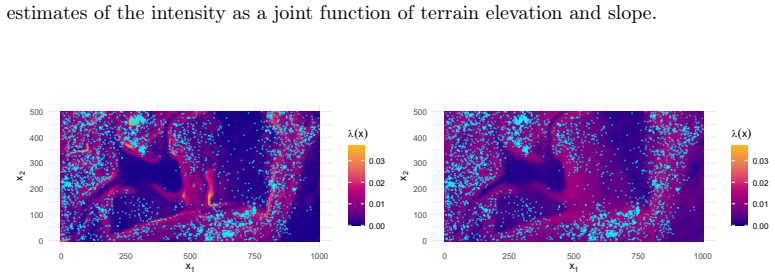
We study the problem of estimating the intensity function of a covariate-driven point process based on observations of the points and covariates over a large window. We consider the nonparametric Bayesian approach, and show that a wide class of Gaussian priors, combined with flexible link functions, achieves minimax-optimal posterior contraction rates in the increasing domain asymptotics and under the assumption that the covariates be ergodic. We also employ Besov-Laplace priors, which are popular in imaging and inverse problems due to their edge-preserving and sparsity-promoting properties. We prove that these yield optimal estimation of spatially inhomogeneous intensities belonging to Besov spaces with low integrability index. These results are based on a general concentration theorem that extends recent findings from the literature. To corroborate the theory, we provide extensive numerical simulations, implementing the considered procedures via suitable posterior sampling schemes. Further, we present two real data analyses motivated by applications in forestry and the environmental sciences.
Editorial analysis
A structured set of objections, weighed in public.
Referee Report
Summary. The manuscript develops nonparametric Bayesian methods for estimating the intensity function of a covariate-driven point process observed over a large domain. It establishes minimax-optimal posterior contraction rates for a class of Gaussian priors with flexible link functions under ergodicity assumptions on the covariates in the increasing domain regime. Additionally, it shows that Besov-Laplace priors achieve optimal rates for intensities in Besov spaces with low integrability indices. The theoretical results rely on a general concentration theorem extension, supported by simulations and real data analyses in forestry and environmental sciences.
Significance. If the results hold, this provides important theoretical foundations for Bayesian nonparametric inference in spatial point processes with covariates, extending concentration theorems to the increasing-domain setting with ergodic covariates. Credit is due for the general concentration theorem approach, the inclusion of Besov-Laplace priors for their edge-preserving properties, and the provision of posterior sampling schemes with simulations and real-data examples. The significance is tempered by the need for precise quantitative control under the ergodicity assumption.
major comments (2)
- [Abstract and main theorems] Abstract and the statement of the main results (likely §4): The claim of minimax-optimal posterior contraction for Gaussian priors under ergodic covariates rests on extending a general concentration theorem, but the abstract and theorem statements provide no indication of a quantitative ergodic theorem with explicit remainder terms. Without this, the bias term from the flexible link function cannot be guaranteed to be controlled at the nonparametric rate.
- [Section 3] The extension of the concentration theorem (Section 3): The transfer of rates to the covariate-driven intensity estimation requires the empirical covariate measure to converge sufficiently fast; if only qualitative ergodicity is assumed without mixing rates matching the contraction rate ε_n, the optimality claim is at risk. A concrete test would involve deriving the remainder under specific α-mixing conditions.
minor comments (2)
- [Abstract] The description of the 'wide class of Gaussian priors' in the abstract could specify the covariance kernels or hyperparameter ranges more explicitly to clarify the scope.
- [Numerical simulations] The simulations section would benefit from additional details on the covariate process generation and the exact posterior sampling implementation to enhance reproducibility.
Simulated Author's Rebuttal
We thank the referee for the careful reading and constructive comments, which help clarify the presentation of the ergodicity assumptions. We address each major comment below and will incorporate clarifications in the revised manuscript.
read point-by-point responses
-
Referee: [Abstract and main theorems] Abstract and the statement of the main results (likely §4): The claim of minimax-optimal posterior contraction for Gaussian priors under ergodic covariates rests on extending a general concentration theorem, but the abstract and theorem statements provide no indication of a quantitative ergodic theorem with explicit remainder terms. Without this, the bias term from the flexible link function cannot be guaranteed to be controlled at the nonparametric rate.
Authors: We agree that explicit mention of quantitative control would strengthen the statements. The general concentration theorem (Section 3) is formulated so that the deviation of the empirical covariate measure from its expectation is absorbed into the remainder term, which is controlled at rate o(ε_n) under the ergodicity assumption via standard results on spatial averages (e.g., the ergodic theorem for stationary random fields). The bias induced by the link function is then dominated by the nonparametric rate. To address the concern directly, we will revise the abstract and the statements of Theorems 4.1–4.3 to include a short parenthetical note referencing the quantitative ergodic convergence that ensures the remainder is negligible relative to ε_n. revision: partial
-
Referee: [Section 3] The extension of the concentration theorem (Section 3): The transfer of rates to the covariate-driven intensity estimation requires the empirical covariate measure to converge sufficiently fast; if only qualitative ergodicity is assumed without mixing rates matching the contraction rate ε_n, the optimality claim is at risk. A concrete test would involve deriving the remainder under specific α-mixing conditions.
Authors: This observation is well taken. The manuscript currently invokes ergodicity in the qualitative sense that the empirical measure converges almost surely to the invariant measure, which is standard for increasing-domain asymptotics. To provide the requested concrete test, we will add a remark (or short appendix subsection) deriving an explicit bound on the remainder under α-mixing conditions on the covariate field with mixing coefficients decaying at a polynomial rate sufficient to be o(ε_n). This will confirm that the optimality claim holds under mixing rates compatible with typical nonparametric contraction rates. revision: yes
Circularity Check
No significant circularity; central results rest on extension of general concentration theorem plus ergodicity assumption
full rationale
The paper derives posterior contraction rates from a general concentration theorem that extends recent literature, under the ergodicity assumption on covariates in the increasing-domain regime. No quoted equations or steps reduce the claimed minimax rates for Gaussian or Besov-Laplace priors to fitted parameters, self-definitions, or load-bearing self-citations by construction. The derivation chain remains self-contained against external benchmarks once the stated assumptions hold.
Axiom & Free-Parameter Ledger
axioms (2)
- domain assumption Covariates are ergodic
- standard math General concentration theorem extends recent findings from the literature
Lean theorems connected to this paper
-
IndisputableMonolith/Cost/FunctionalEquation.leanwashburn_uniqueness_aczel unclearposterior contraction rates ... Gaussian priors ... Besov-Laplace priors ... general concentration theorem ... ergodic covariates
Reference graph
Works this paper leans on
-
[1]
ANNALS OF STATISTICS , volume=
Asymptotic behaviour of the empirical bayes posteriors associated to maximum marginal likelihood estimator , author=. ANNALS OF STATISTICS , volume=
-
[2]
Adams, Ryan Prescott and Murray, Iain and MacKay, David J. C. , booktitle =. Tractable nonparametric
-
[3]
Rates of contraction of posterior distributions based on p -exponential priors , author=
-
[4]
Agapiou, Sergios and Savva, Aimilia , journal=. Adaptive inference over
-
[5]
Agapiou, Sergios and Wang, Sven , journal=
- [6]
- [7]
-
[8]
Baddeley, Adrian and Chang, Ya-Mei and Song, Yong and Turner, Rolf , year =. Nonparametric estimation of the dependence of a spatial point process on spatial covariates , volume =
-
[9]
Spatial point patterns: methodology and applications with R , author=. 2016 , publisher=
work page 2016
-
[10]
Bandyopadhyay, Soutir and Subba Rao, Suhasini , TITLE =. J. Roy. Statist. Soc. Ser. B , FJOURNAL =. 2017 , NUMBER =
work page 2017
-
[11]
Probability theory and related fields , volume=
Risk bounds for model selection via penalization , author=. Probability theory and related fields , volume=. 1999 , publisher=
work page 1999
-
[12]
Belitser, Eduard and Serra, Paulo and van Zanten, Harry , TITLE =. J. Statist. Plann. Inference , FJOURNAL =. 2015 , PAGES =
work page 2015
-
[13]
Anisotropic function estimation using multi-bandwidth
Bhattacharya, Anirban and Pati, Debdeep and Dunson, David , journal=. Anisotropic function estimation using multi-bandwidth
- [14]
-
[15]
Borrajo, M. I. and Gonz\'. Bootstrapping kernel intensity estimation for inhomogeneous point processes with spatial covariates , volume =. Comput. Statist. Data Anal. , pages =
-
[16]
Brillinger, David R. , booktitle =. Comparative aspects of the study of ordinary time series and of point processes , year =
-
[17]
Isma. Ann. Statist. , number =
-
[18]
Statistical Science , author=
-
[19]
Cox, D. R. , TITLE =. J. Roy. Statist. Soc. Ser. B , FJOURNAL =. 1955 , PAGES =
work page 1955
-
[20]
Cressie, Noel A. C. , TITLE =. 2015 , PAGES =
work page 2015
-
[21]
An introduction to the theory of point processes: volume I: elementary theory and methods , author=. 2003 , publisher=
work page 2003
-
[22]
Dashti, Masoumeh and Harris, Stephen and Stuart, Andrew , journal=
-
[23]
DiMatteo, Ilaria and Genovese, Christopher R. and Kass, Robert E. , TITLE =. 2001 , NUMBER =
work page 2001
-
[24]
Diaconis, Persi and Freedman, David , journal=. On the Consistency of. 1986 , publisher=
work page 1986
-
[25]
Peter J. Diggle , issn =. A point process modelling approach to raised incidence of a rare phenomenon in the vicinity of a prespecified point , urldate =. J. Roy. Statist. Soc. Ser. A , number =. 1990 , bdsk-url-1 =
work page 1990
-
[26]
Diggle, Peter J. , edition =. Statistical Analysis of Spatial and Spatio-Temporal Point Patterns , volume =
-
[27]
Diggle and Nicholas Lange and Francine M
Peter J. Diggle and Nicholas Lange and Francine M. Beneš , journal =. Analysis of Variance for Replicated Spatial Point Patterns in Clinical Neuroanatomy , urldate =
- [28]
-
[29]
Dolmeta, Patric and Giordano, Matteo , booktitle=. 2025 , organization=
work page 2025
-
[30]
Supplement to ``Increasing domain asymptotics for covariate-based nonparametric
Dolmeta, Patric and Giordano, Matteo , journal=. Supplement to ``Increasing domain asymptotics for covariate-based nonparametric
-
[31]
Ideal spatial adaptation by wavelet shrinkage , author=. 1994 , publisher=
work page 1994
-
[32]
Minimax estimation via wavelet shrinkage , author=. 1998 , publisher=
work page 1998
-
[33]
Posterior concentration rates for counting processes with
Donnet, Sophie and Rivoirard, Vincent and Rousseau, Judith and Scricciolo, Catia , doi =. Posterior concentration rates for counting processes with. 2017 , bdsk-url-1 =
work page 2017
-
[34]
Annales Henri Lebesgue , volume=
Multiscale functional inequalities in probability: Constructive approach , author=. Annales Henri Lebesgue , volume=
- [35]
-
[36]
Ghosal, Subhashis and Ghosh, Jayanta K. and van der Vaart, Aad W. , date-added =. Convergence rates of posterior distributions , volume =. Ann. Statist. , number =
-
[37]
Ghosal, Subhashis and Van der Vaart, Aad W , year=. Fundamentals of nonparametric
- [38]
-
[39]
Mathematical foundations of infinite-dimensional statistical models , year =
Gin\'e, Evarist and Nickl, Richard , date-added =. Mathematical foundations of infinite-dimensional statistical models , year =
- [40]
-
[41]
Nonparametric Bayesian intensity estimation for covariate-driven inhomogeneous point processes , author=. Bernoulli , volume=. 2026 , publisher=
work page 2026
-
[42]
Giordano, Matteo and Nickl, Richard , journal=. Consistency of. 2020 , publisher=
work page 2020
-
[43]
Giordano, Matteo and Ray, Kolyan , journal=. Nonparametric. 2022 , publisher=
work page 2022
-
[44]
Posterior contraction rates for
Grant, James A and Leslie, David S , journal=. Posterior contraction rates for
-
[45]
Guan, Yongtao , fjournal =. On consistent nonparametric intensity estimation for inhomogeneous spatial point processes , volume =. J. Amer. Statist. Assoc. , mrclass =
-
[46]
Gugushvili, Shota and Spreij, Peter , journal=. A note on non-parametric
-
[47]
Fast and scalable non-parametric
Gugushvili, Shota and Van Der Meulen, Frank and Schauer, Moritz and Spreij, Peter , journal=. Fast and scalable non-parametric
-
[48]
Maximum a posteriori probability estimates in infinite-dimensional
Helin, Tapio and Burger, Martin , journal=. Maximum a posteriori probability estimates in infinite-dimensional. 2015 , publisher=
work page 2015
- [49]
-
[50]
Wavelets, approximation, and statistical applications , author=. 2012 , publisher=
work page 2012
-
[51]
Random rates in anisotropic regression (with a discussion and a rejoinder by the authors) , author=. 2002 , publisher=
work page 2002
-
[52]
Statistical analysis and modelling of spatial point patterns , year =
Illian, Janine and Penttinen, Antti and Stoyan, Helga and Stoyan, Dietrich , isbn =. Statistical analysis and modelling of spatial point patterns , year =
-
[53]
Illian, Janine B. and S. A toolbox for fitting complex spatial point process models using integrated nested. Ann. Appl. Stat. , mrclass =. 2012 , bdsk-url-1 =. doi:10.1214/11-AOAS530 , fjournal =
-
[54]
Asymptotic normality of estimates in spatial point processes , author=. Scand. J. Statist. , pages=. 1993 , volume=
work page 1993
-
[55]
Point processes and queuing problems (Colloqium, Keszthely, 1978) , volume=
Central limit theorem and convergence of empirical processes for stationary point processes , author=. Point processes and queuing problems (Colloqium, Keszthely, 1978) , volume=. 1981 , publisher=
work page 1978
-
[56]
Stochastic Environmental Research and Risk Assessment , volume=
Pinpointing spatio-temporal interactions in wildfire patterns , author=. Stochastic Environmental Research and Risk Assessment , volume=
- [57]
-
[58]
Kirichenko, Alisa and van Zanten, Harry , fjournal =. Optimality of. J. Mach. Learn. Res. , mrclass =
-
[59]
Kolehmainen, Ville and Lassas, Matti and Niinim. Sparsity-promoting. Inverse Probl. , volume=. 2012 , publisher=
work page 2012
-
[60]
The Annals of Applied Statistics , number =
Jonathan Koh and Fran. The Annals of Applied Statistics , number =
-
[61]
Kottas, Athanasios and Sans\'. J. Statist. Plann. Inference , FJOURNAL =. 2007 , NUMBER =
work page 2007
- [62]
-
[63]
Kutoyants, Yu. A. , isbn =. Statistical inference for spatial. 1998 , bdsk-url-1 =
work page 1998
-
[64]
Lassas, M and Saksman, E and Siltanen, S , journal=. Discretization invariant. 2009 , publisher=
work page 2009
-
[65]
Approximation, metric entropy and small ball estimates for
Li, Wenbo V and Linde, Werner , journal=. Approximation, metric entropy and small ball estimates for. 1999 , publisher=
work page 1999
-
[66]
Lo, Albert Y. , doi =. Z. Wahrsch. Verw. Gebiete , mrclass =. 1982 , bdsk-url-1 =
work page 1982
-
[67]
M. Log. Scand. J. Statist. , mrclass =
-
[68]
Statistical inference and simulation for spatial point processes , volume =
M. Statistical inference and simulation for spatial point processes , volume =
- [69]
-
[70]
Ng, Tin Lok J. and Murphy, Thomas B. , TITLE =. Canad. J. Statist. , FJOURNAL =. 2019 , NUMBER =
work page 2019
-
[71]
Nickl, R. , isbn=. 2023 , publisher=
work page 2023
- [72]
-
[73]
Rasmussen, Carl Edward and Williams, Christopher K. I. , title =
- [74]
-
[75]
Rosenblatt, Murray , year=
-
[76]
Rue, H. Approximate. J. Roy. Statist. Soc. Ser. B , mrclass =. 2009 , bdsk-url-1 =. doi:10.1111/j.1467-9868.2008.00700.x , fjournal =
-
[77]
Silverman, B. W. , TITLE =. 1986 , PAGES =
work page 1986
-
[78]
Szabo, B. and van der Vaart, A. and van Zanten, J. H. , journal=. Frequentist coverage of adaptive nonparametric
-
[79]
Random heterogeneous materials: microstructure and macroscopic properties , author=. 2002 , publisher=
work page 2002
-
[80]
van der Vaart, A. W. and van Zanten, J. H. , date-added =. Rates of contraction of posterior distributions based on. Ann. Statist. , number =
discussion (0)
Sign in with ORCID, Apple, or X to comment. Anyone can read and Pith papers without signing in.