Recognition: 1 theorem link
· Lean TheoremPolarized cylinders on blow-ups of weighted projective planes
Pith reviewed 2026-05-12 05:22 UTC · model grok-4.3
The pith
Blow-ups of the weighted projective plane P(1,1,m) at m+4 general points produce rational surfaces containing polarized cylinders.
A machine-rendered reading of the paper's core claim, the machinery that carries it, and where it could break.
Core claim
The authors establish that polarized cylinders exist on these blown-up surfaces and can be studied by using the general position of the points together with the realization of the surfaces as weighted hypersurfaces or quasi-smooth complete intersections.
What carries the argument
The polarized cylinder on the rational surface, consisting of a cylindrical open set equipped with a polarization from an ample divisor class pulled back from the weighted plane.
If this is right
- The cylinders can be described explicitly using the exceptional curves introduced by the blow-ups.
- The hypersurface equations give concrete equations for locating the cylinders inside the surface.
- The family parameterized by m produces infinitely many distinct examples with controlled polarization degrees.
- The general position assumption ensures the cylinders remain non-degenerate under small deformations of the points.
Where Pith is reading between the lines
- The same weighted blow-up technique might produce cylinders on surfaces with other weight vectors beyond (1,1,m).
- Computing the cylinders explicitly could yield new bounds on the number of lines or curves of low degree on these surfaces.
- The construction offers a test case for whether polarized cylinders determine the birational type of the surface.
Load-bearing premise
The m+4 points lie in general position on P(1,1,m) so that the blow-up produces a surface without extra singularities and with the expected Picard group.
What would settle it
An explicit example for some integer m where the blow-up at m+4 general points yields a surface with no polarized cylinder would disprove the existence claim.
Figures




read the original abstract
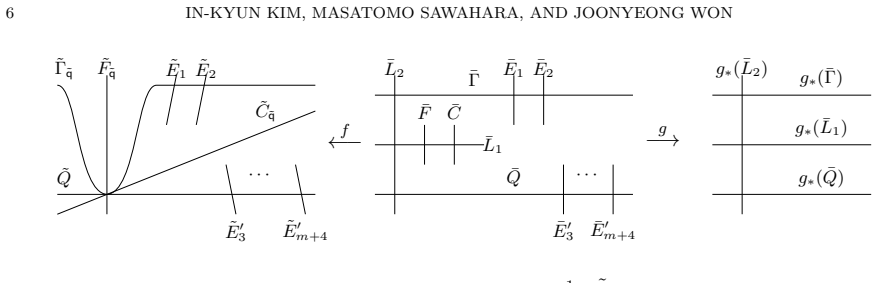
We study polarized cylinders in certain rational surfaces arising from blow-ups of weighted projective planes. In particular, we consider the surfaces obtained by blowing up $m+4$ points in general position on the weighted projective plane $\mathbb{P}(1,1,m)$. These surfaces appear naturally as weighted hypersurfaces or quasi-smooth complete intersections.
Editorial analysis
A structured set of objections, weighed in public.
Referee Report
Summary. The manuscript studies polarized cylinders in rational surfaces obtained by blowing up m+4 points in general position on the weighted projective plane P(1,1,m). These surfaces are claimed to arise naturally as weighted hypersurfaces or quasi-smooth complete intersections.
Significance. If the realizations as hypersurfaces and the subsequent analysis of polarized cylinders hold, the work would supply concrete examples of such structures on rational surfaces with weighted singularities, potentially aiding classification efforts and the study of embeddings in algebraic geometry.
major comments (1)
- [Abstract] Abstract: The central claim that blow-ups of m+4 points in general position on P(1,1,m) appear naturally as weighted hypersurfaces or quasi-smooth complete intersections is load-bearing but unsubstantiated in the provided description. General position on the weighted plane does not automatically ensure the points avoid the singular locus or prevent extra exceptional divisors and degenerations in the anticanonical embedding for m>1; explicit transversality conditions or case-by-case verification for the complete-intersection property are required to support the constructions.
Simulated Author's Rebuttal
We thank the referee for the careful reading and for highlighting the need to substantiate the realization of these blow-ups as weighted hypersurfaces. We address the single major comment below and will incorporate clarifications in the revised manuscript.
read point-by-point responses
-
Referee: [Abstract] Abstract: The central claim that blow-ups of m+4 points in general position on P(1,1,m) appear naturally as weighted hypersurfaces or quasi-smooth complete intersections is load-bearing but unsubstantiated in the provided description. General position on the weighted plane does not automatically ensure the points avoid the singular locus or prevent extra exceptional divisors and degenerations in the anticanonical embedding for m>1; explicit transversality conditions or case-by-case verification for the complete-intersection property are required to support the constructions.
Authors: We agree that the abstract statement would benefit from additional clarification. In the manuscript, 'general position' is defined in Section 2.1 to mean that the m+4 points lie in the smooth locus of P(1,1,m) (i.e., away from the unique singular point of weight m) and satisfy the standard no-three-on-a-line and no-six-on-a-conic conditions adapted to the weighted setting. These conditions ensure that the blow-up has the expected Picard rank and that the anticanonical linear system embeds the surface as a quasi-smooth hypersurface of degree 2m+2 in P(1,1,m,1,1) or as a complete intersection in a weighted projective 3-space, as constructed explicitly in Section 3 via the equations of the weighted hypersurface. The transversality follows from the generality assumption, which avoids the finite number of bad loci in the configuration space. To address the referee's concern directly, we will revise the abstract to include a brief parenthetical reference to this definition and add a short paragraph in the introduction summarizing the verification (with explicit checks for m=2,3 and a general argument for m>3). No new theorems are required, but the exposition will be strengthened. revision: partial
Circularity Check
No circularity; constructions rely on standard algebraic geometry operations
full rationale
The paper defines surfaces by blowing up m+4 points in general position on P(1,1,m) and studies polarized cylinders on the resulting rational surfaces, which are realized as weighted hypersurfaces or quasi-smooth complete intersections. These steps use standard blow-up constructions, embeddings, and birational geometry techniques without fitting parameters to data, without renaming known results as new derivations, and without load-bearing self-citations that reduce the central claims to unverified inputs. The derivation chain is self-contained against external benchmarks in algebraic geometry and does not exhibit any of the enumerated circular patterns.
Axiom & Free-Parameter Ledger
axioms (2)
- standard math Blow-ups of points in general position on weighted projective planes yield rational surfaces with expected Picard rank and canonical class.
- domain assumption Polarized cylinders are well-defined divisors or line bundles satisfying positivity conditions on these surfaces.
Reference graph
Works this paper leans on
-
[1]
G. Belousov,Cylinders in del Pezzo surfaces of degree two, In:Birational Geometry, K¨ ahler-Einstein Metrics and Degenerations, Springer Proc. Math. Stat., Vol. 409, Springer, Cham, 2023, 17–70
work page 2023
-
[2]
D. Cavey and T. M. Prince,Del Pezzo surfaces with a single 1 k (1,1)singularity, J. Math. Soc. Japan72 (2020), no. 2, 465–505
work page 2020
-
[3]
I. Cheltsov, J. Park and J. Won,Affine cones over smooth cubic surfaces, J. Eur. Math. Soc.18(2016), no. 7, 1537–1564
work page 2016
-
[4]
I. Cheltsov, J. Park and J. Won,Cylinders in singular del Pezzo surfaces, Compos. Math.152(2016), no. 6, 1198–1224
work page 2016
-
[5]
I. Cheltsov, J. Park and J. Won,Cylinders in del Pezzo surfaces, Int. Math. Res. Not.2017(2017), no. 4, 1179–1230
work page 2017
-
[6]
A. Dubouloz, I.-K. Kim, T. Kishimoto and J. Won,Cylinders in weighted Fano varieties, arXiv:2603.11490 (2026), 23 pp
-
[7]
I.-K. Kim, J. Kim and J. Won,K-unstable singular del Pezzo surfaces without anticanonical polar cylinder, Int. Math. Res. Not.2024(2024), no. 18, 12599–12619
work page 2024
- [8]
-
[9]
I.-K. Kim, T. Kishimoto and J. Won,Cylinders in weighted Fano hypersurfaces via projections and unpro- jections, Taiwanese J. Math.29(2025), no. 6, 1495–1505
work page 2025
- [10]
- [11]
- [12]
-
[13]
T. Kishimoto, Y. Prokhorov and M. Zaidenberg,Group actions on affine cones, In:Affine Algebraic Geom- etry, CRM Proc. Lecture Notes, Vol. 54, American Mathematical Society, Providence, RI, 2011, 123–163
work page 2011
-
[14]
T. Kishimoto, Y. Prokhorov and M. Zaidenberg,G a-actions on affine cones, Transform. Groups18(2013), no. 4, 1137–1153
work page 2013
-
[15]
T. Kishimoto, Y. Prokhorov and M. Zaidenberg,Unipotent group actions on del Pezzo cones, Algebr. Geom. 1(2014), no. 1, 46–56
work page 2014
-
[16]
Kojima,Algebraic compactifications of some affine surfaces, Algebra Colloq.9(2002), no
H. Kojima,Algebraic compactifications of some affine surfaces, Algebra Colloq.9(2002), no. 4, 417–425
work page 2002
-
[17]
L. Marquand and J. Won,Cylinders in rational surfaces, Eur. J. Math.4(2018), no. 3, 1161–1196
work page 2018
-
[18]
J. Park and J. Won,Flexible affine cones over del Pezzo surfaces of degree 4, Eur. J. Math.2(2016), no. 1, 304–318
work page 2016
-
[19]
A. Y. Perepechko,Flexibility of affine cones over del Pezzo surfaces of degree 4 and 5, Funct. Anal. Appl.47 (2013), no. 4, 284–289
work page 2013
-
[20]
Sawahara,Cylinders in canonical del Pezzo fibrations, Ann
M. Sawahara,Cylinders in canonical del Pezzo fibrations, Ann. Inst. Fourier74(2024), no. 1, 1–69
work page 2024
-
[21]
Sawahara,Cylindrical ample divisors on Du Val del Pezzo surfaces, Forum Math.37(2025), no
M. Sawahara,Cylindrical ample divisors on Du Val del Pezzo surfaces, Forum Math.37(2025), no. 5, 1597–1619
work page 2025
-
[22]
M. Sawahara,Polarized cylinders in Du Val del Pezzo surfaces of degree two, arXiv:2412.09848 (2024), 30 pp
-
[23]
K. Shakhmatov and H. L. Truong,Flexibility of affine cones over a smooth complete intersection of two quadrics, arXiv:2512.05219 (2025), 15 pp. To appear in Proc. Roy. Soc. Edinburgh Sect. A. June E Huh Center for Mathematical Challenges, Korea Institute for Advanced Study, 85, Hoegiro Dongdaemun-gu, Seoul 02455, Republic of Korea Email address:soulcraw@k...
discussion (0)
Sign in with ORCID, Apple, or X to comment. Anyone can read and Pith papers without signing in.