Recognition: 2 theorem links
· Lean TheoremPolarization-sensitive tunable extraordinary terahertz transmission based on a hybrid metal-vanadium dioxide metasurface
Pith reviewed 2026-05-12 05:25 UTC · model grok-4.3
The pith
A hybrid metal-VO2 metasurface with square loops connected by VO2 strips achieves polarization-sensitive tunable extraordinary terahertz transmission via thermal phase change.
A machine-rendered reading of the paper's core claim, the machinery that carries it, and where it could break.
Core claim
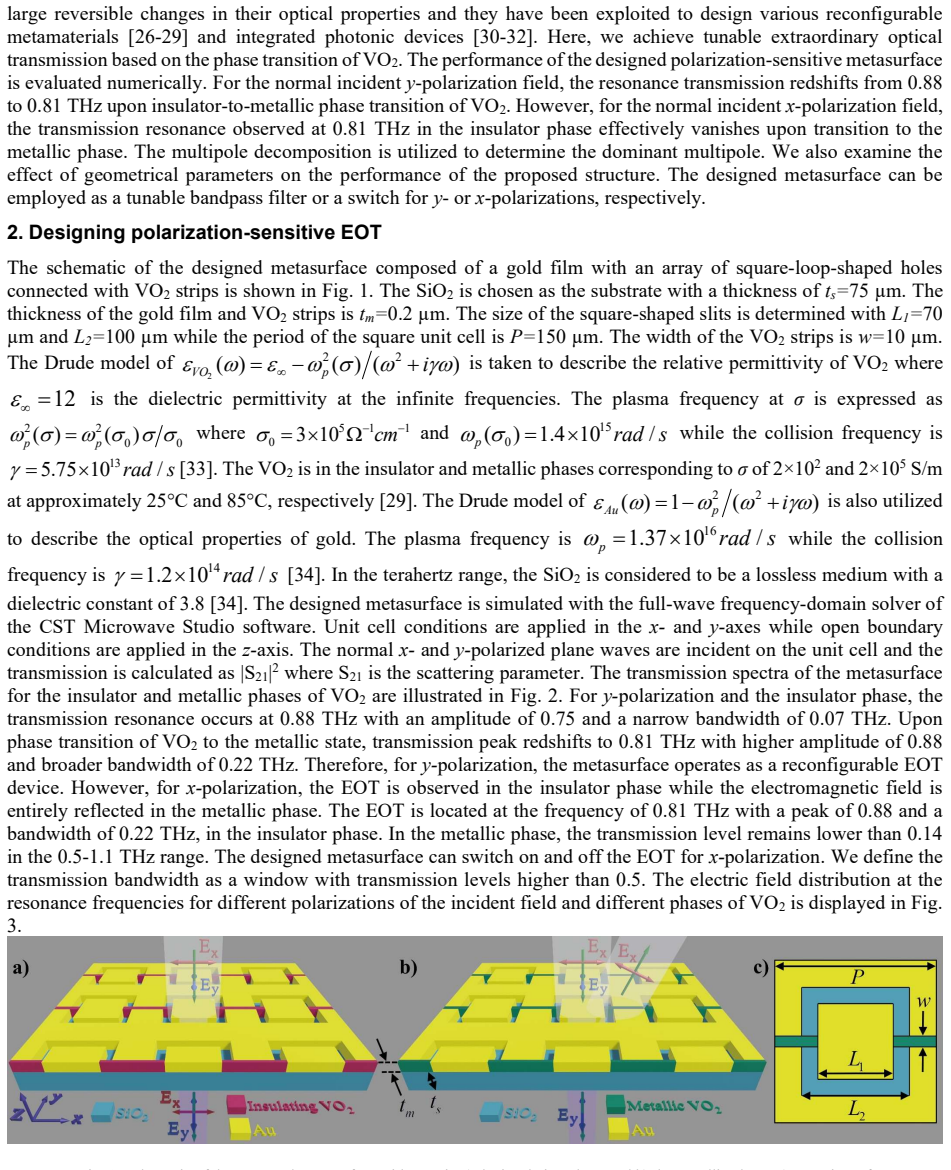
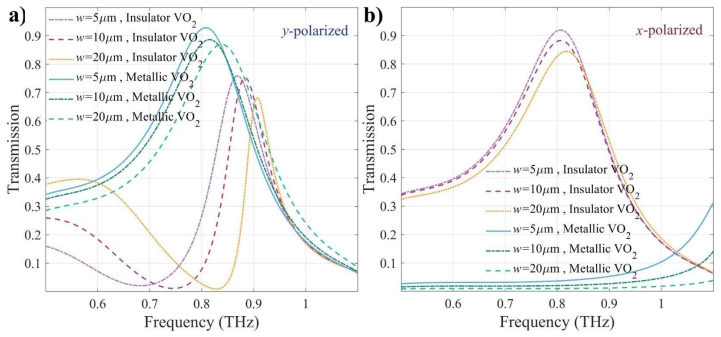
The metasurface consists of a metal sheet perforated by square loops connected with strips of VO2. For y-polarized incident fields the resonance transmission peak redshifts from 0.88 to 0.81 THz upon the insulator-to-metallic phase transition of VO2. For x-polarized incident fields a transmission resonance at 0.81 THz appears in the insulator phase, but in the metallic phase the field is reflected across 0.5-1.1 THz with transmission lower than 0.14. The structure can therefore be used as a terahertz modulator, reconfigurable filter, or switch.
What carries the argument
Square metal loops connected by VO2 strips whose conductivity is switched by the insulator-to-metallic phase transition, thereby modifying resonance conditions differently along x and y axes.
If this is right
- The metasurface functions as a thermally controlled terahertz modulator by shifting or suppressing resonances.
- It serves as a polarization-selective reconfigurable filter with distinct x and y responses.
- It operates as a switch that reflects x-polarized waves while transmitting y-polarized waves at a shifted frequency in the metallic state.
- Frequency and amplitude modulation of extraordinary transmission occur without mechanical movement.
Where Pith is reading between the lines
- Scaling the loop size could adapt the same principle to nearby frequency bands.
- The polarization dependence could be combined with other sensing schemes to add directional selectivity in terahertz systems.
- Response speed would be set by thermal diffusion times rather than electronic switching rates.
Load-bearing premise
The numerical electromagnetic simulation accurately models the conductivity change of VO2 and the geometry of the hybrid structure during the phase transition.
What would settle it
An experimental spectrum in which the y-polarized resonance fails to redshift or the x-polarized transmission stays above 0.14 after VO2 is driven into its metallic state.
Figures




read the original abstract
A thermally tunable extraordinary terahertz transmission in a hybrid metal-vanadium dioxide (VO2) metasurface is numerically demonstrated. The metasurface consists of a metal sheet perforated by square loops while the loops are connected with strips of VO2. The frequency and amplitude of the transmission resonance are modulated by controlling the conductivity of the VO2. For y-polarized incident field, the resonance transmission peak redshifts from 0.88 to 0.81 THz upon insulator-to-metallic phase transition of VO2. For x-polarized incident field, the transmission resonance at 0.81 THz is observed in the insulator phase. However, in the metallic phase of VO2, the electromagnetic field is effectively reflected in the 0.5-1.1 THz range with a transmission level lower than 0.14. The proposed metasurface can be utilized as a terahertz modulator, reconfigurable filter, or switch.
Editorial analysis
A structured set of objections, weighed in public.
Referee Report
Summary. The paper numerically demonstrates a thermally tunable extraordinary terahertz transmission through a hybrid metal-VO2 metasurface consisting of a perforated metal sheet with square loops connected by VO2 strips. Upon the insulator-to-metal transition of VO2, it reports polarization-dependent effects: a redshift of the y-polarized transmission resonance from 0.88 THz to 0.81 THz, and for x-polarization a resonance at 0.81 THz in the insulating phase that is suppressed to transmission below 0.14 across 0.5-1.1 THz in the metallic phase. The structure is proposed for use as a THz modulator, reconfigurable filter, or switch.
Significance. If the reported transmission spectra and polarization sensitivity are reproducible, the design would offer a compact, thermally controlled platform for dynamic THz filtering and modulation. The hybrid geometry exploits the conductivity jump in VO2 to achieve both frequency tuning and broadband reflection switching, which could be of interest for reconfigurable THz components. However, the absence of any experimental validation or detailed simulation methodology limits immediate impact to a conceptual proposal.
major comments (2)
- [Numerical simulation / Results] The central numerical claims (redshift of 0.88→0.81 THz for y-pol and transmission <0.14 for x-pol in the metallic phase) rest on forward EM simulation with inserted VO2 conductivity values, yet no simulation method, mesh convergence study, boundary conditions, or software details are provided. Without these, the quantitative spectra cannot be independently verified.
- [Device design / Results] The frequency shift and reflection window depend directly on the assumed VO2 conductivity jump (insulating ~10–100 S/m to metallic ~10^4–10^5 S/m). No sensitivity analysis, parameter sweep, or comparison against measured VO2 film data on the relevant substrate is reported, leaving the specific numbers (0.88 THz, 0.81 THz, 0.14 transmission) tied to unvalidated material assumptions.
minor comments (2)
- [Abstract] The abstract states specific numerical outcomes but does not indicate whether they derive from a single simulation run or an average; adding a brief statement on simulation repeatability would improve clarity.
- [Figure 1 / Methods] Polarization definitions (x- and y-) should be explicitly tied to the geometry orientation in a figure caption or early methods paragraph to avoid ambiguity.
Simulated Author's Rebuttal
We thank the referee for the constructive comments on our manuscript. We have revised the paper to provide the requested details on the numerical simulation methodology and to include a sensitivity analysis addressing the VO2 conductivity assumptions.
read point-by-point responses
-
Referee: The central numerical claims (redshift of 0.88→0.81 THz for y-pol and transmission <0.14 for x-pol in the metallic phase) rest on forward EM simulation with inserted VO2 conductivity values, yet no simulation method, mesh convergence study, boundary conditions, or software details are provided. Without these, the quantitative spectra cannot be independently verified.
Authors: We agree that the original submission omitted key simulation details. In the revised manuscript we have added a dedicated Methods subsection specifying the use of CST Studio Suite (finite integration technique, frequency-domain solver), periodic boundary conditions in the x-y plane with open boundaries in z, and a tetrahedral mesh with adaptive refinement. A mesh convergence study is now included, demonstrating that transmission spectra stabilize to within 1% when the maximum mesh edge length is reduced below λ/12 at 1.2 THz. revision: yes
-
Referee: The frequency shift and reflection window depend directly on the assumed VO2 conductivity jump (insulating ~10–100 S/m to metallic ~10^4–10^5 S/m). No sensitivity analysis, parameter sweep, or comparison against measured VO2 film data on the relevant substrate is reported, leaving the specific numbers (0.88 THz, 0.81 THz, 0.14 transmission) tied to unvalidated material assumptions.
Authors: We acknowledge the dependence on material parameters. The revised manuscript now contains a new supplementary figure and accompanying text presenting a parameter sweep of insulating conductivity (1–100 S/m) and metallic conductivity (10^3–10^5 S/m). The reported redshift (0.80–0.82 THz) and broadband suppression (<0.15) remain robust for metallic conductivities above 10^4 S/m. We have also added citations to experimental VO2 conductivity data measured on silicon substrates with comparable film thickness and deposition conditions to justify the chosen values of 10 S/m (insulating) and 5×10^4 S/m (metallic). revision: yes
Circularity Check
No circularity: forward numerical simulation from external material parameters
full rationale
The paper reports direct electromagnetic simulations of a fixed metasurface geometry with VO2 strips whose conductivity is switched between two externally supplied values (insulator ~10-100 S/m, metal ~10^4-10^5 S/m). Transmission spectra for x- and y-polarizations are computed outputs, not fitted or renamed inputs. No self-citations, uniqueness theorems, or ansatzes are invoked to justify the conductivity jump or the resulting redshift/reflection; the derivation chain is therefore self-contained and non-circular.
Axiom & Free-Parameter Ledger
free parameters (1)
- VO2 conductivity in insulating and metallic phases
axioms (1)
- standard math Maxwell's equations accurately describe the wave propagation and interaction with the metasurface at terahertz frequencies.
Lean theorems connected to this paper
-
IndisputableMonolith/Cost/FunctionalEquation.leanwashburn_uniqueness_aczel unclear?
unclearRelation between the paper passage and the cited Recognition theorem.
The Drude model of VO2 ... insulator and metallic phases corresponding to σ of 2×10^2 and 2×10^5 S/m ... simulated with the full-wave frequency-domain solver of the CST Microwave Studio
-
IndisputableMonolith/Foundation/DimensionForcing.leanalexander_duality_circle_linking unclear?
unclearRelation between the paper passage and the cited Recognition theorem.
For y-polarized ... resonance transmission peak redshifts from 0.88 to 0.81 THz ... x-polarized ... transmission level lower than 0.14
What do these tags mean?
- matches
- The paper's claim is directly supported by a theorem in the formal canon.
- supports
- The theorem supports part of the paper's argument, but the paper may add assumptions or extra steps.
- extends
- The paper goes beyond the formal theorem; the theorem is a base layer rather than the whole result.
- uses
- The paper appears to rely on the theorem as machinery.
- contradicts
- The paper's claim conflicts with a theorem or certificate in the canon.
- unclear
- Pith found a possible connection, but the passage is too broad, indirect, or ambiguous to say the theorem truly supports the claim.
Reference graph
Works this paper leans on
-
[1]
Recent progress in electromagnetic metamaterial devices for terahertz applications,
H. Tao, W. J. Padilla, X. Zhang, and R. D. Averitt, "Recent progress in electromagnetic metamaterial devices for terahertz applications," IEEE Journal of Selected Topics in Quantum Electronics 17, 92-101 (2010)
work page 2010
-
[2]
Metamaterials in the terahertz regime,
W. Withayachumnankul and D. Abbott, "Metamaterials in the terahertz regime," IEEE Photonics Journal 1, 99-118 (2009)
work page 2009
-
[3]
C.-C. Chang, L. Huang, J. Nogan, and H.-T. Chen, "Invited Article: Narrowband terahertz bandpass filters employing stacked bilayer metasurface antireflection structures," APL Photonics 3, 051602 (2018)
work page 2018
-
[4]
D. Sun, L. Qi, and Z. Liu, "Terahertz broadband filter and electromagnetically induced transparency structure with complementary metasurface," Results in Physics 16, 102887 (2020)
work page 2020
-
[5]
Ultrathin metasurface-based carpet cloak for terahertz wave,
M. Wei, Q. Yang, X. Zhang, Y. Li, J. Gu, J. Han, and W. Zhang, "Ultrathin metasurface-based carpet cloak for terahertz wave," Optics express 25, 15635-15642 (2017)
work page 2017
-
[6]
Nanostructured graphene metasurface for tunable terahertz cloaking,
P.-Y. Chen, J. Soric, Y. R. Padooru, H. M. Bernety, A. B. Yakovlev, and A. Alù, "Nanostructured graphene metasurface for tunable terahertz cloaking," New Journal of Physics 15, 123029 (2013)
work page 2013
-
[7]
Efficient flat metasurface lens for terahertz imaging,
Q. Yang, J. Gu, D. Wang, X. Zhang, Z. Tian, C. Ouyang, R. Singh, J. Han, and W. Zhang, "Efficient flat metasurface lens for terahertz imaging," Optics express 22, 25931-25939 (2014)
work page 2014
-
[8]
A broadband metasurface-based terahertz flat-lens array,
Q. Wang, X. Zhang, Y. Xu, Z. Tian, J. Gu, W. Yue, S. Zhang, J. Han, and W. Zhang, "A broadband metasurface-based terahertz flat-lens array," Advanced Optical Materials 3, 779-785 (2015)
work page 2015
-
[9]
Terahertz sensing based on metasurfaces,
M. Beruete and I. Jáuregui-López, "Terahertz sensing based on metasurfaces," Advanced Optical Materials 8, 1900721 (2020)
work page 2020
-
[10]
Ultrasensitive terahertz sensing with high-Q Fano resonances in metasurfaces,
R. Singh, W. Cao, I. Al-Naib, L. Cong, W. Withayachumnankul, and W. Zhang, "Ultrasensitive terahertz sensing with high-Q Fano resonances in metasurfaces," Applied Physics Letters 105, 171101 (2014)
work page 2014
-
[11]
Design of a wide-gain-bandwidth metasurface antenna at terahertz frequency,
N. Hussain and I. Park, "Design of a wide-gain-bandwidth metasurface antenna at terahertz frequency," AIP Advances 7, 055313 (2017)
work page 2017
-
[12]
S. E. Hosseininejad, K. Rouhi, M. Neshat, A. Cabellos-Aparicio, S. Abadal, and E. Alarcón, "Digital metasurface based on graphene: An application to beam steering in terahertz plasmonic antennas," IEEE Transactions on Nanotechnology 18, 734-746 (2019)
work page 2019
-
[13]
J. Song, Y. Shi, X. Liu, M. Li, X. Wang, and F. Yang, "Enhanced broadband extraordinary terahertz transmission through plasmon coupling between metal hemisphere and hole arrays," Optical Materials Express 11, 2700-2710 (2021)
work page 2021
-
[14]
X. Gao, Z. Zhu, J. Yuan, and L. Jiang, "Tunable and multifunctional terahertz devices based on one-dimensional anisotropic photonic crystals containing graphene and phase-change material," Optics Express 29, 13314-13330 (2021). 10
work page 2021
-
[15]
THz sensing with anomalous extraordinary optical transmission hole arrays,
I. Jáuregui-López, P. Rodriguez-Ulibarri, S. A. Kuznetsov, N. A. Nikolaev, and M. Beruete, "THz sensing with anomalous extraordinary optical transmission hole arrays," Sensors 18, 3848 (2018)
work page 2018
-
[16]
S. Gong, L. Wang, Y. Zhang, Z. Yang, X. Li, Q. Wen, Z. He, S. Liang, L. Yuan, and C. Yu, "Ultra- extraordinary optical transmission induced by cascade coupling of surface plasmon polaritons in composite graphene–dielectric stack," Optics Express 28, 30502-30512 (2020)
work page 2020
-
[17]
C. Genet and T. W. Ebbesen, "Light in tiny holes," Nanoscience And Technology: A Collection of Reviews from Nature Journals, 205-212 (2010)
work page 2010
-
[18]
Extraordinary optical transmission: fundamentals and applications,
S. G. Rodrigo, F. de Leon-Perez, and L. Martin-Moreno, "Extraordinary optical transmission: fundamentals and applications," Proceedings of the IEEE 104, 2288-2306 (2016)
work page 2016
-
[19]
Graphene-supported tunable extraordinary transmission,
X. He and H. Lu, "Graphene-supported tunable extraordinary transmission," Nanotechnology 25, 325201 (2014)
work page 2014
-
[20]
W. Gao, J. Shu, K. Reichel, D. V. Nickel, X. He, G. Shi, R. Vajtai, P. M. Ajayan, J. Kono, and D. M. Mittleman, "High-contrast terahertz wave modulation by gated graphene enhanced by extraordinary transmission through ring apertures," Nano letters 14, 1242-1248 (2014)
work page 2014
-
[21]
Tunable Extraordinary Optical Transmission with Graphene in Terahertz,
Z. Gao, Y. Shi, M. Li, J. Song, X. Liu, X. Wang, and F. Yang, "Tunable Extraordinary Optical Transmission with Graphene in Terahertz," ACS omega 6, 29746-29751 (2021)
work page 2021
-
[22]
Modulation of the extraordinary optical transmission by surface acoustic waves,
D. Gérard, V. Laude, B. Sadani, A. Khelif, D. Van Labeke, and B. Guizal, "Modulation of the extraordinary optical transmission by surface acoustic waves," Physical Review B 76, 235427 (2007)
work page 2007
-
[23]
J. Wu, X. Zhang, B. Jin, H. Liu, Y. Chen, Z. Li, C. Zhang, L. Kang, W. Xu, and J. Chen, "The dynamic process and microscopic mechanism of extraordinary terahertz transmission through perforated superconducting films," Scientific reports 5, 1-12 (2015)
work page 2015
-
[24]
Electrically controllable extraordinary optical transmission in gold gratings on vanadium dioxide,
J. Jeong, A. Joushaghani, S. Paradis, D. Alain, and J. K. Poon, "Electrically controllable extraordinary optical transmission in gold gratings on vanadium dioxide," Optics Letters 40, 4408-4411 (2015)
work page 2015
-
[25]
Multi-cycle reconfigurable THz extraordinary optical transmission using chalcogenide metamaterials,
T. Cao, M. Lian, X. Chen, L. Mao, K. Liu, J. Jia, Y. Su, H. Ren, S. Zhang, and Y. Xu, "Multi-cycle reconfigurable THz extraordinary optical transmission using chalcogenide metamaterials," Opto- Electronic Science 1, 210010-210011-210010-210011 (2022)
work page 2022
-
[26]
Thermally reconfigurable extraordinary terahertz transmission using vanadium dioxide,
S. H. Badri, H. Soofi, and S. SaeidNahaei, "Thermally reconfigurable extraordinary terahertz transmission using vanadium dioxide," JOSA B 39, 1614-1621 (2022)
work page 2022
-
[27]
T. Wang, J. He, J. Guo, X. Wang, S. Feng, F. Kuhl, M. Becker, A. Polity, P. J. Klar, and Y. Zhang, "Thermally switchable terahertz wavefront metasurface modulators based on the insulator-to- metal transition of vanadium dioxide," Optics express 27, 20347-20357 (2019)
work page 2019
-
[28]
S. H. Badri, M. Gilarlue, S. SaeidNahaei, and J. S. Kim, "Narrowband-to-broadband switchable and polarization-insensitive terahertz metasurface absorber enabled by phase-change material," Journal of Optics 24, 025101 (2022)
work page 2022
-
[29]
F. Li, T. Tang, J. Li, L. Luo, C. Li, J. Shen, and J. Yao, "Chiral coding metasurfaces with integrated vanadium dioxide for thermo-optic modulation of terahertz waves," Journal of Alloys and Compounds 826, 154174 (2020)
work page 2020
-
[30]
S. H. Badri and S. G. Farkoush, "Subwavelength grating waveguide filter based on cladding modulation with a phase-change material grating," Applied Optics 60, 2803-2810 (2021)
work page 2021
-
[31]
Active control of surface plasmon waveguides with a phase change material,
M. Rudé, R. E. Simpson, R. Quidant, V. Pruneri, and J. Renger, "Active control of surface plasmon waveguides with a phase change material," Acs Photonics 2, 669-674 (2015)
work page 2015
-
[32]
S. H. Badri, M. M. Gilarlue, S. G. Farkoush, and S.-B. Rhee, "Reconfigurable bandpass optical filters based on subwavelength grating waveguides with a Ge2Sb2Te5 cavity," J. Opt. Soc. Am. B 38, 1283-1289 (2021). 11
work page 2021
-
[33]
X. Luo, F. Hu, and G. Li, "Dynamically reversible and strong circular dichroism based on Babinet- invertible chiral metasurfaces," Optics Letters 46, 1309-1312 (2021)
work page 2021
-
[34]
Z. Song and J. Zhang, "Achieving broadband absorption and polarization conversion with a vanadium dioxide metasurface in the same terahertz frequencies," Optics express 28, 12487- 12497 (2020)
work page 2020
-
[35]
Multiple Fano resonances excitation on all-dielectric nanohole arrays metasurfaces,
L. Yang, S. Yu, H. Li, and T. Zhao, "Multiple Fano resonances excitation on all-dielectric nanohole arrays metasurfaces," Optics Express 29, 14905-14916 (2021)
work page 2021
-
[36]
High-Q Fano resonance in all-dielectric metasurfaces for molecular fingerprint detection,
S. H. Badri, M. M. Gilarlue, S. SaeidNahaei, and J. S. Kim, "High-Q Fano resonance in all-dielectric metasurfaces for molecular fingerprint detection," J. Opt. Soc. Am. B 39, 563-569 (2022)
work page 2022
-
[37]
MENP: an open-source MATLAB implementation of multipole expansion for nanophotonics,
T. Hinamoto and M. Fujii, "MENP: an open-source MATLAB implementation of multipole expansion for nanophotonics," OSA Continuum 4, 1640-1648 (2021)
work page 2021
-
[38]
S. Yu, H. Li, Y. Wang, Z. Gao, T. Zhao, and J. Yu, "Multiple Fano resonance excitation of all- dielectric nanoholes cuboid arrays in near infrared region," Results in Physics 28, 104569 (2021)
work page 2021
-
[39]
An electromagnetic multipole expansion beyond the long-wavelength approximation,
R. Alaee, C. Rockstuhl, and I. Fernandez-Corbaton, "An electromagnetic multipole expansion beyond the long-wavelength approximation," Optics Communications 407, 17-21 (2018)
work page 2018
-
[40]
Multipolar engineering of subwavelength dielectric particles for scattering enhancement,
S. Krasikov, M. Odit, D. Dobrykh, I. Yusupov, A. Mikhailovskaya, D. Shakirova, A. Shcherbakov, A. Slobozhanyuk, P. Ginzburg, and D. Filonov, "Multipolar engineering of subwavelength dielectric particles for scattering enhancement," Physical Review Applied 15, 024052 (2021)
work page 2021
- [41]
-
[42]
P. D. Terekhov, V. E. Babicheva, K. V. Baryshnikova, A. S. Shalin, A. Karabchevsky, and A. B. Evlyukhin, "Multipole analysis of dielectric metasurfaces composed of nonspherical nanoparticles and lattice invisibility effect," Physical Review B 99, 045424 (2019)
work page 2019
-
[43]
Modified Maxwell Garnett model for hysteresis in phase change materials,
J. D. Frame, N. G. Green, and X. Fang, "Modified Maxwell Garnett model for hysteresis in phase change materials," Optical Materials Express 8, 1988-1996 (2018)
work page 1988
discussion (0)
Sign in with ORCID, Apple, or X to comment. Anyone can read and Pith papers without signing in.