Recognition: no theorem link
Principal specializations of Grothendieck polynomials
Pith reviewed 2026-05-12 05:31 UTC · model grok-4.3
The pith
For 1423-avoiding permutations the principal specialization of the β-Grothendieck polynomial expands nonnegatively by pattern counts in the permutation.
A machine-rendered reading of the paper's core claim, the machinery that carries it, and where it could break.
Core claim
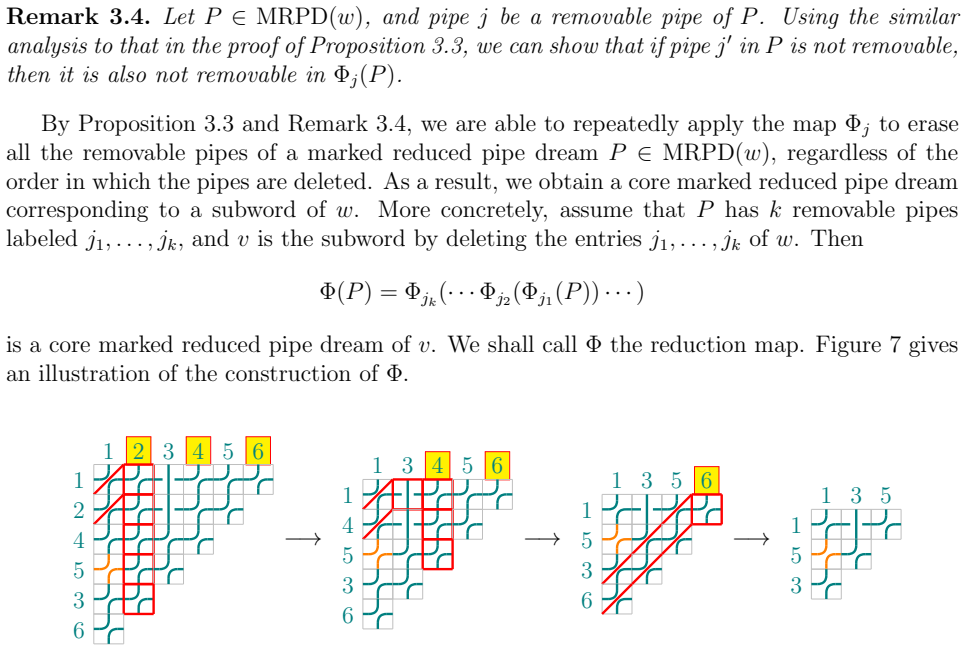
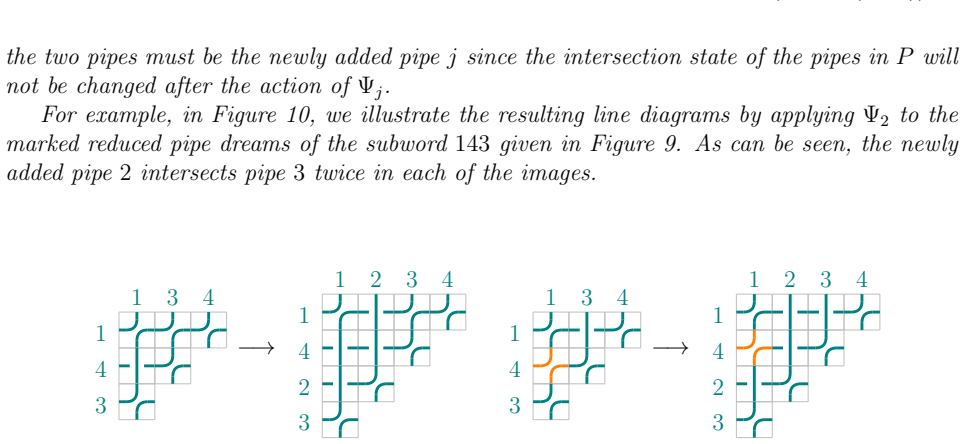
When a permutation w does not contain the 1423 pattern, the principal specialization of the corresponding β-Grothendieck polynomial can be expressed nonnegatively in terms of the occurrences of patterns in w. The same nonnegativity holds for 1342-avoiding permutations by the inverse conservation principle. The proofs rest on a reduction algorithm that operates on the classic pipe-dream model of β-Grothendieck polynomials.
What carries the argument
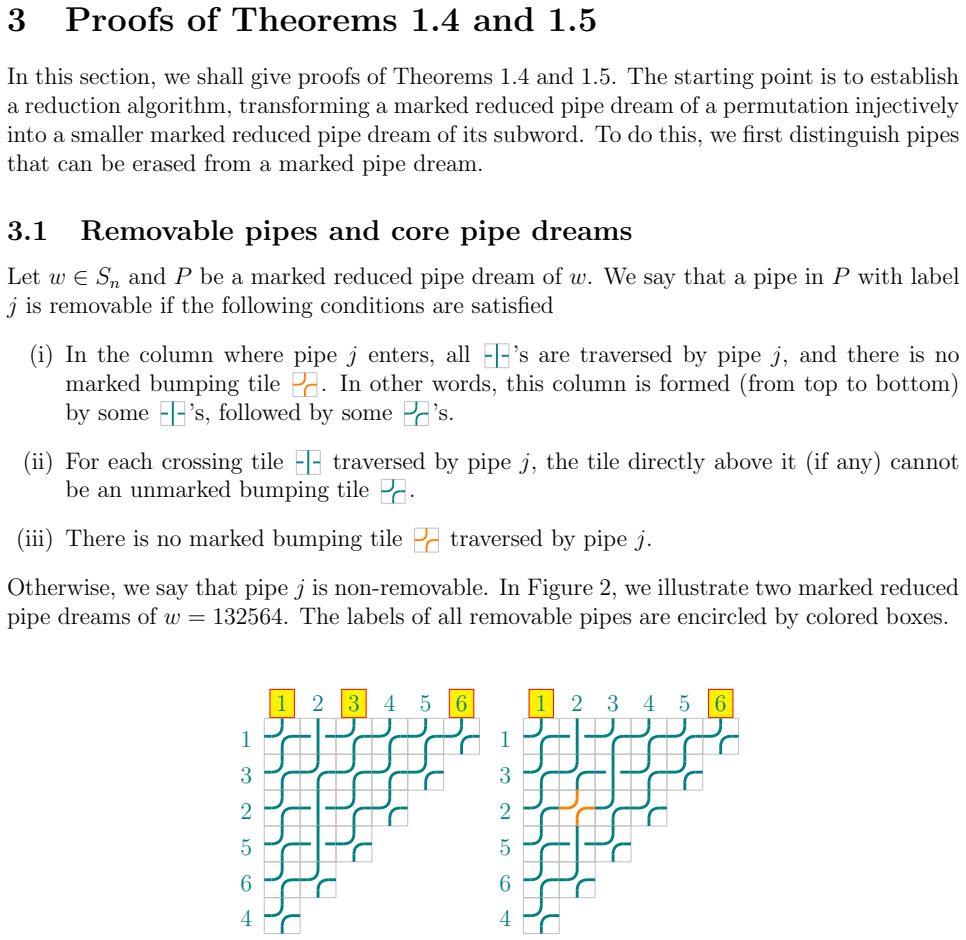
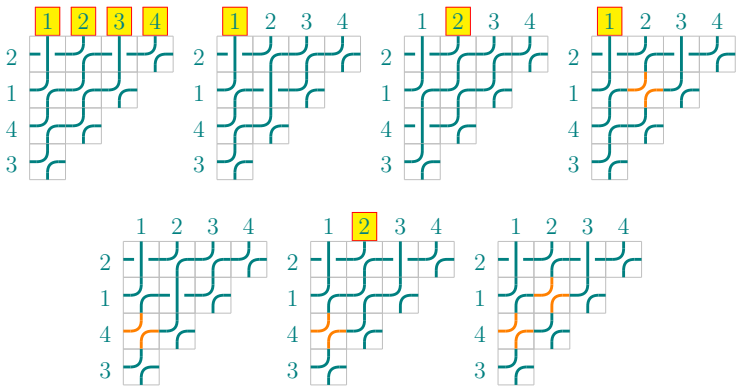
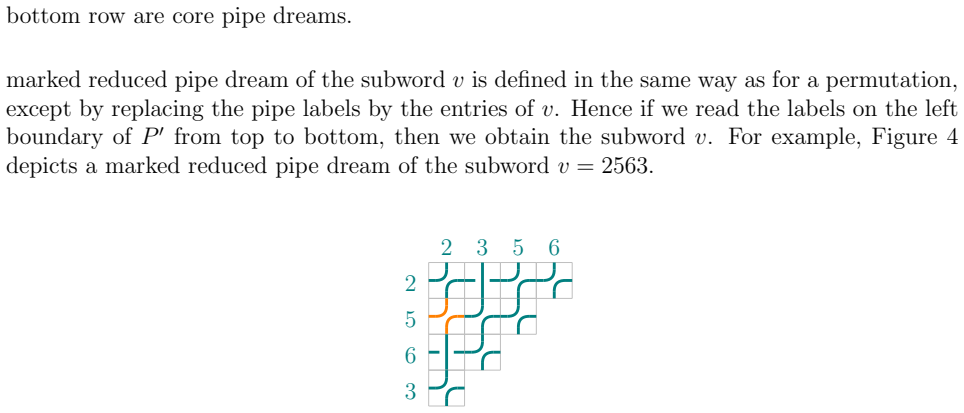
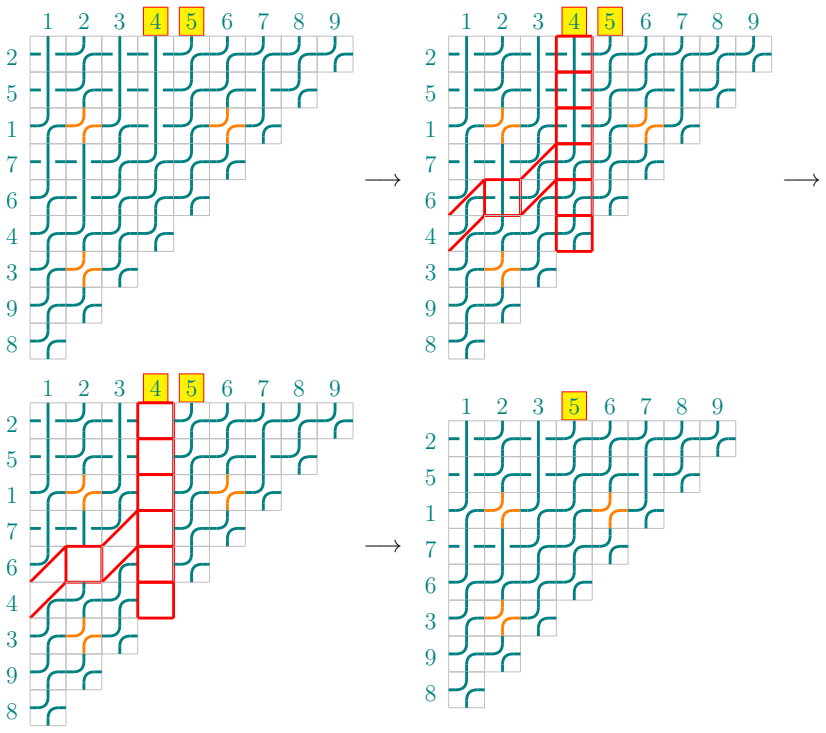
The reduction algorithm on the classic pipe-dream model of β-Grothendieck polynomials, which simplifies diagrams while tracking pattern occurrences in the underlying permutation.
If this is right
- The principal specialization becomes a polynomial in β whose coefficients are explicit nonnegative integers given by pattern multiplicities.
- The same pattern-count formula holds for all 1342-avoiding permutations via the inverse map.
- The reduction process supplies a combinatorial proof for the nonnegativity parts of the conjectures of Gao, Mészáros–Tanjaya, and Dennin.
- Pipe dreams can be successively simplified without changing the specialization value whenever the permutation is 1423-avoiding.
Where Pith is reading between the lines
- The same reduction technique might produce analogous nonnegative expansions for other K-theoretic polynomials once suitable pattern-avoidance conditions are identified.
- One could enumerate small 1423-avoiding permutations and verify that the pattern coefficients exactly reproduce the known values of the specialization.
- Pattern avoidance may delineate the precise boundary between permutations whose Grothendieck specializations admit positive expansions and those that do not.
Load-bearing premise
The reduction algorithm applied to pipe dreams correctly yields the claimed nonnegative pattern-count formula precisely when the permutation avoids 1423.
What would settle it
Compute the principal specialization and the pattern-count expansion for any 1423-avoiding permutation of length 5 or 6; if the two polynomials differ by a negative coefficient in any term, the claim fails.
Figures





read the original abstract
Motivated by Stanley's ``Schubert shenanigans'' paper, commendable attempts have been made to understand the principal specializations of Schubert or Grothendieck polynomials. In this paper, we prove that when a permutation $w$ does not contain the $1423$ pattern, the principal specialization of the corresponding $\beta$-Grothendieck polynomial can be expressed nonnegatively in terms of the occurrences of patterns in $w$. Using an inverse conservation principle, we further obtain the nonnegativity expansion for permutations avoiding the $1342$ pattern. Our results partially resolve conjectures raised respectively by Gao (independently observed by Gaetz), Me\'sz\'aros--Tanjaya, and Dennin. The proofs are achieved based upon a reduction algorithm performing on the classic pipe dream model of $\beta$-Grothendieck polynomials.
Editorial analysis
A structured set of objections, weighed in public.
Referee Report
Summary. The paper proves that for a permutation w avoiding the 1423 pattern, the principal specialization of the associated β-Grothendieck polynomial admits a nonnegative expansion in terms of the number of occurrences of certain patterns in w. Using an inverse conservation principle, an analogous nonnegative expansion is obtained for 1342-avoiding permutations. The proofs are carried out via a reduction algorithm applied to the classical pipe-dream model of β-Grothendieck polynomials. The results partially resolve conjectures of Gao (independently observed by Gaetz), Mészáros–Tanjaya, and Dennin.
Significance. If the claimed expansions hold, the work supplies explicit combinatorial formulas for principal specializations of β-Grothendieck polynomials on two infinite families of pattern-avoiding permutations. This advances the program of finding nonnegative expressions for these specializations and connects pipe-dream combinatorics with pattern avoidance. The algorithmic proof method is constructive and may admit computational verification or generalization; the partial resolution of the cited conjectures is a concrete contribution to the literature.
minor comments (2)
- The reduction algorithm is described in §3; a single worked example showing the successive steps on a small 1423-avoiding permutation would make the procedure easier to follow and verify.
- The statement of the inverse conservation principle (used for the 1342 case) appears in §4; clarifying whether it preserves the pipe-dream weight exactly or up to a sign would strengthen the exposition.
Simulated Author's Rebuttal
We thank the referee for their positive assessment of the manuscript, accurate summary of the results, and recommendation for minor revision. The referee correctly identifies the main theorems on nonnegative expansions for 1423-avoiding and 1342-avoiding permutations via pipe dreams, as well as the partial resolution of the cited conjectures.
Circularity Check
No significant circularity in the derivation
full rationale
The paper proves the claimed nonnegative expansion for principal specializations of β-Grothendieck polynomials precisely when w avoids 1423 (or dually 1342) by means of a reduction algorithm applied directly to the standard pipe-dream model. This is a self-contained combinatorial argument that starts from the classical combinatorial representation of the polynomials and derives the pattern-count formula without fitted parameters, self-definitional reductions, or load-bearing self-citations. The restriction to pattern-avoiding permutations is the natural domain in which such an expansion is expected, and no step reduces the result to its own inputs by construction. The derivation therefore stands as an independent proof from the pipe-dream combinatorics.
Axiom & Free-Parameter Ledger
axioms (2)
- domain assumption The pipe dream model correctly represents β-Grothendieck polynomials and their principal specializations.
- domain assumption Pattern avoidance (1423 and 1342) interacts with the reduction algorithm in a way that preserves nonnegativity.
Reference graph
Works this paper leans on
-
[1]
D. Anderson, G. Panova and L. Petrov, Computation and sampling for Schubert spe- cializations, arXiv: 2603.20104, 2026
-
[2]
N. Bergeron and S.C. Billey, RC-graphs and Schubert polynomials, Experiment. Math. 2 (1993), no. 4, 257–269. 18
work page 1993
-
[3]
V. Buciumas and T. Scrimshaw, Double Grothendieck polynomials and colored lattice models, Int. Math. Res. Not. IMRN 2022, no. 10, 7231–7258
work page 2022
-
[4]
J. Chou and L. Setiabrata, Asymptotically maximal Schubitopes, arXiv:2512.04053v1, 2025
-
[5]
Dennin, Pattern bounds for principal specializations ofβ-Grothendieck polynomials, Algebr
H. Dennin, Pattern bounds for principal specializations ofβ-Grothendieck polynomials, Algebr. Combin. 8 (2025), no. 3, 745–763
work page 2025
-
[6]
A. Fink, K. M´ esz´ aros and A. St. Dizier, Schubert polynomials as integer point transforms of generalized permutahedra, Adv. Math. 332 (2018), 465–475
work page 2018
-
[7]
A. Fink, K. M´ esz´ aros and A. St. Dizier, Zero-one Schubert polynomials, Math. Z. 297 (2021), 1023–1042
work page 2021
-
[8]
S. Fomin and A.N. Kirillov, Grothendieck polynomials and the Yang-Baxter equation, Center for Discrete Mathematics and Theoretical Computer Science (DIMACS), Piscat- away, NJ, 2007, 183–189
work page 2007
-
[9]
S. Fomin and R.P. Stanley, Schubert polynomials and the nil-Coxeter algebra, Adv. Math. 103 (1994), 196–207
work page 1994
-
[10]
Gao, Principal specializations of Schubert polynomials and pattern containment, European J
Y. Gao, Principal specializations of Schubert polynomials and pattern containment, European J. Combin. 94 (2021), Paper No. 103291, 12 pp
work page 2021
- [11]
-
[12]
Z. Hamaker, O. Pechenik, D.E. Speyer and A. Weigandt, Derivatives of Schubert poly- nomials and proof of a determinant conjecture of Stanley, Algebraic Combin. 3 (2020), 301–307
work page 2020
-
[13]
G. James and A. Kerber, The representation theory of the symmetric group, Encyclo- pedia of Mathematics and its Applications, vol. 16, Addison-Wesley Publishing Co., Reading, Mass., 1981, With a foreword by P. M. Cohn, With an introduction by Gilbert de B. Robinson
work page 1981
-
[14]
A. Knutson and E. Miller, Subword complexes in Coxeter groups, Adv. Math. 184 (2004), no. 1, 161–176
work page 2004
-
[15]
A. Knutson and E. Miller, Gr¨ obner geometry of Schubert polynomials, Ann. of Math. (2) 161 (2005), no. 3, 1245–1318
work page 2005
-
[16]
A. Knutson and G. Udell, Interpolating between classic and bumpless pipe dreams, S´ em. Lothar. Combin. 89B (2023), Art. 89, 12 pp
work page 2023
- [17]
- [18]
-
[19]
A. Lascoux and M.-P. Sch¨ utzenberger, Polynˆ omes de Schubert, C. R. Acad. Sci. Paris S´ er. I Math. 294 (1982), 447–450
work page 1982
-
[20]
A. Lascoux and M.-P. Sch¨ utzenberger, Structure de Hopf de l’anneau de cohomologie et de l’anneau de Grothendieck d’une vari´ et´ e de drapeaux, C. R. Acad. Sci. Paris S´ er. I Math. 295 (1982), 629–633
work page 1982
- [21]
-
[22]
I.G. Macdonald, Notes on Schubert Polynomials, Laboratoire de combinatoire et d’informatique math´ ematique (LACIM), Universit´ e du Qu´ ebec ´ a Montr´ eal, Montreal, 1991
work page 1991
-
[23]
K. M´ esz´ aros and A. Tanjaya, Inclusion-exclusion on Schubert polynomials, Algebr. Com- bin. 5 (2022), no. 2, 209–226
work page 2022
-
[24]
A.H. Morales, I. Pak and G. Panova, Asymptotics of principal evaluations of Schubert polynomials for layered permutations, Proc. Amer. Math. Soc. 147 (2019), 1377–1389
work page 2019
-
[25]
A.H. Morales, I. Pak and G. Panova, Hook formulas for skew shapes IV. Increasing tableaux and factorial Grothendieck polynomials, J. Math. Sci. 261 (2022), 630–657
work page 2022
-
[26]
A.H. Morales, G. Panova, L. Petrov and D. Yeliussizov, Grothendieck shenanigans: permutons from pipe dreams via integrable probability, Adv. Math. 480 (2025), part C, Paper No. 110510, 63 pp
work page 2025
-
[27]
Stanley, Some Schubert shenanigans, arXiv:1704.00851v2, 2017
R.P. Stanley, Some Schubert shenanigans, arXiv:1704.00851v2, 2017
-
[28]
Weigandt, Schubert polynomials, 132-patterns, and Stanley’s conjecture, Algebr
A. Weigandt, Schubert polynomials, 132-patterns, and Stanley’s conjecture, Algebr. Combin. 1 (2018), no. 4, 415–423
work page 2018
-
[29]
Weigandt, Bumpless pipe dreams and alternating sign matrices, J
A. Weigandt, Bumpless pipe dreams and alternating sign matrices, J. Combin. Theory Ser. A 182 (2021), 105470
work page 2021
-
[30]
N. Zhang, Principal specializations of Schubert polynomials, multi-layered permutations and asymptotics, Adv. Appl. Math. 163 (2025), 102806, 19 pp. {Haojun Bai, Feng Gu, Peter L. Guo, Jiaji Liu}Center for Combinatorics, Nankai Uni- versity, LPMC, Tianjin 300071, P.R. China Email address:haojunbai@mail.nankai.edu.cn, fgu@mail.nankai.edu.cn, lguo@nankai.ed...
work page 2025
discussion (0)
Sign in with ORCID, Apple, or X to comment. Anyone can read and Pith papers without signing in.