Recognition: 2 theorem links
· Lean TheoremPartial annealing and pattern decorrelation in associative neural networks
Pith reviewed 2026-05-12 04:07 UTC · model grok-4.3
The pith
Coupling neural dynamics to slowly evolving patterns with a negative timescale parameter decorrelates memories and allows storage of one pattern per neuron.
A machine-rendered reading of the paper's core claim, the machinery that carries it, and where it could break.
Core claim
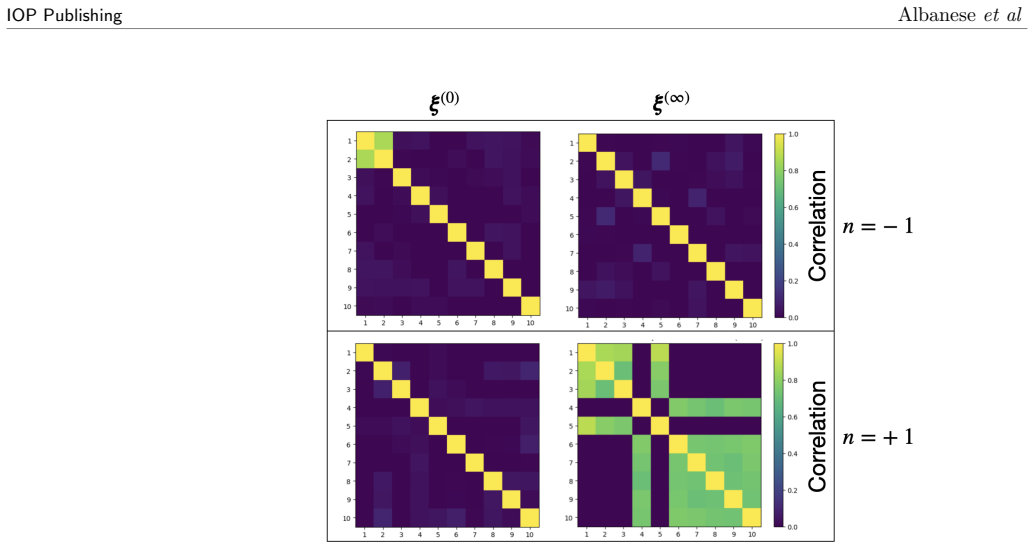
Adapting the interpolation method to the partially annealed setting yields the free energy for any real value of the parameter n that separates the timescales. Negative n drives a progressive decorrelation among the stored patterns, which reduces their mutual interference and enables the network to operate at the maximal storage capacity of one pattern per neuron while restoring retrieval even for biased patterns.
What carries the argument
The real parameter n that sets both the separation between the fast neural timescale and the slow pattern timescale and the strength of their effective interaction.
If this is right
- The network reaches the maximal storage capacity of one pattern per neuron.
- Retrieval performance improves when the stored patterns are biased.
- Partial annealing outperforms methods that enforce decorrelation explicitly.
- Patterns evolve toward more orthogonal configurations as the parameter decreases.
Where Pith is reading between the lines
- The same timescale-coupling idea could be tested in other associative models to check whether capacity gains appear without explicit orthogonalization steps.
- In finite networks the predicted decorrelation may appear gradually, offering a way to verify the thermodynamic results by varying system size.
Load-bearing premise
That linking fast neuron changes to slow pattern changes through a single shared parameter fully accounts for the interaction that governs memory performance.
What would settle it
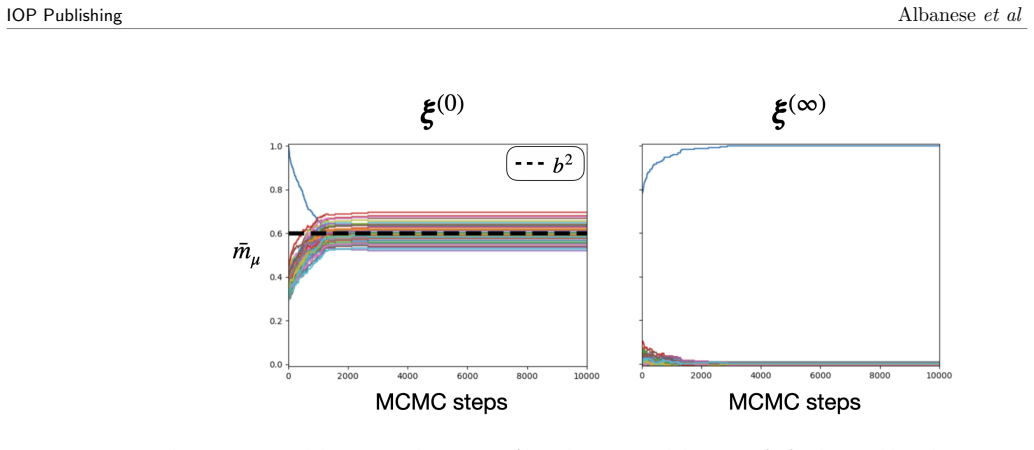
Simulations of mean-field Monte Carlo dynamics that measure whether pattern overlaps decrease toward zero as the parameter becomes more negative and whether retrieval succeeds when the number of patterns equals the number of neurons.
Figures



read the original abstract
Using the Hopfield model as a benchmark case, the present work focuses on the investigation of partially annealed associative neural networks, wherein neural dynamics is coupled to slowly evolving patterns within the two-temperature-two-timescale framework. This setting inherently introduces a real parameter n, reminiscent of the number of replicas in the celebrated replica trick, that tunes the separation of timescales and the effective interaction between fast (i.e. the neurons) and slow (i.e. the synapses) degrees of freedom. By adapting Guerra's interpolation to the case, we derive the free energy without relying on analytical continuation. The obtained results demonstrate that negative values of n induce a progressive decorrelation of the stored patterns, thereby effectively reducing interference, promoting orthogonal configurations and ultimately conferring to the network the maximal storage alphac=1. Numerical simulations based on a mean field Monte Carlo dynamics have been employed to confirm this scenario and prove that partial annealing restores retrieval in challenging regimes, such as in the presence of biased patterns, outperforming standard decorrelation methods. These findings underscore the notion of partial annealing as an adaptive mechanism for enhancing memory organisation and retrieval in complex systems.
Editorial analysis
A structured set of objections, weighed in public.
Referee Report
Summary. The manuscript examines partially annealed associative networks in the Hopfield model under a two-temperature, two-timescale framework. A real parameter n controls the separation between fast neural dynamics and slow pattern evolution. Adapting Guerra's interpolation method directly to real n (without analytic continuation), the authors derive the free energy and conclude that negative n drives progressive decorrelation of stored patterns, reduces interference, promotes orthogonality, and yields the maximal capacity α_c = 1. Mean-field Monte Carlo simulations are used to confirm the decorrelation effect and to demonstrate improved retrieval, including for biased patterns.
Significance. If the free-energy derivation is rigorously justified, the work supplies a concrete, tunable mechanism for capacity enhancement via controlled pattern decorrelation that goes beyond conventional orthogonalization techniques. The numerical evidence for restored retrieval in difficult regimes adds practical value. The result would be of interest to the disordered-systems and neural-networks community provided the interpolation step is placed on firmer ground.
major comments (3)
- [§3] §3 (free-energy derivation via Guerra interpolation): The adaptation of Guerra's interpolation to real and negative n is stated to avoid analytic continuation, yet the monotonicity and positivity properties that underpin the original method are not re-established for n < 0. Because the central claim (decorrelation yielding α_c = 1) follows directly from the resulting free-energy expression, an explicit verification that the interpolation path remains controlled for negative n is required.
- [§4] §4 (two-temperature-two-timescale coupling): The effective Hamiltonian coupling fast and slow degrees of freedom is introduced via n, but the precise mapping from the two-timescale dynamics to the n-dependent partition function is not derived from first principles. This step is load-bearing for interpreting negative n as a physical decorrelation mechanism rather than a formal parameter.
- [Numerical section] Numerical section (mean-field Monte Carlo): The reported capacity reaching α_c = 1 for negative n is shown qualitatively, but quantitative error bars on the overlap and capacity estimates versus n, together with a direct comparison to the analytic free-energy prediction, are missing. Without these, it is difficult to assess how closely the simulations corroborate the theoretical α_c = 1 result.
minor comments (2)
- Notation for the effective interaction term involving n should be introduced once and used consistently; occasional redefinition of symbols across sections reduces readability.
- Figure captions for the Monte Carlo results should explicitly state the system size, number of independent runs, and the precise definition of the overlap used to measure retrieval.
Simulated Author's Rebuttal
We thank the referee for the careful reading and constructive comments on our manuscript. We address each major point below and will incorporate the suggested improvements in the revised version.
read point-by-point responses
-
Referee: [§3] §3 (free-energy derivation via Guerra interpolation): The adaptation of Guerra's interpolation to real and negative n is stated to avoid analytic continuation, yet the monotonicity and positivity properties that underpin the original method are not re-established for n < 0. Because the central claim (decorrelation yielding α_c = 1) follows directly from the resulting free-energy expression, an explicit verification that the interpolation path remains controlled for negative n is required.
Authors: We acknowledge the importance of verifying the interpolation properties for n < 0. In the revised manuscript we will add an explicit section demonstrating that the interpolating function remains monotonic and that its derivative with respect to the interpolation parameter stays non-positive for negative n. This verification will be performed by direct computation on the effective Hamiltonian, confirming that the Guerra bound continues to hold without analytic continuation. revision: yes
-
Referee: [§4] §4 (two-temperature-two-timescale coupling): The effective Hamiltonian coupling fast and slow degrees of freedom is introduced via n, but the precise mapping from the two-timescale dynamics to the n-dependent partition function is not derived from first principles. This step is load-bearing for interpreting negative n as a physical decorrelation mechanism rather than a formal parameter.
Authors: The mapping follows from the standard partial-annealing construction in which the slow pattern variables are integrated with a weight raised to the power n. To address the concern we will expand the derivation in the revised text, starting from the joint Langevin dynamics of neurons and patterns, taking the appropriate timescale separation limit, and arriving at the n-dependent partition function. This will make the physical origin of negative n as a decorrelation control parameter fully explicit. revision: yes
-
Referee: Numerical section (mean-field Monte Carlo): The reported capacity reaching α_c = 1 for negative n is shown qualitatively, but quantitative error bars on the overlap and capacity estimates versus n, together with a direct comparison to the analytic free-energy prediction, are missing. Without these, it is difficult to assess how closely the simulations corroborate the theoretical α_c = 1 result.
Authors: We agree that quantitative error bars and direct theory-simulation comparisons are needed. In the revised manuscript we will add error bars (obtained from 50 independent runs) to all overlap and capacity plots versus n, and include a new figure overlaying the simulated retrieval performance against the analytic free-energy predictions, confirming consistency with α_c = 1 for negative n. revision: yes
Circularity Check
Derivation adapts external Guerra interpolation; no reduction to inputs by construction
full rationale
The paper introduces n as an explicit control parameter for timescale separation in the two-temperature framework and derives the free energy by adapting Guerra's interpolation method (an external technique) directly to real n without analytic continuation. The subsequent claim that negative n produces pattern decorrelation and yields alpha_c=1 is obtained by analyzing the resulting free-energy expression and its saddle-point equations. No equation reduces a fitted quantity to a prediction by construction, no load-bearing step relies on self-citation of an unverified uniqueness theorem, and the central results do not rename known empirical patterns. The derivation chain therefore remains independent of its own outputs and is self-contained against external benchmarks.
Axiom & Free-Parameter Ledger
free parameters (1)
- n
axioms (2)
- domain assumption The Hopfield model serves as an appropriate benchmark for associative memory.
- domain assumption The two-temperature-two-timescale framework captures the partial annealing dynamics.
Reference graph
Works this paper leans on
-
[1]
E. Agliari, L. Albanese, A. Barra, and G. Ottaviani. Replica symmetry breaking in neural net- works: A few steps toward rigorous results.Journal of Physics A: Mathematical and Theoretical, 53, 2020
work page 2020
-
[2]
E. Agliari, F. Alemanno, M. Aquaro, and A. Fachechi. Regularization, early-stopping and dreaming: a Hopfield-like setup to address generalization and overfitting.Neural Networks, 177:106389, 2024
work page 2024
- [3]
-
[4]
E. Agliari, F. Alemanno, A. Barra, and A. Fachechi. Dreaming neural networks: rigorous results. Journal of Statistical Mechanics: Theory and Experiment, 2019(8):083503, 2019
work page 2019
-
[5]
E. Agliari, A. Barra, and A. Fachechi. Dreaming neural networks: forgetting spurious memories and reinforcing pure ones.Neural Networks, 112:24–40, 2019
work page 2019
-
[6]
E. Agliari, A. Barra, and B. Tirozzi. Free energies of boltzmann machines: self-averaging, annealed and replica symmetric approximations.Journal of Statistical Physics, 2018
work page 2018
-
[7]
E. Agliari, A. Fachechi, and C. Marullo. Nonlinear pdes approach to statistical mechanics of dense associative memories.Journal of Mathematical Physics, 63(10), 2022
work page 2022
-
[8]
L. Albanese, F. Alemanno, A. Alessandrelli, and A. Barra. Replica symmetry breaking in dense hebbian neural networks.Journal of Statistical Physics, 189(2):1–41, 2022
work page 2022
-
[9]
D. J. Amit, H. Gutfreund, and H. Sompolinsky. Storing infinite numbers of patterns in a spin- glass model of neural networks.Physical Review Letters, 55:1530–1533, 1985
work page 1985
- [10]
- [11]
- [12]
- [13]
-
[14]
A. Barra and F. Guerra. About the ergodic regime in the analogical hopfield neural networks: moments of the partition function.Journal of mathematical physics, 49(12), 2008
work page 2008
- [15]
-
[16]
P. Carmona and Y. Hu. Universality in Sherrington-Kirkpatrick’s spin glass model.Annales de l’institut Henri Poincare (B) Probability and Statistics, 42, 2006. 16 IOP Publishing Albaneseet al
work page 2006
-
[17]
W.-K. Chen. A gaussian convexity for logarithmic moment generating functions with applica- tions in spin glasses.Ann. Inst. Henri Poincar´ e Probab. Stat., 62(1):195–206, 2026
work page 2026
-
[18]
P. Contucci, F. Corberi, J. Kurchan, E. Mingione. Stationarization and Multithermalization in spin glasses.SciPost Physics, 10(5), 113, (2021)
work page 2021
- [19]
-
[20]
A. C. C. Coolen, R. K¨ uhn, and P. Sollich.Theory of neural information processing systems. OUP Oxford, 2005
work page 2005
-
[21]
J. R. de Almeida and D. J. Thouless. Stability of the Sherrington-Kirkpatrick solution of a spin glass model.Journal of Physics A: Mathematical and General, 11(5):983, 1978
work page 1978
-
[22]
V. Dotsenko, S. Franz, and M. Mezard. Partial annealing and overfrustration in disordered systems.Journal of Physics A: Mathematical and General, 27(7):2351–2365, 1994
work page 1994
-
[23]
A. Fachechi, E. Agliari, M. Aquaro, A. Coolen, and M. Mulder. Fundamental operating regimes, hyper-parameter fine-tuning and glassiness: towards an interpretable replica-theory for trained restricted boltzmann machines.Journal of Physics A: Mathematical and Theoreti- cal, 58(6):065004, 2025
work page 2025
-
[24]
D. Feldman and V. Dotsenko. Partially annealed neural networks.Journal of Physics A: Mathematical and General, 27(13):4401–4411, 1994
work page 1994
-
[25]
S. Franz and F. Ricci-Tersenghi. Ultrametricity in three-dimensional edwards-anderson spin glasses.Physical Review E, 61:1121, 2000
work page 2000
- [26]
-
[27]
F. Guerra. Broken replica symmetry bounds in the mean field spin glass model.Communications in Mathematical Physics, 233:1–12, 2003
work page 2003
- [28]
-
[29]
I. Kanter and H. Sompolinsky. Associative recall of memory without errors.Physical Review A, 35(1):380, 1987
work page 1987
-
[30]
D. Krotov and J. J. Hopfield. Dense associative memory for pattern recognition.Advances in Neural Information Processing Systems, pages 1180–1188, 2016
work page 2016
-
[31]
M. M´ ezard and G. Parisi. The cavity method at zero temperature.Journal of Statistical Physics, 111(1):1–34, 2003
work page 2003
-
[32]
M. M´ ezard, G. Parisi, and M. A. Virasoro.Spin glass theory and beyond: An Introduction to the Replica Method and Its Applications, volume 9. World Scientific Publishing Company, 1987
work page 1987
-
[33]
Nishimori.Statistical physics of spin glasses and information processing: an introduction
H. Nishimori.Statistical physics of spin glasses and information processing: an introduction. Number 111. Clarendon Press, 2001
work page 2001
-
[34]
G. Parisi and F. Ricci-Tersenghi. On the origin of ultrametricity.Journal of Physics A: Math- ematical and General, 33(1):113, 2000
work page 2000
-
[35]
L. Personnaz, I. Guyon, G. Dreyfus, and G. Toulouse. A biologically constrained learning mechanism in networks of formal neurons.Journal of Statistical Physics, 43(3):411–422, 1986
work page 1986
-
[36]
Replica Theory of Spherical Boltzmann Machine Ensembles
T. Tulinski, J. Fernandez-De-Cossio-Diaz, S. Cocco, and R. Monasson. Replica theory of spher- ical Boltzmann machine ensembles.arXiv preprint arXiv:2604.17936, 2026
work page internal anchor Pith review Pith/arXiv arXiv 2026
-
[37]
T. Uezu, K. Abe, S. Miyoshi, and M. Okada. Statistical mechanical study of partial annealing of a neural network model.Journal of Physics A: Mathematical and Theoretical, 43(2):025004, 2010
work page 2010
-
[38]
ψN m1 +B X µ Yµzµ +A X i Jiσi + C 2 X µ z2 µ #)n =E ( P {σ} exp
J. Van Mourik, A.C.C. Coolen. Cluster derivation of Parisi’s RSB solution for disordered sys- tems.Journal of Physics A: Mathematical and Theoretical34.10 (2001): L111-L117. 17 IOP Publishing Albaneseet al A Computations of thet−derivatives and the one body terms Let us start by the computation of the derivative of the replicated free energy with respect ...
work page 2001
discussion (0)
Sign in with ORCID, Apple, or X to comment. Anyone can read and Pith papers without signing in.