Recognition: 2 theorem links
· Lean TheoremSignature Approach for Contextual Bandits with Nonlinear and Path-dependent Rewards
Pith reviewed 2026-05-12 03:56 UTC · model grok-4.3
The pith
Signature transform turns nonlinear path-dependent rewards into linear features for contextual bandits with sublinear regret.
A machine-rendered reading of the paper's core claim, the machinery that carries it, and where it could break.
Core claim
By lifting path-dependent reward functionals into the signature feature space, nonlinear and history-dependent rewards can be handled by linear contextual bandit algorithms such as DisSigUCB, which achieves a high-probability regret bound of order Õ(√((d + m)KT)) under suitable assumptions where d is context dimension and m is signature feature dimension.
What carries the argument
The signature transform, which encodes a continuous path as a collection of iterated integrals that universally approximate nonlinear functionals when used as linear features.
Load-bearing premise
The reward functionals and signature features satisfy boundedness and non-degeneracy assumptions.
What would settle it
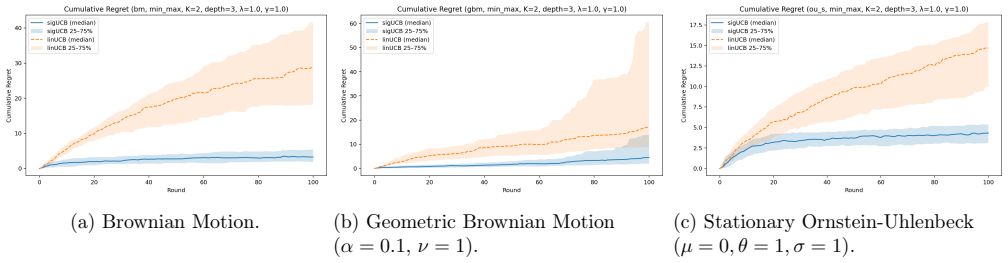
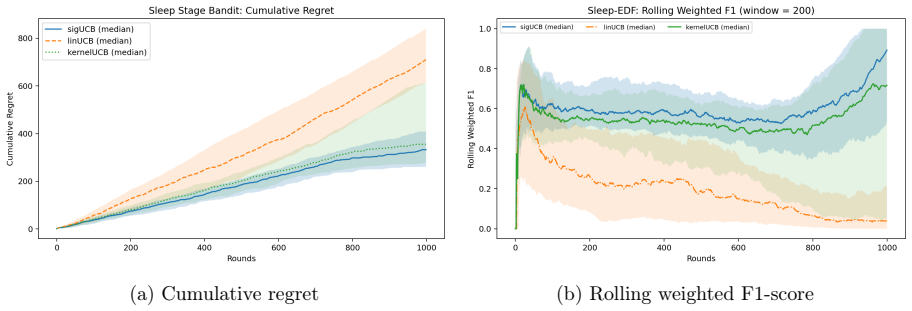
If DisSigUCB fails to achieve lower regret than linear UCB or kernel methods on problems with genuinely nonlinear path-dependent rewards, or if the observed regret exceeds the stated scaling with (d + m), the practical utility of the approximation would be in doubt.
Figures




read the original abstract
We study contextual bandits with nonlinear and path-dependent rewards through a novel signature-transform-based approach. Leveraging the universal nonlinearity property of signatures, we approximate continuous path-dependent reward functionals by linear functionals in the signature space. This representation enables the use of efficient linear contextual bandit methods while preserving expressive sequential structure. Building on this framework, we propose \texttt{DisSigUCB}, a signature-based disjoint upper confidence bound (UCB) algorithm. Under boundedness and non-degeneracy assumptions, we prove a high-probability data-dependent sublinear regret bound of order \(\tilde{\mathcal O}(\sqrt{(d+m)KT})\) where \(d\) is the context dimension and \(m\) is the signature feature dimension. Synthetic experiments and numerical applications on temperature sensor monitoring, sleep-stage classification, and hospital nurse staffing demonstrate that \texttt{DisSigUCB} consistently outperforms classical linear and kernelized contextual bandit baselines in nonlinear and path-dependent settings.
Editorial analysis
A structured set of objections, weighed in public.
Referee Report
Summary. The manuscript proposes a signature-transform approach for contextual bandits with nonlinear path-dependent rewards. It uses the universal approximation property of (truncated) signatures to represent the reward as a linear functional over an m-dimensional signature feature space, enabling application of linear UCB methods. The DisSigUCB algorithm is introduced as a disjoint UCB variant in the lifted (d+m)-dimensional space. Under boundedness and non-degeneracy assumptions on the reward functionals and signature features, a high-probability data-dependent sublinear regret bound of order Õ(√((d+m)KT)) is claimed. Synthetic experiments and applications to temperature sensor monitoring, sleep-stage classification, and hospital nurse staffing show consistent outperformance versus linear and kernelized baselines.
Significance. If the regret analysis fully accounts for signature truncation error while preserving sublinearity, the work would provide a theoretically grounded extension of linear bandit algorithms to expressive path-dependent settings, with the data-dependent bound and empirical results on temporal tasks offering practical value in sequential decision-making with nonlinear dynamics.
major comments (1)
- [Abstract and regret analysis] Abstract and regret analysis (presumably §4 or Theorem 1): The claimed high-probability regret bound Õ(√((d+m)KT)) is asserted for the original nonlinear path-dependent reward, yet the derivation applies standard linear UCB analysis only to the signature-lifted linear approximation. No decomposition or bound appears for the per-step approximation bias |r(true path) - linear(signature features)|; if this residual is not shown to be sufficiently small (e.g., o(1/√T) in aggregate via the non-degeneracy assumption or explicit truncation control), the cumulative error can reach O(T) and destroy sublinearity. This directly undermines the central claim for the true reward.
minor comments (2)
- [Notation and preliminaries] The distinction between the truncation level of the signature and the resulting feature dimension m should be stated explicitly in the notation section to avoid ambiguity when m appears in both the algorithm and the regret bound.
- [Experiments] In the experimental section, reporting standard errors or confidence intervals alongside the average regret curves would strengthen the claim of consistent outperformance.
Simulated Author's Rebuttal
We thank the referee for the thorough review and for identifying this important gap in the regret analysis. We address the concern point-by-point below and will revise the manuscript accordingly.
read point-by-point responses
-
Referee: [Abstract and regret analysis] Abstract and regret analysis (presumably §4 or Theorem 1): The claimed high-probability regret bound Õ(√((d+m)KT)) is asserted for the original nonlinear path-dependent reward, yet the derivation applies standard linear UCB analysis only to the signature-lifted linear approximation. No decomposition or bound appears for the per-step approximation bias |r(true path) - linear(signature features)|; if this residual is not shown to be sufficiently small (e.g., o(1/√T) in aggregate via the non-degeneracy assumption or explicit truncation control), the cumulative error can reach O(T) and destroy sublinearity. This directly undermines the central claim for the true reward.
Authors: We agree that the current presentation does not contain an explicit decomposition of the total regret into the signature approximation bias and the linear UCB regret term on the lifted features. The non-degeneracy assumption ensures that the signature map is injective and that the linear functional in signature space can represent the reward arbitrarily well for sufficiently large truncation level, but it does not directly quantify the per-step bias for a fixed finite m. Consequently, the claimed Õ(√((d+m)KT)) bound is rigorously established only for the approximated linear reward in signature space; extending it to the original nonlinear path-dependent reward requires an additional argument controlling the cumulative approximation error. We will revise §4 and Theorem 1 to include a regret decomposition Regret(T) ≤ approximation error + linear UCB regret, bound the approximation term using the boundedness assumption on the reward functional together with the universal approximation property of truncated signatures, and state the resulting bound explicitly (which will generally contain an additive term that vanishes as m increases). This revision will also update the abstract to reflect the precise setting under which the stated rate holds. revision: yes
Circularity Check
No significant circularity; bound follows from standard linear UCB on signature-lifted space
full rationale
The derivation lifts the nonlinear path-dependent reward to a linear functional over signature features using the known universal approximation property of signatures, then invokes the standard high-probability regret analysis for linear contextual bandits in dimension d+m. The resulting Õ(√((d+m)KT)) bound is the direct, non-circular consequence of this lifting plus existing linear-bandit theory under the stated external boundedness and non-degeneracy assumptions. No step reduces by definition to its own output, renames a fitted quantity as a prediction, or relies on a load-bearing self-citation chain; the paper is self-contained against external benchmarks for the linear case.
Axiom & Free-Parameter Ledger
free parameters (1)
- signature feature dimension m
axioms (1)
- domain assumption Boundedness and non-degeneracy of reward functionals and signature features
Lean theorems connected to this paper
-
IndisputableMonolith/Foundation/AbsoluteFloorClosure.lean (distinction forcing)reality_from_one_distinction unclear?
unclearRelation between the paper passage and the cited Recognition theorem.
Under boundedness and non-degeneracy assumptions... signature pruning... non-stationary covariance
What do these tags mean?
- matches
- The paper's claim is directly supported by a theorem in the formal canon.
- supports
- The theorem supports part of the paper's argument, but the paper may add assumptions or extra steps.
- extends
- The paper goes beyond the formal theorem; the theorem is a base layer rather than the whole result.
- uses
- The paper appears to rely on the theorem as machinery.
- contradicts
- The paper's claim conflicts with a theorem or certificate in the canon.
- unclear
- Pith found a possible connection, but the passage is too broad, indirect, or ambiguous to say the theorem truly supports the claim.
Reference graph
Works this paper leans on
-
[1]
Y. Abbasi-yadkori, D. Pál, and C. Szepesvári. Improved algorithms for linear stochastic bandits. InAdvances in Neural Information Processing Systems, volume 24. Curran Associates, Inc., 2011
work page 2011
-
[2]
S. Agrawal and N. Goyal. Thompson sampling for contextual bandits with linear payoffs. InProceedings of the 30th International Conference on Machine Learning, volume 28 ofProceedings of Machine Learning Research, pages 127–135, Atlanta, Georgia, USA, 17–19 Jun 2013. PMLR
work page 2013
- [3]
-
[4]
I. P. Arribas. Derivatives pricing using signature payoffs, 2018
work page 2018
-
[5]
P. Bonnier, P. Kidger, I. Perez Arribas, C. Salvi, and T. Lyons. Deep signature transforms.arXiv preprint arXiv:1905.08494, 2019
- [6]
-
[7]
O. Chapelle and L. Li. An empirical evaluation of thompson sampling. In J. Shawe-Taylor, R. Zemel, P. Bartlett, F. Pereira, and K. Weinberger, editors,Advances in Neural Information Processing Systems, volume 24. Curran Associates, Inc., 2011
work page 2011
-
[8]
N. Chatterji, V. Muthukumar, and P. Bartlett. Osom: A simultaneously optimal algorithm for multi-armed and linear contextual bandits. InProceedings of the Twenty Third International Conference on Artificial Intelligence and Statistics, volume 108 ofProceedings of Machine Learning Research, pages 1844–1854. PMLR, 26–28 Aug 2020
work page 2020
-
[9]
K.-T. Chen. Iterated integrals and exponential homomorphisms†.Proceedings of the London Mathematical Society, s3-4(1):502–512, 01 1954
work page 1954
-
[10]
K.-T. Chen. Integration of paths, geometric invariants and a generalized baker- hausdorff formula.Annals of Mathematics, 65(1):163–178, 1957
work page 1957
-
[11]
I. Chevyrev and A. Kormilitzin.A Primer on the Signature Method in Machine Learning, page 3–64. Springer Nature Switzerland, Jun 2025
work page 2025
-
[12]
S. R. Chowdhury and A. Gopalan. On kernelized multi-armed bandits. InProceedings of the 34th International Conference on Machine Learning, volume 70 ofProceedings of Machine Learning Research, pages 844–853. PMLR, 06–11 Aug 2017
work page 2017
-
[13]
W. Chu, L. Li, L. Reyzin, and R. Schapire. Contextual bandits with linear payoff functions. InProceedings of the Fourteenth International Conference on Artificial Intelligence and Statistics, volume 15 ofProceedings of Machine Learning Research, pages 208–214, Fort Lauderdale, FL, USA, 11–13 Apr 2011. PMLR. 24
work page 2011
-
[14]
M. C. Cohen, I. Lobel, and R. Paes Leme. Feature-based dynamic pricing.Management Science, 66(11):4921–4943, 2020
work page 2020
-
[15]
C. Cuchiero, G. Gazzani, and S. Svaluto-Ferro. Signature-based models: Theory and calibration.SIAM Journal on Financial Mathematics, 14(3):910–957, 2023
work page 2023
- [16]
-
[17]
S. Filippi, O. Cappe, A. Garivier, and C. Szepesvári. Parametric bandits: The generalized linear case. In Advances in Neural Information Processing Systems, volume 23. Curran Associates, Inc., 2010
work page 2010
-
[18]
P. Friz and N. B. Victoir.Multidimensional Stochastic Processes as Rough Paths: Theory and Applications. Cambridge University Press, 2010
work page 2010
-
[19]
H. Gu, X. Guo, T. L. Jacobs, P. Kaminsky, and X. Li. Transportation marketplace rate forecast using signature transform, 2024
work page 2024
-
[20]
C. Huang and K. Wang. A stability principle for learning under nonstationarity.Operations Research, 73(6):3044– 3064, 2025
work page 2025
- [21]
- [22]
-
[23]
B. Kemp, A. Zwinderman, B. Tuk, H. Kamphuisen, and J. Oberye. Analysis of a sleep-dependent neuronal feedback loop: the slow-wave microcontinuity of the eeg.IEEE Transactions on Biomedical Engineering, 47(9):1185–1194, 2000
work page 2000
-
[24]
N. B. Keskin, X. Min, and J.-S. J. Song. The nonstationary newsvendor: Data-driven nonparametric learning. Ssrn working paper, SSRN, Nov. 2025
work page 2025
-
[25]
F. J. Király and H. Oberhauser. Kernels for sequentially ordered data.Journal of Machine Learning Research, 20(31):1–45, 2019
work page 2019
-
[26]
A. Krause and C. Ong. Contextual gaussian process bandit optimization. InAdvances in Neural Information Processing Systems, volume 24. Curran Associates, Inc., 2011
work page 2011
-
[27]
C. Li, X. Zhang, and L. Jin. Lpsnet: a novel log path signature feature based hand gesture recognition framework. InProceedings of the IEEE international conference on computer vision workshops, pages 631–639, 2017
work page 2017
-
[28]
L. Li, W. Chu, J. Langford, and R. E. Schapire. A contextual-bandit approach to personalized news article recommendation. InProceedings of the 19th international conference on World wide web, page 661–670. ACM, Apr. 2010
work page 2010
-
[29]
L. Li, Y. Lu, and D. Zhou. Provably optimal algorithms for generalized linear contextual bandits. InProceedings of the 34th International Conference on Machine Learning, volume 70 ofProceedings of Machine Learning Research, pages 2071–2080. PMLR, 06–11 Aug 2017
work page 2071
-
[30]
T. Lu, D. Pal, and M. Pal. Contextual multi-armed bandits. In Y. W. Teh and M. Titterington, editors, Proceedings of the Thirteenth International Conference on Artificial Intelligence and Statistics, volume 9 of Proceedings of Machine Learning Research, pages 485–492, Chia Laguna Resort, Sardinia, Italy, 13–15 May 2010. PMLR
work page 2010
- [31]
-
[32]
T. Lyons and N. Victoir. An extension theorem to rough paths.Annales de l’Institut Henri Poincaré C, Analyse non linéaire, 24(5):835–847, 2007. 25
work page 2007
-
[33]
T. J. Lyons. Differential equations driven by rough signals.Revista Matemática Iberoamericana, 14(2):215–310, 1998
work page 1998
- [34]
-
[35]
J. Morrill, A. Fermanian, P. Kidger, and T. Lyons. A generalised signature method for multivariate time series feature extraction.arXiv preprint arXiv:2006.00873, 2020
-
[36]
EpiQuery: Syndromic Surveillance Data – Vomit- ing
New York City Department of Health and Mental Hygiene. EpiQuery: Syndromic Surveillance Data – Vomit- ing. https://a816-health.nyc.gov/hdi/epiquery/visualizations?Indicator=Vomiting&PageType=tsi& PopulationSource=Syndromic&Subtopic=All&Topic=All, 2026
work page 2026
-
[37]
J. A. Tropp. Freedman’s inequality for matrix martingales, 2011
work page 2011
- [38]
-
[39]
Y. Wu, H. Ni, T. J. Lyons, and R. L. Hudson. Signature features with the visibility transformation, 2020
work page 2020
-
[40]
W. Yang, L. Jin, H. Ni, and T. Lyons. Rotation-free online handwritten character recognition using dyadic path signature features, hanging normalization, and deep neural network. In2016 23rd International Conference on Pattern Recognition (ICPR), pages 4083–4088, 2016
work page 2016
-
[41]
Z. Zhou, R. Xu, and J. Blanchet. Learning in generalized linear contextual bandits with stochastic delays. In Advances in Neural Information Processing Systems, volume 32. Curran Associates, Inc., 2019. 26
work page 2019
discussion (0)
Sign in with ORCID, Apple, or X to comment. Anyone can read and Pith papers without signing in.