Recognition: no theorem link
Mapping Partisan Fault Lines Within DAOs
Pith reviewed 2026-05-12 05:19 UTC · model grok-4.3
The pith
Voting patterns in DAOs reveal future forks by showing partisan address clusters months ahead.
A machine-rendered reading of the paper's core claim, the machinery that carries it, and where it could break.
Core claim
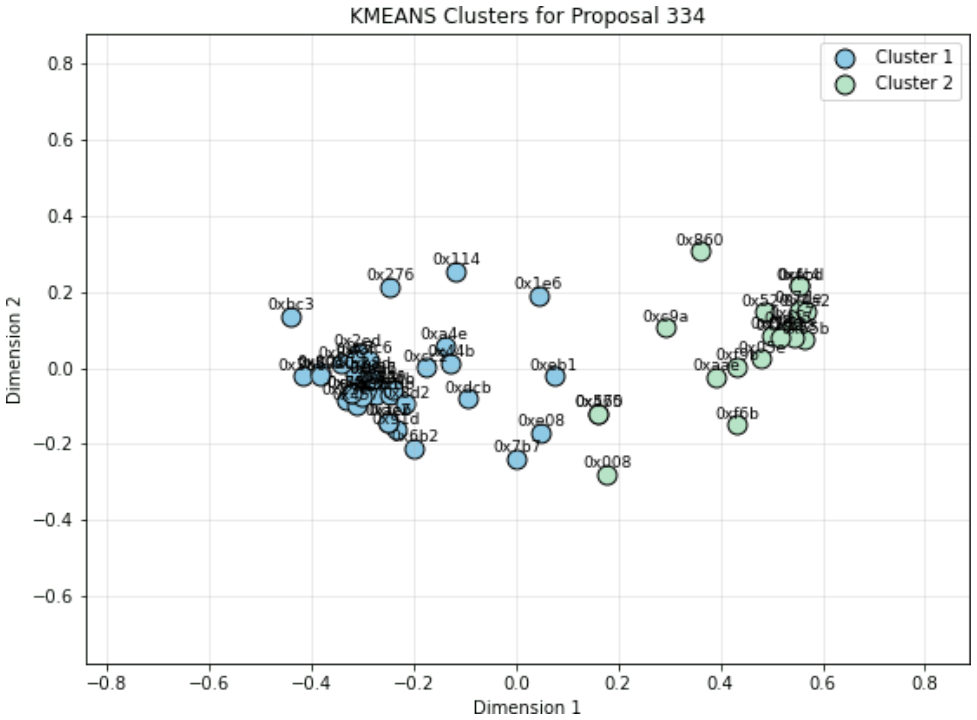
The paper establishes that in Nouns DAO, addresses that later fork can be identified as a cluster through their voting participation patterns months before the fragmentation event. Across 330 proposals, 90% of these fork addresses group together when dissimilarity analysis is restricted to the final 44 proposals, a rate far above the 47% seen in randomized data. The process relies on constructing voter matrices from on-chain records, quantifying ideological divergence via pairwise dissimilarity, and using k-means clustering to isolate the groups.
What carries the argument
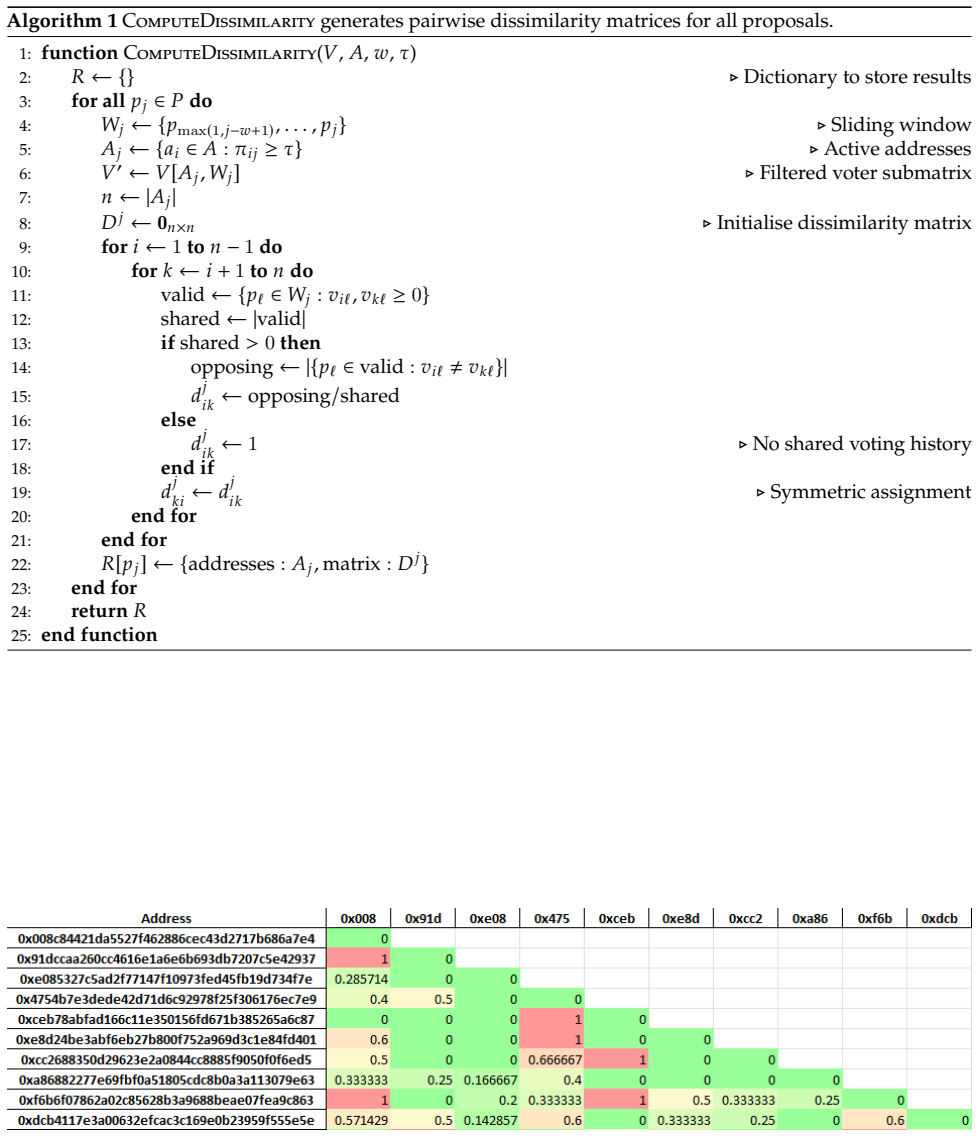
Pairwise dissimilarity computed from voter matrices that encode address participation across proposals, which quantifies divergence and feeds into multidimensional scaling and k-means clustering for community detection.
Load-bearing premise
That patterns of voting participation reliably reflect ideological differences rather than being driven by proposal timing, topic, or differences in voter activity.
What would settle it
Re-running the clustering on the Nouns DAO data and finding that fork addresses do not cluster at rates significantly above random would show the method fails to detect real partisan groups.
Figures





read the original abstract
Decentralised Autonomous Organisations (DAO) can fragment when partisan communities emerge within their governance structures, leading to organisational splits known as "forks". We present a method to detect these emerging communities by analysing on-chain voting behaviour before fragmentation occurs. Our approach extracts voting events from governance smart contracts, constructs voter matrices encoding participation patterns, and applies pairwise dissimilarity analysis to quantify ideological divergence between addresses. We visualise these relationships using multidimensional scaling and identify partisan communities through k-means clustering with silhouette score optimisation. Using Nouns DAO as a case study, a protocol that has experienced multiple documented forks, we demonstrate that addresses destined to fork cluster together months before actual fragmentation events. Our analysis of 330 proposals spanning from contract deployment to the first major fork shows that 90% of fork addresses cluster together in the final 44 proposals, compared to only 47% in randomised data. These results indicate that partisan communities can be detected and visualised through on-chain governance analysis, offering early warnings of emerging divisions before they cause organisational fragmentation.
Editorial analysis
A structured set of objections, weighed in public.
Referee Report
Summary. The paper introduces a method to detect emerging partisan communities in DAOs prior to forks by extracting on-chain voting events, building voter participation matrices, computing pairwise dissimilarities, applying MDS for visualization, and performing k-means clustering with silhouette optimization. In the Nouns DAO case study (330 proposals up to the first major fork), it reports that 90% of fork-destined addresses cluster together in the final 44 proposals versus 47% under randomized label shuffling, interpreting this as evidence of detectable ideological fault lines months in advance.
Significance. If the clustering reliably isolates ideological divergence, the approach could supply an early-warning system for DAO fragmentation with direct relevance to governance design in blockchain protocols. The use of verifiable on-chain data from a DAO with documented forks, together with an explicit randomized baseline, constitutes a reproducible empirical demonstration that strengthens the contribution over purely theoretical treatments.
major comments (3)
- [Methods (voter matrices and dissimilarity)] Methods section on voter-matrix construction and pairwise dissimilarity: the exact dissimilarity function (e.g., Jaccard, cosine, or Euclidean on binary/count vectors) and any per-address normalization for total activity or proposal timing are not specified. This detail is load-bearing for the central claim, because unnormalized participation patterns can induce clustering from activity volume or temporal overlap rather than partisan alignment, as the skeptic correctly notes.
- [Results (clustering statistics)] Results section reporting the 90% vs. 47% figures: the randomized baseline only permutes fork labels uniformly; it does not test whether the observed clustering survives controls for proposal timing, topic, or overlapping voter subsets. Without such checks (e.g., time-windowed permutation or stratification by proposal type), the comparison fails to rule out confounding structure preserved in the real vote matrix.
- [Data and case study] Data and labeling description: the criteria used to identify and label the set of 'fork addresses' are not stated, nor is any robustness analysis against alternative labelings or selection bias. This information is required to evaluate whether the 90% figure is an artifact of how the ground-truth set was defined.
minor comments (2)
- [Abstract] Abstract: the phrase 'months before' should be accompanied by the precise calendar interval between the final 44 proposals and the fork event.
- [Figures] Figure captions for MDS plots: ensure fork addresses and cluster assignments are explicitly marked and that axis scales are reported.
Simulated Author's Rebuttal
We thank the referee for their thoughtful and constructive report. The comments identify important areas for improving methodological transparency and robustness. We address each point below and will revise the manuscript to incorporate the requested clarifications and additional analyses.
read point-by-point responses
-
Referee: Methods section on voter-matrix construction and pairwise dissimilarity: the exact dissimilarity function (e.g., Jaccard, cosine, or Euclidean on binary/count vectors) and any per-address normalization for total activity or proposal timing are not specified. This detail is load-bearing for the central claim, because unnormalized participation patterns can induce clustering from activity volume or temporal overlap rather than partisan alignment, as the skeptic correctly notes.
Authors: We agree that explicit specification of the dissimilarity measure and any normalization is essential for reproducibility and to rule out alternative explanations. The current manuscript describes the construction of binary voter participation matrices but does not name the precise dissimilarity function. In the revised version we will add a dedicated subsection detailing that pairwise dissimilarities are computed using Jaccard distance on the binary vectors (with no per-address activity normalization or timing adjustment), and we will include a short justification of why this choice focuses on participation overlap rather than volume. revision: yes
-
Referee: Results section reporting the 90% vs. 47% figures: the randomized baseline only permutes fork labels uniformly; it does not test whether the observed clustering survives controls for proposal timing, topic, or overlapping voter subsets. Without such checks (e.g., time-windowed permutation or stratification by proposal type), the comparison fails to rule out confounding structure preserved in the real vote matrix.
Authors: The uniform label permutation establishes that the observed clustering is unlikely under random assignment of fork status. However, we acknowledge that it does not address potential temporal or topical structure in the vote matrix. We will therefore augment the Results section with two additional controls: (1) a time-windowed permutation test that preserves proposal order within sliding windows, and (2) stratification by proposal category (e.g., treasury, parameter changes). These will be reported alongside the original baseline. revision: yes
-
Referee: Data and labeling description: the criteria used to identify and label the set of 'fork addresses' are not stated, nor is any robustness analysis against alternative labelings or selection bias. This information is required to evaluate whether the 90% figure is an artifact of how the ground-truth set was defined.
Authors: We agree that the precise criteria for designating fork addresses must be stated explicitly. The manuscript currently refers to 'addresses destined to fork' without detailing the on-chain identification rule. In revision we will add a clear description of the labeling procedure (addresses that participated in the fork-related proposal and subsequently moved to the forked contract) together with a sensitivity analysis using two alternative definitions: (a) stricter participation threshold and (b) inclusion of addresses that only signaled intent via forum posts. This will demonstrate that the 90% clustering result is not sensitive to the exact labeling choice. revision: yes
Circularity Check
No circularity: empirical comparison to randomized null model
full rationale
The paper extracts on-chain voting events into voter-participation matrices, computes pairwise dissimilarity, applies MDS and k-means, then reports the empirical fraction of known fork addresses that fall into the resulting cluster (90% in final 44 proposals) versus a randomized baseline (47%). This is a direct data-driven comparison with no equations, fitted parameters, or self-citations that reduce the reported percentages to the input data by construction. The dissimilarity and clustering steps are standard unsupervised techniques; the randomization supplies an external null that is not derived from the same fitted structure. The analysis is therefore self-contained against the on-chain records.
Axiom & Free-Parameter Ledger
free parameters (2)
- number of clusters k
- dissimilarity metric
axioms (1)
- domain assumption Similarity in on-chain voting records reflects underlying partisan or ideological alignment that precedes organizational forks.
Reference graph
Works this paper leans on
-
[1]
A. Amelio and C. Pizzuti. Mining and analyzing the Italian parliament: Party structure and evolution. InRecommendation and Search in Social Networks, pages 249–279. Springer, 2015. ISBN 9783319364803. doi: 10.1007/978-3-319-14379-8_12
-
[2]
J. Austgen, A. Fábrega, S. Allen, K. Babel, M. Kelkar, and A. Juels. DAO decentralization: Voting-bloc entropy, bribery, and Dark DAOs./external-link-square-althttps://arxiv.org/abs/2311.03530, 2023
-
[3]
H. Axelsen, J. R. Jensen, and O. Ross. When is a DAO decentralized?Complex Systems Informatics and Modeling Quarterly, 176(31):51–75, 2022. doi: 10.7250/csimq.2022-31.04. 12
-
[4]
C. Bellavitis, C. Fisch, and P. P. Momtaz. The rise of decentralized autonomous organizations (DAOs): A first empirical glimpse.V enture Capital: An International Journal of Entrepreneurial Finance, 25(2):187–203, 2023
work page 2023
- [5]
-
[6]
R. Feichtinger, R. Fritsch, Y. Vonlanthen, and R. Wattenhofer. The hidden shortcomings of (D)AOs —- An empirical study of on-chain governance. InFinancial Cryptography and Data Security (FC), 2023
work page 2023
-
[7]
R. Feichtinger, R. Fritsch, L. Heimbach, Y. Vonlanthen, and R. Wattenhofer. SoK: Attacks on DAOs. /external-link-square-althttps://arxiv.org/abs/2406.15071, 2024
-
[8]
R. Fritsch, M. Müller, and R. Wattenhofer. Analyzing voting power in decentralized governance: Who controls DAOs?Blockchain: Research and Applications, 5(3):100208, 2024
work page 2024
-
[9]
T. Lloyd, D. Ó Broin, and M. Harrigan. The on-chain and off-chain mechanisms of DAO-to-DAO voting. InThe IEEE International Conference on Blockchain (BLOCKCHAIN), pages 649–655. IEEE, 2024. doi: 10.1109/BLOCKCHAIN62396.2024.00095
-
[10]
T. Lloyd, D. Ó Broin, and M. Harrigan. Mapping partisan fault lines within DAOs. InThe IEEE International Conference on Blockchain (BLOCKCHAIN), pages 38–45. IEEE, 2025. doi: 10.1109/BLOCKCHAIN67634.2025. 00015
-
[11]
V. Mickevicius, T. Krilavicius, and V. Morkevicius. Analysing voting behavior of the Lithuanian parliament using cluster analysis and multidimensional scaling: Technical aspects. InThe International Conference on Electrical and Control T echnologies (ECT), pages 84–89, 2014
work page 2014
-
[12]
Y. Quan, X. Wu, W. Deng, and L. Zhang. Decoding social sentiment in DAOs: A comparative analysis of blockchain governance communities. InThe IEEE International Conference on Software Quality, Reliability, and Security Companion (QRS-C), pages 216–224, 2024
work page 2024
-
[13]
W. Reijers, I. Wuisman, M. Mannan, P. D. Filippi, C. Wray, V. Rae-Looi, A. C. Vélez, and L. Orgad. Now the code runs itself: On-chain and off-chain governance of blockchain technologies.T opoi: An International Review of Philosophy, 2018. doi: 10.1007/s11245-018-9626-5
-
[14]
Sky (formerly MakerDAO)./external-link-square-althttps://sky.money/, n.d
- [15]
discussion (0)
Sign in with ORCID, Apple, or X to comment. Anyone can read and Pith papers without signing in.