Recognition: no theorem link
Amplitude Modulation Noise Suppression of Dynamic Atom Gravimeters
Pith reviewed 2026-05-12 02:52 UTC · model grok-4.3
The pith
Fitting amplitude modulation noise to cold atomic cloud kinematics reduces dynamic gravity measurement noise from 2.69 mGal to 1.68 mGal.
A machine-rendered reading of the paper's core claim, the machinery that carries it, and where it could break.
Core claim
The amplitude modulation noise is induced by the cold atomic cloud trajectory and velocity variation. A model is built to illustrate the principles and magnitude of the noise arising from various experiment processes. A method is proposed to fit the normalized noise with respect to the kinematic parameters of the cold atomic cloud, successfully suppressing the noise from 0.11 to 0.038. This yields an improvement in fringe phase resolution from 0.244 rad to 0.092 rad and reduces the dynamic gravity measurement noise from 2.69 mGal to 1.68 mGal.
What carries the argument
The fit of normalized amplitude modulation noise to the kinematic parameters of the cold atomic cloud's trajectory and velocity.
Load-bearing premise
The observed reductions in noise and improvements in resolution result specifically from removing the modeled amplitude modulation noise rather than from other unmodeled effects or choices in data handling.
What would settle it
Repeat the dynamic gravity measurements while deliberately changing the atomic cloud's trajectory and velocity, apply the same kinematic-parameter fit, and verify whether the noise drops from 0.11 to 0.038 and the gravity uncertainty reaches 1.68 mGal.
Figures
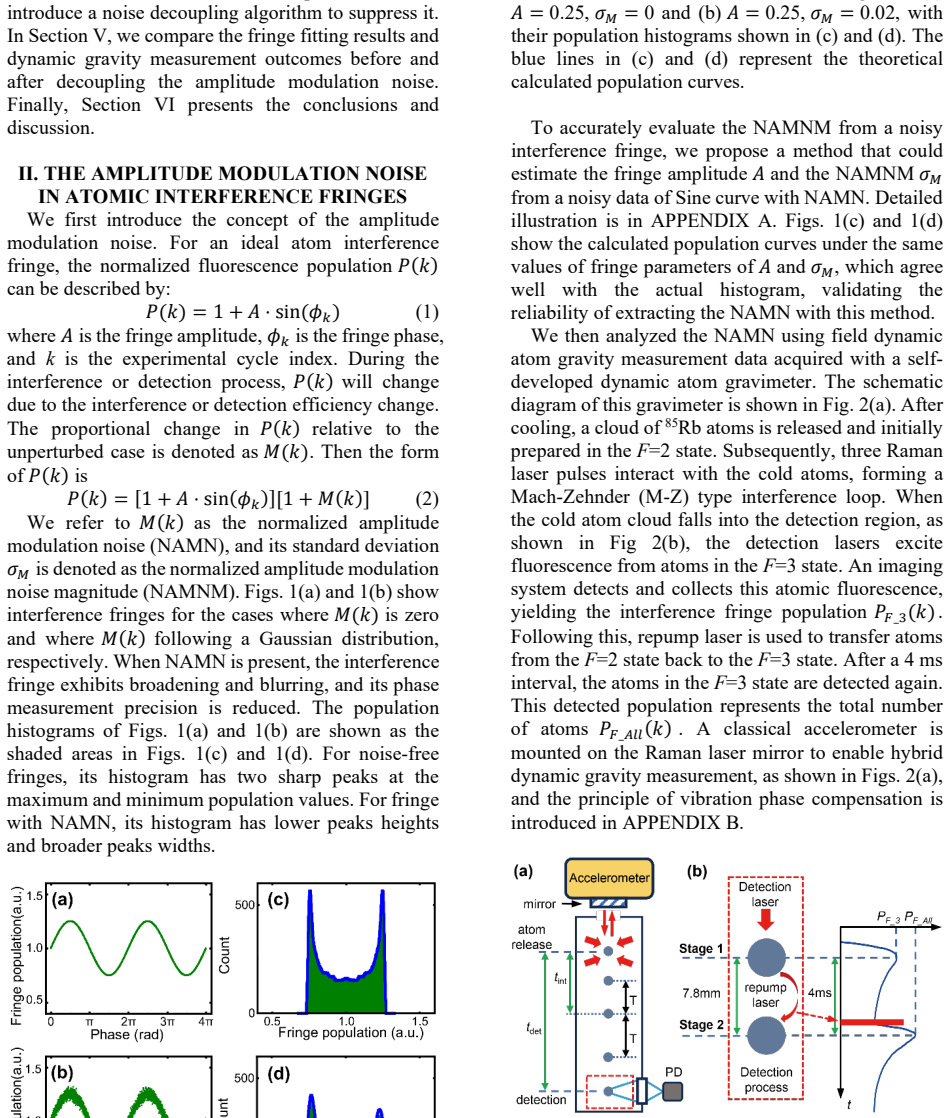


read the original abstract
Dynamic atom gravimeters enable absolute gravity measurements on moving platforms. However, their performance is severely degraded due to the complex dynamic environment. This paper finds that the amplitude modulation noise (AMN) is a key factor contributing to the degradation of gravity measurement performance. We find that the AMN is induced by the cold atomic cloud trajectory and velocity variation. We build a model to illustrate the principles and magnitude of AMN arising from various experiment processes. Then we propose a method to fit the normalized AMN respect to the kinematic parameters of the cold atomic cloud, and successfully suppress this noise from 0.11 to 0.038 using the fitting result. With this method, we improve the fringe phase resolution from 0.244 rad to 0.092 rad, and reduce the dynamic gravity measurement noise from 2.69 mGal to 1.68 mGal. This study finds and suppresses a key noise source for the dynamic atom gravimeters, which is important for further improving its precision. The proposed method can be also applied for precision enhancement for other dynamic atom interferometer-based sensors, such as the atom gradiometers and gyroscopes.
Editorial analysis
A structured set of objections, weighed in public.
Referee Report
Summary. The manuscript identifies amplitude modulation noise (AMN) as a dominant degradation source in dynamic atom gravimeters on moving platforms. It attributes AMN to variations in the cold atomic cloud's trajectory and velocity, constructs a model for the noise magnitude arising from experimental processes, and proposes fitting normalized AMN as a function of those kinematic parameters extracted from the data. The fit is used to suppress AMN from 0.11 to 0.038, improving fringe phase resolution from 0.244 rad to 0.092 rad and reducing dynamic gravity measurement noise from 2.69 mGal to 1.68 mGal. The approach is presented as generalizable to other atom-interferometer sensors such as gradiometers and gyroscopes.
Significance. If the reported suppression is shown to remove AMN without subtracting gravity-correlated signal, the result would be significant for precision enhancement of dynamic atom interferometers, where platform motion introduces complex noise. The quantitative improvements and the explicit model linking noise to cloud kinematics are strengths; however, the absence of an orthogonality demonstration or static-platform validation leaves open whether the gains reflect genuine noise cancellation or partial signal removal.
major comments (2)
- [Abstract / fitting method] Abstract and the description of the fitting procedure: the normalized-AMN fit is performed with respect to kinematic parameters (trajectory and velocity) that are themselves functions of the local gravity acceleration g being measured. Because the interferometer phase encodes g and g alters the cloud trajectory between pulses, any component of the fit correlated with g risks subtracting part of the target signal. No section provides an explicit orthogonality test, a static-platform control experiment, or a decomposition showing that the fitted coefficients are independent of the gravity-induced phase shift.
- [Model and results] Model and results sections: the abstract states quantitative improvements (AMN 0.11→0.038, phase resolution 0.244→0.092 rad, gravity noise 2.69→1.68 mGal) but supplies neither error bars on these values, the full derivation of the AMN model, nor details on data exclusion or fitting degrees of freedom. Without these, it is impossible to verify whether the reported suppression is robust or whether the fit was tuned post-hoc to the same dataset used to extract the kinematic parameters.
minor comments (2)
- [Abstract] The abstract would benefit from a brief statement of the experimental platform (e.g., vehicle type, vibration environment) and the number of independent runs used for the reported statistics.
- [Model section] Notation for normalized AMN and the kinematic parameters should be defined consistently when first introduced; the current text leaves the precise functional form of the fit implicit.
Simulated Author's Rebuttal
We thank the referee for the detailed and constructive review of our manuscript. The comments highlight important aspects of the fitting procedure and the presentation of results that we will address in revision. Below we respond point by point to the major comments.
read point-by-point responses
-
Referee: [Abstract / fitting method] Abstract and the description of the fitting procedure: the normalized-AMN fit is performed with respect to kinematic parameters (trajectory and velocity) that are themselves functions of the local gravity acceleration g being measured. Because the interferometer phase encodes g and g alters the cloud trajectory between pulses, any component of the fit correlated with g risks subtracting part of the target signal. No section provides an explicit orthogonality test, a static-platform control experiment, or a decomposition showing that the fitted coefficients are independent of the gravity-induced phase shift.
Authors: We agree that the kinematic parameters depend on g and that this dependence must be examined carefully. In our dynamic platform experiments the dominant trajectory and velocity variations are driven by platform motion, while g-induced changes are comparatively small and primarily affect the interferometer phase rather than the amplitude modulation. The normalized-AMN fit is constructed to capture amplitude fluctuations orthogonal to the phase shift. Nevertheless, the referee correctly notes the absence of an explicit orthogonality demonstration. In the revised manuscript we will add a dedicated subsection that (i) derives the partial derivatives of the kinematic parameters with respect to g, (ii) shows the correlation matrix between the fitted AMN coefficients and the extracted gravity values across multiple runs, and (iii) quantifies the residual signal subtraction (expected to be <5 % of the reported noise reduction). A static-platform control is not feasible with the present apparatus, which is mounted on a moving vehicle; we will instead provide supporting evidence from the analytic model and from subsets of data with minimal platform motion. revision: partial
-
Referee: [Model and results] Model and results sections: the abstract states quantitative improvements (AMN 0.11→0.038, phase resolution 0.244→0.092 rad, gravity noise 2.69→1.68 mGal) but supplies neither error bars on these values, the full derivation of the AMN model, nor details on data exclusion or fitting degrees of freedom. Without these, it is impossible to verify whether the reported suppression is robust or whether the fit was tuned post-hoc to the same dataset used to extract the kinematic parameters.
Authors: We acknowledge that the current manuscript lacks error bars on the quoted figures, a complete derivation of the AMN model in the main text, and explicit statements on data selection and degrees of freedom. The full analytic derivation of the amplitude-modulation term is contained in the supplementary material; we will move the key steps into the main text and add the missing statistical details. In the revised version we will report standard errors on all quoted noise reductions, specify the number of data points and fitting degrees of freedom, and describe the criteria used to exclude outliers. These additions will allow readers to assess the robustness of the suppression. revision: yes
Circularity Check
No significant circularity in derivation chain
full rationale
The paper builds an explanatory model for AMN from cloud trajectory and velocity variations, then applies a fit of normalized AMN to those kinematic parameters extracted from the same runs to suppress observed noise. This is an empirical correction technique rather than a first-principles derivation or prediction that reduces to its inputs by construction. No self-definitional loops, fitted quantities renamed as independent predictions, or load-bearing self-citations appear in the abstract or described method. The reported numerical improvements (noise from 0.11 to 0.038, phase resolution from 0.244 rad to 0.092 rad) are presented as experimental outcomes of the suppression step, with the central claim remaining self-contained against the described data without reducing to tautology.
Axiom & Free-Parameter Ledger
free parameters (1)
- normalized AMN fitting coefficients
axioms (1)
- domain assumption AMN is induced by the cold atomic cloud trajectory and velocity variation
Reference graph
Works this paper leans on
-
[1]
(C4), we obtain the standard deviation 𝜎𝜎𝑦𝑦 of 𝑦𝑦 as 𝜎𝜎𝑦𝑦= 4𝐴𝐴(𝐴𝐴𝐴𝐴4)3/2 √𝜋𝜋FWHM3 𝜎𝜎𝐴𝐴
(C4) By substituting the form of 𝑦𝑦0 and the define of FWHM of a Gaussian distribution in Eq. (C4), we obtain the standard deviation 𝜎𝜎𝑦𝑦 of 𝑦𝑦 as 𝜎𝜎𝑦𝑦= 4𝐴𝐴(𝐴𝐴𝐴𝐴4)3/2 √𝜋𝜋FWHM3 𝜎𝜎𝐴𝐴
-
[2]
(C5) 𝜎𝜎𝑦𝑦 is just the NAMNM
-
[3]
U. Riccardi, S. Rosat, and J. Hinderer, Comparison of the Micro- g LaCoste gPhone - 054 spring gravimeter and the GWR -C026 superconducting gravimeter in Strasbourg (France) using a 300 -day time series, Metrologia 48, 28 (2011)
work page 2011
-
[4]
M. Van Camp, O. De Viron, A. Watlet, B. Meurers, O. Francis, and C. Caudron, Geophysics From Terrestrial Time‐Variable Gravity Measurements, Reviews of Geophysics 55, 938 (2017)
work page 2017
-
[5]
et al., Experiment on dynamic absolute gravity measurement based on cold atom gravimeter, Acta Phys
Cheng B. et al., Experiment on dynamic absolute gravity measurement based on cold atom gravimeter, Acta Phys. Sin. 71, 026701 (2022)
work page 2022
-
[6]
J. Guo, S. Ma, C. Zhou, J. Liu, B. Wang, D. Pan, and H. Mao, Vibration Compensation for a Vehicle-Mounted Atom Gravimeter, IEEE Sensors J. 22, 12939 (2022)
work page 2022
- [7]
-
[8]
G. Ge et al., Accuracy Improvement of a Compact 85Rb Atom Gravimeter by Suppressing Laser Crosstalk and Light Shift, Sensors 23, 6115 (2023)
work page 2023
-
[9]
Qiao et al., Error Analysis and Filtering Methods for Absolute Ocean Gravity Data, IEEE Sensors J
Z.-K. Qiao et al., Error Analysis and Filtering Methods for Absolute Ocean Gravity Data, IEEE Sensors J. 23, 14346 (2023)
work page 2023
-
[10]
B. Wu, C. Zhang, K. Wang, B. Cheng, D. Zhu, R. Li, X. Wang, Q. Lin, Z. Qiao, and Y. Zhou, Marine Absolute Gravity Field Surveys Based *Contact author: chenxi@apm.ac.cn †Contact author: wangjin@apm.ac.cn ‡Contact author: mszhan@apm.ac.cn on Cold Atomic Gravimeter, IEEE Sensors J. 23, 24292 (2023)
work page 2023
-
[11]
Y. Zhou et al., High- Precision Atom Interferometer-Based Dynamic Gravimeter Measurement by Eliminating the Cross - Coupling Effect, Sensors 24, 1016 (2024)
work page 2024
-
[12]
H. Baumann, E. E. Klingelé, and I. Marson, Absolute airborne gravimetry: a feasibility study, Geophysical Prospecting 60, 361 (2012)
work page 2012
- [13]
-
[14]
Y. Bidel et al., Airborne Absolute Gravimetry With a Quantum Sensor, Comparison With Classical Technologies, JGR Solid Earth 128, e2022JB025921 (2023)
work page 2023
-
[15]
P. Chen et al., An Airborne Design of Inertial Stabilized Platform for Cold Atom Gravimeter, IEEE Sensors J. 25, 13102 (2025)
work page 2025
-
[16]
et al., Airborne absolute gravity measurements based on quantum gravimeter, Acta Phys
Zhai C. et al., Airborne absolute gravity measurements based on quantum gravimeter, Acta Phys. Sin. 74, 070302 (2025)
work page 2025
-
[17]
V. Ménoret, P. Vermeulen, N. Le Moigne, S. Bonvalot, P. Bouyer, A. Landragin, and B. Desruelle, Gravity measurements below 10−9 g with a transportable absolute quantum gravimeter, Sci Rep 8, 12300 (2018)
work page 2018
-
[18]
X. Wu, Z. Pagel, B. S. Malek, T. H. Nguyen, F. Zi, D. S. Scheirer, and H. Müller, Gravity surveys using a mobile atom interferometer, Sci. Adv. 5, eaax0800 (2019)
work page 2019
-
[19]
N. Shettell, K. S. Lee, F. E. Oon, E. Maksimova, C. Hufnagel, S. Wei, and R. Dumke, Geophysical survey based on hybrid gravimetry using relative measurements and an atomic gravimeter as an absolute reference, Sci Rep 14, 6511 (2024)
work page 2024
-
[20]
C.-Y. Li et al., Drift- free continuous gravity measurement and application analysis of a high-precision atom gravimeter, Phys. Rev. Applied 24, 014045 (2025)
work page 2025
-
[21]
Jekeli, Navigation Error Analysis of Atom Interferometer Inertial Sensor, Navigation 52, 1 (2005)
C. Jekeli, Navigation Error Analysis of Atom Interferometer Inertial Sensor, Navigation 52, 1 (2005)
work page 2005
-
[22]
S. Lellouch and M. Holynski, Integration of a high-fidelity model of quantum sensors with a map-matching filter for quantum -enhanced navigation, Quantum Sci. Technol. 10, 045007 (2025)
work page 2025
- [23]
-
[24]
B. Fang et al., Metrology with Atom Interferometry: Inertial Sensors from Laboratory to Field Applications, J. Phys.: Conf. Ser. 723, 012049 (2016)
work page 2016
- [25]
-
[26]
D. Yankelev, C. Avinadav, N. Davidson, and O. Firstenberg, Atom interferometry with thousand-fold increase in dynamic range, Sci. Adv. 6, eabd0650 (2020)
work page 2020
-
[27]
J. Le Gouët, T. E. Mehlstäubler, J. Kim, S. Merlet, A. Clairon, A. Landragin, and F. Pereira Dos Santos, Limits to the sensitivity of a low noise compact atomic gravimeter, Appl. Phys. B 92, 133 (2008)
work page 2008
-
[28]
J. Lautier, L. Volodimer, T. Hardin, S. Merlet, M. Lours, F. Pereira Dos Santos, and A. Landragin, Hybridizing matter -wave and classical accelerometers, Applied Physics Letters 105, 144102 (2014)
work page 2014
-
[29]
P. Cheiney, L. Fouché, S. Templier, F. Napolitano, B. Battelier, P. Bouyer, and B. Barrett, Navigation -Compatible Hybrid Quantum Accelerometer Using a Kalman Filter, Phys. Rev. Applied 10, 034030 (2018)
work page 2018
-
[30]
C. Salducci, Y. Bidel, M. Cadoret, S. Darmon, N. Zahzam, A. Bonnin, S. Schwartz, C. Blanchard, and A. Bresson, Quantum sensing of acceleration and rotation by interfering magnetically launched atoms, Sci. Adv. 10, eadq4498 (2024)
work page 2024
-
[31]
M. Kasevich and S. Chu, Atomic interferometry using stimulated Raman transitions, Phys. Rev. Lett. 67, 181 (1991)
work page 1991
- [32]
- [33]
- [34]
-
[35]
Xu et al., Evaluation of the transportable atom gravimeter HUST -QG, Metrologia 59, 055001 (2022)
Y.-Y. Xu et al., Evaluation of the transportable atom gravimeter HUST -QG, Metrologia 59, 055001 (2022). *Contact author: chenxi@apm.ac.cn †Contact author: wangjin@apm.ac.cn ‡Contact author: mszhan@apm.ac.cn
work page 2022
-
[36]
G. R. Terrell and D. W. Scott, Oversmoothed Nonparametric Density Estimates, Journal of the American Statistical Association 80, 209 (1985)
work page 1985
-
[37]
B. Kaczmarczuk, J. Gomes Baptista, S. Merlet, L. A. Sidorenkov, Q. Beaufils, and F. Pereira Dos Santos, Statistical Analysis of the Rotation Induced Decay of the Contrast in an Onboard Atom Interferometer, IEEE Sensors J. 25, 30889 (2025)
work page 2025
-
[38]
W. Gong, A. Li, J. Luo, H. Che, J. Ma, and F. Qin, A Vibration Compensation Approach for Atom Gravimeter Based on Improved Sparrow Search Algorithm, IEEE Sensors J. 23, 5911 (2023)
work page 2023
-
[39]
H. Che, A. Li, Z. Zhou, W. Gong, J. Ma, and F. Qin, An Approach of Vibration Compensation for Atomic Gravimeter under Complex Vibration Environment, Sensors 23, 3535 (2023)
work page 2023
- [40]
-
[41]
Z. Qiao, Z. Shen, R. Hu, L. Li, P. Yuan, G. Wu, Y. Yuan, Y. Zhou, B. Wu, and Q. Lin, A vibration compensation approach for shipborne atomic gravimeter based on particle swarm optimization, Sci Rep 15, 8864 (2025)
work page 2025
-
[42]
A. Xu, D. Kong, Z. Fu, Z. Wang, and Q. Lin, Vibration compensation of an atom gravimeter, Chin. Opt. Lett. 17, 070201 (2019)
work page 2019
-
[43]
M. Guo, J. Bai, D. Hu, Z. Tang, J. You, R. Chen, and Y. Wang, A vibration correction system for cold atom gravimeter, Meas. Sci. Technol. 35, 035011 (2024)
work page 2024
-
[44]
P. Cheinet, B. Canuel, F. Pereira Dos Santos, A. Gauguet, F. Yver -Leduc, and A. Landragin, Measurement of the Sensitivity Function in a Time-Domain Atomic Interferometer, IEEE Trans. Instrum. Meas. 57, 1141 (2008)
work page 2008
-
[45]
Eric Canuteson, Mark Zumberge, and Jeffrey Hanson, An absolute method of vertical seismometer calibration by reference to a falling mass with application to the measurement of the gain, Bulletin of the Seismological Society of America 87, 484 (1997)
work page 1997
discussion (0)
Sign in with ORCID, Apple, or X to comment. Anyone can read and Pith papers without signing in.