Recognition: no theorem link
How sea level paces faulting at fast-spreading mid-ocean ridges
Pith reviewed 2026-05-12 03:11 UTC · model grok-4.3
The pith
Sea-level variability modulates plate thickness to control normal fault spacing at fast-spreading mid-ocean ridges.
A machine-rendered reading of the paper's core claim, the machinery that carries it, and where it could break.
Core claim
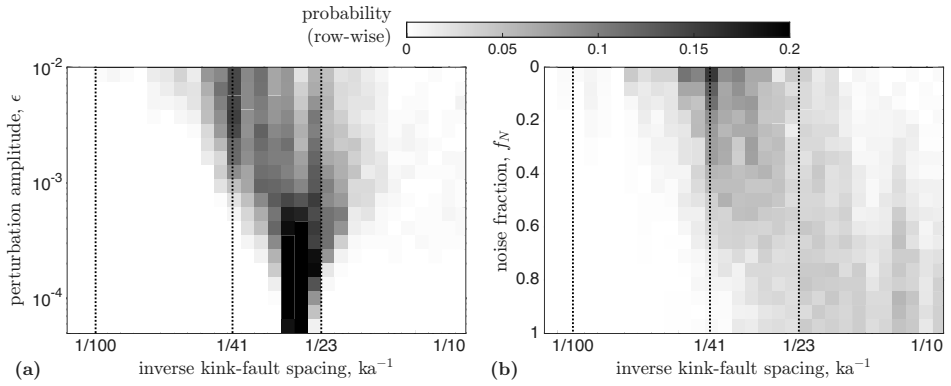
When driven by plate-thickness perturbations derived from the Pleistocene oxygen-isotope record, the model predicts fault spacings concentrated near 41 ky in the early Pleistocene and near 100 ky in the late Pleistocene, consistent with observed abyssal-hill spectra.
What carries the argument
Extended elastic unbending theory incorporating spatially variable plate thickness and yield-weakening viscoplastic flexure that localizes deformation into discrete kinks as faults; thickness perturbations modulate fibre stresses proportionally.
Load-bearing premise
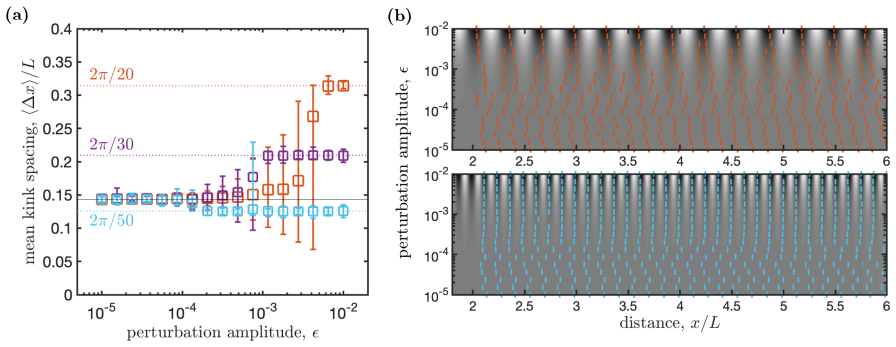
Sea-level variability produces plate-thickness perturbations as small as 0.1 percent that are sufficient to phase-lock faulting via modulated fibre stresses in the extended elastic unbending model.
What would settle it
High-resolution bathymetric mapping showing abyssal-hill fault spacings whose spectral peaks do not concentrate near 41 ky and 100 ky periods matching the oxygen-isotope record.
Figures







read the original abstract
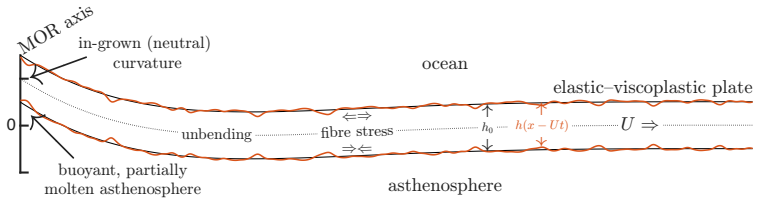
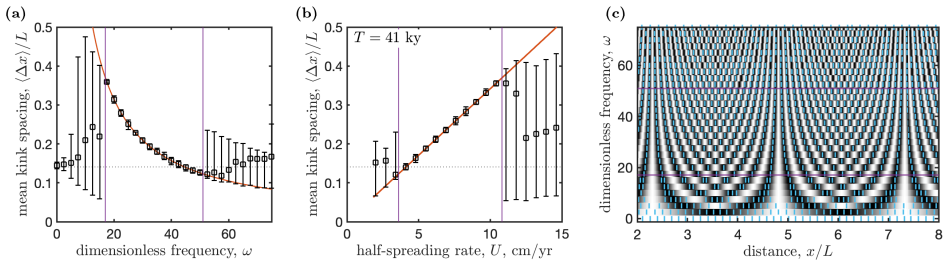
Abyssal hills, arguably the most extensive coherent pattern in Earth's surface topography, record the spacing of normal faults formed at mid-ocean ridges. At fast-spreading ridges, high-resolution bathymetry shows a pronounced spectral peak near 41 ky, coincident with obliquity-paced Pleistocene sea-level variability. The origin of this apparent orbital imprint on seafloor structure remains unresolved. We hypothesise that glacial-interglacial sea-level variability influences fault spacing by modulating plate thickness and the flexural stresses produced during plate unbending. Sea-level change alters mantle melting rates and magma supply at ridge axes, generating variations in the properties of the accreting plate. As the plate moves off axis, it unbends from its ingrown curvature, producing tensile fibre stresses that drive normal faulting. We hypothesise that small perturbations in elastic plate thickness modulate these stresses and thereby influence fault spacing. To test this, we extend the elastic unbending theory of Buck (2001) to include spatially variable plate thickness and yield-weakening viscoplastic flexure, which localises deformation into discrete kinks interpreted as faults. Linearised analysis shows that plate-thickness perturbations generate proportional fibre-stress variations. Numerical solutions demonstrate that perturbations as small as approximately 0.1 percent can phase-lock faulting to the imposed forcing. When driven by plate-thickness perturbations derived from the Pleistocene oxygen-isotope record, the model predicts fault spacings concentrated near 41 ky in the early Pleistocene and near 100 ky in the late Pleistocene, consistent with observed abyssal-hill spectra. These results provide a quantitative mechanism by which glacial-interglacial sea-level variability can be transmitted into tectonic structure.
Editorial analysis
A structured set of objections, weighed in public.
Referee Report
Summary. The manuscript presents a hypothesis that sea-level variability during the Pleistocene influences the spacing of normal faults at fast-spreading mid-ocean ridges by modulating the thickness of the accreting plate, which in turn affects the fibre stresses during unbending. Extending Buck (2001)'s elastic unbending theory to include variable plate thickness and viscoplastic yielding, linearized analysis indicates that thickness perturbations lead to proportional stress changes, while numerical models show that perturbations of about 0.1% are sufficient to phase-lock fault formation. Forcing the model with thickness changes inferred from oxygen isotope records produces fault spacing spectra with peaks at 41 kyr in the early Pleistocene and 100 kyr in the late Pleistocene, aligning with bathymetric observations.
Significance. Should the mechanism prove robust, it would establish a direct connection between climate-induced sea-level fluctuations and the formation of the most widespread topographic features on the ocean floor. This could reshape interpretations of abyssal hill morphology as a paleoclimate archive and highlight feedbacks between surface processes and mid-ocean ridge tectonics. The paper's strengths include its use of an independent forcing function (oxygen isotopes) and its extension of a prior theoretical framework with explicit predictions rather than fits, though the absence of detailed methods limits current evaluation of its impact.
major comments (2)
- The numerical demonstration that 0.1% plate-thickness perturbations suffice for phase-locking is central to the claim, yet the abstract provides no governing equations, boundary conditions, or description of how the yield-weakening viscoplastic flexure localizes into kinks; this prevents verification of the result's sensitivity to model assumptions.
- The mapping from the oxygen-isotope record to plate-thickness perturbations is not detailed, including the amplitude scaling and any filtering applied; since the model outputs depend directly on this input, the consistency with observed 41 ky and 100 ky peaks cannot be fully assessed without these specifics.
minor comments (1)
- The abstract refers to 'observed abyssal-hill spectra' without specifying the data sources or ridges (e.g., East Pacific Rise), which would aid context.
Simulated Author's Rebuttal
We thank the referee for their constructive comments and for highlighting the potential significance of the work. We address each of the major comments point by point below.
read point-by-point responses
-
Referee: The numerical demonstration that 0.1% plate-thickness perturbations suffice for phase-locking is central to the claim, yet the abstract provides no governing equations, boundary conditions, or description of how the yield-weakening viscoplastic flexure localizes into kinks; this prevents verification of the result's sensitivity to model assumptions.
Authors: We agree that the provided abstract lacks these details, which are necessary for full verification. The manuscript will be revised to incorporate a brief overview of the governing equations, boundary conditions, and the viscoplastic localization process into the abstract. A more comprehensive methods section will also be added to the revised version to describe the model assumptions and allow assessment of sensitivity. revision: yes
-
Referee: The mapping from the oxygen-isotope record to plate-thickness perturbations is not detailed, including the amplitude scaling and any filtering applied; since the model outputs depend directly on this input, the consistency with observed 41 ky and 100 ky peaks cannot be fully assessed without these specifics.
Authors: We concur that the abstract does not provide these specifics. In the revised manuscript, we will detail the procedure for mapping the oxygen isotope record to plate thickness perturbations, explicitly stating the amplitude scaling and any filtering applied. This will enable readers to evaluate the input's role in producing the spectral peaks at 41 kyr and 100 kyr. revision: yes
Circularity Check
No significant circularity; derivation uses independent forcing and external model
full rationale
The abstract describes a forward model that extends the external Buck (2001) elastic unbending theory, applies linearised analysis and numerical solutions to show that ~0.1% thickness perturbations can phase-lock faulting, and then drives the model with plate-thickness perturbations taken from the independent Pleistocene oxygen-isotope record. The resulting fault-spacing spectra are presented as predictions that match observed abyssal-hill data. No equations, fitted parameters, or self-citations are shown that would reduce the claimed predictions to the inputs by construction. The derivation chain therefore remains self-contained against external benchmarks.
Axiom & Free-Parameter Ledger
free parameters (1)
- plate thickness perturbation amplitude =
approximately 0.1 percent
axioms (2)
- domain assumption Elastic unbending of the accreting plate produces tensile fibre stresses that drive normal faulting (Buck 2001)
- domain assumption Glacial-interglacial sea-level variability alters mantle melting rates and magma supply at ridge axes, generating variations in accreting plate thickness
Reference graph
Works this paper leans on
-
[1]
Geochemistry, Geophysics, Geosystems , volume=
A semi-Lagrangian Crank-Nicolson algorithm for the numerical solution of advection-diffusion problems , author=. Geochemistry, Geophysics, Geosystems , volume=
-
[2]
SIAM Journal on Numerical Analysis , author =
Monotone Piecewise Cubic Interpolation , volume =. SIAM Journal on Numerical Analysis , author =. 1980 , pages =. doi:10.1137/0717021 , number =
-
[3]
Satish Balay and Shrirang Abhyankar and Mark F. Adams and Steven Benson and Jed Brown and Peter Brune and Kris Buschelman and Emil Constantinescu and Lisandro Dalcin and Alp Dener and Victor Eijkhout and Jacob Faibussowitsch and William D. Gropp and V'. doi:10.2172/2998643 , Institution =
-
[4]
Earth and Planetary Science Letters , volume=
Fast magma ascent, revised estimates from the deglaciation of Iceland , author=. Earth and Planetary Science Letters , volume=
-
[5]
Gropp and Lois Curfman McInnes and Barry F
Satish Balay and William D. Gropp and Lois Curfman McInnes and Barry F. Smith , Title =. Modern Software Tools in Scientific Computing , Editor =
-
[6]
Applied Mathematical Modelling , publisher =
Analytical solutions in elasto-plastic bending of beams with rectangular cross section , volume =. Applied Mathematical Modelling , publisher =. 2009 , pages =. doi:10.1016/j.apm.2008.03.011 , number =
-
[7]
Buck, W. R. , year =. Accretional curvature of lithosphere at magmatic spreading centers and the flexural support of axial highs , volume =. Journal of Geophysical Research: Solid Earth , publisher =. doi:10.1029/2000jb900360 , number =
-
[8]
Hewitt, I. J. and Balmforth, N. J. , year =. Viscoelastic ribbons , volume =. doi:10.1017/jfm.2020.870 , journal =
-
[9]
Shah, Anjana K and Buck, W. Roger , year =. Plate bending stresses at axial highs, and implications for faulting behavior , volume =. Earth and Planetary Science Letters , publisher =. doi:10.1016/s0012-821x(03)00187-0 , number =
-
[10]
Olive, J.-A. and Behn, M. D. and Ito, G. and Buck, W. R. and Escartín, J. and Howell, S. , year =. Sensitivity of seafloor bathymetry to climate-driven fluctuations in mid-ocean ridge magma supply , volume =. Science , publisher =. doi:10.1126/science.aad0715 , number =
-
[11]
Olive, J.-A. and Behn, M. D. and Ito, G. and Buck, W. R. and Escartín, J. and Howell, S. , year =. Science , publisher =. doi:10.1126/science.aaf2022 , number =
-
[12]
Lund, David C. and Asimow, Paul D. , year =. Geochemistry, Geophysics, Geosystems , publisher =. doi:10.1029/2011gc003693 , number =
-
[13]
Earth and Planetary Science Letters , publisher =
Huybers, Peter and Langmuir, Charles , year =. Earth and Planetary Science Letters , publisher =. doi:10.1016/j.epsl.2009.07.014 , number =
-
[14]
Crowley, John W. and Katz, Richard F. and Huybers, Peter and Langmuir, Charles H. and Park, Sung-Hyun , year =. Glacial cycles drive variations in the production of oceanic crust , volume =. Science , publisher =. doi:10.1126/science.1261508 , number =
-
[15]
Cerpa, Nestor G. and Rees Jones, David W. and Katz, Richard F. , year =. Consequences of glacial cycles for magmatism and carbon transport at mid-ocean ridges , volume =. doi:10.1016/j.epsl.2019.115845 , journal =
-
[16]
Huybers, Peter and Liautaud, Parker and Proistosescu, Cristian and Boulahanis, Bridgit and Carbotte, Suzanne M. and Katz, Richard F. and Langmuir, Charles , year =. Proceedings of the National Academy of Sciences , publisher =. doi:10.1073/pnas.2204761119 , number =
-
[17]
Katz, Richard F. and Rees Jones, David W. and Rudge, John F. and Keller, Tobias , year =. Physics of Melt Extraction from the Mantle: Speed and Style , volume =. Annual Review of Earth and Planetary Sciences , publisher =. doi:10.1146/annurev-earth-032320-083704 , number =
-
[18]
Sensitivity of seafloor bathymetry to climate-driven fluctuations in mid-ocean ridge magma supply
Huybers, Peter and Langmuir, Charles and Katz, Richard F. and Ferguson, David and Proistosescu, Cristian and Carbotte, Suzanne , year =. Comment on “Sensitivity of seafloor bathymetry to climate-driven fluctuations in mid-ocean ridge magma supply” , volume =. Science , publisher =. doi:10.1126/science.aae0451 , number =
-
[19]
The bending and stretching of plates , author=. Cambridge, New York , year=
- [20]
-
[21]
Richard F Katz and Peter Huybers , title =
-
[22]
Journal of Geophysical Research: Solid Earth , volume=
Factors controlling normal fault offset in an ideal brittle layer , author=. Journal of Geophysical Research: Solid Earth , volume=. 2000 , doi =
work page 2000
-
[23]
Journal of Geophysical Research: Solid Earth , issn =
Abyssal Hill Segmentation: Quantitative analysis of the East Pacific Rise flanks 7°S-9°S , author =. Journal of Geophysical Research: Solid Earth , issn =. 1993 , rating =. doi:10.1029/93jb01095 , pages =
-
[24]
Geophysical Research Letters , doi =
Mid‐ocean ridge eruptions as a climate valve , author =. Geophysical Research Letters , doi =. 2015 , rating =
work page 2015
-
[25]
Earth And Planetary Science Letters , doi =
Do sea level variations influence mid-ocean ridge magma supply? A test using crustal thickness and bathymetry data from the East Pacific Rise , author =. Earth And Planetary Science Letters , doi =. 2020 , rating =
work page 2020
-
[26]
Poliakov, A. N. B. and Buck, W. R. , title =. Faulting and Magmatism at Mid-Ocean Ridges , editor =. 1998 , doi =
work page 1998
-
[27]
Rift topography linked to magmatism at the intermediate spreading Juan de Fuca Ridge , author =. Geology , doi =. 2006 , rating =
work page 2006
-
[28]
Modes of faulting at mid-ocean ridges , author =. Nature , doi =. 2005 , rating =
work page 2005
-
[29]
Hays, JD and Imbrie, J and Shackleton, NJ , journal =. Variations in. 1976 , rating =. doi:10.1126/science.194.4270.1121 , pages =
-
[30]
Geophysical Research Letters , volume=
Persistent magma-rich waves beneath mid-ocean ridges explain long periodicity on ocean floor fabric , author=. Geophysical Research Letters , volume=
-
[31]
Goff, John A. and Zahirovic, Sabin and M\". No Evidence for Milankovitch Cycle Influence on Abyssal Hills at Intermediate, Fast, and Superfast Spreading Rates , volume =. Geophysical Research Letters , publisher =. doi:10.1029/2018gl079400 , number =
- [32]
- [33]
-
[34]
Astronomical theory of the Pleistocene ice ages: A brief historical review , author=. Icarus , volume=
-
[35]
Geophysical Journal International , author =
A global analysis of mid-ocean ridge axial topography , volume =. Geophysical Journal International , author =. 1994 , month = jan, pages =. doi:10.1111/j.1365-246x.1994.tb02128.x , number =
-
[36]
Pure and Applied Geophysics , author =
Friction of rocks , volume =. Pure and Applied Geophysics , author =. 1978 , pages =. doi:10.1007/bf00876528 , number =
-
[37]
Glacial cycles drive variations in the production of oceanic crust
Goff, John A. , year =. Comment on “Glacial cycles drive variations in the production of oceanic crust” , volume =. Science , publisher =. doi:10.1126/science.aab2350 , number =
-
[38]
Rift topography linked to magmatism at the intermediate spreading Juan de Fuca Ridge , author=. Geology , volume=. 2006 , publisher=
work page 2006
-
[39]
Journal of Geophysical Research: Solid Earth , volume=
Dike-induced faulting and graben subsidence in volcanic rift zones , author=. Journal of Geophysical Research: Solid Earth , volume=
-
[40]
Journal of Geophysical Research: Solid Earth , volume=
Constraints on hydrothermal heat flux through the oceanic lithosphere from global heat flow , author=. Journal of Geophysical Research: Solid Earth , volume=. 1994 , publisher=
work page 1994
-
[41]
Geophysical Monograph Series , volume=
Geophysical constraints on the subseafloor environment near mid-ocean ridges , author=. Geophysical Monograph Series , volume=
-
[42]
Cooling of the lower oceanic crust , author=. Geology , volume=. 2005 , publisher=
work page 2005
-
[43]
Crowder, Lisa K. and Macdonald, Ken C. , journal =. 2000 , title =. doi:10.1023/a:1004875609890 , pages =
-
[44]
Escartín, J. and Soule, S. A. and Fornari, D. J. and Tivey, M. A. and Schouten, H. and Perfit, M. R. , journal =. 2007 , title =. doi:10.1029/2006gc001399 , number =
-
[45]
Earth and Planetary Science Letters , issn =
Jackson, James and. Earth and Planetary Science Letters , issn =. 2023 , title =. doi:10.1016/j.epsl.2023.118279 , pages =
-
[46]
Parnell-Turner, R. and Sohn, R.A. and Peirce, C. and Reston, T.J. and. Geology , issn =. 2017 , title =. doi:10.1130/g39232.1 , pages =
-
[47]
Roger and Liu, Zhonglan and Escartín, Javier and Bickert, Manon , journal =
Olive, Jean-Arthur and Ekström, Göran and Buck, W. Roger and Liu, Zhonglan and Escartín, Javier and Bickert, Manon , journal =. 2024 , title =. doi:10.1038/s41586-024-07247-w , pmid =
-
[48]
and Burlini, Luigi , journal =
Faccenda, Manuele and Gerya, Taras V. and Burlini, Luigi , journal =. 2009 , title =. doi:10.1038/ngeo656 , pages =
-
[49]
Marine Geophysical Researches , volume=
Fault patterns at outer trench walls , author=. Marine Geophysical Researches , volume=. 1991 , publisher=
work page 1991
-
[50]
and Olive, Jean‐Arthur , journal =
Zhou, Zhiyuan and Lin, Jian and Behn, Mark D. and Olive, Jean‐Arthur , journal =. 2015 , title =. doi:10.1002/2015gl063917 , pages =
-
[51]
Glacial cycles drive variations in the production of oceanic crust
Response to Comment on "Glacial cycles drive variations in the production of oceanic crust" , author =. Science , doi =. 2015 , rating =
work page 2015
-
[52]
and Villeneuve, Marlène and Albino, Fabien and Farquharson, Jamie I
Heap, Michael J. and Villeneuve, Marlène and Albino, Fabien and Farquharson, Jamie I. and Brothelande, Elodie and Amelung, Falk and Got, Jean-Luc and Baud, Patrick , journal =. 2020 , title =. doi:10.1016/j.jvolgeores.2019.106684 , pages =
-
[53]
Marine and Petroleum Geology , doi =
Rheology and strength of the lithosphere , author =. Marine and Petroleum Geology , doi =. 2011 , rating =
work page 2011
-
[54]
Abyssal hills formed by stretching oceanic lithosphere , author =. Nature , doi =. 1998 , rating =
work page 1998
-
[55]
Buck, W. Roger , journal =. 1993 , title =. doi:10.1130/0091-7613(1993)021<0933:EOLTOT>2.3.CO;2 , pages =
-
[56]
Quaternary Science Reviews , author =
Glacial variability over the last two million years: an extended depth-derived agemodel, continuous obliquity pacing, and the Pleistocene progression , volume =. Quaternary Science Reviews , author =. 2007 , pages =. doi:10.1016/j.quascirev.2006.07.013 , number =
-
[57]
Physical review letters , volume=
Improved surrogate data for nonlinearity tests , author=. Physical review letters , volume=. 1996 , publisher=
work page 1996
- [58]
discussion (0)
Sign in with ORCID, Apple, or X to comment. Anyone can read and Pith papers without signing in.