Recognition: 2 theorem links
· Lean TheoremApproximate Envy-Free Allocations up to any k Goods
Pith reviewed 2026-05-12 04:18 UTC · model grok-4.3
The pith
For any k>2, (k+1)/(k+2)-EFkX allocations exist for any number of agents and can be computed in polynomial time.
A machine-rendered reading of the paper's core claim, the machinery that carries it, and where it could break.
Core claim
For any k>2, (k+1)/(k+2)-EFkX allocations exist for any number of agents with additive valuations over goods, and such allocations can be computed in polynomial time via a generalization of the 3PA algorithm. This yields 3/4-EF2X allocations for arbitrary numbers of agents. Additionally, 2/3-EFX allocations exist for eight agents, and EFkX graph orientations do not always exist with their existence decision being NP-complete.
What carries the argument
Generalization of the 3PA algorithm that iteratively assigns goods while ensuring envy can be eliminated by removing at most k goods from any bundle.
If this is right
- 3/4-EF2X allocations exist for any number of agents.
- 2/3-EFX allocations exist for eight agents.
- EFkX graph orientations do not always exist.
- Deciding existence of EFkX graph orientations is NP-complete.
Where Pith is reading between the lines
- The polynomial-time result opens the door to implementing these fairness guarantees in automated resource allocation systems.
- The same algorithmic template may extend to related fairness notions such as proportionality or maximin share.
- The NP-completeness for orientations suggests that structural variants of approximate fairness remain hard even when the basic existence question is settled.
Load-bearing premise
The generalized 3PA procedure produces allocations meeting the (k+1)/(k+2) ratio for EFkX under only additive valuations and no further hidden constraints.
What would settle it
A concrete instance of additive valuations for which the generalized algorithm outputs an allocation violating (k+1)/(k+2)-EFkX, or for which no such allocation exists at all.
Figures
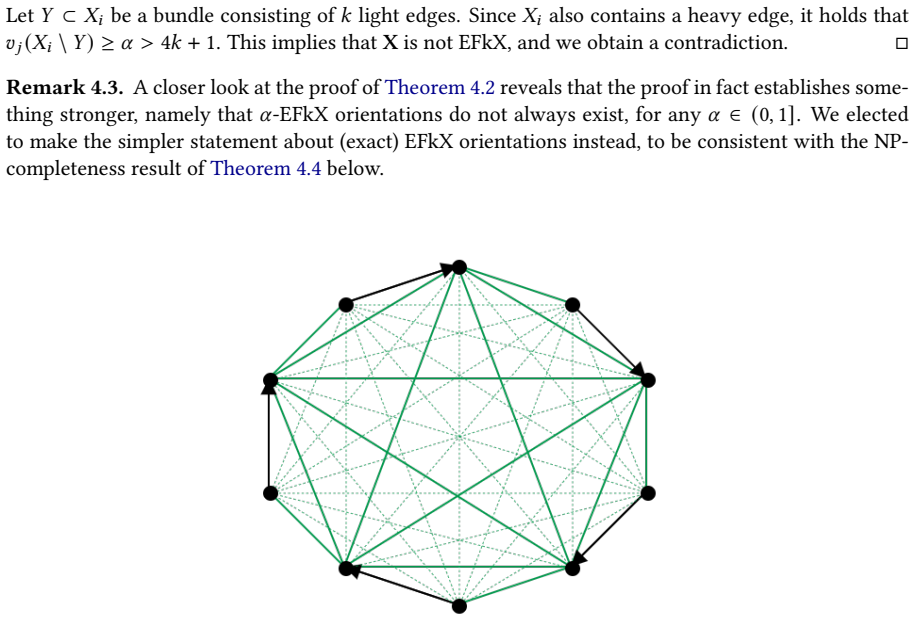
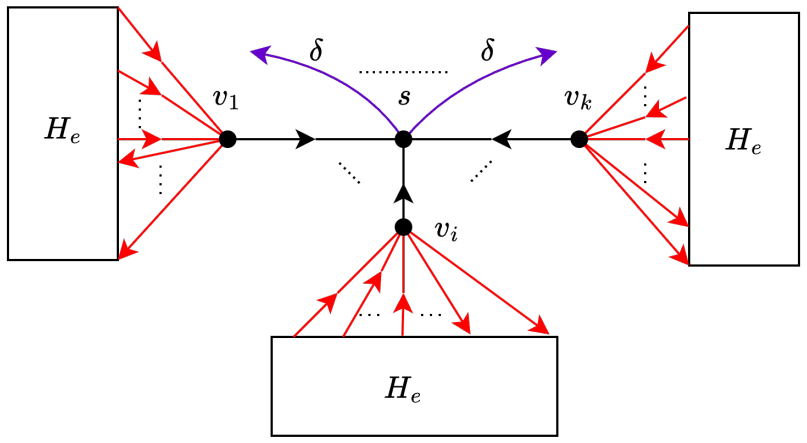
read the original abstract
We study the problem of finding approximate envy-free allocations up to any $k$ goods ($\alpha$-EFkX), when agents have additive values over goods in a bundle. As our main result, we show that for any $k>2$, $\frac{k+1}{k+2}$-EFkX allocations exist for any number of agents, and can be computed in polynomial time, via an appropriate generalization of the 3PA algorithm of [Amanatidis et al., 2024]. An immediate corollary of this result is that $3/4$-EF2X allocations exist for any number of agents; in contrast, $2/3$-EFX allocations are only known to exist for up to 7 agents. We improve this latter result by devising an algorithm that achieves $2/3$-EFX for 8 agents. We also consider EFkX graph orientations; we prove that such orientations do not always exist, and that deciding their existence is NP-complete, thereby generalizing the corresponding result of [Christodoulou et., 2023] for $k=1$.
Editorial analysis
A structured set of objections, weighed in public.
Referee Report
Summary. The manuscript studies approximate envy-free allocations up to any k goods (α-EFkX) under additive valuations. Its central claim is that for any k>2, (k+1)/(k+2)-EFkX allocations exist for arbitrary numbers of agents and can be computed in polynomial time via a generalization of the 3PA algorithm from Amanatidis et al. (2024). It also derives the corollary that 3/4-EF2X allocations exist for any number of agents, presents an algorithm achieving 2/3-EFX for 8 agents, and proves that EFkX graph orientations do not always exist with NP-completeness for deciding their existence (generalizing Christodoulou et al. for k=1).
Significance. If the generalization of 3PA preserves the stated ratio without degradation, the result would be significant for providing the first poly-time constant-factor approximation to EFkX that improves toward 1 as k increases and holds for any number of agents, in contrast to the more limited existence results known for exact EFX. The explicit improvement to 8 agents for 2/3-EFX and the structural negative result on orientations would further strengthen the contribution to fair division.
major comments (1)
- [Generalization of 3PA algorithm] The section describing the generalization of the 3PA algorithm: the claim that the generalized procedure achieves exactly the (k+1)/(k+2) ratio for EFkX for arbitrary k>2 rests on an inductive or recursive extension of the k=3 base case. The analysis must explicitly confirm that the envy bound (when each agent compares her bundle to any other after removing at most k goods) is preserved without introducing hidden restrictions on the number of goods, bundle sizes, or valuation additivity assumptions, as any weakening of the ratio for larger k would invalidate the main existence and algorithmic result.
minor comments (3)
- [Abstract] Abstract: the statement of the main result could briefly indicate the key structural property of the 3PA generalization that enables the ratio to hold for all k>2.
- [EFX for 8 agents] The 8-agent 2/3-EFX algorithm: the description should clarify whether the construction is a direct specialization of the generalized 3PA or requires additional case analysis.
- [EFkX graph orientations] The NP-completeness reduction for EFkX orientations: the proof should explicitly note how it extends the k=1 case from Christodoulou et al. (2023) to highlight the generalization.
Simulated Author's Rebuttal
We thank the referee for their careful reading of the manuscript and for identifying the need for greater explicitness in the analysis of the generalized 3PA algorithm. We address the major comment below.
read point-by-point responses
-
Referee: The section describing the generalization of the 3PA algorithm: the claim that the generalized procedure achieves exactly the (k+1)/(k+2) ratio for EFkX for arbitrary k>2 rests on an inductive or recursive extension of the k=3 base case. The analysis must explicitly confirm that the envy bound (when each agent compares her bundle to any other after removing at most k goods) is preserved without introducing hidden restrictions on the number of goods, bundle sizes, or valuation additivity assumptions, as any weakening of the ratio for larger k would invalidate the main existence and algorithmic result.
Authors: We appreciate the referee highlighting this point. In Section 3, the manuscript defines the generalized 3PA algorithm recursively, extending the k=3 procedure of Amanatidis et al. (2024) to arbitrary k>2. The approximation guarantee is established by induction on k: the base case reuses the known 3/4-EF3X bound, and the inductive step assumes a suitable (k/(k+1))-EF(k-1)X allocation and shows that the next iteration produces an allocation satisfying the (k+1)/(k+2)-EFkX bound. Because valuations are additive, the value of any bundle after removal of at most k goods is controlled by the sum of the k highest-valued goods in the compared bundle; the algorithm's selection rule (which prioritizes bundles that minimize maximum envy after such removals) ensures the factor is preserved. The argument places no restrictions on the total number of goods, the sizes of individual bundles, or the number of agents, and the polynomial-time bound holds uniformly. We agree, however, that the current exposition of the inductive step could be expanded with an explicit lemma verifying that the envy ratio does not degrade. We will therefore revise the proof to include these additional calculations and a self-contained verification that the bound holds under the stated assumptions. revision: yes
Circularity Check
No significant circularity detected
full rationale
The paper's central result generalizes the 3PA algorithm from the independent prior work of Amanatidis et al. (2024) to establish the existence of (k+1)/(k+2)-EFkX allocations for any k>2 and any number of agents, along with a polynomial-time algorithm. This generalization is presented as a new constructive contribution rather than reducing by definition or construction to the paper's own inputs. The corollary for 3/4-EF2X, the improvement to 2/3-EFX for 8 agents, and the NP-completeness result for EFkX orientations (generalizing Christodoulou et al. 2023) are likewise independent extensions that do not rely on self-definitional equivalences, fitted parameters renamed as predictions, or load-bearing self-citation chains. The derivation chain remains self-contained against the external benchmarks of the cited prior algorithms and standard additive valuation assumptions.
Axiom & Free-Parameter Ledger
axioms (2)
- domain assumption Agents have additive valuations over bundles of goods.
- ad hoc to paper The 3PA algorithm of Amanatidis et al. 2024 can be generalized to achieve the claimed approximation for EFkX.
Lean theorems connected to this paper
-
IndisputableMonolith/Cost/FunctionalEquation.leanwashburn_uniqueness_aczel unclear?
unclearRelation between the paper passage and the cited Recognition theorem.
We show that for any k>2, (k+1)/(k+2)-EFkX allocations exist ... via an appropriate generalization of the 3PA algorithm
-
IndisputableMonolith/Foundation/ArithmeticFromLogic.leanembed_injective unclear?
unclearRelation between the paper passage and the cited Recognition theorem.
the modified envy graph ... proxy valuation function
What do these tags mean?
- matches
- The paper's claim is directly supported by a theorem in the formal canon.
- supports
- The theorem supports part of the paper's argument, but the paper may add assumptions or extra steps.
- extends
- The paper goes beyond the formal theorem; the theorem is a base layer rather than the whole result.
- uses
- The paper appears to rely on the theorem as machinery.
- contradicts
- The paper's claim conflicts with a theorem or certificate in the canon.
- unclear
- Pith found a possible connection, but the passage is too broad, indirect, or ambiguous to say the theorem truly supports the claim.
Reference graph
Works this paper leans on
-
[1]
Proceedings of the 24th ACM Conference on Economics and Computation , pages=
Fair allocation in graphs , author=. Proceedings of the 24th ACM Conference on Economics and Computation , pages=
-
[2]
Proceedings of the 25th ACM Conference on Economics and Computation , pages=
Pushing the frontier on approximate EFX allocations , author=. Proceedings of the 25th ACM Conference on Economics and Computation , pages=
-
[3]
EFX allocations and orientations on bipartite multi-graphs: A complete picture , author=. Proceedings of the 24th International Conference on Autonomous Agents and Multiagent Systems , pages =
-
[4]
Proceedings of the 26th ACM Conference on Economics and Computation , pages=
Simultaneously satisfying MXS and EFL , author=. Proceedings of the 26th ACM Conference on Economics and Computation , pages=
-
[5]
Journal of Political Economy , volume=
The combinatorial assignment problem: Approximate competitive equilibrium from equal incomes , author=. Journal of Political Economy , volume=. 2011 , publisher=
work page 2011
-
[6]
Proceedings of the AAAI Conference on Artificial Intelligence , volume=
Groupwise maximin fair allocation of indivisible goods , author=. Proceedings of the AAAI Conference on Artificial Intelligence , volume=
-
[7]
New fairness concepts for allocating indivisible items , author=. 2023 , organization=
work page 2023
-
[8]
Proceedings of the Thirty-Fourth International Joint Conference on Artificial Intelligence , pages =
EF1 and EFX orientations , author=. Proceedings of the Thirty-Fourth International Joint Conference on Artificial Intelligence , pages =
-
[9]
On the structure of EFX orientations on graphs , author=. Proceedings of the 24th International Conference on Autonomous Agents and Multiagent Systems , pages =
-
[10]
Proceedings of the 5th ACM Conference on Electronic Commerce , pages=
On approximately fair allocations of indivisible goods , author=. Proceedings of the 5th ACM Conference on Electronic Commerce , pages=
-
[11]
Markakis, Evangelos and Santorinaios, Christodoulos , title =. Proceedings of the 2023 International Conference on Autonomous Agents and Multiagent Systems , pages =
work page 2023
-
[12]
Proceedings of the Thirty-First International Joint Conference on Artificial Intelligence,
An EF2X Allocation Protocol for Restricted Additive Valuations , author =. Proceedings of the Thirty-First International Joint Conference on Artificial Intelligence,. 2022 , month =. doi:10.24963/ijcai.2022/3 , url =
-
[13]
Artificial Intelligence , volume=
Fair division of indivisible goods: Recent progress and open questions , author=. Artificial Intelligence , volume=. 2023 , publisher=
work page 2023
-
[14]
Theoretical Computer Science , volume =
Georgios Amanatidis and Evangelos Markakis and Apostolos Ntokos , title =. Theoretical Computer Science , volume =
-
[15]
Almost envy-freeness, envy-rank, and
Farhadi, Alireza and Hajiaghayi, MohammadTaghi and Latifian, Mohamad and Seddighin, Masoud and Yami, Hadi , booktitle=. Almost envy-freeness, envy-rank, and
-
[16]
Proceedings of the 26th ACM Conference on Economics and Computation , pages=
EFX Exists for Three Types of Agents , author=. Proceedings of the 26th ACM Conference on Economics and Computation , pages=
-
[17]
arXiv preprint arXiv:2508.15380 , year=
Almost and Approximate EFX for Few Types of Agents , author=. arXiv preprint arXiv:2508.15380 , year=
-
[18]
ACM Transactions on Economics and Computation , volume=
Caragiannis, Ioannis and Kurokawa, David and Moulin, Herv. ACM Transactions on Economics and Computation , volume=
-
[19]
EFX exists for three agents , author=. Journal of the ACM , volume=. 2024 , publisher=
work page 2024
-
[20]
Benjamin Plaut and Tim Roughgarden , title =
-
[21]
EFX: a simpler approach and an (almost) optimal guarantee via rainbow cycle number , author=. Operations Research , volume=. 2025 , publisher=
work page 2025
-
[22]
Amanatidis, Georgios and Birmpas, Georgios and Filos-Ratsikas, Aris and Hollender, Alexandros and Voudouris, Alexandros A , journal=. 2021 , publisher=
work page 2021
-
[23]
Proceedings of the AAAI Conference on Artificial Intelligence , volume=
EF2X Exists For Four Agents , author=. Proceedings of the AAAI Conference on Artificial Intelligence , volume=
-
[24]
Ioannis Caragiannis and Nick Gravin and Xin Huang , title =. Proceedings of the 2019
work page 2019
-
[25]
Bhaskar Ray Chaudhury and Telikepalli Kavitha and Kurt Mehlhorn and Alkmini Sgouritsa , title =
-
[26]
Ben Berger and Avi Cohen and Michal Feldman and Amos Fiat , title =. Proceedings of the 36th
discussion (0)
Sign in with ORCID, Apple, or X to comment. Anyone can read and Pith papers without signing in.