Recognition: 2 theorem links
· Lean TheoremEnergy-resolved pulse profiles of Vela X-1: cross-calibrating XMM-Newton and NuSTAR to trace spectral features
Pith reviewed 2026-05-12 03:53 UTC · model grok-4.3
The pith
Pulsed fraction spectra of Vela X-1 from simultaneous XMM-Newton and NuSTAR observations agree within 5% after corrections and reveal emission lines plus cyclotron features across 1-70 keV.
A machine-rendered reading of the paper's core claim, the machinery that carries it, and where it could break.
Core claim
After correcting for instrumental effects, the pulsed fraction spectra derived strictly over the common exposure intervals of the two instruments agree within 5% in their overlapping 3-10 keV range. Remaining discrepancies larger than 5% are confined to the iron-line region and can be attributed to the different energy resolutions of the two instruments. The broadband pulsed fraction spectrum reveals significant localized features corresponding to known emission lines in the soft band and to cyclotron resonant scattering features. Orbital-phase-resolved modeling of the EPIC-pn pulsed fraction spectrum shows that the soft-band features depend strongly on the equivalent absorption column, with
What carries the argument
The pulsed fraction spectrum, obtained from energy-phase matrices of the pulse profiles, serving as both a quantitative cross-calibration diagnostic and a spectro-timing tracer of spectral features.
If this is right
- The pulsed fraction spectrum can be applied as a cross-calibration check between any pair of X-ray instruments observing the same pulsar.
- Cyclotron resonant scattering features and emission lines can be identified through their timing signatures in the pulsed fraction without relying solely on spectral fitting.
- Absorption column variations across the orbit modulate the visibility of soft-band features in the pulsed fraction spectrum.
- The method provides a compact observable that combines timing and spectral information for studying emission geometry in accreting X-ray pulsars.
Where Pith is reading between the lines
- This approach could help reconcile spectral model disagreements between instruments by providing an independent timing-based check on feature presence.
- Applying the same analysis to other bright pulsars might test whether pulsed fraction spectra generally trace cyclotron lines across different magnetic field strengths.
- Future missions with overlapping energy coverage could use pulsed fraction spectra as a built-in calibration verification tool during early operations.
- The strong dependence on absorption suggests the pulsed fraction could serve as a proxy for inferring column density changes without full spectral modeling.
Load-bearing premise
All instrumental response differences and observational effects including exposure overlaps and orbital variations have been fully and accurately corrected so that remaining differences reflect only astrophysical or resolution effects.
What would settle it
A new simultaneous observation of Vela X-1 with a third instrument that produces a pulsed fraction spectrum deviating by more than 5% from the XMM-Newton plus NuSTAR result in the 3-10 keV overlap region would falsify the agreement after corrections.
Figures



read the original abstract
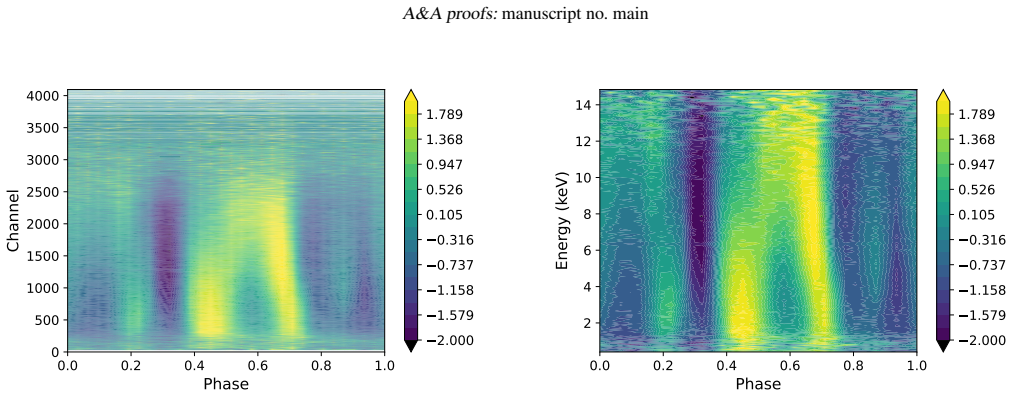
Pulse profiles probe the emission geometry of accreting X-ray pulsars, but their observed shapes may depend on instrumental response and observational setup. The pulsed fraction spectrum provides a compact spectro-timing observable that can both trace localized spectral features and serve as a quantitative cross-calibration diagnostic. We assess the consistency of energy-resolved pulse profiles obtained with simultaneous XMM-Newton/EPIC-pn and NuSTAR/FPM observations of Vela X-1, and investigate the broadband pulsed fraction spectrum as a diagnostic of spectral features from 1 to 70 keV. We construct energy-phase matrices for both instruments and derive pulsed fraction spectra after carefully accounting for instrumental and observational effects. We quantify the residual systematics in the overlapping 3-10 keV band. We then model the broadband pulsed fraction spectra phenomenologically and search for timing signatures of spectral features. After correcting for instrumental effects, the pulsed fraction spectra derived strictly over the common exposure intervals of the two instruments agree within 5% in their overlapping 3-10 keV range. Remaining discrepancies larger than 5% are confined to the iron-line region and can be attributed to the different energy resolutions of the two instruments. The broadband pulsed fraction spectrum reveals significant localized features corresponding to known emission lines in the soft band and to cyclotron resonant scattering features. Orbital-phase-resolved modeling of the EPIC-pn pulsed fraction spectrum shows that the soft-band features depend strongly on the equivalent absorption column, with emission-line signatures becoming progressively suppressed during highly absorbed intervals. The pulsed fraction spectrum serves both as a quantitative cross-calibration diagnostic and as a powerful spectro-timing diagnostic.
Editorial analysis
A structured set of objections, weighed in public.
Referee Report
Summary. The manuscript analyzes simultaneous XMM-Newton/EPIC-pn and NuSTAR/FPM observations of the accreting X-ray pulsar Vela X-1. It constructs energy-phase matrices, derives pulsed fraction spectra after corrections for instrumental and observational effects, and reports that these spectra agree within 5% in the 3-10 keV overlap when restricted to common exposure intervals. Discrepancies exceeding 5% are localized to the iron-line region and attributed to differing energy resolutions. The broadband (1-70 keV) pulsed fraction spectrum is shown to exhibit localized features matching known emission lines and cyclotron resonant scattering features (CRSFs); orbital-phase-resolved modeling further indicates that soft-band features are suppressed at high absorption columns.
Significance. If the corrections hold, the work demonstrates that the pulsed fraction spectrum is a robust, largely model-independent spectro-timing diagnostic capable of both quantitative cross-calibration between instruments and identification of astrophysical spectral features. The use of strictly overlapping exposures and explicit quantification of residuals (rather than assumption of perfect cancellation) is a clear strength. The approach could be applied to other bright pulsars and provides a practical test of instrumental consistency in the 3-10 keV band where both telescopes operate.
major comments (1)
- [Methods / Results (pulsed fraction derivation)] The central 5% agreement claim rests on the completeness of the instrumental and observational corrections (exposure overlap, background, orbital variations, response differences). The manuscript states that these have been 'carefully accounted for' and that residuals are quantified, but provides no explicit breakdown or table showing the magnitude of each correction term before and after application. This detail is load-bearing for the cross-calibration result and should be added (e.g., as a supplementary table or dedicated subsection).
minor comments (2)
- [Abstract and § on broadband spectrum] The abstract and text refer to 'significant localized features' without quoting the statistical significance threshold or the exact energy bins used for the broadband spectrum; a brief statement of the detection criterion would improve clarity.
- [Figures] Figure captions should explicitly state whether the plotted pulsed fraction spectra are normalized or absolute, and whether error bars include only statistical or also systematic uncertainties from the corrections.
Simulated Author's Rebuttal
We thank the referee for their positive assessment of the manuscript and for recommending minor revision. We address the single major comment below.
read point-by-point responses
-
Referee: The central 5% agreement claim rests on the completeness of the instrumental and observational corrections (exposure overlap, background, orbital variations, response differences). The manuscript states that these have been 'carefully accounted for' and that residuals are quantified, but provides no explicit breakdown or table showing the magnitude of each correction term before and after application. This detail is load-bearing for the cross-calibration result and should be added (e.g., as a supplementary table or dedicated subsection).
Authors: We agree that an explicit, step-by-step quantification of the individual corrections would strengthen the transparency of the 5% agreement result. In the revised manuscript we will add a dedicated subsection (or supplementary table) that tabulates the pulsed-fraction spectrum in the 3-10 keV overlap before and after each correction term in turn: (i) restriction to strictly common exposure intervals, (ii) background subtraction, (iii) orbital-phase selection, and (iv) convolution with the respective instrument responses. The final residuals after all corrections are already shown in the main text and figures; the new table will simply make the contribution of each term explicit and allow readers to judge the robustness of the cross-calibration claim. revision: yes
Circularity Check
No significant circularity in the derivation chain
full rationale
The paper performs an observational comparison of simultaneous XMM-Newton and NuSTAR data on Vela X-1, deriving pulsed fraction spectra from energy-phase matrices after applying standard instrumental corrections and restricting to common exposure intervals. The reported 5% agreement in the 3-10 keV overlap is a direct empirical measurement of residuals, not a model prediction or fitted parameter renamed as output. Broadband feature identification relies on known emission lines and CRSFs with phenomenological modeling, and orbital-phase dependence is shown via data subsets. No load-bearing step reduces by construction to self-definition, fitted inputs called predictions, or self-citation chains; the analysis is self-contained against the external datasets and does not invoke uniqueness theorems or ansatzes from prior author work.
Axiom & Free-Parameter Ledger
Lean theorems connected to this paper
-
IndisputableMonolith/Cost/FunctionalEquation.leanwashburn_uniqueness_aczel unclear?
unclearRelation between the paper passage and the cited Recognition theorem.
After correcting for instrumental effects, the pulsed fraction spectra ... agree within 5% in their overlapping 3-10 keV range. ... model the broadband pulsed fraction spectra phenomenologically and search for timing signatures of spectral features.
-
IndisputableMonolith/Foundation/RealityFromDistinction.leanreality_from_one_distinction unclear?
unclearRelation between the paper passage and the cited Recognition theorem.
The broadband pulsed fraction spectrum reveals significant localized features corresponding to known emission lines ... and to the fundamental and harmonic cyclotron resonant scattering features at ~25 and ~55 keV.
What do these tags mean?
- matches
- The paper's claim is directly supported by a theorem in the formal canon.
- supports
- The theorem supports part of the paper's argument, but the paper may add assumptions or extra steps.
- extends
- The paper goes beyond the formal theorem; the theorem is a base layer rather than the whole result.
- uses
- The paper appears to rely on the theorem as machinery.
- contradicts
- The paper's claim conflicts with a theorem or certificate in the canon.
- unclear
- Pith found a possible connection, but the passage is too broad, indirect, or ambiguous to say the theorem truly supports the claim.
Reference graph
Works this paper leans on
-
[1]
2023, PeerJ Computer Science, 9, e1516
Abril-Pla, O., Andreani, V ., Carroll, C., et al. 2023, PeerJ Computer Science, 9, e1516
work page 2023
- [2]
-
[3]
Ambrosi, E., D’Aì, A., Cusumano, G., et al. 2026 [arXiv:2603.13107]
-
[4]
Bachetti, M., Harrison, F. A., Cook, R., et al. 2015, The Astrophysical Journal, 800, 109
work page 2015
-
[5]
2026, Publications of the Astronom- ical Society of the Pacific, 138, 014501
Bachetti, M., Terada, Y ., Shidatsu, M., et al. 2026, Publications of the Astronom- ical Society of the Pacific, 138, 014501
work page 2026
-
[6]
A., Klochkov, D., Schönherr, G., et al
Becker, P. A., Klochkov, D., Schönherr, G., et al. 2012, A&A, 544, A123
work page 2012
-
[7]
Becker, R. H., Boldt, E. A., Holt, S. S., Serlemitsos, P. J., & Swank, J. H. 1978, ApJ, 221, 912–920
work page 1978
-
[8]
1997, The Astrophysical Journal Supplement Series, 113, 367
Bildsten, L., Chakrabarty, D., Chiu, J., et al. 1997, The Astrophysical Journal Supplement Series, 113, 367
work page 1997
-
[9]
Blondin, J. M. 1994, in AIP Conference Proceedings, V ol. 308, The Evolution of X-ray Binaries, ed. S. Holt & C. S. Day (American Institute of Physics), 578–582
work page 1994
-
[10]
Blondin, J. M., Kallman, T. R., Fryxell, B. A., & Taam, R. E. 1990, The Astro- physical Journal, 356, 591
work page 1990
-
[11]
Blondin, J. M., Stevens, I. R., & Kallman, T. R. 1991, The Astrophysical Journal, 371, 684
work page 1991
-
[12]
Caballero, I. & Wilms, J. 2012, arXiv preprint arXiv:1206.3124 D’Aì, A., Maniadakis, D. K., Ferrigno, C., et al. 2025, A&A, 694, A316
-
[13]
M., Dupourqué, S., Zhou, M., Quintin, E., Matzeu, G
Diez, C., Dupourqué, S., Zhou, M., et al. 2025, arXiv preprint arXiv:2509.07258
-
[14]
M., Grinberg, V ., Fürst, F., et al
Diez, C. M., Grinberg, V ., Fürst, F., et al. 2022, A&A, 660, A19
work page 2022
-
[15]
M., Grinberg, V ., Fürst, F., & et al
Diez, C. M., Grinberg, V ., Fürst, F., & et al. 2023, A&A, 674, A147
work page 2023
-
[16]
Ducci, L. & Malacaria, C. 2023, in Handbook of X-ray and Gamma-ray Astro- physics (Springer), 1–34
work page 2023
-
[17]
Falanga, M., Bozzo, E., Lutovinov, A., et al. 2015, A&A, 577, A130
work page 2015
- [18]
-
[19]
Foreman-Mackey, D., Hogg, D. W., Lang, D., & Goodman, J. 2013, PASP, 125, 306
work page 2013
- [20]
-
[21]
Fryxell, B. A., Taam, R. E., & McMillan, S. L. W. 1987, The Astrophysical Journal, 315, 536
work page 1987
-
[22]
2014, in American Astronomical So- ciety Meeting Abstracts, V ol
Fuerst, F., Pottschmidt, K., Wilms, J., et al. 2014, in American Astronomical So- ciety Meeting Abstracts, V ol. 223, American Astronomical Society Meeting Abstracts #223, 438.20 Fürst, F., Pottschmidt, K., Wilms, J., et al. 2014, The Astrophysical Journal, 780, 133
work page 2014
-
[23]
Goldstein, G., Huenemoerder, D. P., & Blank, D. 2004, AJ, 127, 2310–2315
work page 2004
-
[24]
Grinberg, V ., Hell, N., El Mellah, I., et al. 2017, A&A, 608, A143
work page 2017
-
[25]
2002, arXiv preprint astro- ph/0203235
Haberl, F., Briel, U., Dennerl, K., & Zavlin, V . 2002, arXiv preprint astro- ph/0203235
- [26]
-
[27]
Houck, J., Denicola, L., Manset, N., Veillet, C., & Crabtree, D. 2000
work page 2000
-
[28]
2001, Astronomy & Astrophysics, 365, L1
Jansen, F., Lumb, D., Altieri, B., et al. 2001, Astronomy & Astrophysics, 365, L1
work page 2001
-
[29]
Kaastra, J. S. & Bleeker, J. A. M. 2016, A&A, 587, A151
work page 2016
-
[30]
Kretschmar, P., El Mellah, I., Martínez-Núñez, S., et al. 2021, A&A, 652, A95
work page 2021
-
[31]
2019, Journal of Open Source Software, 4, 1143
Kumar, R., Carroll, C., Hartikainen, A., & Martin, O. 2019, Journal of Open Source Software, 4, 1143
work page 2019
-
[32]
1992, The Astrophysical Journal, 389, 665
Lewis, W., Rappaport, S., Levine, A., & Nagase, F. 1992, The Astrophysical Journal, 389, 665
work page 1992
-
[33]
Lomaeva, M., Grinberg, V ., Guainazzi, M., et al. 2020, A&A, 641, A144
work page 2020
-
[34]
2025, arXiv preprint arXiv:2512.10615
Lucchini, M., Ricketts, B., Uttley, P., & Huppenkothen, D. 2025, arXiv preprint arXiv:2512.10615
-
[35]
Lucy, L. B. & White, R. L. 1980, The Astrophysical Journal, 241, 300
work page 1980
- [36]
- [37]
-
[38]
Malacaria, C., Mihara, T., Santangelo, A., et al. 2016, A&A, 588, A100
work page 2016
-
[39]
Malacaria, C., Pike, S. N., D’Aì, A., et al. 2026, A&A, 706, A321
work page 2026
-
[40]
K., Sokolova-Lapa, E., D’Aì, A., et al
Maniadakis, D. K., Sokolova-Lapa, E., D’Aì, A., et al. 2025, A&A, 700, A70
work page 2025
-
[41]
Manousakis, A. & Walter, R. 2015, A&A, 575, A58 Martínez-Núñez, S., Kretschmar, P., Bozzo, E., et al. 2017, Space Sci. Rev., 212, 59 Martínez-Núñez, S., Kretschmar, P., Bozzo, E., & et al. 2017, Space Science Reviews, 212, 59
work page 2015
- [42]
-
[43]
Mushtukov, A. & Tsygankov, S. 2022, arXiv e-prints, arXiv:2204.14185
-
[44]
Nagase, F., Zylstra, G., Sonobe, T., & et al. 1994, ApJ, 436, L1–L4
work page 1994
-
[45]
Ohashi, T., Inoue, H., Koyama, K., & et al. 1984, PASJ, 36, 699–708
work page 1984
-
[46]
Orlandini, M. & Dal Fiume, D. 2001, in AIP Conference Proceedings, V ol. 599 (American Institute of Physics), 283–294
work page 2001
-
[47]
M., Hamann, W.-R., & Feldmeier, A
Oskinova, L. M., Hamann, W.-R., & Feldmeier, A. 2007, Astronomy & Astro- physics, 476, 1331
work page 2007
-
[48]
2025, Monthly Notices of the Royal Astronomical Society, 537, 3421
Rawlings, A., Keitaanranta, A., Mattero, M., et al. 2025, Monthly Notices of the Royal Astronomical Society, 537, 3421
work page 2025
-
[49]
Rawls, M. L., Orosz, J. A., McClintock, J. E., & et al. 2011, The Astrophysical Journal, 730, 25
work page 2011
-
[50]
Sako, M., Liedahl, D. A., Kahn, S. M., & Paerels, F. 1999, ApJ, 525, 921–928
work page 1999
-
[51]
1986, Publications of the Astronom- ical Society of Japan, 38, 731
Sato, N., Hayakawa, S., Nagase, F., & et al. 1986, Publications of the Astronom- ical Society of Japan, 38, 731
work page 1986
-
[52]
Schulz, N. S., Canizares, C. R., Lee, J. C., & Sako, M. 2002, ApJ, 564, L21–L25
work page 2002
-
[53]
Sokolova-Lapa, E. 2023, Radiative Transfer in the Vicinity of Accreting Neutron Stars-Polarized Emission in Strong Magnetic Fields (Friedrich-Alexander- Universitaet Erlangen-Nuernberg (Germany))
work page 2023
-
[54]
Sokolova-Lapa, E., Gornostaev, M., Wilms, J., et al. 2021, A&A, 651, A12
work page 2021
-
[55]
S., Doroshenko, V ., Mushtukov, A
Tsygankov, S. S., Doroshenko, V ., Mushtukov, A. A., et al. 2019, MNRAS, 487, L30
work page 2019
-
[56]
P., van de Sande, J., Fraser-McKelvie, A., et al
Vaughan, S. P., van de Sande, J., Fraser-McKelvie, A., et al. 2024, Monthly No- tices of the Royal Astronomical Society, 528, 5852
work page 2024
-
[57]
2017, Statistics and computing, 27, 1413
Vehtari, A., Gelman, A., & Gabry, J. 2017, Statistics and computing, 27, 1413
work page 2017
-
[58]
2021, Bayesian analysis, 16, 667
Vehtari, A., Gelman, A., Simpson, D., Carpenter, B., & Bürkner, P.-C. 2021, Bayesian analysis, 16, 667
work page 2021
-
[59]
2006, The Astrophysical Journal, 651, 421
Watanabe, S., Sako, M., Ishida, M., & et al. 2006, The Astrophysical Journal, 651, 421
work page 2006
-
[60]
2023, The Astronomical Journal, 165, 112
Welbanks, L., McGill, P., Line, M., & Madhusudhan, N. 2023, The Astronomical Journal, 165, 112
work page 2023
-
[61]
Zalot, N., Sokolova-Lapa, E., Stierhof, J., et al. 2024, A&A, 686, A95 Article number, page 12 of 15 Maniadakis et al.: Energy-resolved pulse profiles of Vela X-1 0.1 0.2 0.3 0.4 0.5 0.6 0.7 0.8PF (a) PF corrected PF 3 10 20 30 40 50 6070 Energy (keV) 25 0 25 PF/PFcorr [%] (b) Fig. A.1: Panel (a) compares the PF spectrum computed with and without applying...
work page 2024
discussion (0)
Sign in with ORCID, Apple, or X to comment. Anyone can read and Pith papers without signing in.