Recognition: no theorem link
High-speed single-photoelectron detection for Cherenkov astronomy
Pith reviewed 2026-05-12 03:21 UTC · model grok-4.3
The pith
A custom SiPM sensor and 65 nm CMOS ASIC achieve clear single-photoelectron separation with 1.7 ns rise time for Cherenkov telescope cameras.
A machine-rendered reading of the paper's core claim, the machinery that carries it, and where it could break.
Core claim
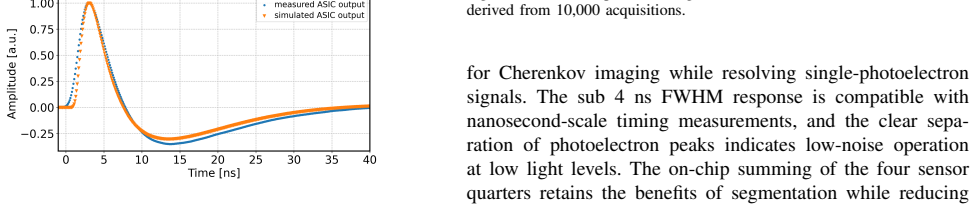
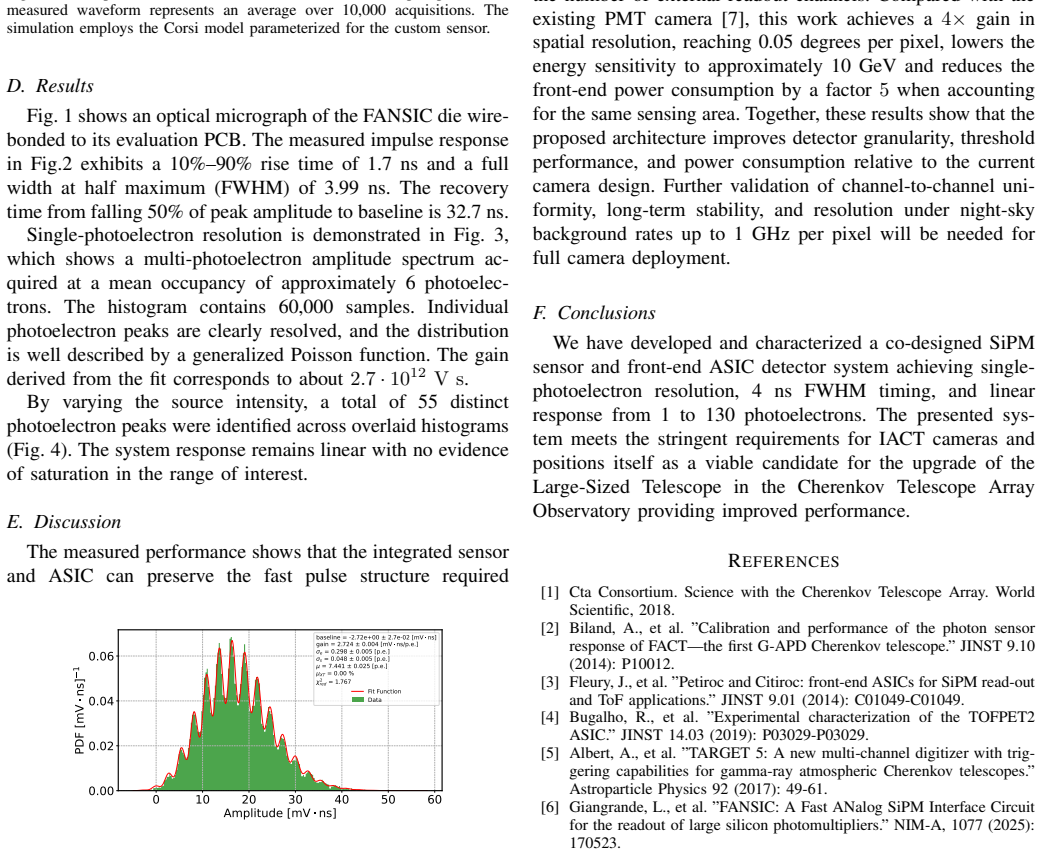
The co-designed hexagonal SiPM sensor and FANSIC ASIC deliver clear single-photoelectron peak separation with a gain of 2.7 times 10 to the minus 12 V s, an impulse response below 4 ns FWHM and 1.7 ns rise time that preserves the nanosecond structure of Cherenkov pulses, linear response from 1 to 130 photoelectrons, and resolution of 55 distinct peaks, demonstrating that the architecture meets the speed, resolution, and dynamic range needed for imaging atmospheric Cherenkov telescopes while providing a scalable path to large-area camera modules.
What carries the argument
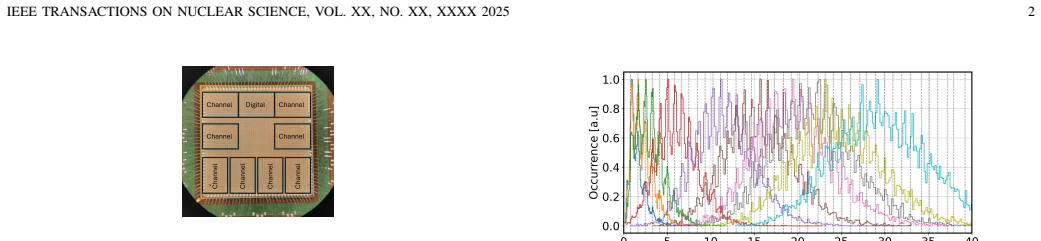
The hexagonal SiPM sensor with integrated optical filter and fourfold pixel segmentation, read out by the eight-channel FANSIC ASIC fabricated in 65 nm CMOS that performs on-chip analog summing.
If this is right
- The sub-4 ns impulse response preserves the temporal structure of Cherenkov light pulses for accurate reconstruction.
- Linearity from 1 to 130 photoelectrons and resolution of 55 peaks support precise intensity measurements across typical signal ranges.
- On-chip summing and 24 mW per channel power draw enable scaling to large camera arrays without prohibitive electronics overhead.
- The integrated design reduces external components, improving reliability for telescope cameras.
- The 1.7 ns rise time allows capture of the fastest features in atmospheric Cherenkov flashes.
Where Pith is reading between the lines
- If the design scales as claimed, it could support cameras with thousands of pixels while keeping total power and noise manageable.
- The fourfold segmentation combined with analog summing may permit finer spatial sampling in future telescope focal planes without added readout complexity.
- Successful translation to field conditions would open similar architectures for other fast photon-counting applications such as fluorescence detection in air-shower arrays.
Load-bearing premise
Laboratory performance measured with controlled light sources will translate without significant loss to the variable temperature, background light, and full integration conditions of an actual Cherenkov telescope camera array.
What would settle it
A field deployment of the sensor-ASIC module on an operating Cherenkov telescope that measures single-photoelectron peak separation and timing resolution under real night-sky background and temperature swings would confirm or refute whether the laboratory results hold in practice.
Figures
read the original abstract
Silicon photomultipliers are increasingly replacing photomultiplier tubes in Cherenkov telescope cameras, but achieving single-photoelectron resolution with nanosecond timing in a low-noise, scalable detector system remains challenging. We present a co-designed SiPM sensor and front-end application specific integrated circuit (ASIC) that meets these requirements. The custom hexagonal sensor, developed with Hamamatsu Photonics, incorporates an integrated optical filter and fourfold pixel segmentation. The readout is performed by a second prototype of the FANSIC ASIC, optimized for this application and fabricated in 65~nm standard CMOS technology, it provides eight channels with on-chip analog summing of sub-channels on a $3.5\times 3.5~\mathrm{mm}^2$ die, while consuming only 24~mW per channel. We demonstrate clear single-photoelectron peak separation with a gain of $2.7 \times 10^{-12}~ \mathrm{V \cdot s}$ , and an impulse response below 4~ns full width at half maximum with a 1.7 ns rise time, preserving the nanosecond-scale structure of Cherenkov pulses. The system responds linearly from 1 to 130 photoelectrons, and 55 distinct photoelectron peaks are resolved by varying the source intensity. These results demonstrate that the integrated sensor-electronics architecture delivers the speed, resolution, and dynamic range required for imaging atmospheric Cherenkov telescopes, and provides a scalable path toward large-area camera modules.
Editorial analysis
A structured set of objections, weighed in public.
Referee Report
Summary. The manuscript presents a co-designed hexagonal SiPM sensor (with integrated optical filter and fourfold segmentation, developed with Hamamatsu) and a prototype FANSIC ASIC (65 nm CMOS, eight channels with on-chip analog summing, 24 mW/channel). Laboratory tests are reported to show clear single-photoelectron peak separation at a gain of 2.7 × 10^{-12} V·s, an impulse response with 1.7 ns rise time and <4 ns FWHM, linear response from 1 to 130 photoelectrons, and resolution of 55 distinct peaks by varying source intensity. The authors conclude that the architecture meets the speed, resolution, and dynamic range needs of imaging atmospheric Cherenkov telescopes and offers a scalable path to large-area camera modules.
Significance. If the reported laboratory metrics hold upon detailed verification, the work would be significant for Cherenkov astronomy by demonstrating a low-power, integrated SiPM-ASIC solution capable of preserving nanosecond Cherenkov pulse structure while achieving single-PE resolution and high dynamic range. The emphasis on scalability and power efficiency addresses key engineering constraints for next-generation IACT camera arrays.
major comments (2)
- [Abstract] Abstract: the central claims of 'clear single-photoelectron peak separation', <4 ns FWHM impulse response, and linearity to 130 PE are presented without any description of the experimental setup, light source calibration, data acquisition method, or error analysis. These omissions are load-bearing because the entire demonstration of suitability for IACTs rests on the validity and reproducibility of these unshown measurements.
- [Abstract] Abstract: no measurements or discussion are provided on performance under realistic telescope conditions such as continuous night-sky background rates (typically tens of MHz per pixel), temperature-induced shifts in SiPM breakdown voltage/gain, or long-term stability. This gap directly undermines the claim that the lab metrics 'deliver the speed, resolution, and dynamic range required for imaging atmospheric Cherenkov telescopes'.
minor comments (1)
- [Abstract] The gain unit is given as V·s; a brief clarification of whether this represents integrated charge or another quantity, and how it was extracted from the single-PE peak, would improve interpretability.
Simulated Author's Rebuttal
We thank the referee for the thorough review and valuable feedback. The comments highlight important aspects of clarity and completeness in presenting our laboratory results. We address each major comment point by point below and will incorporate revisions to strengthen the manuscript.
read point-by-point responses
-
Referee: [Abstract] Abstract: the central claims of 'clear single-photoelectron peak separation', <4 ns FWHM impulse response, and linearity to 130 PE are presented without any description of the experimental setup, light source calibration, data acquisition method, or error analysis. These omissions are load-bearing because the entire demonstration of suitability for IACTs rests on the validity and reproducibility of these unshown measurements.
Authors: We agree that the abstract, as a concise summary, omits key methodological details that support the central claims. The full manuscript includes a dedicated experimental section describing the setup: a calibrated pulsed LED light source with intensity controlled via neutral density filters and verified against a reference photodiode, data acquisition via a 5 GS/s oscilloscope for waveform capture, and error analysis through multi-Gaussian fits to charge spectra with uncertainties from repeated measurements and baseline noise subtraction. To address this, we will revise the abstract to briefly note the use of a calibrated pulsed source and high-speed digitization, while directing readers to the methods for full reproducibility. revision: yes
-
Referee: [Abstract] Abstract: no measurements or discussion are provided on performance under realistic telescope conditions such as continuous night-sky background rates (typically tens of MHz per pixel), temperature-induced shifts in SiPM breakdown voltage/gain, or long-term stability. This gap directly undermines the claim that the lab metrics 'deliver the speed, resolution, and dynamic range required for imaging atmospheric Cherenkov telescopes'.
Authors: We acknowledge that the work is a laboratory demonstration and does not include new measurements under continuous high-rate night-sky background (NSB) or extended temperature cycling. The manuscript discusses how the 1.7 ns rise time and low power enable pile-up rejection for typical NSB rates via timing discrimination, and notes standard bias compensation for temperature shifts (as SiPM gain variation is well-characterized). Long-term stability data are not presented, as the study focuses on prototype characterization. We will add a dedicated discussion paragraph on expected performance under realistic conditions, referencing the architecture's design margins and prior SiPM literature, to better support the suitability claim without overstating the lab results. revision: partial
Circularity Check
No circularity: purely experimental hardware demonstration
full rationale
The paper reports direct laboratory measurements of a co-designed SiPM sensor and FANSIC ASIC, including single-PE peak separation at a stated gain of 2.7e-12 V·s, <4 ns FWHM impulse response, 1.7 ns rise time, and linearity to 130 PE with 55 resolved peaks. These are presented as measured outcomes from controlled light sources with no equations, derivations, fitted parameters renamed as predictions, or self-citations invoked to justify uniqueness. The central claim follows immediately from the reported metrics without any reduction to inputs by construction, rendering the work self-contained.
Axiom & Free-Parameter Ledger
Reference graph
Works this paper leans on
-
[1]
Science with the Cherenkov Telescope Array
Cta Consortium. Science with the Cherenkov Telescope Array. World Scientific, 2018
work page 2018
-
[2]
Biland, A., et al. ”Calibration and performance of the photon sensor response of FACT—the first G-APD Cherenkov telescope.” JINST 9.10 (2014): P10012
work page 2014
-
[3]
Fleury, J., et al. ”Petiroc and Citiroc: front-end ASICs for SiPM read-out and ToF applications.” JINST 9.01 (2014): C01049-C01049
work page 2014
-
[4]
”Experimental characterization of the TOFPET2 ASIC.” JINST 14.03 (2019): P03029-P03029
Bugalho, R., et al. ”Experimental characterization of the TOFPET2 ASIC.” JINST 14.03 (2019): P03029-P03029
work page 2019
-
[5]
Albert, A., et al. ”TARGET 5: A new multi-channel digitizer with trig- gering capabilities for gamma-ray atmospheric Cherenkov telescopes.” Astroparticle Physics 92 (2017): 49-61
work page 2017
-
[6]
Giangrande, L., et al. ”FANSIC: A Fast ANalog SiPM Interface Circuit for the readout of large silicon photomultipliers.” NIM-A, 1077 (2025): 170523
work page 2025
-
[7]
Sanuy, A., et al. ”Wideband (500 MHz) 16 bit dynamic range current mode PreAmplifier for the CTA cameras (PACTA).” JINST 7.01 (2012): C01100-C01100
work page 2012
discussion (0)
Sign in with ORCID, Apple, or X to comment. Anyone can read and Pith papers without signing in.