Recognition: no theorem link
SAPLE: Swift Analysis Pipeline for Lightcurve Extraction
Pith reviewed 2026-05-12 05:09 UTC · model grok-4.3
The pith
A semi-automated pipeline extracts absorption-corrected fluxes and photon indices from Swift UVOT and XRT observations.
A machine-rendered reading of the paper's core claim, the machinery that carries it, and where it could break.
Core claim
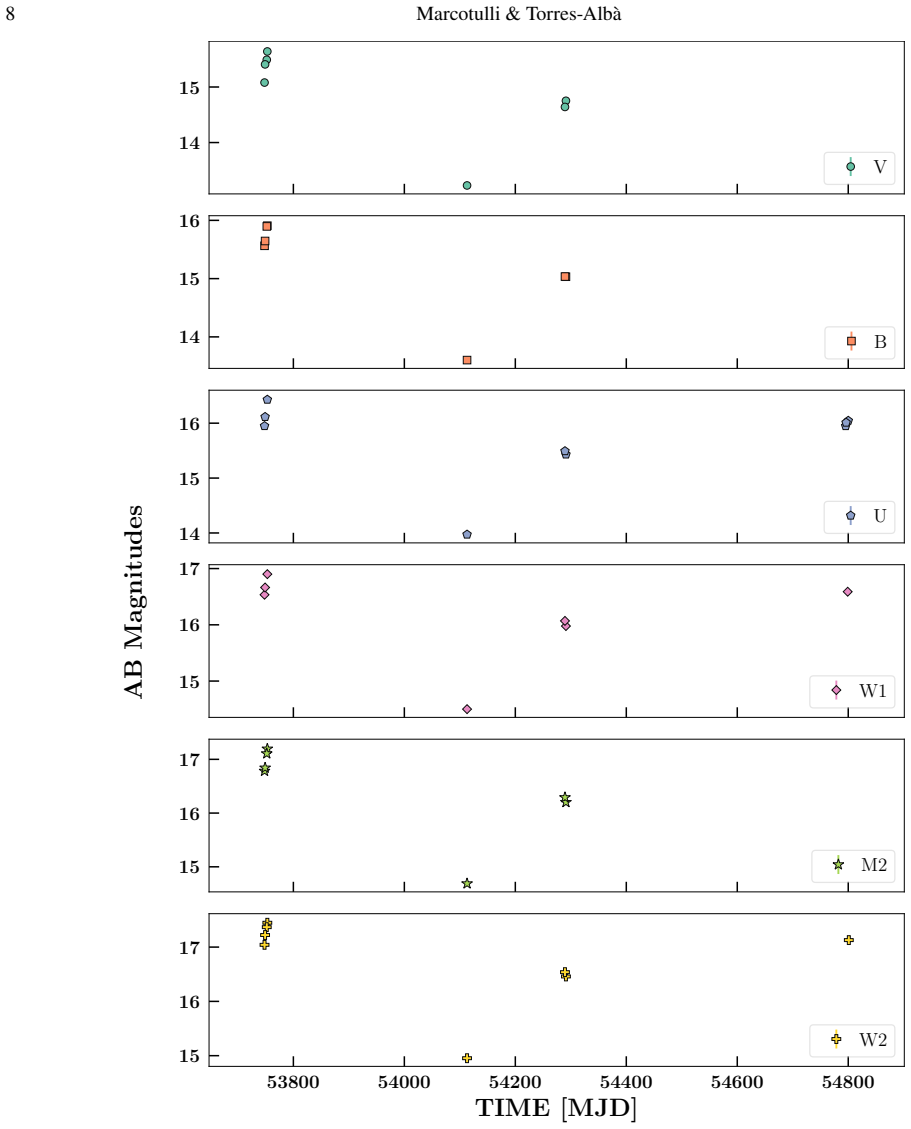
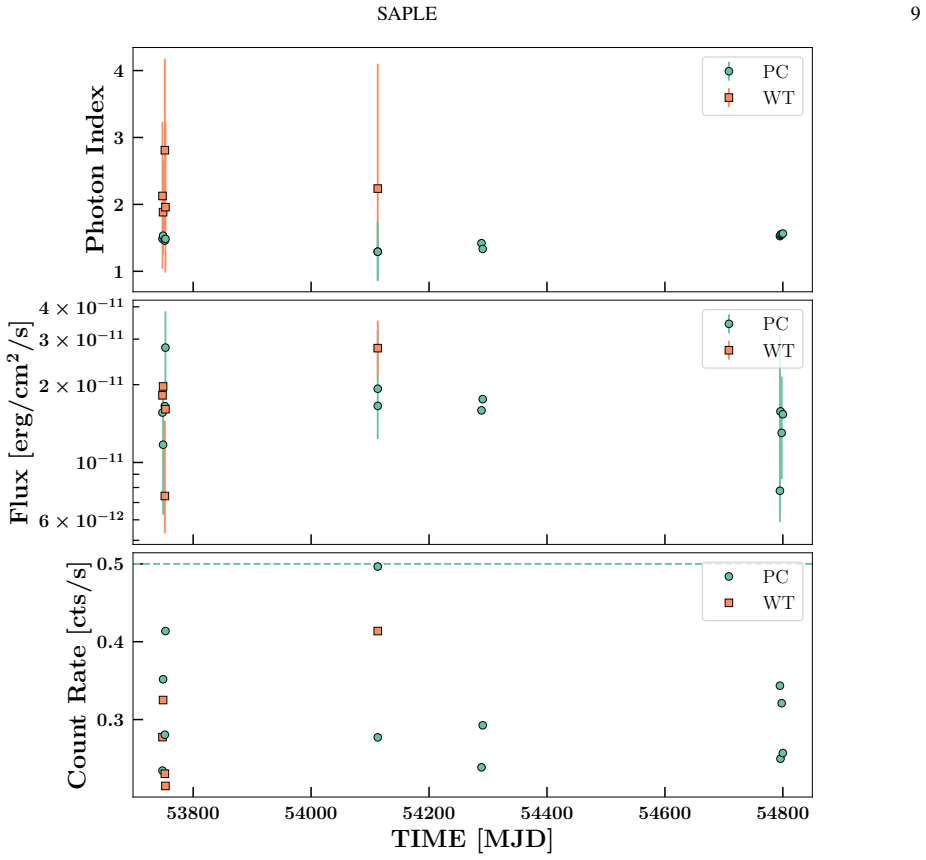
The pipeline extracts Swift-UVOT and Swift-XRT data products and spectral information including magnitudes, photon indices, and fluxes for a set of observations of any point source. It returns absorption-corrected specific fluxes for any UVOT observation and filter of interest. For XRT data it produces lightcurves of both flux and photon index with associated uncertainties assuming a redshifted powerlaw spectrum. The pipeline implements standard data reduction, background subtraction, and spectral fitting steps to generate these products.
What carries the argument
The SAPLE pipeline that automates data reduction steps, background subtraction, spectral fitting for XRT, and absorption corrections for UVOT fluxes.
If this is right
- Lightcurves become available for both ultraviolet and X-ray bands from the same set of observations.
- Absorption corrections are applied automatically to specific fluxes in each UV filter.
- X-ray outputs track the evolution of spectral shape through the photon index alongside intensity.
- Users obtain consistent results with uncertainties for any chosen point source without custom scripting.
Where Pith is reading between the lines
- Adoption could reduce variability in results across different groups analyzing the same Swift datasets.
- The approach supports faster follow-up on transient events by shortening the time from observation to usable lightcurves.
- It could be extended to test alternative spectral models or combine outputs with data from other facilities.
Load-bearing premise
Standard data reduction and background subtraction steps are implemented without introducing unaccounted systematic errors, and a redshifted power-law spectrum adequately models the XRT observations.
What would settle it
Direct comparison of pipeline outputs for fluxes, magnitudes, and photon indices against independent manual reductions of the same Swift observations on a test set of sources.
Figures


read the original abstract
We present the Swift Analysis Pipeline for Lightcurve Extraction (SAPLE), a semi-automated pipeline to extract the Swift-UVOT and Swift-XRT data products and spectral information (magnitudes, photon indices, and fluxes) for a set of observations of any point source of interest. This pipeline is not meant to substitute, but to complement the tools the Swift team has already set up. Specifically, SAPLE provides a Swift-UVOT semi-automated pipeline that also returns the absorption corrected specific fluxes for any observation and filter of interest, a tool which to our knowledge is not publicly available to the community yet. Moreover, for Swift-XRT, SAPLE enables the user to extract a lightcurve of both flux and photon index (with associated uncertainties), assuming a redshifted powerlaw spectrum. The main codes are available through a GitHub repository (L. Marcotulli & N. Torres-Alb\`a 2026), and the following paper summarizes the main steps of the analysis.
Editorial analysis
A structured set of objections, weighed in public.
Referee Report
Summary. The paper presents SAPLE, a semi-automated pipeline for extracting Swift-UVOT and Swift-XRT data products (magnitudes, absorption-corrected specific fluxes, photon indices, and fluxes) for point sources. It claims to complement official Swift tools by providing UVOT absorption-corrected fluxes (not publicly available elsewhere) and XRT lightcurves of both flux and photon index under an explicit redshifted power-law spectral assumption. The main codes are released on GitHub, and the manuscript summarizes the analysis steps.
Significance. The public availability of the code on GitHub is a strength that supports reproducibility and community adoption. If the implementation matches the described steps, SAPLE would provide a useful addition to the Swift analysis ecosystem by enabling convenient access to absorption-corrected UVOT fluxes and joint flux-plus-photon-index XRT lightcurves, which could facilitate multi-wavelength studies of transients and variable sources.
major comments (1)
- [Pipeline description and methods summary] The manuscript describes the intended functionality, assumptions, and high-level steps but contains no validation tests, error budgets, comparisons to existing Swift tools (e.g., the official UVOT/XRT pipelines or xrtpipeline), or example applications with known sources. This omission makes it impossible to assess whether standard reduction steps (background subtraction, aperture photometry, spectral fitting) are implemented without unaccounted systematics or whether the redshifted power-law model is adequate for the intended XRT sources (see abstract and pipeline summary sections).
minor comments (2)
- [Abstract] The GitHub citation in the abstract ('L. Marcotulli & N. Torres-Albà 2026') should be updated to the correct reference or year once the repository is finalized.
- [UVOT processing summary] Clarify the exact list of supported UVOT filters and any restrictions on source brightness or observation modes.
Simulated Author's Rebuttal
We thank the referee for their constructive review and for highlighting the strengths of the publicly released code. We address the single major comment below.
read point-by-point responses
-
Referee: The manuscript describes the intended functionality, assumptions, and high-level steps but contains no validation tests, error budgets, comparisons to existing Swift tools (e.g., the official UVOT/XRT pipelines or xrtpipeline), or example applications with known sources. This omission makes it impossible to assess whether standard reduction steps (background subtraction, aperture photometry, spectral fitting) are implemented without unaccounted systematics or whether the redshifted power-law model is adequate for the intended XRT sources (see abstract and pipeline summary sections).
Authors: We agree that the current manuscript is primarily a high-level description of the pipeline steps and does not contain the requested validation material. In the revised version we will add a dedicated validation section. This will include (i) side-by-side comparisons of SAPLE magnitudes, absorption-corrected fluxes, and XRT photon indices against the official Swift UVOT and XRT pipelines for a set of calibration sources, (ii) a quantitative discussion of the error budget for background subtraction, aperture photometry, and spectral fitting steps, and (iii) example light-curve extractions for known transients to demonstrate performance under the redshifted power-law assumption. The GitHub repository will be updated with the corresponding test scripts. revision: yes
Circularity Check
No significant circularity identified
full rationale
This is a software pipeline description paper with no theoretical derivations, equations, fitted parameters presented as predictions, or load-bearing self-citations. The manuscript summarizes standard Swift-UVOT and XRT data reduction steps (background subtraction, spectral fitting under an explicit redshifted power-law model) and points to public GitHub code for implementation. Outputs such as magnitudes, absorption-corrected fluxes, and photon-index light curves are produced by applying documented procedures under stated assumptions; no step reduces to its own inputs by construction or via an internal loop. The work is self-contained as a practical tool complementing existing Swift resources.
Axiom & Free-Parameter Ledger
axioms (1)
- domain assumption X-ray spectra of point sources can be modeled as a redshifted power-law for the purpose of extracting flux and photon index
Reference graph
Works this paper leans on
-
[1]
Arnaud, K. A. 1996, XSPEC: The First Ten Years, in Astronomical Society of the Pacific Conference Series, Vol. 101, Astronomical Data Analysis Software and Systems V, ed. G. H. Jacoby & J. Barnes, 17
work page 1996
-
[2]
Barthelmy, S. D., Barbier, L. M., Cummings, J. R., et al. 2005, The Burst Alert Telescope (BAT) on the SWIFT Midex Mission, Space Sci. Rev., 120, 143, doi:10.1007/s11214-005-5096-3
-
[3]
2022, The scientific payload of the Ultraviolet Transient Astronomy Satellite (ULTRASAT), in
Ben-Ami, S., Shvartzvald, Y., Waxman, E., et al. 2022, The scientific payload of the Ultraviolet Transient Astronomy Satellite (ULTRASAT), in
work page 2022
-
[4]
12181, Space Telescopes and Instrumentation 2022: Ultraviolet to Gamma Ray, ed
SPIE, Vol. 12181, Space Telescopes and Instrumentation 2022: Ultraviolet to Gamma Ray, ed. J.-W. A. den Herder, S. Nikzad, & K. Nakazawa, 1218105, doi:10.1117/12.2629850
-
[5]
Breeveld, A. A., Landsman, W., Holland, S. T., et al. 2011, An Updated Ultraviolet Calibration for the Swift/UVOT, in AIP, Vol. 1358, Gamma Ray Bursts 2010, ed. J. E. McEnery, J. L. Racusin, & N. Gehrels (AIP), 373–376, doi:10.1063/1.3621807
-
[6]
Buchner, J., & Boorman, P. 2023, Statistical Aspects of X-ray Spectral Analysis, in Handbook of X-ray and Gamma-ray Astrophysics (Springer Singapore), 150, doi:10.1007/978-981-16-4544-0_175-1
-
[7]
Buchner, J., Georgakakis, A., Nandra, K., et al. 2014, X-ray spectral modelling of the AGN obscuring region in the CDFS: Bayesian model selection and catalogue, A&A, 564, A125, doi:10.1051/0004-6361/201322971
work page internal anchor Pith review doi:10.1051/0004-6361/201322971 2014
- [8]
-
[9]
Telescope, Space Sci. Rev., 120, 165, doi:10.1007/s11214-005-5097-2
-
[10]
Cruise, M., Guainazzi, M., Aird, J., et al. 2025, The NewAthena mission concept in the context of the next decade of X-ray astronomy, Nature Astronomy, 9, 36, doi:10.1038/s41550-024-02416-3
-
[11]
Evans, P. A., Page, K. L., Beardmore, A. P., et al. 2023, A real-time transient detector and the living Swift-XRT point source catalogue, MNRAS, 518, 174, doi:10.1093/mnras/stac2937
-
[12]
Evans, P. A., Cenko, S. B., Kennea, J. A., et al. 2017, Swift and NuSTAR observations of GW170817: Detection of a blue kilonova, Science, 358, 1565, doi:10.1126/science.aap9580
-
[13]
Gordon, C., & Arnaud, K. 2021, PyXspec: Python interface to XSPEC spectral-fitting program„ Astrophysics Source Code Library, record ascl:2101.014http://ascl.net/2101.014 Heasarc. 2014, HEAsoft: Unified Release of FTOOLS and XANADU„ Astrophysics Source Code Library, record ascl:1408.004 http://ascl.net/1408.004 IceCube Collaboration, Aartsen, M. G., Acker...
-
[14]
Kulkarni, S. R., Harrison, F. A., Grefenstette, B. W., et al. 2021, Science with the Ultraviolet Explorer (UVEX), arXiv e-prints, arXiv:2111.15608, doi:10.48550/arXiv.2111.15608
-
[15]
2026, SAPLE - Swift Analysis Pipeline for Lightcurve Extraction, v1.0.0 GitHub
Marcotulli, L., & Torres-Albà, N. 2026, SAPLE - Swift Analysis Pipeline for Lightcurve Extraction, v1.0.0 GitHub. https://github.com/leamarcotulli/saple/
work page 2026
-
[16]
Parsotan, T., Palmer, D. M., Ronchini, S., et al. 2025, BatAnalysis—A Comprehensive Python Pipeline for Swift BAT Time-tagged Event Data
work page 2025
-
[17]
Analysis, ApJ, 988, 23, doi:10.3847/1538-4357/ade240 Peñil, P., Torres-Albà, N., Marcotulli, L., et al. 2026, Testing X-ray Periodicity and Long-Term Trend in PG 1553+113 via Targeted Swift-XRT Monitoring, arXiv e-prints, arXiv:2604.05905, doi:10.48550/arXiv.2604.05905 Peñil, P., Westernacher-Schneider, J. R., Ajello, M., et al. 2024a, Multiwavelength ana...
work page internal anchor Pith review Pith/arXiv arXiv doi:10.3847/1538-4357/ade240 2026
-
[18]
Poole, T. S., Breeveld, A. A., Page, M. J., et al. 2008, Photometric calibration of the Swift ultraviolet/optical telescope, MNRAS, 383, 627, doi:10.1111/j.1365-2966.2007.12563.x
-
[19]
Romano, P., Campana, S., Chincarini, G., et al. 2006, Panchromatic study of GRB 060124: from precursor to afterglow, A&A, 456, 917, doi:10.1051/0004-6361:20065071
-
[20]
Roming, P. W. A., Kennedy, T. E., Mason, K. O., et al. 2005, The Swift Ultra-Violet/Optical Telescope, Space Sci. Rev., 120, 95, doi:10.1007/s11214-005-5095-4
-
[21]
Roming, P. W. A., Koch, T. S., Oates, S. R., et al. 2008, THE FIRST SWIFT ULTRAVIOLET/OPTICAL TELESCOPE GRB AFTERGLOW
work page 2008
-
[22]
CATALOG, The Astrophysical Journal, 690, 163, doi:10.1088/0004-637X/690/1/163
-
[23]
Tohuvavohu, A., Kennea, J. A., Roberts, C. J., et al. 2024, Swiftly Chasing Gravitational Waves across the Sky in Real Time, ApJ, 975, L19, doi:10.3847/2041-8213/ad87ce
-
[24]
Wilms, J., Allen, A., & McCray, R. 2000, On the Absorption of X-Rays in the Interstellar Medium, ApJ, 542, 914, doi:10.1086/317016
work page internal anchor Pith review doi:10.1086/317016 2000
-
[25]
Yi, F., Haibo, Y., Ruoyi, Z., Jian, G., & Shuai, X. 2023, Empirical extinction coefficients for the Swift-UVOT optical-through-ultraviolet passbands, MNRAS, 525, 2701, doi:10.1093/mnras/stad2463 ThispaperwasbuiltusingtheOpenJournalofAstrophysics LATEX template. The OJA is a journal which provides fast and easypeerreviewfornewpapersintheastro-phsectionofth...
discussion (0)
Sign in with ORCID, Apple, or X to comment. Anyone can read and Pith papers without signing in.