Recognition: 2 theorem links
· Lean TheoremSyndrome Adaptive Gain Control for Min-Sum Decoding of Quantum LDPC Codes
Pith reviewed 2026-05-12 05:22 UTC · model grok-4.3
The pith
A decoder that adjusts its scaling factor online from unsatisfied stabilizers matches optimized fixed-scaling min-sum and nears belief propagation performance for quantum LDPC codes.
A machine-rendered reading of the paper's core claim, the machinery that carries it, and where it could break.
Core claim
The paper claims that the syndrome adaptive gain Min-Sum decoder, which sets its message scaling factor at each iteration from the current fraction of unsatisfied stabilizers, achieves frame error rates that match or exceed those of an offline-optimized scaled Min-Sum decoder and approach those of belief propagation on generalized bicycle quantum LDPC codes, all while operating at min-sum computational cost.
What carries the argument
The syndrome adaptive gain Min-Sum (SAGMS) decoder, which computes a time-varying scaling factor from the fraction of unsatisfied stabilizers to correct the systematic overestimation of message magnitudes that occurs in plain min-sum check-node updates.
If this is right
- Fixed scaling factors become unnecessary, removing the performance loss that arises whenever check-node degree varies across a code.
- Decoders can be deployed without separate optimization runs for each code family or noise variance.
- Min-sum complexity is retained while the gap to belief propagation narrows or disappears under the tested conditions.
- Error-correction performance remains stable even when the underlying code or noise statistics are not known in advance.
Where Pith is reading between the lines
- The same unsatisfied-stabilizer signal could be used to adapt other iterative message-passing rules beyond plain min-sum.
- Hardware realizations could exploit the self-adjusting property to reduce the amount of calibration logic required.
- The approach may extend to classical LDPC codes where degree variation or unknown channel parameters also degrade fixed-scaling performance.
Load-bearing premise
That the fraction of unsatisfied stabilizers by itself supplies enough information to choose a near-optimal scaling factor for any code structure and any noise level.
What would settle it
A simulation result on a generalized bicycle quantum LDPC code and a chosen noise level in which the SAGMS decoder produces a higher frame error rate than a carefully tuned fixed-scaling SMS decoder.
Figures


read the original abstract
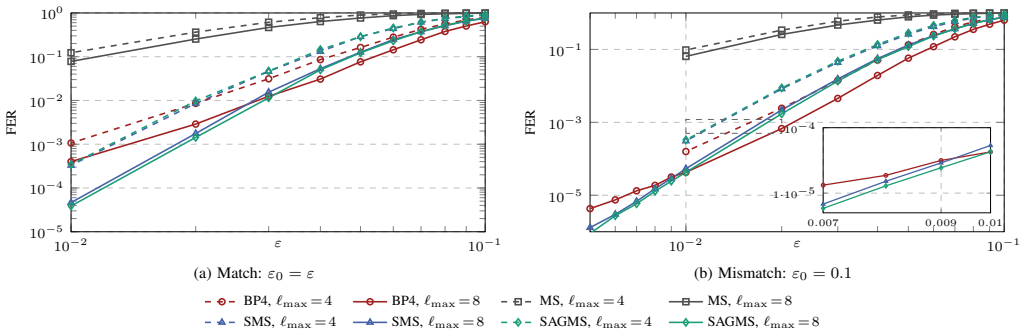
Min-Sum (MS) decoding is a popular low-complexity alternative to belief propagation (BP), retaining only the minimum incoming message magnitude during check-node (CN) processing, at the cost of systematic message magnitude overestimation. The scaled MS (SMS) decoder compensates for this effect using a fixed scaling factor. We propose the syndrome adaptive gain Min-Sum (SAGMS) decoder for quantum low-density parity-check (QLDPC) codes, which adapts the message gain online based on the fraction of unsatisfied stabilizers, requiring no per-code or per-noise level optimization. We show that the scaling factor required for SMS to match belief propagation decreases with the CN degree, so any fixed scaling optimized for one degree incurs into a growing penalty as the CN degree varies. SAGMS avoids this limitation by adapting the gain during decoding. Simulations on generalized bicycle QLDPC codes demonstrate that SAGMS matches or outperforms the frame error rate (FER) of an offline optimized SMS decoder. Moreover, SAGMS approaches BP performance and, under certain conditions outperforms it while retaining MS-level complexity.
Editorial analysis
A structured set of objections, weighed in public.
Referee Report
Summary. The paper proposes the syndrome adaptive gain Min-Sum (SAGMS) decoder for quantum LDPC codes. SAGMS dynamically sets the message scaling gain at each iteration using only the instantaneous fraction of unsatisfied stabilizers, eliminating the need for per-code or per-noise offline optimization required by fixed-scale scaled Min-Sum (SMS). The authors note that the SMS scaling factor needed to approach BP performance decreases with check-node degree, so any fixed scale incurs growing penalties across heterogeneous degrees; SAGMS sidesteps this by adapting online. Simulations on generalized bicycle QLDPC codes show SAGMS matches or exceeds the FER of an offline-optimized SMS decoder, approaches BP performance, and under some conditions outperforms BP while retaining MS-level complexity.
Significance. If the adaptation rule generalizes, the work supplies a low-complexity, tuning-free decoder for QLDPC codes that closes much of the gap to BP. This is valuable for practical quantum error correction, where decoder complexity and parameter sensitivity are bottlenecks. The approach usefully exploits online syndrome information to handle degree variation without explicit optimization, and the reported simulations provide concrete evidence of gains on the tested family.
major comments (2)
- [Simulation results and adaptation-rule sections] The central claim that SAGMS requires no per-code or per-noise optimization rests on the untested assumption that the unsatisfied-stabilizer fraction alone is a sufficient statistic for the optimal gain, independent of Tanner-graph structure, check locations, and code degeneracy. Simulations are reported only for generalized bicycle QLDPC codes; without results on other families (e.g., hypergraph-product codes), the generality of the heuristic cannot be assessed and the “no optimization” claim remains scoped to one construction.
- [Proposed decoder definition] The exact functional mapping from unsatisfied-stabilizer fraction to gain value (including any thresholds, piecewise definitions, or constants) is load-bearing for the reproducibility and “parameter-free” claim. If this mapping was selected or fitted on the bicycle codes used in the experiments, the adaptation is not truly free of per-code choices, contradicting the abstract statement that SAGMS requires no per-code optimization.
minor comments (2)
- [Abstract and simulation section] The abstract reports performance gains but omits the number of Monte Carlo trials, whether error bars or confidence intervals are shown, exact code parameters (n, k, d), and the precise noise model (depolarizing, etc.). These details should appear in the simulation section for verification.
- [Notation and figures] Notation for the gain factor, the unsatisfied fraction, and iteration index should be introduced once and used consistently; minor inconsistencies in variable names appear between the method description and the figures.
Simulated Author's Rebuttal
We thank the referee for the constructive feedback and positive assessment of the significance of the SAGMS decoder. Below we respond point-by-point to the major comments, indicating where revisions will be incorporated.
read point-by-point responses
-
Referee: [Simulation results and adaptation-rule sections] The central claim that SAGMS requires no per-code or per-noise optimization rests on the untested assumption that the unsatisfied-stabilizer fraction alone is a sufficient statistic for the optimal gain, independent of Tanner-graph structure, check locations, and code degeneracy. Simulations are reported only for generalized bicycle QLDPC codes; without results on other families (e.g., hypergraph-product codes), the generality of the heuristic cannot be assessed and the “no optimization” claim remains scoped to one construction.
Authors: We agree that the empirical validation is currently limited to generalized bicycle codes. However, the adaptation rule is motivated by the general, code-independent observation (detailed in Section II of the manuscript) that the SMS scaling factor required to approach BP performance decreases with check-node degree. The unsatisfied-stabilizer fraction is employed precisely because it is a direct, online measure of syndrome satisfaction that does not depend on specific Tanner-graph structure, check locations, or degeneracy. The same fixed adaptation function is applied without any per-code tuning. We acknowledge that results on additional families such as hypergraph-product codes would strengthen the generality claim. In the revised manuscript we will add an explicit discussion of the current scope and the structural independence of the heuristic. revision: partial
-
Referee: [Proposed decoder definition] The exact functional mapping from unsatisfied-stabilizer fraction to gain value (including any thresholds, piecewise definitions, or constants) is load-bearing for the reproducibility and “parameter-free” claim. If this mapping was selected or fitted on the bicycle codes used in the experiments, the adaptation is not truly free of per-code choices, contradicting the abstract statement that SAGMS requires no per-code optimization.
Authors: The exact mapping is defined in Section III as a fixed, deterministic function of the instantaneous unsatisfied-stabilizer fraction, using only universal constants chosen from the general degree-dependent scaling behavior rather than any fitting or optimization on the bicycle codes. No code-specific thresholds, piecewise adjustments, or parameters are introduced. Consequently, the decoder can be deployed on any new QLDPC code or noise level with no offline optimization, consistent with the abstract claim. We will verify that the definition is presented with complete reproducibility in the revision, but the claim itself requires no modification. revision: no
Circularity Check
No circularity detected; adaptation heuristic validated externally by simulation
full rationale
The paper defines the SAGMS adaptation rule directly from the instantaneous fraction of unsatisfied stabilizers without referencing the target FER or BP performance in its construction. Claims of matching offline-optimized SMS or approaching BP performance are supported solely by reported simulation results on generalized bicycle QLDPC codes rather than any self-referential equation, fitted parameter renamed as prediction, or load-bearing self-citation. The method is presented as a practical heuristic with no uniqueness theorem or ansatz smuggled from prior author work, making the derivation self-contained against external benchmarks.
Axiom & Free-Parameter Ledger
axioms (2)
- domain assumption Min-Sum decoding systematically overestimates message magnitudes relative to belief propagation
- domain assumption The scaling factor required for SMS to match BP decreases with check-node degree
Lean theorems connected to this paper
-
IndisputableMonolith/Cost/FunctionalEquation.leanwashburn_uniqueness_aczel unclearSAGMS adapts the message gain online based on the fraction of unsatisfied stabilizers... α_eff = [α_max − (α_max − α_min)γ] · η_unsat
-
IndisputableMonolith/Foundation/DimensionForcing.leanalexander_duality_circle_linking unclearProposition 1: α⋆(L0, d_c) is strictly decreasing in d_c
Reference graph
Works this paper leans on
-
[1]
Asymptotically good quantum and classical LDPC codes from expander graphs,
P. Panteleev and G. Kalachev, “Asymptotically good quantum and classical LDPC codes from expander graphs,”IEEE Trans. Inf. Theory, vol. 70, no. 1, pp. 1–23, 2024
work page 2024
-
[2]
A. Leverrier and G. Z´emor, “Quantum Tanner codes,”Proc. IEEE FOCS, pp. 872–883, 2022
work page 2022
-
[3]
J. P. Tillich and G. Zemor, “Quantum ldpc codes with positive rate and minimum distance proportional to the square root of the blocklength,” IEEE Transactions on Information Theory, vol. 60, no. 2, pp. 1193–1202, 2014
work page 2014
-
[4]
Sparse-graph codes for quantum error correction,
D. J. C. MacKay, G. Mitchison, and P. L. McFadden, “Sparse-graph codes for quantum error correction,”IEEE Transactions on Information Theory, vol. 50, no. 10, pp. 2315–2330, 2004
work page 2004
-
[5]
Quantum graphical models and belief propagation,
M. S. Leifer and D. Poulin, “Quantum graphical models and belief propagation,”Annals of Physics, vol. 323, no. 8, pp. 1899–1946, 2008
work page 1946
-
[6]
Stabilizer codes and quantum error correction,
D. Gottesman, “Stabilizer codes and quantum error correction,” Ph.D. dissertation, California Institute of Technology, 1997
work page 1997
-
[7]
Near optimum universal belief propagation based decoding of low-density parity check codes,
J. Chen and M. P. Fossorier, “Near optimum universal belief propagation based decoding of low-density parity check codes,”IEEE Trans. Commun., vol. 50, no. 3, pp. 406–414, 2002
work page 2002
-
[8]
Reduced complexity decoding of ldpc codes,
J. Chen and M. Fossorier, “Reduced complexity decoding of ldpc codes,” IEEE Transactions on Communications, vol. 53, no. 8, pp. 1288–1299, 2005
work page 2005
-
[9]
Low-density parity-check codes,
R. G. Gallager, “Low-density parity-check codes,”IRE Transactions on Information Theory, vol. 8, no. 1, pp. 21–28, 1962
work page 1962
-
[10]
W. E. Ryan and S. Lin,Channel Codes: Classical and Modern. Cambridge University Press, 2009
work page 2009
-
[11]
S. Miao, A. Schnerring, H. Li, and L. Schmalen, “Quaternary neural belief propagation decoding of quantum ldpc codes with overcomplete check matrices,”IEEE Access, vol. 13, p. 25637–25649, 2025
work page 2025
-
[12]
Variable LLR scaling in min-sum decoding for irregular LDPC codes,
Y . Xu, L. Szczecinski, B. Rong, F. Labeau, D. He, Y . Wu, and W. Zhang, “Variable LLR scaling in min-sum decoding for irregular LDPC codes,” IEEE Trans. Broadcast., vol. 60, no. 4, pp. 606–613, 2014
work page 2014
-
[13]
SNR-considered adaptive scaling for normalized min-sum decoding of LDPC codes,
Y . Jung, C. Park, and J. Kim, “SNR-considered adaptive scaling for normalized min-sum decoding of LDPC codes,”IEEE Commun. Lett., vol. 18, no. 3, pp. 399–402, 2014
work page 2014
-
[14]
Adaptive normalized min-sum algorithm for LDPC decoding,
L. Fan, C. Pan, K. Peng, and J. Huang, “Adaptive normalized min-sum algorithm for LDPC decoding,” inProc. 9th Int. Wireless Commun. Mobile Comput. Conf. (IWCMC), 2013, pp. 1081–1084
work page 2013
-
[15]
Adaptive-normalized/offset min-sum algorithm,
X. Wuet al., “Adaptive-normalized/offset min-sum algorithm,”IEEE Commun. Lett., vol. 14, no. 7, pp. 667–669, 2010
work page 2010
-
[16]
Enhanced min-sum decoding of quantum codes using previous iteration dynamics,
D. Chytas, N. Raveendran, and B. Vasic, “Enhanced min-sum decoding of quantum codes using previous iteration dynamics,” 2025. [Online]. Available: https://arxiv.org/abs/2501.05021
-
[17]
Low- complexity linear programming based decoding of quantum LDPC codes,
S. Javed, F. Garcia-Herrero, B. Vasi ´c, and M. F. Flanagan, “Low- complexity linear programming based decoding of quantum LDPC codes,” inProc. IEEE Int. Symp. Topics in Coding (ISTC), 2023
work page 2023
-
[18]
Log-domain decoding of quantum ldpc codes over binary finite fields,
C.-Y . Lai and K.-Y . Kuo, “Log-domain decoding of quantum ldpc codes over binary finite fields,”IEEE Transactions on Quantum Engineering, vol. 2, p. 1–15, 2021
work page 2021
-
[19]
T. M ¨uller, T. Alexander, M. E. Beverland, M. B ¨uhler, B. R. John- son, T. Maurer, and D. Vandeth, “Improved belief propagation is sufficient for real-time decoding of quantum memory,”arXiv preprint arXiv:2506.01779, 2025
-
[20]
Modified belief propagation decoders for quantum low-density parity-check codes,
A. Rigby, J. C. Olivier, and P. Jarvis, “Modified belief propagation decoders for quantum low-density parity-check codes,”Physical Review A, vol. 100, no. 1, p. 012330, 2019
work page 2019
-
[21]
Stabilizer inactivation for message- passing decoding of quantum ldpc codes,
J. du Crest, M. Mhalla, and V . Savin, “Stabilizer inactivation for message- passing decoding of quantum ldpc codes,” inIEEE Information Theory Workshop, 2022
work page 2022
-
[22]
Localized statistics decoding for quantum low-density parity- check codes,
T. Hillmann, L. Berent, A. O. Quintavalle, J. Eisert, R. Wille, and J. Roffe, “Localized statistics decoding for quantum low-density parity- check codes,”Nature Communications, vol. 16, 2025
work page 2025
-
[23]
Deep learning methods for improved decoding of linear codes,
E. Nachmani, E. Marciano, L. Lugosch, W. J. Gross, D. Burshtein, and Y . Be’ery, “Deep learning methods for improved decoding of linear codes,”IEEE Journal of Selected Topics in Signal Processing, vol. 12, no. 1, pp. 119–131, 2018
work page 2018
-
[24]
Good quantum error-correcting codes exist,
A. R. Calderbank and P. W. Shor, “Good quantum error-correcting codes exist,”Physical Review A, vol. 54, no. 2, pp. 1098–1105, August 1996
work page 1996
-
[25]
High-threshold and low-overhead fault-tolerant quantum memory,
S. Bravyi, A. W. Cross, J. M. Gambetta, D. Maslov, P. Rall, and T. J. Yoder, “High-threshold and low-overhead fault-tolerant quantum memory,”Nature, vol. 627, pp. 778–782, March 2024
work page 2024
-
[26]
Quantum error correction via codes over GF(4),
A. R. Calderbank, E. M. Rains, P. W. Shor, and N. J. A. Sloane, “Quantum error correction via codes over GF(4),”IEEE Transactions on Information Theory, vol. 44, no. 4, pp. 1369–1387, Jul. 1998
work page 1998
-
[27]
Optimal single-shot decoding of quantum codes,
A. Cumitini, S. Tinelli, B. Matuz, F. Lazaro, and L. Barletta, “Optimal single-shot decoding of quantum codes,”IEEE Communications Letters, vol. 28, no. 6, pp. 1243–1247, 2024
work page 2024
-
[28]
J. Zhao, F. Zarkeshvari, and A. H. Banihashemi, “On implementation of min-sum algorithm and its modifications for decoding low-density parity-check (LDPC) codes,”IEEE Trans. Commun., vol. 53, no. 4, pp. 549–554, 2005
work page 2005
-
[29]
T. J. Richardson and R. L. Urbanke,Modern Coding Theory. Cambridge University Press, 2008
work page 2008
-
[30]
Asymptotically good quantum ldpc codes,
P. Panteleev and G. Kalachev, “Asymptotically good quantum ldpc codes,”IEEE Transactions on Information Theory, vol. 68, no. 1, pp. 213–229, 2022
work page 2022
-
[31]
Probable inference, the law of succession, and statistical inference,
E. B. Wilson, “Probable inference, the law of succession, and statistical inference,”J. Amer. Stat. Assoc., vol. 22, no. 158, pp. 209–212, 1927
work page 1927
discussion (0)
Sign in with ORCID, Apple, or X to comment. Anyone can read and Pith papers without signing in.