Recognition: no theorem link
A Flexible Raspberry Pi-Based Data Logger Platform for Modbus Sensors with Ansible Deployment
Pith reviewed 2026-05-12 04:35 UTC · model grok-4.3
The pith
A Raspberry Pi platform lets users deploy custom Modbus sensor networks for monitoring by editing one YAML file and has proven reliable in continuous field use.
A machine-rendered reading of the paper's core claim, the machinery that carries it, and where it could break.
Core claim
The central claim is that LibrePiLogger provides a complete, flexible platform for Modbus-based environmental data logging on Raspberry Pi hardware, with Ansible-based deployment that reduces setup to editing one YAML inventory file, and that this system has demonstrated reliable long-term operation in real-world continuous monitoring of CO2 and radon levels.
What carries the argument
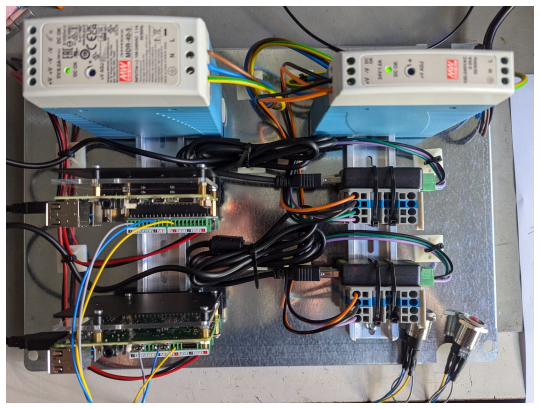
The key mechanism is the combination of Raspberry Pi hardware with RS-485 interfaces, a Python-based sensor communication library that uses a driver template, and Ansible automation scripts, which together allow rapid deployment and data logging to timestamped CSV files with metadata.
If this is right
- Adding support for a new sensor requires only about 100 lines of Python code following the provided template.
- Hardware costs stay between 54 and 63 euros depending on the configuration chosen.
- The system produces timestamped CSV data files accompanied by JSON metadata for easy analysis.
- All designs, code, and scripts are freely available under the GNU General Public License version 3.
- The platform supports ongoing environmental monitoring projects with minimal ongoing intervention.
Where Pith is reading between the lines
- Such automated deployment could enable rapid scaling of sensor networks across multiple sites with consistent configurations.
- The open-source release may encourage adaptations for other communication protocols or sensor types not yet implemented.
- Long-term reliability in harsh environments like karst areas suggests potential for use in similar remote or challenging field conditions.
- Integration with existing data analysis tools could be straightforward given the standard CSV and JSON output formats.
Load-bearing premise
The load-bearing premise is that the hardware setups, sensor drivers, and deployment scripts will function without significant issues over extended periods, even though only a high-level summary of the deployment is given without error logs or maintenance details.
What would settle it
Collecting and publishing detailed system logs showing uptime percentages, any downtime events, sensor communication errors, or data gaps from the spring 2025 deployment onward would either support or contradict the claim of reliable long-term performance.
Figures


read the original abstract
This article presents LibrePiLogger, an open-source data logging platform based on the Raspberry Pi for environmental monitoring using Modbus sensors over RS-485. The system combines the AtmosPyre Python library for sensor communication with Ansible-based deployment automation, allowing researchers to deploy sensor networks by editing a single YAML inventory file. Two hardware configurations are described: a minimal setup using a Raspberry Pi Zero with an RS-485 HAT, and a maximal setup using a Raspberry Pi 4 with a USB-to-RS-485 converter. Currently implemented sensors include the Vaisala GMP252 for CO$_2$ and the RadonTech AlphaTRACER for $^{222}$Rn, with new sensors requiring approximately 100 lines of Python following a provided driver template. Data is logged to timestamped CSV files with JSON metadata. The system has been deployed for continuous CO$_2$ and $^{222}$Rn monitoring in a karst environment since spring 2025 and remains in active operation, demonstrating reliable long-term performance. All hardware designs, software, and deployment scripts are released under the GNU General Public License v3.0. Total hardware costs range from 54 to 63EUR (excluding housing), depending on the configuration.
Editorial analysis
A structured set of objections, weighed in public.
Referee Report
Summary. The paper presents LibrePiLogger, an open-source Raspberry Pi-based data logging platform for Modbus sensors over RS-485. It describes two hardware configurations (Raspberry Pi Zero with RS-485 HAT and Raspberry Pi 4 with USB-to-RS-485 converter), the AtmosPyre Python library for sensor communication, Ansible-based deployment via a single YAML inventory file, support for sensors including Vaisala GMP252 (CO₂) and RadonTech AlphaTRACER (²²²Rn), and logging to timestamped CSV files with JSON metadata. New sensors require approximately 100 lines of Python code following a provided template. The system is reported to have been deployed for continuous CO₂ and ²²²Rn monitoring in a karst environment since spring 2025 and remains operational, with all hardware designs, software, and scripts released under GPL v3.0 at a hardware cost of 54–63 EUR.
Significance. If the deployment claims hold, this work delivers a practical, low-cost, and extensible platform that lowers barriers for researchers conducting long-term environmental monitoring with Modbus-compatible sensors. The Ansible automation and open-source release under GPL v3.0 enable straightforward replication and community extension, while the dual hardware options accommodate different field constraints. This addresses a real need in geosciences and ecology for flexible data acquisition systems beyond commercial offerings.
major comments (1)
- [Abstract] Abstract (final sentence): The claim that the deployment 'demonstrates reliable long-term performance' since spring 2025 rests on a high-level summary of components and operation without any quantitative metrics such as uptime, data completeness rates, error counts, gap statistics, or maintenance logs. This is load-bearing for the central demonstration of reliability, as operational success cannot be verified from code and architecture descriptions alone.
minor comments (2)
- [Hardware Configurations] The manuscript would benefit from a brief table or bullet list explicitly comparing the minimal and maximal hardware configurations (e.g., cost, power draw, I/O expandability) to improve readability.
- [Software Architecture] Consider including a short code excerpt or pseudocode for the sensor driver template to illustrate the ~100-line addition process for new sensors.
Simulated Author's Rebuttal
We thank the referee for the positive summary and recommendation of minor revision. We address the single major comment below.
read point-by-point responses
-
Referee: [Abstract] Abstract (final sentence): The claim that the deployment 'demonstrates reliable long-term performance' since spring 2025 rests on a high-level summary of components and operation without any quantitative metrics such as uptime, data completeness rates, error counts, gap statistics, or maintenance logs. This is load-bearing for the central demonstration of reliability, as operational success cannot be verified from code and architecture descriptions alone.
Authors: We agree that the abstract's phrasing 'demonstrating reliable long-term performance' is not supported by quantitative metrics, which are absent from the manuscript. The paper's focus is the platform architecture, Ansible deployment, and sensor integration rather than a performance evaluation study. The deployment statement is intended only to indicate that the system has been running continuously since spring 2025 and is still operational. We will revise the abstract's final sentence to read: 'The system has been deployed for continuous CO₂ and ²²²Rn monitoring in a karst environment since spring 2025 and remains in active operation.' This removes the unsupported claim while preserving the factual deployment context. No additional quantitative data will be added, as none were collected for the purpose of this platform-description paper. revision: yes
Circularity Check
No circularity: purely descriptive implementation paper with no derivations or fitted predictions
full rationale
The paper is a technical description of an open-source Raspberry Pi data logger using Modbus sensors, Ansible deployment, and released source code. It contains no equations, no derivations, no predictions of any kind, and no self-citations that could form a load-bearing chain. The deployment claim since spring 2025 is presented as an empirical fact supported by the released implementation rather than any self-referential reduction. This matches the default case of a self-contained descriptive account with external benchmarks (actual field operation and open-source release).
Axiom & Free-Parameter Ledger
Reference graph
Works this paper leans on
-
[1]
Low cost CO2 sensing: A simple microcontroller approach with calibration and field use
SL Brown et al. “Low cost CO2 sensing: A simple microcontroller approach with calibration and field use”. In:HardwareX8 (2020), e00136
work page 2020
-
[2]
Holger Class, Kilian Weishaupt, and Oliver Tr¨ otschler. “Experimental and simulation study on validating a numerical model for CO2 density-driven dissolution in water”. In:Water12.3 (2020), p. 738. 12
work page 2020
-
[3]
Holger Class et al. “Seasonal Dynamics of Gaseous CO2 Concentrations in a Karst Cave Correspond with Aqueous Concentrations in a Stagnant Water Column”. In:Geosciences13.2 (2023).issn: 2076-3263.doi: 10.3390/geosciences13020051.url: https://www.mdpi.com/2076-3263/13/2/51
-
[4]
Leon Keim and Holger Class. “Rayleigh invariance allows the estimation of effective CO2 fluxes due to con- vective dissolution into water-filled fractures”. In:Water Resources Research61.2 (2025), e2024WR037778
work page 2025
-
[5]
Zenodo, May 2026.doi: 10.5281/ZENODO.20117805
Leon Keim and Steffen H¨ agele.Design Files for a Flexible Raspberry Pi-Based Data Logger Platform for Modbus Sensors with Ansible Deployment. Zenodo, May 2026.doi: 10.5281/ZENODO.20117805
-
[6]
Design and development of multi-channel data logger for built environment
Anuj Kumar, IP Singh, and SK Sud. “Design and development of multi-channel data logger for built environment”. In:Proceedings of the International Multi Conference of Engineers and Computer Scientists IMEC, Hong Kong. Vol. 2. 2010
work page 2010
-
[7]
Air quality monitoring system based on IoT using Raspberry Pi
Somansh Kumar and Ashish Jasuja. “Air quality monitoring system based on IoT using Raspberry Pi”. In:2017 International conference on computing, communication and automation (ICCCA). IEEE. 2017, pp. 1341–1346
work page 2017
-
[8]
Elad Levintal et al. “eGreenhouse: Robotically positioned, low-cost, open-source CO2 analyzer and sensor device for greenhouse applications”. In:HardwareX9 (2021), e00193
work page 2021
-
[9]
C Li˜ n´ an et al. “Fluctuations of CO2 and 222Rn concentration in the karst vadose zone: Comparing exhalation, indoor concentrations, and cave air dynamics (Nerja Cave, Southern Spain)”. In:Science of the Total Environment984 (2025), p. 179723
work page 2025
-
[10]
Nicolas Peyraube et al. “Designing a Cave Air Monitoring System: Guide and feedback from 15 years of monitoring the Cussac Cave (France)”. In:International Journal of Speleology54.3 (Mar. 2025).doi: 10.5038/1827-806X.ijs2529.url: https://hal.science/hal-05272850
-
[11]
Carlos Sainz et al. “Use of radon and CO2 for the identification and analysis of short-term fluctuations in the ventilation of the polychrome room inside the Altamira Cave”. In:International Journal of Envi- ronmental Research and Public Health19.6 (2022), p. 3662
work page 2022
-
[12]
Measurement of air exchange rates in different indoor environments using continuous CO2 sensors
Yan You et al. “Measurement of air exchange rates in different indoor environments using continuous CO2 sensors”. In:Journal of Environmental Sciences24.4 (2012), pp. 657–664. 13
work page 2012
discussion (0)
Sign in with ORCID, Apple, or X to comment. Anyone can read and Pith papers without signing in.