Recognition: unknown
Adaptive Context Matters: Towards Provable Multi-Modality Guidance for Super-Resolution
Pith reviewed 2026-05-12 05:01 UTC · model grok-4.3
The pith
Multi-modal super-resolution improves generalization bounds by aligning modality weights to their actual contributions.
A machine-rendered reading of the paper's core claim, the machinery that carries it, and where it could break.
Core claim
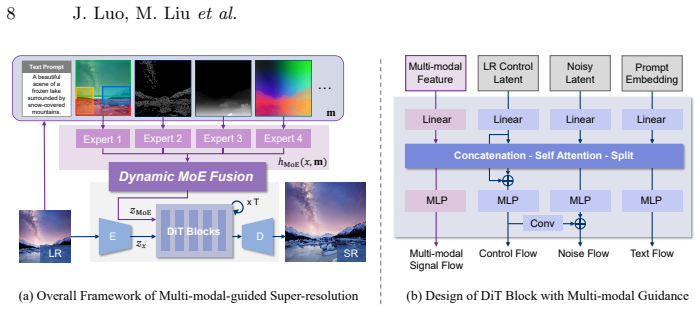
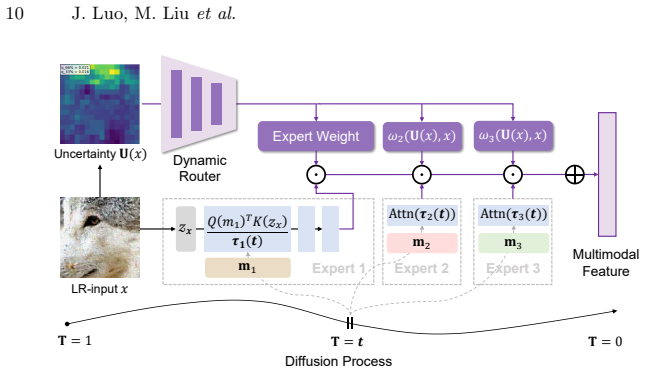
Prior multi-modal SR methods are bottlenecked by sub-optimal modality utilization. The generalization risk bound can be improved by strengthening the alignment between modality weights and their effective contributions while reducing representation complexity. This insight leads to the M³ESR framework that performs generalization-oriented dynamic modality fusion through a spatially dynamic modality weighting module and a temporally adaptive modality temperature scheduling mechanism.
What carries the argument
The M³ESR framework's generalization-oriented dynamic modality fusion, implemented via a spatially dynamic modality weighting module and a temporally adaptive modality temperature scheduling mechanism.
If this is right
- Dynamic modality weighting enables precise control over generalization risk during fusion.
- Modality contributions can be optimized without increasing overall representation complexity.
- The approach yields measurable gains in both generalization performance and semantic consistency.
- Spatially and temporally adaptive weighting extends to handling heterogeneous input modalities.
Where Pith is reading between the lines
- The same alignment principle could guide fusion design in other ill-posed vision tasks such as denoising or inpainting.
- Testing the framework on additional modality pairs (for example depth plus text) would reveal how broadly the risk-bound improvement holds.
- The theoretical modeling might supply a template for deriving similar bounds in non-super-resolution multi-modal settings.
Load-bearing premise
That the proposed spatially dynamic modality weighting and temporally adaptive temperature scheduling will produce the claimed tightening of the generalization risk bound on real heterogeneous modalities.
What would settle it
A controlled comparison in which the proposed dynamic fusion produces no reduction in measured generalization error or no gain in semantic consistency relative to static multi-modal baselines would falsify the central claim.
Figures


read the original abstract
Super-resolution (SR) is a severely ill-posed problem with inherent ambiguity, as widely recognized in both empirical and theoretical studies. Although recent semantic-guided and multi-modal SR methods exploit large models or external priors to enhance semantic alignment, the fusion of heterogeneous modalities remains insufficiently understood in practice and theory. In this work, we provide the first theoretical modeling of multi-modal SR, revealing that prior methods are bottlenecked by sub-optimal modality utilization. Our analysis shows that the generalization risk bound can be improved by strengthening the alignment between modality weights and their effective contributions, while reducing representation complexity. This theoretical insight inspires us to propose the novel Multi-Modal Mixture-of-Experts Super-Resolution framework (M$^3$ESR) that employs generalization-oriented dynamic modality fusion for accurate risk control and modality contribution optimization. In detail, we propose a novel spatially dynamic modality weighting module and a temporally adaptive modality temperature scheduling mechanism, enabling flexible and adaptive spatial-temporal modality weighting for effective risk control. Extensive experiments demonstrate that our M$^3$ESR significantly boosts generalization and semantic consistency performances, which confirms our superiority.
Editorial analysis
A structured set of objections, weighed in public.
Referee Report
Summary. The paper claims to deliver the first theoretical modeling of multi-modal super-resolution, revealing sub-optimal modality utilization in prior work. It asserts that the generalization risk bound improves by strengthening alignment between modality weights and effective contributions while reducing representation complexity; this insight motivates the M³ESR framework, which introduces a spatially dynamic modality weighting module and temporally adaptive modality temperature scheduling for risk control. Experiments are reported to demonstrate gains in generalization and semantic consistency on SR tasks.
Significance. If the unshown derivations are rigorous and the dynamic modules are shown to tighten the claimed bound, the work could supply a principled, generalization-oriented alternative to heuristic multi-modal fusion in ill-posed inverse problems. The explicit link between theory and adaptive architecture is a potential strength, but only if closed-loop validation is provided.
major comments (3)
- [Abstract / Theoretical Analysis] Abstract and theoretical analysis section: the central claim that the generalization risk bound is improved by alignment strengthening and complexity reduction is asserted without any displayed equations, derivations, or explicit bound expressions, preventing verification that the improvement is non-circular or independent of the proposed modules.
- [Experiments] Experiments section: downstream metrics (PSNR/SSIM, semantic consistency) are reported, yet the generalization risk bound itself is never recomputed or tabulated for M³ESR versus ablated versions of the dynamic weighting and temperature modules; this leaves the causal link between the theoretical insight and the practical mechanisms unverified.
- [Method] Method section describing the spatially dynamic modality weighting module: no derivation or proposition is supplied showing how the module's design directly implements the weight-contribution alignment required by the risk-bound analysis, rendering the transfer from theory to architecture informal.
minor comments (1)
- [Abstract] Ensure that the full name 'Multi-Modal Mixture-of-Experts Super-Resolution' and the acronym M³ESR are introduced consistently on first use and that any subsequent notation for the temperature scheduling parameter is defined before use.
Simulated Author's Rebuttal
We thank the referee for the insightful comments that help clarify the presentation of our theoretical contributions and their connection to the proposed architecture. We address each major comment below and commit to a major revision that incorporates explicit derivations, bound evaluations, and formal links from theory to design.
read point-by-point responses
-
Referee: [Abstract / Theoretical Analysis] Abstract and theoretical analysis section: the central claim that the generalization risk bound is improved by alignment strengthening and complexity reduction is asserted without any displayed equations, derivations, or explicit bound expressions, preventing verification that the improvement is non-circular or independent of the proposed modules.
Authors: We agree that the abstract provides only a high-level summary. The full theoretical analysis section derives a generalization risk bound for multi-modal super-resolution that explicitly decomposes the bound into terms involving modality weight alignment and representation complexity. The improvement follows from standard PAC-Bayesian or Rademacher complexity arguments applied to the multi-modal setting and is derived prior to and independently of the specific M³ESR modules. To enable verification, the revised manuscript will display the key bound expressions, the alignment and complexity terms, and the full derivation steps. revision: yes
-
Referee: [Experiments] Experiments section: downstream metrics (PSNR/SSIM, semantic consistency) are reported, yet the generalization risk bound itself is never recomputed or tabulated for M³ESR versus ablated versions of the dynamic weighting and temperature modules; this leaves the causal link between the theoretical insight and the practical mechanisms unverified.
Authors: We acknowledge that reporting only empirical metrics leaves the direct link to the risk bound unverified. While the observed gains in generalization and semantic consistency are consistent with the theory, we did not numerically evaluate the bound on the trained models. In the revision we will add a dedicated subsection that estimates the relevant terms of the generalization bound (via empirical proxies for alignment and complexity) for M³ESR and its ablations, thereby providing a quantitative check of the theoretical predictions. revision: yes
-
Referee: [Method] Method section describing the spatially dynamic modality weighting module: no derivation or proposition is supplied showing how the module's design directly implements the weight-contribution alignment required by the risk-bound analysis, rendering the transfer from theory to architecture informal.
Authors: We accept that the current manuscript presents the module design without a formal proposition linking it to the alignment condition in the risk bound. The module was motivated by that condition, but the connection is stated descriptively. The revised version will include a new proposition that mathematically shows how the spatially dynamic weighting realizes the required alignment (by construction of the weight update rule) and how the temperature scheduling controls complexity, thereby making the theory-to-architecture mapping explicit. revision: yes
Circularity Check
No circularity: theoretical bound analysis presented as independent of modules
full rationale
The provided text (abstract and description) states that a first theoretical modeling of multi-modal SR reveals sub-optimal modality utilization, with the generalization risk bound improved via better weight-contribution alignment and lower complexity; this insight then motivates the M³ESR dynamic fusion modules. No equations, derivations, or self-citations appear in the text that would allow inspection for reductions by construction (e.g., no fitted parameter renamed as prediction, no ansatz smuggled via prior work, no uniqueness theorem imported from authors). The central claim is framed as inspirational transfer from theory to architecture rather than tautological equivalence. Experiments are referenced only at high level (PSNR/SSIM gains) without any indication that risk bounds were recomputed on ablations, but absence of such detail does not create circularity. The derivation chain is therefore self-contained against external benchmarks.
Axiom & Free-Parameter Ledger
Reference graph
Works this paper leans on
-
[1]
Agustsson, E., Timofte, R.: NTIRE 2017 challenge on single image super- resolution: Dataset and study. In: IEEE Conf. Comput. Vis. Pattern Recog. Worksh. (2017)
work page 2017
-
[2]
Ai, Y., Zhou, X., Huang, H., Han, X., Chen, Z., You, Q., Yang, H.: DreamClear: High-capacity real-world image restoration with privacy-safe dataset curation. In: Adv. Neural Inform. Process. Syst. (2024)
work page 2024
-
[3]
Bartlett, P.L., Mendelson, S.: Rademacher and gaussian complexities: risk bounds and structural results. J. Mach. Learn. Res.3, 463–482 (2003)
work page 2003
-
[4]
Bosse, S., Maniry, D., M¨ uller, K.R., Wiegand, T., Samek, W.: Deep neural networks for no-reference and full-reference image quality assessment. IEEE Trans. Image Process.27(1), 206–219 (2017)
work page 2017
-
[5]
Canny, J.: A computational approach to edge detection. IEEE Trans. Pattern Anal. Mach. Intell.8(6), 679–698 (1986)
work page 1986
-
[6]
Chen, H., Wang, Y., Guo, T., Xu, C., Deng, Y., Liu, Z., Ma, S., Xu, C., Xu, C., Gao, W.: Pre-trained image processing transformer. In: IEEE Conf. Comput. Vis. Pattern Recog. (2021)
work page 2021
-
[7]
Image super- resolution with text prompt diffusion.arXiv preprint arXiv:2311.14282, 2023
Chen, Z., Zhang, Y., Gu, J., Yuan, X., Kong, L., Chen, G., Yang, X.: Image super- resolution with text prompt diffusion. arXiv Preprint arXiv:2311.14282 (2025)
-
[8]
Cheng, B., Schwing, A.G., Kirillov, A.: Per-pixel classification is not all you need for semantic segmentation. In: Adv. Neural Inform. Process. Syst. (2021)
work page 2021
-
[9]
Dong, C., Loy, C.C., He, K., Tang, X.: Image super-resolution using deep convo- lutional networks. IEEE Trans. Pattern Anal. Mach. Intell.38(2), 295–307 (2016)
work page 2016
-
[10]
Dong, C., Loy, C.C., Tang, X.: Accelerating the super-resolution convolutional neural network. In: Eur. Conf. Comput. Vis. (2016)
work page 2016
-
[11]
Duan, Z.P., Zhang, J., Jin, X., Zhang, Z., Xiong, Z., Zou, D., Ren, J.S., Guo, C., Li, C.: DiT4SR: Taming diffusion transformer for real-world image super-resolution. In: IEEE Int. Conf. Comput. Vis. (2025)
work page 2025
-
[12]
Esser, P., Kulal, S., Blattmann, A., Entezari, R., M¨ uller, J., Saini, H., Levi, Y., Lorenz, D., Sauer, A., Boesel, F., Podell, D., Dockhorn, T., English, Z., Rombach, R.: Scaling rectified flow transformers for high-resolution image synthesis. In: Int. Conf. Mach. Learn. (2024)
work page 2024
-
[13]
Esser, P., Rombach, R., Ommer, B.: Taming transformers for high-resolution image synthesis. In: IEEE Conf. Comput. Vis. Pattern Recog. (2021)
work page 2021
- [14]
-
[15]
arXiv Preprint arXiv:2508.16158 (2025)
He, H., Bai, Y., Lan, R., Duan, X., Sun, L., Chu, X., Xia, G.S.: RAGSR: Regional attention guided diffusion for image super-resolution. arXiv Preprint arXiv:2508.16158 (2025)
-
[16]
Karras, T., Laine, S., Aila, T.: A style-based generator architecture for generative adversarial networks. In: IEEE Conf. Comput. Vis. Pattern Recog. (2019)
work page 2019
-
[17]
Ke, J., Wang, Q., Wang, Y., Milanfar, P., Yang, F.: MUSIQ: Multi-scale image quality transformer. In: IEEE Int. Conf. Comput. Vis. (2021)
work page 2021
-
[18]
Kim, K.I., Kwon, Y.: Single-image super-resolution using sparse regression and natural image prior. IEEE Trans. Pattern Anal. Mach. Intell.32(6), 1127–1133 (2010)
work page 2010
-
[19]
Li, J., Fang, F., Mei, K., Zhang, G.: Multi-scale residual network for image super- resolution. In: Eur. Conf. Comput. Vis. (2018) 16 J. Luo, M. Liuet al
work page 2018
-
[20]
Li, Y., Zhang, K., Liang, J., Cao, J., Liu, C., Gong, R., Zhang, Y., Tang, H., Liu, Y., Demandolx, D., et al.: LSDIR: A large scale dataset for image restoration. In: IEEE Conf. Comput. Vis. Pattern Recog. (2023)
work page 2023
-
[21]
Liang, J., Cao, J., Sun, G., Zhang, K., Van Gool, L., Timofte, R.: SwinIR: Image restoration using swin transformer. In: IEEE Int. Conf. Comput. Vis. Worksh. (2021)
work page 2021
-
[22]
Lin, X., He, J., Chen, Z., Lyu, Z., Dai, B., Yu, F., Qiao, Y., Ouyang, W., Dong, C.: DiffBIR: Toward blind image restoration with generative diffusion prior. In: Eur. Conf. Comput. Vis. (2024)
work page 2024
-
[23]
Liu, H., Li, C., Wu, Q., Lee, Y.J.: Visual instruction tuning. In: Adv. Neural Inform. Process. Syst. (2023)
work page 2023
-
[24]
Long, W., Zhou, X., Zhang, L., Gu, S.: Progressive focused transformer for single image super-resolution. In: IEEE Conf. Comput. Vis. Pattern Recog. (2025)
work page 2025
-
[25]
Mei, K., Talebi, H., Ardakani, M., Patel, V.M., Milanfar, P., Delbracio, M.: The power of context: How multimodality improves image super-resolution. In: IEEE Conf. Comput. Vis. Pattern Recog. (2025)
work page 2025
-
[26]
Radford, A., Kim, J.W., Hallacy, C., Ramesh, A., Goh, G., Agarwal, S., Sastry, G., Askell, A., Mishkin, P., Clark, J., Krueger, G., Sutskever, I.: Learning transferable visual models from natural language supervision. In: Int. Conf. Mach. Learn. (2021)
work page 2021
-
[27]
Sim´ eoni, O., Vo, H.V., Seitzer, M., Baldassarre, F., Oquab, M., Jose, C., Khalidov, V., Szafraniec, M., Yi, S., Ramamonjisoa, M., Massa, F., Haziza, D., Wehrstedt, L., Wang, J., Darcet, T., Moutakanni, T., Sentana, L., Roberts, C., Vedaldi, A., Tolan, J., Brandt, J., Couprie, C., Mairal, J., J´ egou, H., Labatut, P., Bojanowski, P.: DINOv3. arXiv Prepri...
work page internal anchor Pith review Pith/arXiv arXiv 2025
-
[28]
Su, S., Yan, Q., Zhu, Y., Zhang, C., Ge, X., Sun, J., Zhang, Y.: Blindly assess image quality in the wild guided by a self-adaptive hyper network. In: IEEE Conf. Comput. Vis. Pattern Recog. (2020)
work page 2020
-
[29]
Sun, L., Wu, R., Ma, Z., Liu, S., Yi, Q., Zhang, L.: Pixel-level and semantic-level adjustable super-resolution: A dual-LoRA approach. In: IEEE Conf. Comput. Vis. Pattern Recog. (2025)
work page 2025
-
[30]
In: AAAI Conference on Artificial Intelligence (2023)
Wang, J., Chan, K.C., Loy, C.C.: Exploring clip for assessing the look and feel of images. In: AAAI Conference on Artificial Intelligence (2023)
work page 2023
-
[31]
Wang, J., Yue, Z., Zhou, S., Chan, K.C., Loy, C.C.: Exploiting diffusion prior for real-world image super-resolution. Int. J. Comput. Vis.132(12), 5929–5949 (2024)
work page 2024
-
[32]
Wang, X., Xie, L., Dong, C., Shan, Y.: Real-ESRGAN: Training real-world blind super-resolution with pure synthetic data. In: IEEE Int. Conf. Comput. Vis. Worksh. (2021)
work page 2021
-
[33]
Wei, H., Liu, S., Yuan, C., Zhang, L.: Perceive, understand and restore: Real- world image super-resolution with autoregressive multimodal generative models. In: IEEE Int. Conf. Comput. Vis. (2025)
work page 2025
-
[34]
Wu, R., Yang, T., Sun, L., Zhang, Z., Li, S., Zhang, L.: SeeSR: Towards semantics- aware real-world image super-resolution. In: IEEE Conf. Comput. Vis. Pattern Recog. (2024)
work page 2024
-
[35]
arXiv Preprint arXiv:2412.02960 (2024)
Xiao, J., Zhang, J., Zou, D., Zhang, X., Ren, J., Wei, X.: Semantic seg- mentation prior for diffusion-based real-world super-resolution. arXiv Preprint arXiv:2412.02960 (2024)
-
[36]
Xiong, Z., Sun, X., Wu, F.: Robust web image/video super-resolution. IEEE Trans. Image Process.19(8), 2017–2028 (2010)
work page 2017
-
[37]
Yang, L., Kang, B., Huang, Z., Zhao, Z., Xu, X., Feng, J., Zhao, H.: Depth anything V2. arXiv Preprint arXiv:2406.09414 (2024) Towards Provable Multi-Modality Guidance for Super-Resolution 17
work page internal anchor Pith review arXiv 2024
-
[38]
Yang, T., Wu, R., Ren, P., Xie, X., Zhang, L.: Pixel-aware stable diffusion for real- istic image super-resolution and personalized stylization. In: Eur. Conf. Comput. Vis. (2024)
work page 2024
-
[39]
Yi, Q., Li, S., Wu, R., Sun, L., Wu, Y., Zhang, L.: Fine-structure preserved real- world image super-resolution via transfer VAE training. In: IEEE Int. Conf. Com- put. Vis. (2025)
work page 2025
-
[40]
Yue, Z., Liao, K., Loy, C.C.: Arbitrary-steps image super-resolution via diffusion inversion. In: IEEE Conf. Comput. Vis. Pattern Recog. (2025)
work page 2025
-
[41]
Yue, Z., Wang, J., Loy, C.C.: Efficient diffusion model for image restoration by residual shifting. IEEE Trans. Pattern Anal. Mach. Intell.47(1), 116–130 (2025)
work page 2025
-
[42]
Zhang, K., Liang, J., Van Gool, L., Timofte, R.: Designing a practical degradation model for deep blind image super-resolution. In: IEEE Int. Conf. Comput. Vis. (2021)
work page 2021
-
[43]
Zhang, L., You, W., Shi, K., Gu, S.: Uncertainty-guided perturbation for image super-resolution diffusion model. In: IEEE Conf. Comput. Vis. Pattern Recog. (2025)
work page 2025
-
[44]
Zhang, R., Isola, P., Efros, A.A., Shechtman, E., Wang, O.: The unreasonable effectiveness of deep features as a perceptual metric. In: IEEE Conf. Comput. Vis. Pattern Recog. (2018)
work page 2018
-
[45]
Zhang, W., Zhai, G., Wei, Y., Yang, X., Ma, K.: Blind image quality assessment via vision-language correspondence: A multitask learning perspective. In: IEEE Conf. Comput. Vis. Pattern Recog. (2023)
work page 2023
discussion (0)
Sign in with ORCID, Apple, or X to comment. Anyone can read and Pith papers without signing in.