Recognition: no theorem link
Algorithm for finding vertex-edge domination number on graphs with bounded treewidth and related problems on planar graphs
Pith reviewed 2026-05-12 04:33 UTC · model grok-4.3
The pith
Graphs with bounded treewidth admit a polynomial-time algorithm for computing the vertex-edge domination number.
A machine-rendered reading of the paper's core claim, the machinery that carries it, and where it could break.
Core claim
A polynomial-time algorithm exists for finding a minimum ve-dominating set on graphs with bounded treewidth. Moreover, the treewidth of a planar graph G with ve-domination number gamma_ve(G) is O(sqrt(gamma_ve(G))), which yields an O(c^sqrt(k) |V(G)|)-time algorithm for the k-ve-domination problem on planar graphs.
What carries the argument
Dynamic programming on tree decompositions whose states track which edges incident to the current bag are covered by the ve-domination rule.
If this is right
- Minimum ve-dominating sets can be computed in linear time on trees and all other graphs of constant treewidth.
- The k-ve-domination problem on planar graphs can be solved in time exponential only in the square root of k.
- Any planar graph with small ve-domination number must also have small treewidth.
- The same dynamic-programming tables decide the problem for every fixed treewidth bound.
Where Pith is reading between the lines
- The treewidth bound could be combined with known planar-separator techniques to obtain polynomial-time approximation schemes for ve-domination on planar graphs.
- The same state-tracking idea may apply directly to other edge-covering domination variants on bounded-treewidth graphs.
- Practical implementations on moderate-sized planar graphs would test whether the hidden constants in the O(c^sqrt(k) n) bound remain manageable.
- If the constant hidden in O(sqrt(gamma_ve)) can be lowered, the subexponential algorithm for planar instances would become faster.
Load-bearing premise
The standard dynamic-programming framework on tree decompositions can be adapted to the ve-domination definition without introducing an extra exponential factor in the treewidth.
What would settle it
A graph of treewidth 5 on which no polynomial-time procedure computes the exact vertex-edge domination number, or a planar graph whose treewidth exceeds any fixed multiple of the square root of its ve-domination number.
Figures



read the original abstract
Given a graph $G=(V,E)$, a vertex $u \in V$ {\em ve-dominates} all edges incident to any vertex of $N_G[u]$. A set $S \subseteq V$ is a {\em ve-dominating set} if for all edges $e\in E$, there exists a vertex $u\in S$ such that $u$ ve-dominates $e$. The minimum cardinality among all ve-dominating sets is known as the \textit{vertex-edge domination number} (or simply ve-domination number) and denoted by $\gamma_{ve}(G)$. Finding a minimum ve-dominating set was proved to be NP-complete. Restricted to trees, the problem admits a linear-time algorithm. Treewidth is a commonly used parameter for solving NP-hard problems. In this paper, we present a polynomial-time algorithm for finding a minimum ve-dominating set on graphs with bounded treewidth. Moreover, we show that the treewidth of a planar graph $G$ with ve-domination number $\gamma_{ve}(G)$ is $O(\sqrt{\gamma_{ve}(G)})$ and present an $O(c^{\sqrt{k}}|V(G)|)$-time algorithm for the $k$-ve-domination problem on planar graphs.
Editorial analysis
A structured set of objections, weighed in public.
Referee Report
Summary. The manuscript presents a polynomial-time algorithm for computing a minimum vertex-edge dominating set on graphs of bounded treewidth via dynamic programming on tree decompositions. It further proves that any planar graph G satisfies tw(G) = O(√γ_ve(G)) and derives an O(c^√k |V(G)|)-time algorithm for the k-ve-domination problem on planar graphs.
Significance. If the claims hold, the work extends standard DP techniques for domination-type problems to the vertex-edge variant, yielding exact polynomial-time solutions on bounded-treewidth graphs and subexponential-time solutions on planar graphs. The constructive algorithmic results and the separator-based treewidth bound (once N[S] forms a vertex cover) are strengths that align with established methods in parameterized complexity.
minor comments (1)
- [Abstract] Abstract: the running-time dependence on the treewidth bound w is not stated (e.g., whether the algorithm is O(n·f(w)) for some function f); adding this would improve clarity for readers familiar with treewidth results.
Simulated Author's Rebuttal
We thank the referee for the positive recommendation to accept the manuscript and for the accurate summary of our results. We appreciate the recognition of the algorithmic contributions and the treewidth bound for planar graphs.
Circularity Check
No significant circularity; derivation is self-contained via standard techniques
full rationale
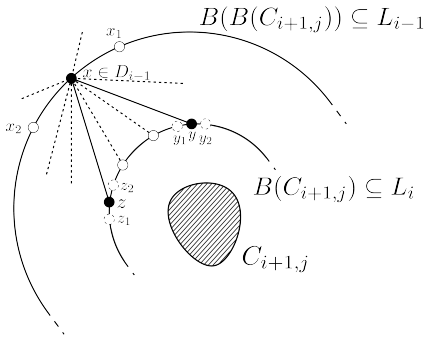
The paper's central claims are a constructive polynomial-time DP algorithm on tree decompositions for bounded-treewidth graphs (adapting standard bag-state tracking for ve-domination coverage) and a planar treewidth bound derived from the observation that N[S] forms a vertex cover for any ve-dominating set S, followed by known planar separator properties. Neither step reduces to a self-definition, fitted parameter renamed as prediction, or load-bearing self-citation; both rest on externally verifiable graph-theoretic facts and algorithmic frameworks that do not presuppose the target results. No equations or claims in the derivation chain are equivalent to their inputs by construction.
Axiom & Free-Parameter Ledger
axioms (2)
- domain assumption Dynamic programming on a tree decomposition of width w solves the ve-domination problem in time polynomial in n but exponential in w.
- domain assumption Planar graphs admit tree decompositions whose width is O(sqrt of the solution size) for many covering problems.
Reference graph
Works this paper leans on
-
[1]
Alber, Bodlaender, Fernau, Kloks, and Niedermeier. Fixed parameter algorithms for dominating set and related problems on planar graphs.Algorithmica, 33:461–493, 2002
work page 2002
-
[2]
J. Alber and R. Niedermeier. Improved tree decomposition based algorithms for domination-like problems. InLatin American Symposium on Theoretical Informatics, pages 613–627. Springer, 2002
work page 2002
-
[3]
S. Arnborg, J. Lagergren, and D. Seese. Easy problems for tree-decomposable graphs. Journal of Algorithms, 12(2):308–340, 1991
work page 1991
-
[4]
Z. Bai, J. Tu, and Y. Shi. An improved algorithm for the vertex coverP3 problem on graphs of bounded treewidth.Discrete Mathematics & Theoretical Computer Science, 21, 2019
work page 2019
-
[5]
B. S. Baker. Approximation algorithms for np-complete problems on planar graphs. Journal of the ACM (JACM), 41(1):153–180, 1994
work page 1994
-
[6]
H. L. Bodlaender. Treewidth: Algorithmic techniques and results. InInterna- tional Symposium on Mathematical Foundations of Computer Science, pages 19–36. Springer, 1997
work page 1997
-
[7]
H. L. Bodlaender. A partial k-arboretum of graphs with bounded treewidth.Theo- retical computer science, 209(1-2):1–45, 1998
work page 1998
-
[8]
R. Boutrig, M. Chellali, T. W. Haynes, and S. T. Hedetniemi. Vertex-edge domination in graphs.Aequationes mathematicae, 90:355–366, 2016
work page 2016
- [9]
-
[10]
Kloks.Treewidth: computations and approximations
T. Kloks.Treewidth: computations and approximations. Springer, 1994
work page 1994
-
[11]
B. Krishnakumari, Y. B. Venkatakrishnan, and M. Krzywkowski. Bounds on the vertex–edge domination number of a tree.Comptes rendus mathematique, 352(5):363– 366, 2014
work page 2014
-
[12]
J. R. Lewis.Vertex-edge and edge-vertex parameters in graphs. Ph.D. thesis, Clemson University, 2007. 19
work page 2007
-
[13]
S. Paul and K. Ranjan. Results on vertex-edge and independent vertex-edge domi- nation.Journal of Combinatorial Optimization, 44(1):303–330, 2022
work page 2022
-
[14]
S.-L. Peng and Y.-H. Tsai. Roman domination on graphs of bounded treewidth. In Proceedings of the 24th Workshop on Combinatorial Mathematics and Computation Theory, pages 128–131. 2007
work page 2007
-
[15]
K. W. Peters Jr.Theoretical and algorithmic results on domination and connectivity (Nordhaus-Gaddum, Gallai type results, max-min relationships, linear time, series- parallel). Clemson University, 1986
work page 1986
- [16]
discussion (0)
Sign in with ORCID, Apple, or X to comment. Anyone can read and Pith papers without signing in.