Recognition: no theorem link
On T-positive links
Pith reviewed 2026-05-12 04:17 UTC · model grok-4.3
The pith
T-positive links are precisely the strongly quasipositive links that are closures of T-homogeneous braids.
A machine-rendered reading of the paper's core claim, the machinery that carries it, and where it could break.
Core claim
T-positive links form a subset of strongly quasipositive links that strictly contains the set of all non-split braid positive links. They are precisely the strongly quasipositive links that are the closures of T-homogeneous braids. This complements characterizations as boundaries of positive Hopf-plumbed baskets or closures of staircase braids.
What carries the argument
The T-homogeneous braid, whose closure under the strong quasipositivity condition identifies the T-positive links.
If this is right
- The set of T-positive links properly contains all non-split braid positive links.
- All strongly quasipositive fibered knots with at most 12 crossings are T-positive.
- T-positive links admit additional characterizations as boundaries of positive Hopf-plumbed baskets and as closures of staircase braids.
- The behavior of T-positivity under cabling and connected sum operations is determined explicitly in the work.
Where Pith is reading between the lines
- Further investigation could reveal whether T-positivity persists under other common link operations beyond those studied.
- The inclusion of all low-crossing fibered examples suggests that T-positivity may be a frequent property among fibered knots in general.
- Comparisons with other positivity notions might lead to a hierarchy of link classes with increasing strength.
Load-bearing premise
The definitions of T-positive links and T-homogeneous braids are consistent and the equivalence holds for the class of links considered without hidden restrictions on splitting or fibering.
What would settle it
Observing a strongly quasipositive link that cannot be presented as the closure of any T-homogeneous braid would falsify the equivalence, or finding a T-homogeneous braid closure that fails to be strongly quasipositive.
Figures



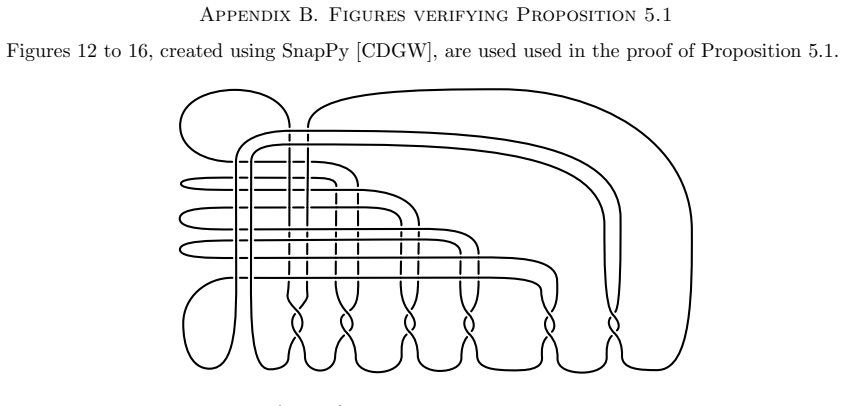
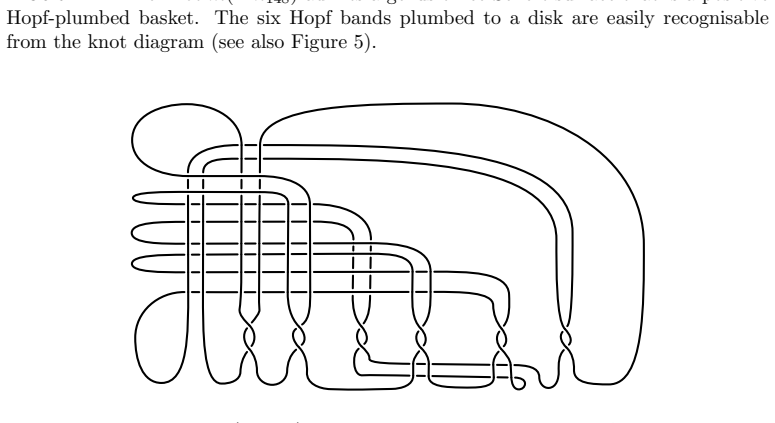
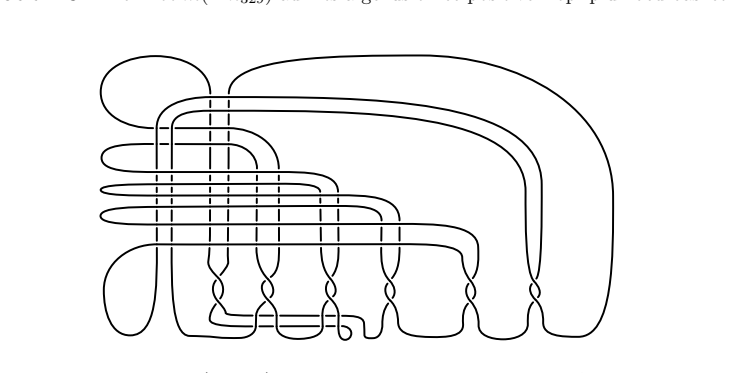
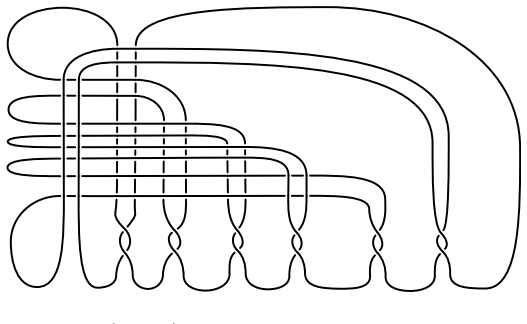


read the original abstract
T-positive links form a subset of strongly quasipositive links that strictly contains the set of all non-split braid positive links. Analogous to Baader's characterisation of positive links as precisely the strongly quasipositive and homogeneous links, we show that T-positive links are precisely the strongly quasipositive links that are the closures of T-homogeneous braids. This complements previous characterizations of T-positive links by Rudolph and Banfield as links arising as boundaries of positive Hopf-plumbed baskets, or closures of staircase braids. We examine the behavior of T-positive links under cabling operations and connected sums, and demonstrate that all strongly quasipositive, fibered knots with at most 12 crossings are T-positive. Additionally, we compare T-positivity with other positivity notions for links and compile open questions.
Editorial analysis
A structured set of objections, weighed in public.
Referee Report
Summary. The paper defines T-positive links as a subset of strongly quasipositive links strictly containing non-split braid-positive links. It proves that T-positive links are precisely the strongly quasipositive links arising as closures of T-homogeneous braids, providing a braid-theoretic characterization analogous to Baader's theorem for positive links. This complements prior geometric characterizations (positive Hopf-plumbed baskets or staircase braids) due to Rudolph and Banfield. The manuscript further studies the behavior of T-positive links under cabling and connected sum operations, computationally verifies that all strongly quasipositive fibered knots with at most 12 crossings are T-positive, compares T-positivity with other positivity notions, and lists open questions.
Significance. If the central equivalence holds, the result supplies a new, explicitly braid-based description of T-positive links that may simplify proofs involving cabling or sums and facilitate comparisons with other positivity classes. The computational verification for small fibered knots and the explicit closure properties under standard operations provide concrete support and generate testable predictions. The paper also ships a list of open questions, which is a positive contribution to the literature on link positivity.
minor comments (3)
- §2: The definition of T-homogeneous braids is stated but would benefit from an explicit small example (e.g., a 3-braid) showing how the T-condition differs from ordinary homogeneity, to aid readers unfamiliar with the prior staircase-braid literature.
- §4 (computational section): The verification is performed only for fibered knots; the text should clarify whether the same enumeration method applies directly to non-fibered strongly quasipositive links or to links with more than one component.
- The comparison table (or list) of positivity notions in the final section would be clearer if each notion were accompanied by a one-sentence reference to its defining property rather than relying solely on citations.
Simulated Author's Rebuttal
We thank the referee for their careful reading and positive assessment of the manuscript. The referee's summary accurately captures the definition of T-positive links, the central braid-theoretic characterization, the comparisons with prior geometric descriptions by Rudolph and Banfield, the results on cabling and connected sums, the computational verification for fibered knots up to 12 crossings, and the list of open questions. We are pleased that the work is viewed as a useful contribution to the study of link positivity. Since the report recommends minor revision but lists no specific major comments, we have no points requiring rebuttal or substantive change.
Circularity Check
No significant circularity; characterization derived from explicit definitions and external prior results
full rationale
The paper defines T-positive links and T-homogeneous braids explicitly, then proves a two-way equivalence to a subclass of strongly quasipositive links via direct arguments that build on independent prior characterizations (Baader, Rudolph, Banfield). No parameters are fitted to data, no quantity is renamed as a prediction after being used as input, and self-citations are not invoked to force uniqueness or smuggle ansatzes. The central claim is a theorem proved from the stated definitions plus externally established facts; small-case computational verification supplies independent support rather than circular confirmation. The derivation chain is therefore self-contained against external benchmarks.
Axiom & Free-Parameter Ledger
axioms (2)
- standard math Links arise as closures of braids in the standard way in 3-space
- domain assumption Strongly quasipositive links satisfy the properties referenced in the characterization
Reference graph
Works this paper leans on
-
[1]
Banfield, I. M. , TITLE =. J. Knot Theory Ramifications , FJOURNAL =. 2022 , NUMBER =. doi:10.1142/S0218216522500730 , URL =
-
[2]
Baader, S. , TITLE =. Math. Proc. Cambridge Philos. Soc. , FJOURNAL =. 2005 , NUMBER =. doi:10.1017/S0305004105008698 , URL =
-
[3]
Abe, T. , TITLE =. Proc. Amer. Math. Soc. , FJOURNAL =. 2011 , NUMBER =. doi:10.1090/S0002-9939-2010-10687-1 , URL =
-
[4]
Abe, T. and Tagami, K. , TITLE =. Canad. J. Math. , FJOURNAL =. 2017 , NUMBER =. doi:10.4153/CJM-2016-030-7 , URL =
-
[5]
M. Boileau and S. Boyer and C. McA. Gordon , keywords =. On definite strongly quasipositive links and L-space branched covers , journal =. 2019 , issn =. doi:https://doi.org/10.1016/j.aim.2019.106828 , url =
- [6]
- [7]
-
[8]
Stöcker, R. and Zieschang, H. , publisher =. Algebraische Topologie , year =
-
[9]
Massey, W. S. , publisher =. A Basic Course in Algebraic Topology , year =
- [10]
-
[11]
Moise, Edwin E. , publisher =. Geometric Topology in Dimensions 2 and 3 , year =
-
[12]
Prasolov, V. V. , publisher =. Elements of homology theory , year =
-
[13]
Hilton, P. J. AND Wylie, S. , publisher =. Homology Theory - An Introduction to Algebraic Topology , year =
-
[14]
Hsieh, Chun-Chung and Kauffman, Louis and Tsau, Chichen M. , doi =. A combinatorial algorithm for computing higher order linking numbers , url =. Asian J. Math. , mrclass =
- [15]
-
[16]
Efrat, Ido and Matzri, Eliyahu , doi =. Vanishing of. Canad. Math. Bull. , mrclass =
-
[17]
Maunder., C. R. F. , edition =. Algebraic Topology , year =
-
[18]
Hudson, John F. P. , edition =. Piecewise linear topology , year =
- [19]
-
[20]
Rotman, Joseph J. , edition =. An Introduction to Homological Algebra , year =
-
[21]
Massey, W. S. , booktitle =. Some higher order cohomology operations , year =
-
[22]
Massey, W. S. , doi =. Higher order linking numbers , url =. J. Knot Theory Ramifications , mrclass =
-
[23]
Uehara, Hiroshi and Massey, W. S. , booktitle =. The
-
[24]
Lickorish, W. B. R. , isbn =. An Introduction to Knot Theory , year =
- [25]
- [26]
- [27]
-
[28]
Rourke, C. P. and Sanderson, B. J. , edition =. Introduction to Piecewise-Linear Topology , year =
- [29]
-
[30]
Armstrong, M. A. and Zeeman, E. C. , journal =. Transversality for piecewise linear manifolds , year =
- [31]
-
[32]
Seifert, H. , doi =. Über das. Math. Ann. , mrclass =
-
[33]
Whitehead, G. W. , edition =. Elements of Homotopy Theory , year =
-
[34]
Rolfsen, D. , doi =. Knots and Links , year =
-
[35]
Baker, K. L. , doi =. A note on the concordance of fibered knots , url =. J. Topol. , mrclass =
-
[36]
Fox, R. H. , doi =. Some problems in knot theory , volume =. Topology of 3-manifolds and related topics (Proc. The Univ. of Georgia Institute, 1961) , number =
work page 1961
-
[37]
Hedden, M. , doi =. Notions of positivity and the. J. Knot Theory Ramifications , mrclass =
-
[38]
Lisca, P. , doi =. Lens spaces, rational balls and the ribbon conjecture , url =. Geometry & Topology , month =
-
[39]
Greene, J. and Jabuka, S. , doi =. The slice-ribbon conjecture for 3-stranded pretzel knots , url =. Amer. J. Math. , mrclass =
-
[40]
Gompf, R. E. and Scharlemann, M. and Thompson, A. , doi =. Fibered knots and potential counterexamples to the property 2. Geom. Topol. , mrclass =
-
[41]
Freedman, M. H. , doi =. The topology of four-dimensional manifolds , url =. J. Differential Geom. , number =
-
[42]
Gompf, R. E. , doi =. Smooth concordance of topologically slice knots , url =. Topology , number =
-
[43]
Stallings, J. R. , doi =. Constructions of fibred knots and links , volume =. Proceedings of Symposia in Pure Mathematics , pages =
-
[44]
Tristram, A. G. , doi =. Some cobordism invariants for links , volume =. Mathematical Proceedings of the Cambridge Philosophical Society , number =
-
[45]
Trotter, H. F. , issn =. Homology of Group Systems With Applications to Knot Theory , url =. Annals of Mathematics , number =
- [46]
-
[47]
Menasco, W. W. , title =. Topology , year =
-
[48]
Cromwell, P. R. , title =. Proc. London Math. Soc. , year =
- [49]
-
[50]
Birman, J. S. and Menasco, W. W. , doi =. A note on closed 3-braids , url =. Commun. Contemp. Math. , mrclass =
- [51]
-
[52]
Gompf, R. and Stipsicz, A. , doi =. Graduate Studies in Mathematics , title =
-
[53]
Livingston, C. , booktitle =. A survey of classical knot concordance , url =. doi:10.1016/B978-044451452-3/50008-3 , mrclass =
-
[54]
Litherland, R. A. , booktitle =. Signatures of iterated torus knots , volume =
-
[55]
Kervaire, M. , doi =. Les nœuds de dimensions supérieures , url =. Bulletin de la Société Mathématique de France , language =. 1965 , zbl =
work page 1965
-
[56]
Casson, A. J. and Gordon, C. Mca. , doi =. Cobordism of classical knots , volume =. À la recherche de la topologie perdue. Progress in Mathematics , organization =
-
[57]
Alexander, J. W. , doi =. A Lemma on Systems of Knotted Curves , url =. Proceedings of the National Academy of Sciences of the United States of America , month = mar, number =
-
[58]
Artin, E. , TITLE =. Abh. Math. Sem. Univ. Hamburg , FJOURNAL =. 1925 , NUMBER =. doi:10.1007/BF02950718 , URL =
-
[59]
Rudolph, L. , title =. Proc. Am. Math. Soc. , issn =. 1998 , language =. doi:10.1090/S0002-9939-98-04407-4 , keywords =
-
[60]
Boileau, M. and Orevkov, S. , doi =. Quasi-positivité d'une courbe analytique dans une boule pseudo-convexe , url =. C. R. Acad. Sci. Paris Sér. I Math. , mrclass =
-
[61]
Baader, S. and Dehornoy, P. and Liechti, L. , doi =. Signature and concordance of positive knots , url =. Bulletin of the London Mathematical Society , month =
-
[62]
Rudolph, L. , journal =. How independent are the knot-cobordism classes of links of plane curve singularities? , volume =
-
[63]
Abe, T. and Tagami, K. , doi =. Fibered knots with the same 0-surgery and the slice-ribbon conjecture , url =. Math. Res. Lett. , mrclass =
-
[64]
Rudolph, L. , doi =. Algebraic functions and closed braids , url =. Topology , number =
-
[65]
Carter, S. and Kamada, S. and Saito, M. , doi =. Encyclopaedia of Mathematical Sciences , title =
-
[66]
Hughes, M. C. , doi =. Braiding link cobordisms and non-ribbon surfaces , url =. Algebraic & Geometric Topology , month =
-
[67]
Garside, F. A. , doi =. THE BRAID GROUP AND OTHER GROUPS , url =. The Quarterly Journal of Mathematics , month =. https://academic.oup.com/qjmath/article-pdf/20/1/235/4400004/20-1-235.pdf , issn =
-
[68]
Friedl, S and Vidussi, S. , booktitle =. A survey of twisted. doi:10.1007/978-3-642-15637-3_3 , mrclass =
-
[69]
Fox, R. H. and Milnor, J. W. , journal =. Singularities of 2-spheres in 4-space and cobordism of knots , volume =
-
[70]
Lin, X. S. , doi =. Representations of knot groups and twisted. Acta Math. Sin. (Engl. Ser.) , mrclass =
-
[71]
Kirk, P. and Livingston, C. , journal =. Twisted knot polynomials: inversion, mutation and concordan , volume =
-
[72]
Herald, C. and Kirk, P. and Livingston, C. , doi =. Metabelian representations, twisted. Math. Z. , mrclass =
-
[73]
Ozsváth, P. and Szabó, Z. , doi =. Holomorphic disks and knot invariants , url =. Adv. Math. , mrclass =
-
[74]
Rasmussen, J. A. , isbn =. Floer homology and knot complements , url =
- [75]
-
[76]
Ozsváth, P. and Stipsicz, A. I. and Szabó, Z. , doi =. Concordance homomorphisms from knot. Advances in Mathematics , month =
-
[77]
Ozsváth, P. and Szabó, Z. , doi =. Holomorphic disks and topological invariants for closed three-manifolds , url =. Ann. of Math. (2) , mrclass =
-
[78]
Hom, J. , doi =. The knot Floer complex and the smooth concordance group , url =. Commentarii Mathematici Helvetici , number =
-
[79]
Birman, Joan S. and Menasco, William W. , fjournal =. Studying links via closed braids. Pacific J. Math. , mrclass =
-
[80]
Bode, B. and Hsueh, C.-S. , title =. arXiv e-prints , year =. arXiv , eid =:2511.21837 , pages =
discussion (0)
Sign in with ORCID, Apple, or X to comment. Anyone can read and Pith papers without signing in.