Recognition: no theorem link
Combinatorial extension of a simple construction of Lefschetz fibrations
Pith reviewed 2026-05-12 03:59 UTC · model grok-4.3
The pith
Varying the isotopy of the 0-handle during PALF construction produces different regular fibers on diffeomorphic Stein surfaces.
A machine-rendered reading of the paper's core claim, the machinery that carries it, and where it could break.
Core claim
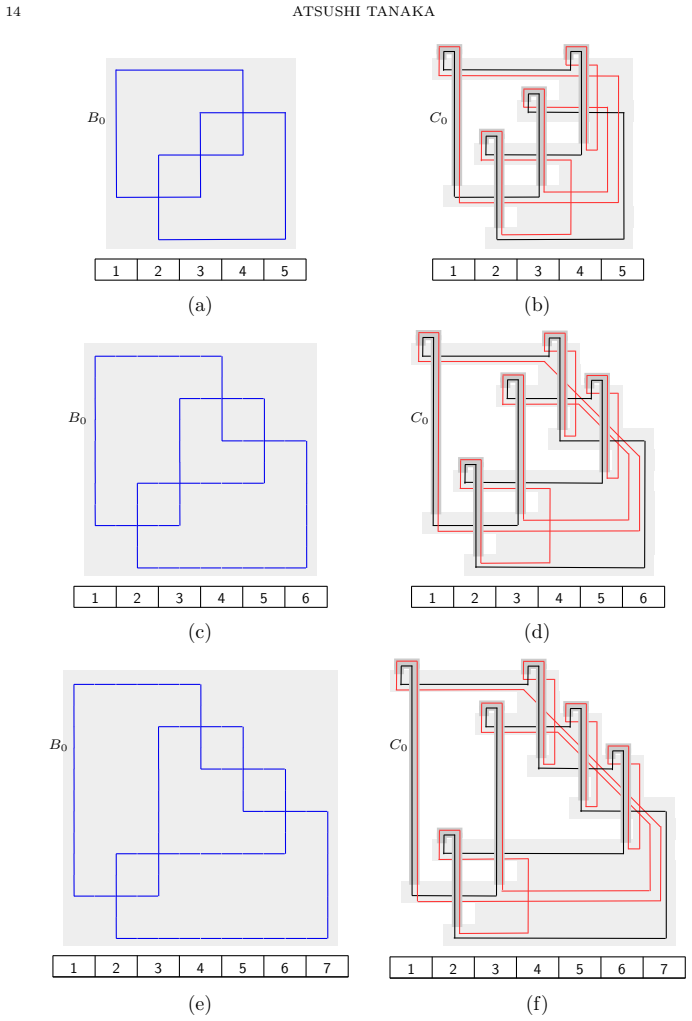
By introducing variations in the isotopy of the 0-handle in the construction process, we obtain PALFs whose total spaces are diffeomorphic to the original Stein surface but which possess different regular fibers. As a primary application, we prove the existence of PALFs with genus 1 regular fibers whose total spaces are diffeomorphic to the knot traces of Legendrian positive twist knots and positive torus knots T_{2, 2n+1}. Furthermore, we explicitly compare our PALF associated with the positive torus knot T_{2, 2n+1} to the specific open book decomposition generated by Avdek's Algorithm 2, demonstrating that the regular fiber and monodromy of our construction coincide with the page and mon
What carries the argument
Variations in the isotopy of the 0-handle in the combinatorial construction of PALFs from 2-handlebody decompositions of Stein surfaces.
If this is right
- The knot traces of Legendrian positive twist knots admit PALFs with genus 1 regular fibers.
- The knot traces of positive torus knots T_{2, 2n+1} admit PALFs with genus 1 regular fibers.
- The PALF constructed for T_{2, 2n+1} has the same regular fiber and monodromy as the open book from Avdek's Algorithm 2.
Where Pith is reading between the lines
- This combinatorial flexibility may allow similar reductions in fiber genus for fibrations on other classes of Stein 4-manifolds.
- Direct matching of Lefschetz fibrations to open books could clarify relations between supported contact structures on the boundary 3-manifold.
- Handle isotopy variations might serve as a general tool to control fiber complexity without altering the diffeomorphism type of the total space.
Load-bearing premise
That modifications to the 0-handle isotopy during the PALF construction preserve the diffeomorphism type of the total space while changing the regular fiber.
What would settle it
Explicitly construct the PALF for the knot trace of a positive torus knot T_{2,5} and verify whether its total space is diffeomorphic to that knot trace or whether the regular fiber has genus other than 1.
Figures





read the original abstract
In a previous work, we introduced a simple and systematic method for constructing a positive allowable Lefschetz fibration (PALF) from a 2-handlebody decomposition of a given Stein surface. In this paper, we present a combinatorial extension of this construction, focusing on the flexibility of the regular fiber. By introducing variations in the isotopy of the 0-handle during the construction process, we obtain PALFs whose total spaces are diffeomorphic to the original Stein surface but which possess different regular fibers. As a primary application, we prove the existence of PALFs with genus $1$ regular fibers whose total spaces are diffeomorphic to the knot traces of Legendrian positive twist knots and positive torus knots $T_{2, 2n+1}$. Furthermore, we explicitly compare our PALF associated with the positive torus knot $T_{2, 2n+1}$ to the specific open book decomposition generated by Avdek's Algorithm 2, demonstrating that the regular fiber and monodromy of our construction coincide with the page and monodromy of the corresponding open book.
Editorial analysis
A structured set of objections, weighed in public.
Referee Report
Summary. The paper extends a prior construction of positive allowable Lefschetz fibrations (PALFs) from 2-handlebody decompositions of Stein surfaces. By introducing isotopy variations of the 0-handle, it produces PALFs whose total spaces remain diffeomorphic to the input Stein surface while the regular fiber changes. The main result establishes the existence of genus-1 PALFs for the knot traces of Legendrian positive twist knots and positive torus knots T_{2,2n+1}. It further shows that the PALF for T_{2,2n+1} matches the page and monodromy of the open book obtained from Avdek's Algorithm 2 via explicit comparison of positive Dehn twists on the once-punctured torus.
Significance. If the diffeomorphism invariance under 0-handle isotopy variation holds via the described handle moves, the work supplies a flexible combinatorial tool for realizing specific Stein 4-manifolds as total spaces of genus-1 PALFs. This is particularly useful for contact geometry and symplectic fillings associated with twist knots and torus knots. The explicit monodromy matching with an independent construction (Avdek) provides a consistency check and strengthens the applicability of the method.
major comments (1)
- [§2] §2 (combinatorial extension via 0-handle isotopy): The central claim that isotopy variations preserve the diffeomorphism type of the total space while altering the regular fiber is load-bearing for all applications. The manuscript indicates that explicit handle moves are used to show the 2-handles attach equivalently, but a fully expanded step-by-step calculation (including before/after attaching circles and any 3-handle cancellations) for at least one concrete example, such as the simplest positive twist knot, is needed to confirm no hidden change in the 4-manifold diffeomorphism type.
minor comments (3)
- [Introduction] Introduction and §1: The citation to the authors' previous work should include the arXiv identifier or full bibliographic details to facilitate cross-referencing.
- [§5] §5 (comparison with Avdek): While the matching of positive Dehn twists is asserted, an explicit side-by-side list or table of the twist sequences (or the resulting monodromy factorizations) would make the equality immediately verifiable rather than relying on narrative description.
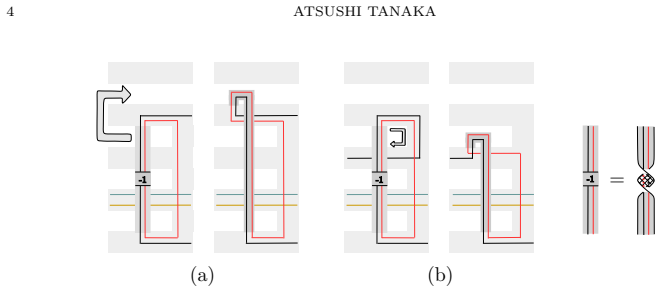
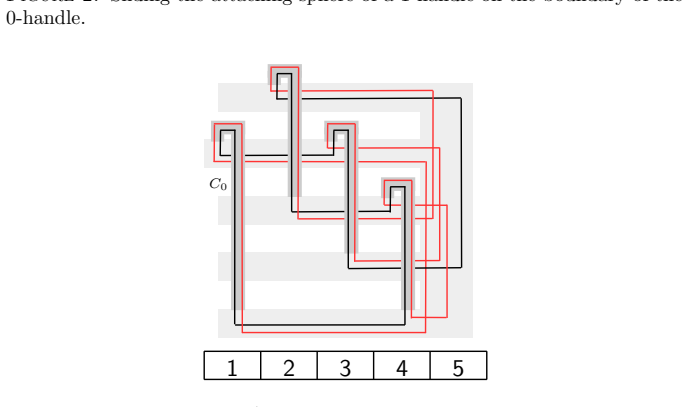
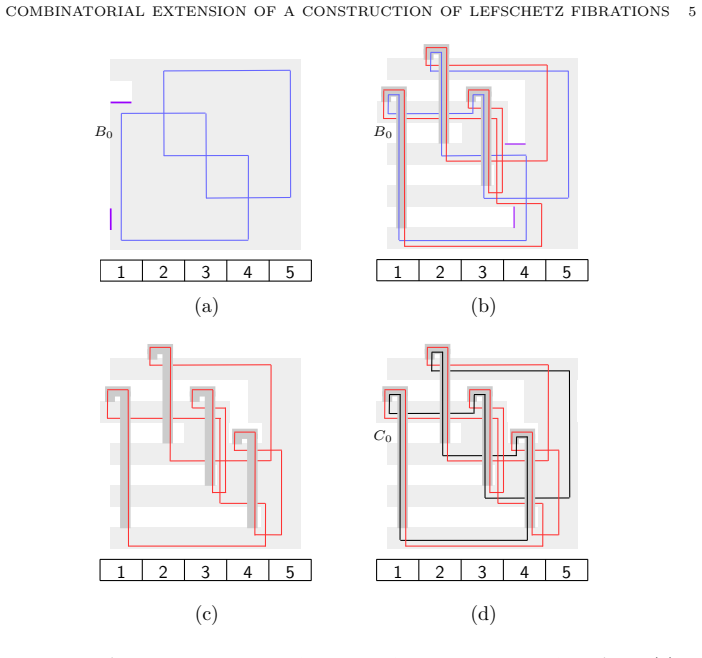
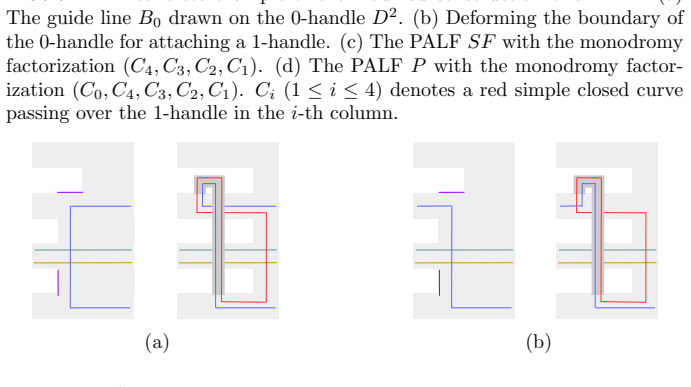
- [Figures] Figures illustrating handle diagrams: Additional labels indicating the changed regular fiber after isotopy variation would improve readability of the combinatorial changes.
Simulated Author's Rebuttal
We thank the referee for their careful reading of the manuscript and for the constructive suggestion regarding the presentation of the handle calculus in §2. We agree that an expanded example will make the invariance of the diffeomorphism type more transparent and will incorporate the requested material in the revised version.
read point-by-point responses
-
Referee: [§2] §2 (combinatorial extension via 0-handle isotopy): The central claim that isotopy variations preserve the diffeomorphism type of the total space while altering the regular fiber is load-bearing for all applications. The manuscript indicates that explicit handle moves are used to show the 2-handles attach equivalently, but a fully expanded step-by-step calculation (including before/after attaching circles and any 3-handle cancellations) for at least one concrete example, such as the simplest positive twist knot, is needed to confirm no hidden change in the 4-manifold diffeomorphism type.
Authors: We agree that a fully expanded, concrete calculation is desirable for clarity. In the revised manuscript we will add a detailed step-by-step example for the simplest positive twist knot (the right-handed trefoil). The new subsection will display the initial 2-handlebody diagram, the isotopy variation of the 0-handle, the resulting attaching circles before and after the move, the explicit 3-handle cancellations that occur, and the final diagram confirming that the 2-handles attach to the same framed link. This will explicitly verify that the total space remains diffeomorphic while the regular fiber changes. revision: yes
Circularity Check
Minor self-citation for base method; new isotopy extension is independent
full rationale
The manuscript cites the author's prior work solely for the initial PALF construction from a 2-handlebody. The load-bearing steps here are the explicit combinatorial variations in 0-handle isotopy, which are shown via handle moves to change the regular fiber while keeping the total space diffeomorphic to the input Stein surface. These variations are new, not derived from the prior paper by definition or fit, and the genus-1 constructions plus Avdek monodromy match are obtained directly from the updated decompositions without circular reduction.
Axiom & Free-Parameter Ledger
axioms (2)
- domain assumption Handlebody decompositions of Stein surfaces admit a systematic conversion to positive allowable Lefschetz fibrations
- ad hoc to paper Isotopy variations of the 0-handle preserve the diffeomorphism type of the total space
Reference graph
Works this paper leans on
-
[1]
Akbulut, Selman and Arikan, M. Firat , TITLE =. Commun. Contemp. Math. , FJOURNAL =. 2012 , NUMBER =. doi:10.1142/S0219199712500356 , URL =
-
[2]
Akbulut, Selman and Ozbagci, Burak , TITLE =. Geom. Topol. , FJOURNAL =. 2001 , PAGES =. doi:10.2140/gt.2001.5.319 , URL =
-
[3]
Akbulut, Selman and Yasui, Kouichi , TITLE =. J. G\"okova Geom. Topol. GGT , FJOURNAL =. 2008 , PAGES =
work page 2008
- [4]
-
[5]
Avdek, Russell , TITLE =. Algebr. Geom. Topol. , FJOURNAL =. 2013 , NUMBER =. doi:10.2140/agt.2013.13.1613 , URL =
-
[6]
Eliashberg, Yakov , TITLE =. Internat. J. Math. , FJOURNAL =. 1990 , NUMBER =. doi:10.1142/S0129167X90000034 , URL =
-
[7]
Sugaku Expositions , FJOURNAL =
Endo, Hisaaki , TITLE =. Sugaku Expositions , FJOURNAL =. 2021 , NUMBER =. doi:10.1090/suga/462 , URL =
-
[8]
Etnyre, John B. and Fuller, Terry , TITLE =. Int. Math. Res. Not. , FJOURNAL =. 2006 , PAGES =. doi:10.1155/IMRN/2006/70272 , URL =
-
[9]
Gompf, Robert E. , TITLE =. Ann. of Math. (2) , FJOURNAL =. 1998 , NUMBER =. doi:10.2307/121005 , URL =
-
[10]
Gompf, Robert E. and Stipsicz, Andr\'as I. , TITLE =. 1999 , PAGES =. doi:10.1090/gsm/020 , URL =
- [11]
-
[12]
Loi, Andrea and Piergallini, Riccardo , TITLE =. Invent. Math. , FJOURNAL =. 2001 , NUMBER =. doi:10.1007/s002220000106 , URL =
-
[13]
Ng, Lenhard and Thurston, Dylan , TITLE =. Proceedings of. 2009 , ISBN =
work page 2009
-
[14]
Ng, Lenhard , TITLE =. Algebr. Geom. Topol. , FJOURNAL =. 2005 , PAGES =. doi:10.2140/agt.2005.5.1637 , URL =
-
[15]
Ozbagci, Burak and Stipsicz, Andr\'as I. , TITLE =. 2004 , PAGES =. doi:10.1007/978-3-662-10167-4 , URL =
-
[16]
Interactions between low-dimensional topology and mapping class groups , SERIES =
Ozbagci, Burak , TITLE =. Interactions between low-dimensional topology and mapping class groups , SERIES =. 2015 , MRCLASS =. doi:10.2140/gtm.2015.19.73 , URL =
-
[17]
Ozsv\'ath, Peter S. and Stipsicz, Andr\'as I. and Szab\'o, Zolt\'an , TITLE =. 2015 , PAGES =. doi:10.1090/surv/208 , URL =
-
[18]
Ukida, Takuya , TITLE =. Topology Appl. , FJOURNAL =. 2016 , PAGES =. doi:10.1016/j.topol.2016.10.003 , URL =
-
[19]
Ukida, Takuya , TITLE =. Osaka J. Math. , FJOURNAL =. 2022 , NUMBER =
work page 2022
-
[20]
Ukida, Takuya , TITLE =
- [21]
-
[22]
A Simple Construction of Lefschetz Fibrations on Compact Stein Surfaces , author=. 2026 , eprint=
work page 2026
-
[23]
Atsushi Tanaka , title =
discussion (0)
Sign in with ORCID, Apple, or X to comment. Anyone can read and Pith papers without signing in.