Recognition: 2 theorem links
· Lean TheoremHH-SAE: Discovering and Steering Hierarchical Knowledge of Complex Manifolds
Pith reviewed 2026-05-12 03:09 UTC · model grok-4.3
The pith
A hierarchical sparse autoencoder resolves feature density conflict by factorizing complex manifolds into contextual, atomic, and compository tiers.
A machine-rendered reading of the paper's core claim, the machinery that carries it, and where it could break.
Core claim
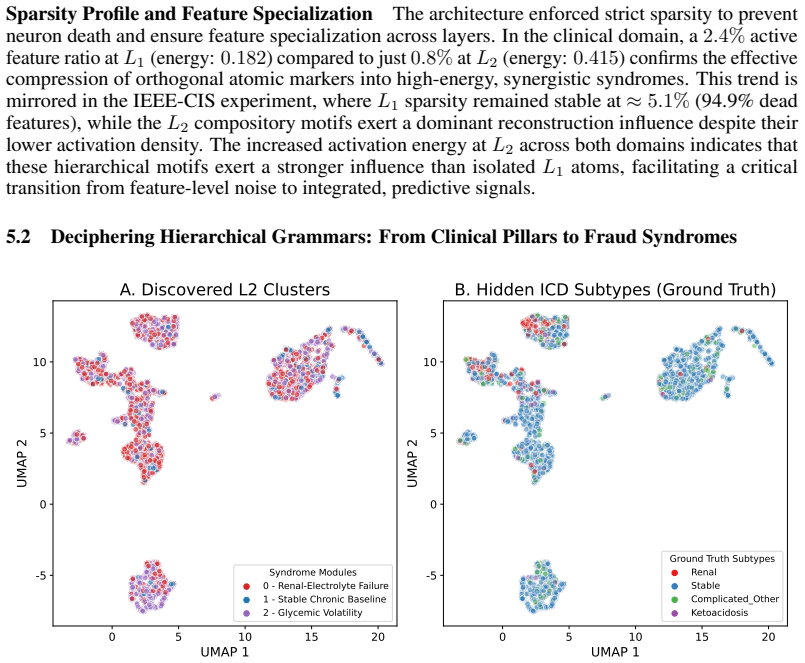
HH-SAE factorizes manifolds into a nested hierarchy of Contextual (L_0), Atomic (f_1), and Compository (f_2) tiers to resolve feature density conflict, demonstrating superior resolution by fracturing administrative clinical labels into physiological modes, achieving a peak cross-domain zero-shot AUC of 0.9156 in fraud detection, with a 13.46% utility collapse when contextual subtraction is removed and a +9.9% AUPRC lift in knowledge-steered synthesis.
What carries the argument
The Hybrid Hierarchical SAE (HH-SAE), which performs nested factorization of manifolds into Contextual (L0), Atomic (f1), and Compository (f2) tiers to separate dense backgrounds from rare semantic innovations.
If this is right
- Administrative clinical labels fracture into distinct physiological modes.
- Cross-domain zero-shot fraud detection reaches a peak AUC of 0.9156.
- Removing contextual subtraction produces a 13.46% drop in utility.
- Knowledge-steered synthesis improves by 9.9% AUPRC over state-of-the-art generators.
Where Pith is reading between the lines
- The factorization may apply to other dense high-dimensional domains where background contexts mask key signals.
- Standard sparse autoencoders likely miss the explicit separation of tiers needed for rare feature isolation.
- The tiers could be tested for correspondence to mechanistic concepts in additional scientific or financial datasets.
Load-bearing premise
High-dimensional manifolds possess a nested hierarchical structure that can be cleanly factorized into Contextual, Atomic, and Compository tiers without significant loss of rare semantic information or introduction of spurious modes.
What would settle it
Demonstrating that administrative clinical labels cannot be fractured into distinct physiological modes or that the reported AUC and AUPRC gains disappear when the full three-tier factorization is replaced by a non-hierarchical sparse autoencoder would falsify the central claim.
Figures

read the original abstract
Rare semantic innovations in high-dimensional, mission-critical domains are often obscured by dense background contexts, a challenge we define as \textit{feature density conflict}. We introduce the \textbf{Hybrid Hierarchical SAE (HH-SAE)} to resolve this by factorizing manifolds into a nested hierarchy of \textbf{Contextual} ($L_0$), \textbf{Atomic} ($f_1$), and \textbf{Compository} ($f_2$) tiers. Evaluating across disparate manifolds, HH-SAE demonstrates superior resolution by \textbf{``fracturing'' administrative clinical labels into physiological modes} and achieving a peak \textbf{cross-domain zero-shot AUC of 0.9156 in fraud detection}. Path ablation confirms the architecture's structural necessity, revealing a 13.46\% utility collapse when contextual subtraction is removed. Finally, knowledge-steered synthesis achieves a +9.9\% AUPRC lift over state-of-the-art generators, proving that HH-SAE effectively prioritizes high-order mechanistic innovation over environmental proxies to enable high-precision discovery in high-stakes environments.
Editorial analysis
A structured set of objections, weighed in public.
Referee Report
Summary. The paper introduces the Hybrid Hierarchical SAE (HH-SAE) to resolve feature density conflict in high-dimensional manifolds by factorizing them into a nested hierarchy of Contextual (L0), Atomic (f1), and Compository (f2) tiers. It reports empirical results across clinical and fraud-detection manifolds, including fracturing of administrative labels into physiological modes, a peak cross-domain zero-shot AUC of 0.9156, a 13.46% utility collapse in path ablation when contextual subtraction is removed, and a +9.9% AUPRC lift in knowledge-steered synthesis over state-of-the-art generators.
Significance. If the hierarchical factorization is shown to be faithful rather than capacity-driven, the work could meaningfully extend sparse autoencoder methods for disentangling rare semantic signals from dense background contexts in high-stakes domains. The reported ablation and cross-domain transfer results provide a starting point for assessing architectural necessity, though stronger controls would be needed to elevate the contribution.
major comments (2)
- [Experimental results and ablation studies] The central claim that HH-SAE achieves superior resolution by cleanly factorizing manifolds into L0/f1/f2 tiers without loss of rare semantics or introduction of spurious modes is load-bearing for all performance interpretations (including the 'fracturing' of labels and the 0.9156 AUC). No direct validation is provided, such as tier-wise mutual information on low-frequency features, reconstruction fidelity metrics for rare modes, or a capacity-matched non-hierarchical SAE baseline. Without these, the reported gains cannot be distinguished from effects of increased model capacity or post-hoc labeling.
- [Path ablation experiments] The path ablation reports a 13.46% utility collapse when contextual subtraction is removed, but supplies no details on experimental protocol: number of runs, error bars, baseline models, data exclusion criteria, or full metric tables. This makes it impossible to evaluate whether the ablation confirms structural necessity or reflects implementation artifacts.
minor comments (2)
- [Abstract and Methods] The abstract and results sections would benefit from explicit statements of dataset sizes, train/test splits, and hyperparameter ranges for the tier factorization parameters.
- [Model architecture] Notation for the tiers (L0, f1, f2) and the subtraction operation should be accompanied by a clear diagram or pseudocode to clarify the forward pass and training objective.
Simulated Author's Rebuttal
We thank the referee for the constructive feedback on our manuscript. We address each major comment below and outline revisions to improve the rigor and transparency of our experimental claims.
read point-by-point responses
-
Referee: [Experimental results and ablation studies] The central claim that HH-SAE achieves superior resolution by cleanly factorizing manifolds into L0/f1/f2 tiers without loss of rare semantics or introduction of spurious modes is load-bearing for all performance interpretations (including the 'fracturing' of labels and the 0.9156 AUC). No direct validation is provided, such as tier-wise mutual information on low-frequency features, reconstruction fidelity metrics for rare modes, or a capacity-matched non-hierarchical SAE baseline. Without these, the reported gains cannot be distinguished from effects of increased model capacity or post-hoc labeling.
Authors: We acknowledge that the absence of direct validations such as tier-wise mutual information on low-frequency features, reconstruction fidelity for rare modes, and a capacity-matched non-hierarchical SAE baseline represents a genuine limitation in distinguishing architectural benefits from capacity effects. The current manuscript relies on indirect evidence from cross-domain AUC, label fracturing observations, and path ablations. In revision, we will add a capacity-matched non-hierarchical SAE baseline comparison and report tier-wise mutual information and rare-mode reconstruction metrics where the data supports it. This will strengthen the evidence that the factorization is faithful rather than capacity-driven. revision: yes
-
Referee: [Path ablation experiments] The path ablation reports a 13.46% utility collapse when contextual subtraction is removed, but supplies no details on experimental protocol: number of runs, error bars, baseline models, data exclusion criteria, or full metric tables. This makes it impossible to evaluate whether the ablation confirms structural necessity or reflects implementation artifacts.
Authors: We agree that the path ablation section lacks sufficient experimental protocol details, which hinders evaluation of robustness. The reported 13.46% collapse is based on our internal runs, but these specifics were not fully documented. In the revised manuscript, we will expand this section to include the number of independent runs, error bars, baseline models, data exclusion criteria, and full metric tables (moved to main text or supplementary material as needed). revision: yes
Circularity Check
No significant circularity; empirical claims independent of inputs
full rationale
The paper proposes the HH-SAE model to factorize manifolds into L0/f1/f2 tiers and reports empirical results including 0.9156 cross-domain AUC and a 13.46% ablation drop when contextual subtraction is removed. These outcomes are measured on external tasks (clinical labels, fraud detection) rather than being algebraically forced by the model definition. No equations redefine a target quantity using fitted parameters from the same data, no self-citations supply load-bearing uniqueness theorems, and no ansatz is smuggled via prior work. The hierarchical factorization is presented as an architectural choice whose validity is tested by ablation and downstream metrics, not presupposed by the results themselves.
Axiom & Free-Parameter Ledger
free parameters (1)
- Tier factorization parameters
axioms (1)
- domain assumption High-dimensional manifolds in the target domains exhibit a nested hierarchical structure factorizable into contextual background, atomic features, and compository combinations.
invented entities (3)
-
Contextual tier (L0)
no independent evidence
-
Atomic tier (f1)
no independent evidence
-
Compository tier (f2)
no independent evidence
Lean theorems connected to this paper
-
IndisputableMonolith/Cost/FunctionalEquation.leanwashburn_uniqueness_aczel unclearfactorizing manifolds into a nested hierarchy of Contextual (L0), Atomic (f1), and Compository (f2) tiers... Path ablation... 13.46% utility collapse when contextual subtraction is removed
-
IndisputableMonolith/Foundation/RealityFromDistinction.leanreality_from_one_distinction unclearTriplet Knowledge Hypothesis: complex manifolds are factorizable into three distinct semantic tiers
Reference graph
Works this paper leans on
-
[1]
Online dictionary learning for sparse coding
Julien Mairal, Francis Bach, Jean Ponce, and Guillermo Sapiro. Online dictionary learning for sparse coding. InProceedings of the 26th Annual International Conference on Machine Learning (ICML), pages 689–696, 2009
work page 2009
-
[2]
Trenton Bricken, Adly Templeton, Joshua Batson, Brian Chen, Scott Jerome, Catherine Moore, Catherine Morrison, Chris Olah, et al. Towards monosemanticity: Decomposing language models with dictionary learning.Transformer Circuits Thread, 2023
work page 2023
-
[3]
Scaling and evaluating sparse autoencoders
Leo Gao, Tom Bloom, Adly Templeton, et al. Scaling and evaluating sparse autoencoders. Technical report, OpenAI, 2024. Demonstrates scaling laws and the tension between model size, sparsity, and the recovery of hypothesized features
work page 2024
-
[4]
Improving dictionary learning with gated sparse autoen- coders.arXiv preprint arXiv:2404.16014,
Senthooran Rajamanoharan, Arthur Conmy, Lewis Smith, Tom Lieberum, Vikrant Varma, János Kramár, Rohin Shah, and Neel Nanda. Improving dictionary learning with gated sparse autoencoders.arXiv preprint arXiv:2404.16014, 2024
-
[5]
Mimic-iv, a freely accessible electronic health record dataset.Scientific data, 10(1):1, 2023
Alistair EW Johnson, Lucas Bulgarelli, Lu Shen, Alvin Gayles, Ayad Shammout, Steven Horng, Tom J Pollard, Sicheng Hao, Benjamin Moody, Brian Gow, et al. Mimic-iv, a freely accessible electronic health record dataset.Scientific data, 10(1):1, 2023
work page 2023
-
[6]
Guanglin Zhou and Sebastiano Barbieri. Generating clinically realistic ehr data via a hierarchy- and semantics-guided transformer.arXiv preprint arXiv:2502.20719, 2025
-
[7]
Lei Xu, Maria Skoularidou, Alfredo Cuesta-Infante, and Kalyan Veeramachaneni. Modeling tabular data using conditional gan.Advances in neural information processing systems, 32, 2019
work page 2019
-
[8]
Brandon Theodorou, Cao Xiao, and Jimeng Sun. Synthesize high-dimensional longitudinal elec- tronic health records via hierarchical autoregressive language model.Nature communications, 14(1):5305, 2023
work page 2023
-
[9]
Wei-Chen Chang, Lu Dai, and Ting Xu. Machine learning approaches to clinical risk pre- diction: Multi-scale temporal alignment in electronic health records (EHR).arXiv preprint arXiv:2511.21561, 2025
-
[10]
Tabdiff: A multi-modal diffusion model for tabular data generation
Juntong Shi, Minkai Xu, Harper Hua, Hengrui Zhang, Stefano Ermon, and Jure Leskovec. Tabdiff: A multi-modal diffusion model for tabular data generation. InInternational Conference on Learning Representations (ICLR), 2025
work page 2025
-
[11]
Tabddpm: Mod- elling tabular data with diffusion models
Akim Kotelnikov, Dmitry Baranchuk, Ivan Rubachev, and Artem Babenko. Tabddpm: Mod- elling tabular data with diffusion models. InInternational conference on machine learning, pages 17564–17579. PMLR, 2023. 10
work page 2023
-
[12]
Doudou Zhou, Han Tong, Linshanshan Wang, Suqi Liu, Xin Xiong, Ziming Gan, Griffier Romain, Boris P. Hejblum, Yun-Chung Liu, Chuan Hong, Clara-Lea Bonzel, Tianrun Cai, Kevin Pan, Yuk-Lam Ho, Lauren Costa, Vidul A. Panickan, J. Michael Gaziano, Kenneth D. Mandl, Vianney Jouhet, Rodolphe Thiebaut, Zongqi Xia, Kelly Cho, Katherine Liao, and Tianxi Cai. Repres...
work page 2026
-
[13]
Zeyu Yang, Han Yu, Peikun Guo, Khadija Zanna, Xiaoxue Yang, and Akane Sano. Balanced mixed-type tabular data synthesis with diffusion models.Transactions on machine learning research, 2025:3537, 2025
work page 2025
-
[14]
Mark Muchane, Sean Richardson, Kiho Park, and Victor Veitch. Incorporating hierarchical semantics in sparse autoencoder architectures.arXiv preprint arXiv:2506.01197, 2025
-
[15]
Mechanistic interpretability: A survey.arXiv preprint, 2024
Shav Vimalendiran. Mechanistic interpretability: A survey.arXiv preprint, 2024
work page 2024
-
[16]
Nikita Balagansky, Yaroslav Aksenov, Daniil Laptev, Vadim Kurochkin, Gleb Gerasimov, Nikita Koryagin, and Daniil Gavrilov. Train one sparse autoencoder across multiple sparsity budgets to preserve interpretability and accuracy.arXiv preprint arXiv:2505.24473, 2025
-
[17]
SNOMED Clinical Terms (SNOMED CT) International Edition
SNOMED International. SNOMED Clinical Terms (SNOMED CT) International Edition. https://www.snomed.org/, 2024. Accessed: 2026-04-27
work page 2024
-
[18]
Adam Karvonen, Can Rager, Johnny Lin, Curt Tigges, Joseph Bloom, David Chanin, Yeu-Tong Lau, Eoin Farrell, Callum McDougall, Kola Ayonrinde, Demian Till, Matthew Wearden, Arthur Conmy, Samuel Marks, and Neel Nanda. SAEBench: A comprehensive benchmark for sparse autoencoders in language model interpretability.arXiv preprint arXiv:2503.09532, 2025
-
[19]
Building sparse autoencoders (saes) from scratch.Data Science Collective, 2026
Ayo Akinkugbe. Building sparse autoencoders (saes) from scratch.Data Science Collective, 2026
work page 2026
-
[20]
Aivin V Solatorio and Olivier Dupriez. Realtabformer: Generating realistic relational and tabular data using transformers.arXiv preprint arXiv:2302.02041, 2023
-
[21]
IEEE Computational Intelligence Society. Ieee-cis fraud detection: Can you detect fraudulent transactions? https://www.kaggle.com/c/ieee-fraud-detection, 2019. Accessed: 2026-05-05. 11 A Hierarchical Knowledge Discovery in MIMIC-IV: Rare Cardiovascular Disease To validate the interpretive power of the HH-SAE, we perform an in-depth analysis of the discove...
work page 2019
-
[22]
This linkage captures the feedback loop between kidney filtration and cardiac stability
Biochemical Pillar(Atoms 565, 324): These atoms integrate acute electrolyte fluctua- tions (e.g., Potassium lab_50971) with chronic hypertensive (dx_401) and renal (dx_585) histories. This linkage captures the feedback loop between kidney filtration and cardiac stability
-
[23]
Physiological Integration(Atom 346): This layer bridges real-time hemodynamics (Mean Arterial Pressure, vital_220050) with metabolic Glucose instability ( vital_220621), identifying the systemic stress that often precedes acute decompensation
-
[24]
Diagnostic Context(Atom 80): This grounds the acute signals within longitudinal elec- trolyte balance histories ( dx_276), allowing the model to distinguish between transient spikes and chronic pathological shifts. Recovery of Marginal PatientsA critical finding of this discovery regime is the role ofSmall Marginal Detectors(Modules 0 and 4). These module...
discussion (0)
Sign in with ORCID, Apple, or X to comment. Anyone can read and Pith papers without signing in.