Recognition: 3 theorem links
· Lean TheoremHausdorff Dimension of a Class of Self-Affine Sets
Pith reviewed 2026-05-12 03:44 UTC · model grok-4.3
The pith
Self-affine attractors with eventually similar maps and commuting linear parts have exact Hausdorff dimensions under the open set condition.
A machine-rendered reading of the paper's core claim, the machinery that carries it, and where it could break.
Core claim
For a class of self-affine attractors generated by affine iterated function systems containing an affine map whose n-th iterate is a similarity contraction and standard similarities whose linear parts commute with the symmetric operator A transpose A, the attractor exists uniquely and under the open set condition its exact Hausdorff dimension is computed. The framework extends to systems where all map compositions of some fixed length are similarities, to systems with overlaps that are exact homothetic copies, and to hybrid systems combining multiple eventually contractive affine maps with universally aligned similarities. In the plane, for a two-map system with contraction ratios c and r, c
What carries the argument
The commuting condition of the linear parts of the similarities with the symmetric operator A transpose A derived from the affine map, which enables the exact dimension calculation by allowing the system to behave like a similarity system in key respects.
If this is right
- The attractor exists and is unique for the systems considered.
- Exact Hausdorff dimension is obtained under the open set condition.
- The results unify to give dimension formulas for hybrid systems with multiple affine maps and aligned similarities.
- For two-map systems in the plane the parameter balance c plus r equals one uniquely ensures the open set condition and connectedness.
Where Pith is reading between the lines
- The commuting requirement implies that the maps must be specially aligned, so the formulas apply only to non-generic choices of linear parts.
- The topological bottleneck identified in the plane suggests that similar parameter relations could be sought in higher dimensions to control connectedness.
- These special cases may serve as test beds for verifying numerical methods for computing dimensions of more general self-affine sets.
Load-bearing premise
The linear parts of the standard similarities commute with the symmetric operator A transpose A, where A is the linear part of the affine map.
What would settle it
An explicit two-map system with contraction ratios c and r where c plus r does not equal one, yet the open set condition still holds or the attractor is connected, would falsify the claim that this balance is the unique guarantor.
Figures





read the original abstract
In this paper, exact Hausdorff dimension formulas for a class of self-affine attractors generated by affine Iterated Function Systems are derived. We consider systems containing an affine map whose $n$-th iterate is a similarity contraction, alongside standard similarities whose linear parts commute with the symmetric operator $A^\top A$, where $A$ is the linear part of the affine map. We prove that the attractor of such a system exists uniquely, and, under the Open Set Condition, we compute its exact Hausdorff dimension. We extend this framework to systems where all map compositions of some fixed length are similarities, and to systems where overlaps are exact homothetic copies of the attractor. We unify these approaches to establish dimension formulas for hybrid systems that combine multiple eventually contractive affine maps with universally aligned similarities. Finally, we conclude with a topological classification of these systems in the plane. For a two-map system comprising an affine map whose second iterate is a similarity with contraction ratio $c$, alongside an $f$-aligned similarity with ratio $r$, we prove that the precise parameter balance $c + r = 1$ acts as a strict topological bottleneck uniquely guaranteeing both the open set condition and the connectedness of the attractor.
Editorial analysis
A structured set of objections, weighed in public.
Referee Report
Summary. The paper derives exact Hausdorff dimension formulas for self-affine attractors generated by affine IFSs that include an affine map whose n-th iterate is a similarity contraction together with standard similarities whose linear parts commute with the symmetric operator A^T A (A the linear part of the affine map). It establishes existence and uniqueness of the attractor, computes the precise dimension under the open set condition (OSC), extends the framework to systems in which all compositions of fixed length are similarities and to cases of exact homothetic overlaps, unifies these for hybrid systems combining multiple eventually contractive affine maps with aligned similarities, and concludes with a planar topological classification: for a two-map system with an affine map whose second iterate is a similarity of ratio c and an f-aligned similarity of ratio r, the relation c + r = 1 is the unique parameter balance that simultaneously guarantees the OSC and connectedness of the attractor.
Significance. If the results hold, the work supplies rare closed-form dimension expressions for a nontrivial subclass of self-affine sets by exploiting the commuting condition to reduce the singular-value pressure to an explicitly solvable equation under OSC. The unification across eventually-similar, exact-overlap, and hybrid cases, together with the explicit identification of c + r = 1 as a strict topological bottleneck linking dimension theory to connectedness, constitutes a concrete advance within the restricted class of systems defined by the commuting and eventual-similarity hypotheses.
minor comments (3)
- The abstract introduces the term “f-aligned similarity” without a preliminary definition; a one-sentence clarification of this alignment condition (presumably with respect to the fixed point or the linear part A) should appear in the introduction or the statement of the main theorems.
- In the extension to hybrid systems, the manuscript should explicitly record whether the OSC assumed for the individual subsystems is inherited by the combined IFS or whether a separate verification is required; a short paragraph or remark after the unification theorem would remove any ambiguity.
- The topological classification is stated for planar two-map systems; a brief remark on whether the c + r = 1 bottleneck extends verbatim to higher-dimensional analogues (or why it does not) would help readers assess the scope of the result.
Simulated Author's Rebuttal
We thank the referee for the careful summary of our results on exact Hausdorff dimensions for self-affine attractors under the stated hypotheses (eventual similarities, commuting linear parts, OSC), as well as for the positive assessment of the unification across eventually-similar, exact-overlap, and hybrid cases and the planar topological classification. We appreciate the recognition that the commuting condition permits an explicit solution of the singular-value pressure equation.
Circularity Check
No significant circularity identified
full rationale
The derivation proceeds by defining a restricted class of IFS (affine maps whose iterates are similarities, plus similarities whose linear parts commute with A^T A) and then applying standard singular-value pressure techniques under the explicitly assumed OSC to obtain explicit dimension formulas. The two-map topological result (c + r = 1 as the unique balance forcing both OSC and connectedness) is proved directly from the planar geometry and second-iterate similarity assumption without reducing to prior self-citations or fitted parameters. All load-bearing steps remain within the stated hypotheses and do not equate the output dimension to an input by construction or rename a known empirical pattern.
Axiom & Free-Parameter Ledger
axioms (2)
- domain assumption Open Set Condition holds for the IFS
- domain assumption Linear parts of similarities commute with A^T A
Lean theorems connected to this paper
-
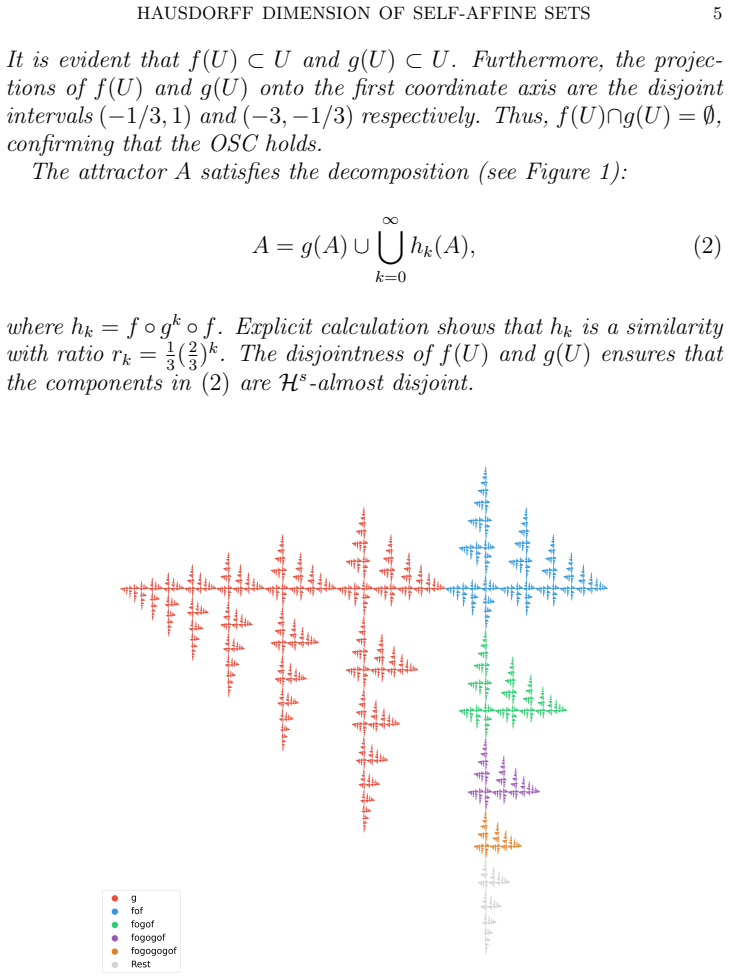
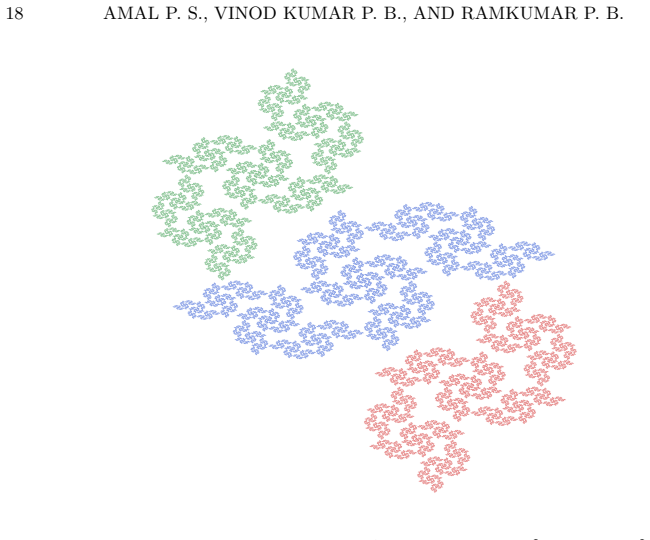
IndisputableMonolith/Constants/AlphaDerivationExplicit.leanphi_golden_ratio echoesSubstituting u = (1/2)^{s/2} yields the quadratic equation u² + u − 1 = 0. The positive solution is the inverse of the Golden Ratio, u = 1/φ = (√5 − 1)/2. Solving for s, we find the exact dimension s = 2 log₂(φ) ≈ 1.388.
-
IndisputableMonolith/Cost/FunctionalEquation.leanwashburn_uniqueness_aczel echoesc^{s/n} + ∑ r_i^s = 1 (under f-alignment and OSC)
-
IndisputableMonolith/Foundation/BranchSelection.leanbranch_selection refinesthe precise parameter balance c + r = 1 acts as a strict topological bottleneck uniquely guaranteeing both the open set condition and the connectedness of the attractor
Reference graph
Works this paper leans on
-
[1]
P. S. Amal, P. B. Vinod Kumar, and P. B. Ramkumar,G-contractions and g-iterated function system, Chaos, Solitons & Fractals209(2026), 118406
work page 2026
-
[2]
Bal´ azs B´ ar´ any, Michael Hochman, and Ariel Rapaport,Hausdorff dimension of planar self-affine sets and measures, Inventiones mathematicae216(2019), no. 3, 601–659
work page 2019
-
[3]
Bal´ azs B´ ar´ any, Antti K¨ aenm¨ aki, and Henna Koivusalo,Dimension of self-affine sets for fixed translation vectors, Journal of the London Mathematical Society 98(2018), no. 1, 223–244
work page 2018
-
[4]
Bal´ azs B´ ar´ any, Micha l Rams, and K´ aroly Simon,On the dimension of self-affine sets and measures with overlaps, Proceedings of the American Mathematical Society144(2016), no. 10, 4427–4440
work page 2016
-
[5]
HAUSDORFF DIMENSION OF SELF-AFFINE SETS 59
Michael F Barnsley,Fractals everywhere, new edition ed., Academic Press, 2014. HAUSDORFF DIMENSION OF SELF-AFFINE SETS 59
work page 2014
-
[6]
Michael F Barnsley and Stephen Demko,Iterated function systems and the global construction of fractals, Proceedings of the Royal Society of London. A. Mathematical and Physical Sciences399(1985), no. 1817, 243–275
work page 1985
-
[7]
Michael F Barnsley, V Ervin, D Hardin, and J Lancaster,Solution of an inverse problem for fractals and other sets, Proceedings of the National Academy of Sciences83(1986), no. 7, 1975–1977
work page 1986
-
[8]
Kenneth Falconer,Fractal geometry: Mathematical foundations and applica- tions, 3rd ed., John Wiley & Sons, Chichester, UK, 2014
work page 2014
-
[9]
Kenneth Falconer and Tom Kempton,Planar self-affine sets with equal haus- dorff, box and affinity dimensions, Ergodic Theory and Dynamical Systems38 (2018), no. 4, 1369–1388
work page 2018
-
[10]
Kenneth J Falconer,The hausdorff dimension of self-affine fractals, Mathe- matical Proceedings of the Cambridge Philosophical Society103(1988), no. 2, 339–350
work page 1988
-
[11]
Michael Hochman and Ariel Rapaport,Hausdorff dimension of planar self- affine sets and measures with overlaps, Journal of the European Mathematical Society24(2022), no. 7, 2361–2441
work page 2022
- [12]
-
[13]
John E Hutchinson,Fractals and self-similarity, Indiana University Mathemat- ics Journal30(1981), no. 5, 713–747
work page 1981
-
[14]
Thomas Jordan, Mark Pollicott, and K´ aroly Simon,Hausdorff dimension for randomly perturbed self affine attractors, Communications in Mathematical Physics270(2007), no. 2, 519–544
work page 2007
- [15]
-
[16]
Ian D Morris and Pablo Shmerkin,On equality of hausdorff and affinity di- mensions, via self-affine measures on positive subsystems, Transactions of the American Mathematical Society371(2019), no. 3, 1547–1582
work page 2019
-
[17]
Roger D Nussbaum, Amit Priyadarshi, and Sjoerd Verduyn Lunel,Positive op- erators and hausdorff dimension of invariant sets, Transactions of the American Mathematical Society364(2012), no. 2, 1029–1066
work page 2012
-
[18]
Andreas Schief,Separation properties for self-similar sets, Proceedings of the American Mathematical Society122(1994), no. 1, 111–115. 60 AMAL P. S., VINOD KUMAR P. B., AND RAMKUMAR P. B. APJ Abdul Kalam Technological University, Thiruvananthapuram, Kerala, India; Rajagiri School of Engineering and Technology, Kochi, Kerala, India Email address:amalb9111@...
work page 1994
discussion (0)
Sign in with ORCID, Apple, or X to comment. Anyone can read and Pith papers without signing in.