Recognition: 2 theorem links
· Lean TheoremFrequencyCT: Frequency domain pseudo-label generation for self-supervised low-dose CT denoising
Pith reviewed 2026-05-12 03:39 UTC · model grok-4.3
The pith
Frequency-domain anchoring and perturbation generate pseudo-labels that train a denoiser on noisy low-dose CT data alone.
A machine-rendered reading of the paper's core claim, the machinery that carries it, and where it could break.
Core claim
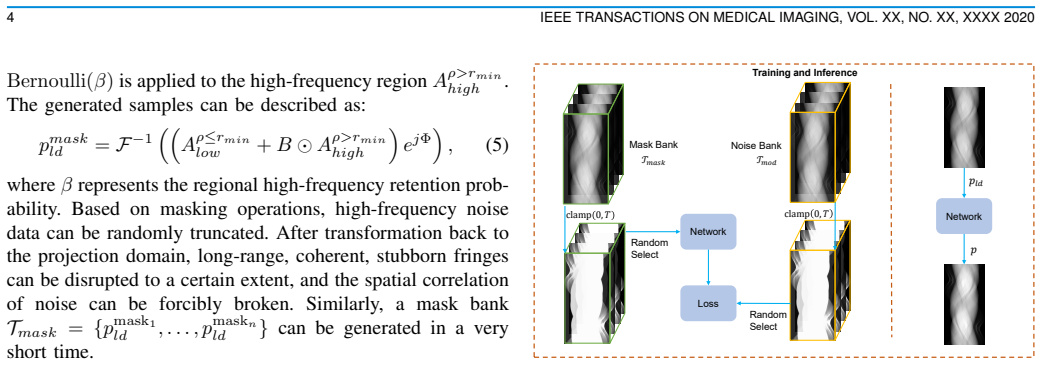
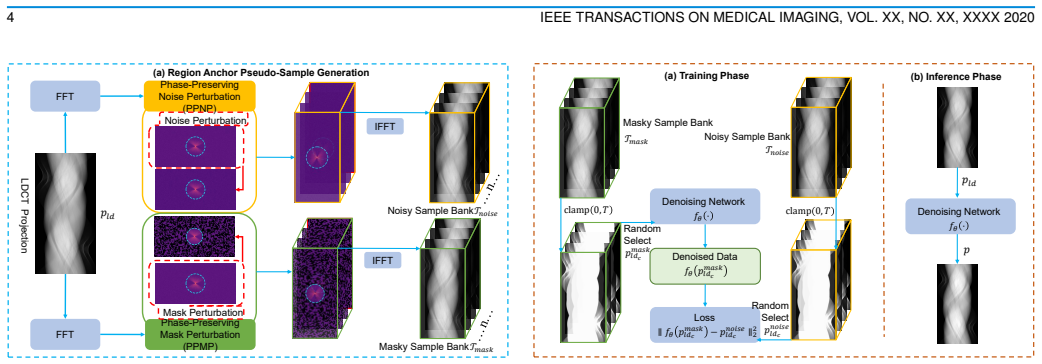
FrequencyCT creates usable pseudo-label data for self-supervision by first anchoring low-frequency coefficients, then performing phase-preserving amplitude modulation together with high-frequency mask perturbation, and finally truncating the resulting samples to stabilize gradient flow during training of a denoising network on low-dose CT projections.
What carries the argument
Regional low-frequency anchoring combined with phase-preserving amplitude modulation and high-frequency mask perturbation, which together isolate noise characteristics in the frequency domain to synthesize pseudo-labels.
If this is right
- The method runs in a zero-shot self-supervised regime, needing no paired clean data for either training or deployment.
- Truncation of generated samples counters the effect of fluctuating projection noise variance and keeps optimization stable.
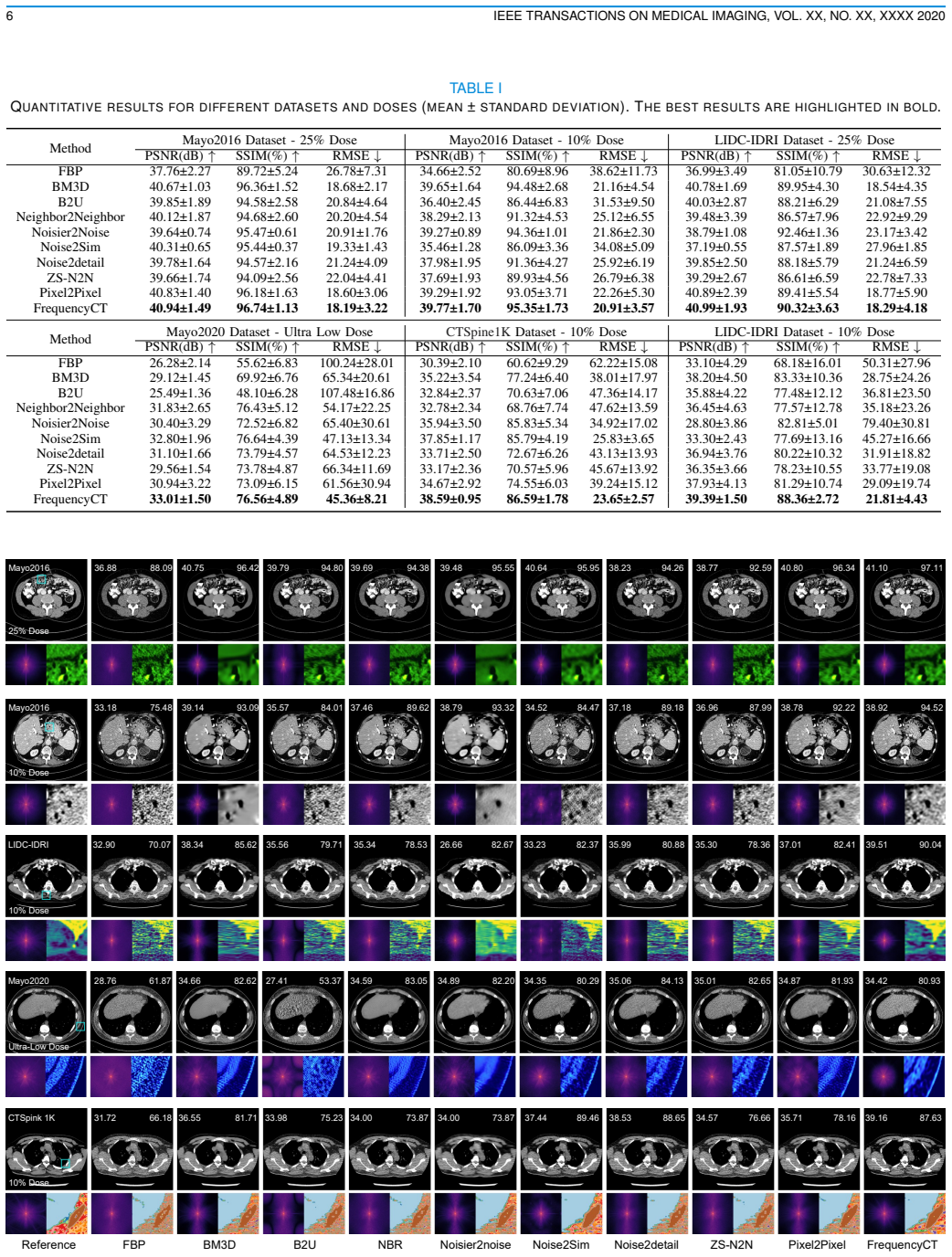
- Performance is reported on both public benchmark datasets and real-world clinical acquisitions, indicating direct applicability.
Where Pith is reading between the lines
- The same frequency-separation idea for creating pseudo-labels could be tried on other modalities whose noise exhibits different spectral behavior, such as PET or ultrasound.
- If the pseudo-labels prove sufficiently faithful, the approach would support routine use of lower radiation-dose CT protocols without requiring new supervised datasets.
- The truncation step suggests that any frequency-based pseudo-label method may need an explicit variance-stabilization stage when applied to real acquisition data.
Load-bearing premise
The frequency domain largely isolates noise from the clean signal, so that low-frequency anchoring plus high-frequency perturbation produces reliable training targets.
What would settle it
A controlled experiment in which networks trained on the generated pseudo-labels show no denoising gain, or even degrade image quality, when compared with the same architecture trained on the raw noisy inputs alone.
Figures




read the original abstract
Despite extensive research on computed tomography (CT) denoising, few studies exploit projection-domain data characteristics to mitigate noise correlation. To address this, this work proposes FrequencyCT, the first zero-shot self-supervised method for pseudo-label generation in the frequency domain for low-dose CT denoising. Leveraging the characteristic of the frequency domain that largely isolates noise from clean signals, a regional low-frequency anchoring technique is proposed. Phase-preserving amplitude modulation and mask perturbation in the high-frequency region generate pseudo-label data for self-supervision. The fluctuating noise variance in the projection domain prompts truncation of the generated samples to stabilize the network's optimization gradient. Evaluation results on multiple public and real-world datasets confirm the clinical application potential of this research, which will have a revolutionary impact on the field of denoising. The code can be obtained from https://github.com/yqx7150/FrequencyCT.
Editorial analysis
A structured set of objections, weighed in public.
Referee Report
Summary. The manuscript proposes FrequencyCT, the first zero-shot self-supervised method for pseudo-label generation in the frequency domain for low-dose CT denoising. It leverages frequency-domain isolation of noise via a regional low-frequency anchoring technique, combined with phase-preserving amplitude modulation and high-frequency mask perturbation to generate pseudo-labels, and applies sample truncation to stabilize optimization gradients amid fluctuating noise variance in the projection domain. Evaluations on multiple public and real-world datasets are presented to support claims of clinical application potential.
Significance. If the quantitative results hold, the work offers a coherent pipeline for self-supervised CT denoising that directly targets projection-domain noise correlation through frequency-domain operations, which is a useful extension of standard signal-processing heuristics. The explicit stabilization steps (truncation) and open-sourced code are strengths that aid reproducibility. The approach could reduce reliance on paired clean/noisy data, a persistent bottleneck in medical imaging, though its practical significance depends on demonstrated gains over existing self-supervised baselines.
major comments (1)
- Abstract: the assertion that the research 'will have a revolutionary impact on the field of denoising' is disproportionate to the described evidence and should be replaced with a measured statement of specific contributions relative to prior self-supervised CT denoising methods.
minor comments (1)
- Abstract: the description of the method components is clear, but the absence of any numerical results, baseline names, or dataset identifiers makes it difficult for readers to gauge the scale of improvement; the results section should include these details with error bars.
Simulated Author's Rebuttal
We thank the referee for the constructive feedback. We agree that the language in the abstract overstates the potential impact and have revised it to a measured statement focused on our specific contributions relative to prior self-supervised CT denoising methods.
read point-by-point responses
-
Referee: Abstract: the assertion that the research 'will have a revolutionary impact on the field of denoising' is disproportionate to the described evidence and should be replaced with a measured statement of specific contributions relative to prior self-supervised CT denoising methods.
Authors: We acknowledge that the original phrasing was disproportionate to the presented evidence. In the revised manuscript, the final sentence of the abstract has been changed to: 'Evaluation results on multiple public and real-world datasets confirm the clinical application potential of this research, which introduces a zero-shot self-supervised approach for low-dose CT denoising via frequency-domain pseudo-label generation.' This provides a specific, evidence-based description of the contributions without hyperbolic claims. revision: yes
Circularity Check
No significant circularity detected
full rationale
The paper's core pipeline generates pseudo-labels via explicit frequency-domain operations (regional low-frequency anchoring, phase-preserving amplitude modulation, high-frequency mask perturbation, and sample truncation) applied directly to the input noisy projections. These steps are deterministic transformations of the observed data and do not reduce any claimed output or prediction to a fitted parameter or self-referential definition. No self-citations appear as load-bearing premises, no uniqueness theorems are invoked, and the self-supervised training objective remains independent of the final denoised result. The derivation is therefore self-contained against external benchmarks and standard frequency-domain heuristics.
Axiom & Free-Parameter Ledger
axioms (1)
- domain assumption The frequency domain largely isolates noise from clean signals
Lean theorems connected to this paper
-
IndisputableMonolith/Cost/FunctionalEquation.leanwashburn_uniqueness_aczel unclear?
unclearRelation between the paper passage and the cited Recognition theorem.
Leveraging the characteristic of the frequency domain that largely isolates noise from clean signals, a regional low-frequency anchoring technique is proposed. Phase-preserving amplitude modulation and mask perturbation in the high-frequency region generate pseudo-label data
-
IndisputableMonolith/Foundation/ArithmeticFromLogic.leanembed_strictMono_of_one_lt unclear?
unclearRelation between the paper passage and the cited Recognition theorem.
Theorem 1... σ²_y ≈ exp(p)/I0 ... truncation of the generated samples to stabilize the network's optimization gradient
What do these tags mean?
- matches
- The paper's claim is directly supported by a theorem in the formal canon.
- supports
- The theorem supports part of the paper's argument, but the paper may add assumptions or extra steps.
- extends
- The paper goes beyond the formal theorem; the theorem is a base layer rather than the whole result.
- uses
- The paper appears to rely on the theorem as machinery.
- contradicts
- The paper's claim conflicts with a theorem or certificate in the canon.
- unclear
- Pith found a possible connection, but the passage is too broad, indirect, or ambiguous to say the theorem truly supports the claim.
Reference graph
Works this paper leans on
-
[1]
Computed tomography—an increasing source of radiation exposure,
D. J. Brenner and E. J. Hall, “Computed tomography—an increasing source of radiation exposure,” N. Engl. J. Med., vol. 357, no. 22, pp. 2277–2284, 2007
work page 2007
-
[2]
R. Smith-Bindman, J. Lipson,et al., “Radiation dose associated with common computed tomography examinations and the associated lifetime attributable risk of cancer,” Arch. Intern. Med., vol. 169, no. 22, pp. 2078–2086, 2009
work page 2078
-
[3]
Photon-counting computed tomography (PCCT): technical background and cardio-vascular applications,
A. Meloni, F. Frijia,et al., “Photon-counting computed tomography (PCCT): technical background and cardio-vascular applications,” Diag- nostics, vol. 13, no. 4, pp. 645, 2023
work page 2023
-
[4]
M. Bosch de Basea, I. Thierry-Chef,et al., “Risk of hematological malignancies from CT radiation exposure in children, adolescents and young adults,” Nat. Med., vol. 29, no. 12, pp. 3111–3119, 2023
work page 2023
-
[5]
A. Buades, B. Coll,et al., “Non-local means denoising,” Image Process. Line, vol. 1, pp. 208–212, 2011
work page 2011
-
[6]
Sparsity-based image denoising via dictionary learning and structural clustering,
W. Dong, X. Li,et al., “Sparsity-based image denoising via dictionary learning and structural clustering,” in Proc. CVPR, pp. 457–464, 2011
work page 2011
-
[7]
Iterative methods for total variation denoising,
C. R. V ogel and M. E. Oman, “Iterative methods for total variation denoising,” SIAM J. Sci. Comput., vol. 17, no. 1, pp. 227–238, 1996
work page 1996
-
[8]
Image denoising by sparse 3-D transform- domain collaborative filtering,
K. Dabov, A. Foi,et al., “Image denoising by sparse 3-D transform- domain collaborative filtering,” IEEE Trans. Image Process., vol. 16, no. 8, pp. 2080–2095, 2007
work page 2080
-
[9]
Iterative algorithms based on decoupling of deblurring and denoising for image restoration,
Y .-W. Wen, M. K. Ng,et al., “Iterative algorithms based on decoupling of deblurring and denoising for image restoration,” SIAM J. Sci. Comput., vol. 30, no. 5, pp. 2655–2674, 2008
work page 2008
-
[10]
H. Shan, A. Padole,et al., “Competitive performance of a modularized deep neural network compared to commercial algorithms for low-dose CT image reconstruction,” Nat. Mach. Intell., vol. 1, no. 6, pp. 269–276, 2019
work page 2019
-
[11]
Deep learning for tomographic image reconstruction,
G. Wang, J. C. Ye,et al., “Deep learning for tomographic image reconstruction,” Nat. Mach. Intell., vol. 2, no. 12, pp. 737–748, 2020
work page 2020
-
[12]
Diffusion models: A comprehensive survey of methods and applications,
L. Yang, Z. Zhang,et al., “Diffusion models: A comprehensive survey of methods and applications,” ACM Comput. Surv., vol. 56, no. 4, pp. 1–39, 2023
work page 2023
-
[13]
Towards generalist foundation model for ra- diology by leveraging web-scale 2D&3D medical data,
C. Wu, X. Zhang,et al., “Towards generalist foundation model for ra- diology by leveraging web-scale 2D&3D medical data,” Nat. Commun., vol. 16, no. 1, pp. 7866, 2025
work page 2025
-
[14]
HorusEye: a self-supervised foundation model for generalizable X-ray tomography restoration,
Y . Chu, L. Zhou,et al., “HorusEye: a self-supervised foundation model for generalizable X-ray tomography restoration,” Nat. Comput. Sci., pp. 1–16, 2026
work page 2026
-
[15]
3D Gaussian splatting for real-time radiance field rendering,
B. Kerbl, G. Kopanas,et al., “3D Gaussian splatting for real-time radiance field rendering,” ACM Trans. Graph., vol. 42, no. 4, pp. 139–1, 2023
work page 2023
-
[16]
A survey on contrastive self-supervised learning,
A. Jaiswal, A. R. Babu,et al., “A survey on contrastive self-supervised learning,” Technologies, vol. 9, no. 1, pp. 2, 2020
work page 2020
-
[17]
Noise2Noise: Learning Image Restoration without Clean Data
J. Lehtinen, J. Munkberg,et al., “Noise2Noise: Learning image restora- tion without clean data,” arXiv preprint arXiv:1803.04189, 2018
work page Pith review arXiv 2018
-
[18]
Zero-shot noise2noise: Efficient image denoising without any data,
Y . Mansour and R. Heckel, “Zero-shot noise2noise: Efficient image denoising without any data,” in Proc. IEEE/CVF Conf. Comput. Vis. Pattern Recognit., pp. 14018–14027, 2023
work page 2023
-
[19]
A fast blind zero-shot denoiser,
J. Lequyer, R. Philip,et al., “A fast blind zero-shot denoiser,” Nat. Mach. Intell., vol. 4, no. 11, pp. 953–963, 2022
work page 2022
-
[20]
Nonlocal image and movie denoising,
A. Buades, B. Coll,et al., “Nonlocal image and movie denoising,” Int. J. Comput. Vis., vol. 76, no. 2, pp. 123–139, 2008
work page 2008
-
[21]
D. Ulyanov, A. Vedaldi,et al., “Deep image prior,” in Proc. IEEE/CVF Conf. Comput. Vis. Pattern Recognit., pp. 9446–9454, 2018
work page 2018
-
[22]
Noise suppression with similarity-based self- supervised deep learning,
C. Niu, M. Li,et al., “Noise suppression with similarity-based self- supervised deep learning,” IEEE Trans. Med. Imaging, vol. 42, no. 6, pp. 1590–1602, 2022
work page 2022
-
[23]
Pixel2pixel: A pixelwise approach for zero-shot single image denoising,
Q. Ma, J. Jiang,et al., “Pixel2pixel: A pixelwise approach for zero-shot single image denoising,” IEEE Trans. Pattern Anal. Mach. Intell., 2025
work page 2025
-
[24]
Lightweight Data-free denoising for Detail-Preserving Biomedical Image Restoration,
T. Chobola, J. A. Schnabel,et al., “Lightweight Data-free denoising for Detail-Preserving Biomedical Image Restoration,” in Proc. MICCAI, pp. 318–327, 2025
work page 2025
-
[25]
Proj2Proj: self-supervised low-dose CT reconstruction,
M. O. Unal, M. Ertas,et al., “Proj2Proj: self-supervised low-dose CT reconstruction,” PeerJ Comput. Sci., vol. 10, 2024
work page 2024
-
[26]
Self-supervised denoising of projection data for low-dose cone-beam CT,
K. Choi, S. H. Kim,et al., “Self-supervised denoising of projection data for low-dose cone-beam CT,” Med. Phys., vol. 50, no. 10, pp. 6319– 6333, 2023
work page 2023
-
[27]
Self-supervised dual-domain balanced dropblock-network for low-dose CT denoising,
R. An, K. Chen,et al., “Self-supervised dual-domain balanced dropblock-network for low-dose CT denoising,” Phys. Med. Biol., vol. 69, no. 7, pp. 075026, 2024
work page 2024
-
[28]
The physical meaning of parseval’s theorem,
H. K. Hughes, “The physical meaning of parseval’s theorem,” Am. J. Phys., vol. 33, no. 2, pp. 99–101, 1965
work page 1965
-
[29]
D. F. Swinehart, “The beer-lambert law,” J. Chem. Educ., vol. 39, no. 7, pp. 333, 1962
work page 1962
-
[30]
Z. M. Odibat and N. T. Shawagfeh, “Generalized Taylor’s formula,” Appl. Math. Comput., vol. 186, no. 1, pp. 286–293, 2007
work page 2007
-
[31]
Neighbor2neighbor: Self-supervised denoising from single noisy images,
T. Huang, S. Li,et al., “Neighbor2neighbor: Self-supervised denoising from single noisy images,” in Proc. IEEE/CVF Conf. Comput. Vis. Pattern Recognit., pp. 14781–14790, 2021
work page 2021
-
[32]
Principal components analysis (PCA),
A. Ma ´ckiewicz and W. Ratajczak, “Principal components analysis (PCA),” Comput. Geosci., vol. 19, no. 3, pp. 303–342, 1993
work page 1993
-
[33]
An open library of CT patient projection data,
B. Chen, S. Leng,et al., “An open library of CT patient projection data,” in Proc. SPIE Med. Imaging, vol. 9783, pp. 330–335, 2016
work page 2016
-
[34]
S. G. Armato III, G. McLennan,et al., “The lung image database consortium (LIDC) and image database resource initiative (IDRI): a completed reference database of lung nodules on CT scans,” Med. Phys., vol. 38, no. 2, pp. 915–931, 2011
work page 2011
-
[35]
Ctspine1k: A large-scale dataset for spinal vertebrae segmentation in computed tomography,
Y . Deng, C. Wang,et al., “Ctspine1k: A large-scale dataset for spinal vertebrae segmentation in computed tomography,” arXiv preprint arXiv:2105.14711, 2021
-
[36]
Low-dose CT image and projection dataset,
T. R. Moen, B. Chen,et al., “Low-dose CT image and projection dataset,” Med. Phys., vol. 48, no. 2, pp. 902–911, 2021
work page 2021
-
[37]
Torchradon: Fast differentiable routines for computed tomography,
M. Ronchetti, “Torchradon: Fast differentiable routines for computed tomography,” arXiv preprint arXiv:2009.14788, 2020
-
[38]
Operator discretization library (ODL),
J. Adler, H. Kohr,et al., “Operator discretization library (ODL),” Zenodo, 2017
work page 2017
-
[39]
Robust low-dose CT sinogram preprocessing via exploiting noise-generating mechanism,
Q. Xie, D. Zeng,et al., “Robust low-dose CT sinogram preprocessing via exploiting noise-generating mechanism,” IEEE Trans. Med. Imaging, vol. 36, no. 12, pp. 2487–2498, 2017
work page 2017
-
[40]
Blind2unblind: Self-supervised image denoising with visible blind spots,
Z. Wang, J. Liu,et al., “Blind2unblind: Self-supervised image denoising with visible blind spots,” in Proc. IEEE/CVF Conf. Comput. Vis. Pattern Recognit., pp. 2027–2036, 2022
work page 2027
-
[41]
Noisier2noise: Learning to denoise from unpaired noisy data,
N. Moran, D. Schmidt,et al., “Noisier2noise: Learning to denoise from unpaired noisy data,” in Proc. IEEE/CVF Conf. Comput. Vis. Pattern Recognit., pp. 12064–12072, 2020
work page 2020
-
[42]
Penalized weighted least-squares image reconstruction for positron emission tomography,
J. A. Fessler, “Penalized weighted least-squares image reconstruction for positron emission tomography,” IEEE Trans. Med. Imaging, vol. 13, no. 2, pp. 290–300, 1994
work page 1994
discussion (0)
Sign in with ORCID, Apple, or X to comment. Anyone can read and Pith papers without signing in.