Recognition: 2 theorem links
· Lean TheoremCurvature-Dependent Lower Bounds for Frank-Wolfe
Pith reviewed 2026-05-12 04:37 UTC · model grok-4.3
The pith
Frank-Wolfe cannot converge faster than order T to the minus p over p minus one on p-uniformly convex sets for p at least 3.
A machine-rendered reading of the paper's core claim, the machinery that carries it, and where it could break.
Core claim
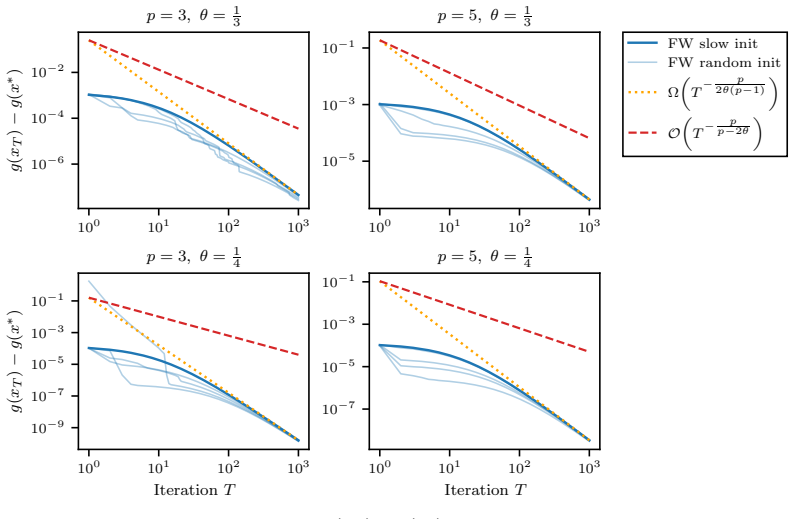
For every p at least 3 there exist smooth convex problems over p-uniformly convex domains on which the Frank-Wolfe algorithm with exact line search or short steps satisfies a lower bound of Omega of T to the minus p over p minus one. The proofs follow the evolution of iterates on low-dimensional explicit examples rather than relying on high-dimensional information-theoretic arguments, and the same lower bound applies when the objective satisfies a Hölderian error bound.
What carries the argument
Direct tracking of the progress made by successive linear optimization oracle calls on low-dimensional p-uniformly convex sets, which limits improvement per iteration according to the curvature parameter p.
If this is right
- The previously known upper bounds of order T to the minus p over p minus one are optimal for p at least 3.
- The lower bound applies even in low dimensions through concrete constructions.
- The same rate lower bound holds for objectives satisfying a Hölderian error bound.
- Further acceleration would require assumptions stronger than p-uniform convexity or changes to the algorithm steps.
Where Pith is reading between the lines
- For domains whose curvature sits between strong convexity and general convexity, Frank-Wolfe may lose out to other first-order methods that exploit different geometry.
- The low-dimensional instances could be reused to derive matching lower bounds for accelerated variants or related conditional-gradient methods.
- If a feasible set has locally varying curvature, the global worst-case rate would be governed by the smallest local p value.
Load-bearing premise
The feasible set must be p-uniformly convex for a fixed p at least 3 and the objective must be smooth and convex, while the algorithm uses exact line search or short steps.
What would settle it
An explicit p-uniformly convex set together with a smooth convex objective on which Frank-Wolfe with exact line search or short steps reaches the optimum faster than the stated rate would falsify the lower bound.
Figures


read the original abstract
The Frank-Wolfe algorithm achieves a convergence rate of $\mathcal{O}(1/T)$ for smooth convex optimization over compact convex domains, accelerating to $\mathcal{O}(1/T^2)$ when both the objective and the feasible set are strongly convex. This acceleration extends beyond strong convexity: Kerdreux et al. (2021a) proved rates of $\mathcal{O}(T^{-p/(p-1)})$ over $p$-uniformly convex feasible sets, a class that interpolates between strongly convex sets and more general curved domains such as $\ell_p$ balls. In this work, we establish a matching $\Omega(T^{-p/(p-1)})$ lower bound for every $p\ge 3$ under exact line search or short steps, and extend the lower bound to objectives satisfying a H\"olderian error bound. The proofs analyze the dynamics of Frank-Wolfe iterates on simple instances and hence are not limited to the high-dimensional setting, unlike information-theoretic lower bounds.
Editorial analysis
A structured set of objections, weighed in public.
Referee Report
Summary. The manuscript establishes matching lower bounds of Ω(T^{-p/(p-1)}) for the Frank-Wolfe algorithm on p-uniformly convex feasible sets (p ≥ 3) under exact line search or short steps. The bounds are derived via explicit analysis of the algorithm's iterate dynamics on simple low-dimensional instances with smooth convex objectives, and the result is extended to objectives satisfying a Hölderian error bound. The approach is constructive and not restricted to high-dimensional regimes.
Significance. If the central claims hold, the work is significant because it provides matching lower bounds that confirm the optimality of the upper bounds from Kerdreux et al. (2021) for curvature-dependent acceleration in Frank-Wolfe, even in low dimensions. The direct dynamic analysis on explicit instances is a clear strength, yielding constructive and falsifiable examples rather than relying on information-theoretic arguments. This completes the rate picture for Frank-Wolfe under p-uniform convexity and Hölderian error bounds.
minor comments (3)
- [Preliminaries] The precise definition and constants for p-uniform convexity should be recalled explicitly in the preliminaries section to ensure the simple instances are immediately verifiable against the assumption.
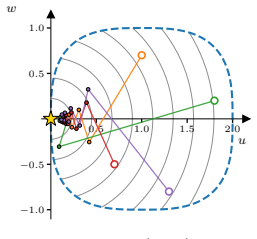
- A brief numerical example or plot illustrating the constructed lower-bound instance for p=3 would help readers confirm the dynamics without reconstructing the full proof.
- [Main results] The statement of the short-step rule in the main theorem should include a reference to the exact step-size formula used, to distinguish it from other variants in the literature.
Simulated Author's Rebuttal
We thank the referee for their positive summary of our work and for recommending minor revision. We appreciate the recognition that our constructive analysis on low-dimensional instances provides matching lower bounds confirming the optimality of the rates in Kerdreux et al. (2021), and that the approach extends naturally to Hölderian error bounds without relying on high-dimensional information-theoretic arguments.
Circularity Check
No significant circularity identified
full rationale
The paper establishes its Ω(T^{-p/(p-1)}) lower bounds via direct, explicit analysis of Frank-Wolfe iterate dynamics on low-dimensional instances that satisfy the p-uniform convexity assumption (p≥3) together with standard smoothness and convexity of the objective. This constructive approach yields the matching rate under exact line search or short steps and extends to Hölderian error bounds without reducing any quantity to a fitted parameter, a self-referential definition, or a load-bearing self-citation. The cited upper-bound result (Kerdreich et al. 2021a) is external to the lower-bound derivation and does not enter the proof equations. The argument is therefore self-contained against the stated assumptions.
Axiom & Free-Parameter Ledger
axioms (2)
- domain assumption The feasible set is p-uniformly convex for p ≥ 3
- domain assumption The objective function is smooth and convex
Lean theorems connected to this paper
-
IndisputableMonolith/Cost/FunctionalEquation.leanwashburn_uniqueness_aczel unclearWe establish a matching Ω(T^{-p/(p-1)}) lower bound for every p≥3 under exact line search or short steps... by analyzing the dynamics of FW iterates on simple instances
-
IndisputableMonolith/Foundation/RealityFromDistinction.leanreality_from_one_distinction unclearthe constraint set is p-uniformly convex... Hölderian error bound
Reference graph
Works this paper leans on
-
[1]
The Agentic Researcher: A Practical Guide to AI-Assisted Research in Mathematics and Machine Learning , author=. 2026 , eprint=
work page 2026
-
[2]
Lower Bounds for Frank-Wolfe on Strongly Convex Sets , author=. 2026 , eprint=
work page 2026
- [3]
-
[4]
Adrien B. Taylor and Julien M. Hendrickx and Fran. Smooth strongly convex interpolation and exact worst-case performance of first-order methods , url =. doi:10.1007/S10107-016-1009-3 , journal =
-
[5]
Performance of first-order methods for smooth convex minimization: a novel approach , url =
Yoel Drori and Marc Teboulle , doi =. Performance of first-order methods for smooth convex minimization: a novel approach , url =. Math. Program. , number =
-
[6]
An algorithm for quadratic programming , volume =
Frank, Marguerite and Wolfe, Philip , journal =. An algorithm for quadratic programming , volume =
-
[7]
Acceleration of Frank-Wolfe Algorithms with Open-Loop Step-Sizes , url =
Elias Samuel Wirth and Thomas Kerdreux and Sebastian Pokutta , booktitle =. Acceleration of Frank-Wolfe Algorithms with Open-Loop Step-Sizes , url =
-
[8]
Weibel, Julien and Gaillard, Pierre and Koolen, Wouter M and Taylor, Adrien , journal =. Optimized projection-free algorithms for online learning: construction and worst-case analysis , year =
-
[9]
Convergence theory in nonlinear programming , year =
Wolfe, Philip , booktitle =. Convergence theory in nonlinear programming , year =
-
[10]
Revisiting Frank-Wolfe: Projection-Free Sparse Convex Optimization , url =
Martin Jaggi , booktitle =. Revisiting Frank-Wolfe: Projection-Free Sparse Convex Optimization , url =
-
[11]
A tight upper bound on the rate of convergence of Frank-Wolfe algorithm , volume =
Canon, Michael D and Cullum, Clifton D , journal =. A tight upper bound on the rate of convergence of Frank-Wolfe algorithm , volume =
-
[12]
Performance Estimation for Smooth and Strongly Convex Sets , year =
Alan Luner and Benjamin Grimmer , journal =. Performance Estimation for Smooth and Strongly Convex Sets , year =
-
[13]
The complexity of large-scale convex programming under a linear optimization oracle , year =
Lan, Guanghui , journal =. The complexity of large-scale convex programming under a linear optimization oracle , year =
-
[14]
Problem Complexity and Method Efficiency in Optimization , year =
Nemirovski, Arkadi. Problem Complexity and Method Efficiency in Optimization , year =
-
[15]
Faster Rates for the Frank-Wolfe Method over Strongly-Convex Sets , url =
Dan Garber and Elad Hazan , booktitle =. Faster Rates for the Frank-Wolfe Method over Strongly-Convex Sets , url =
-
[16]
Braun, G. and Carderera, A. and Combettes, C.W. and Hassani, H. and Karbasi, A. and Mokhtari, A. and Pokutta, S. , isbn =. Conditional Gradient Methods:
-
[17]
Projection-Free Optimization on Uniformly Convex Sets , url =
Thomas Kerdreux and Alexandre d'Aspremont and Sebastian Pokutta , booktitle =. Projection-Free Optimization on Uniformly Convex Sets , url =
-
[18]
Affine Invariant Analysis of Frank-Wolfe on Strongly Convex Sets , url =
Thomas Kerdreux and Lewis Liu and Simon Lacoste-Julien and Damien Scieur , booktitle =. Affine Invariant Analysis of Frank-Wolfe on Strongly Convex Sets , url =
-
[19]
Constrained minimization methods , volume =
Levitin, Evgeny S and Polyak, Boris T , journal =. Constrained minimization methods , volume =
-
[20]
Christophe Roux and Max Zimmer and Alexandre d'Aspremont and Sebastian Pokutta , doi =. CoRR , title =. 2510.13713 , eprinttype =
-
[21]
Faster Projection-free Convex Optimization over the Spectrahedron , url =
Dan Garber , booktitle =. Faster Projection-free Convex Optimization over the Spectrahedron , url =
-
[22]
Sinkhorn Barycenters with Free Support via Frank-Wolfe Algorithm , url =
Giulia Luise and Saverio Salzo and Massimiliano Pontil and Carlo Ciliberto , booktitle =. Sinkhorn Barycenters with Free Support via Frank-Wolfe Algorithm , url =
-
[23]
Solving the Optimal Experiment Design Problem with Mixed-Integer Convex Methods , url =
Deborah Hendrych and Mathieu Besan. Solving the Optimal Experiment Design Problem with Mixed-Integer Convex Methods , url =. 22nd International Symposium on Experimental Algorithms,. doi:10.4230/LIPICS.SEA.2024.16 , editor =
-
[24]
Approximate Methods in Optimization Problems , volume =
Demyanov, Vladimir Fedorovich and Rubinov, Aleksandr Moiseevich , journal =. Approximate Methods in Optimization Problems , volume =
-
[25]
Dunn, Joseph C , journal =. Rates of convergence for conditional gradient algorithms near singular and nonsingular extremals , volume =
-
[26]
Lower Bounds for Linear Minimization Oracle Methods Optimizing over Strongly Convex Sets , author=. 2026 , eprint=
work page 2026
-
[27]
On the Global Linear Convergence of Frank-Wolfe Optimization Variants , booktitle =
Simon Lacoste. On the Global Linear Convergence of Frank-Wolfe Optimization Variants , booktitle =. 2015 , url =
work page 2015
-
[28]
Vincent Roulet and Alexandre d'Aspremont , title =. 2020 , url =. doi:10.1137/18M1224568 , timestamp =
discussion (0)
Sign in with ORCID, Apple, or X to comment. Anyone can read and Pith papers without signing in.