Recognition: 2 theorem links
· Lean TheoremCo-evolution of the Milky Way high- and low-{α} sequences with chemical evolution models
Pith reviewed 2026-05-12 04:34 UTC · model grok-4.3
The pith
A revised chemical evolution model with a pre-enriched delayed second gas infall reproduces the Milky Way high- and low-alpha sequences together with their stellar age distributions.
A machine-rendered reading of the paper's core claim, the machinery that carries it, and where it could break.
Core claim
The authors show that the high-alpha and low-alpha sequences arise from two successive infall episodes of slightly pre-enriched gas, the second delayed by about 1 Gyr. When the model is run with observationally derived star-formation histories triggered by Sagittarius passages, it reproduces the full [alpha/Fe]–[Fe/H] diagram of APOGEE DR17 stars, the age distributions of thick- and thin-disc samples, and the existence of old low-alpha stars, while predicting only a short period of co-evolution between the two sequences.
What carries the argument
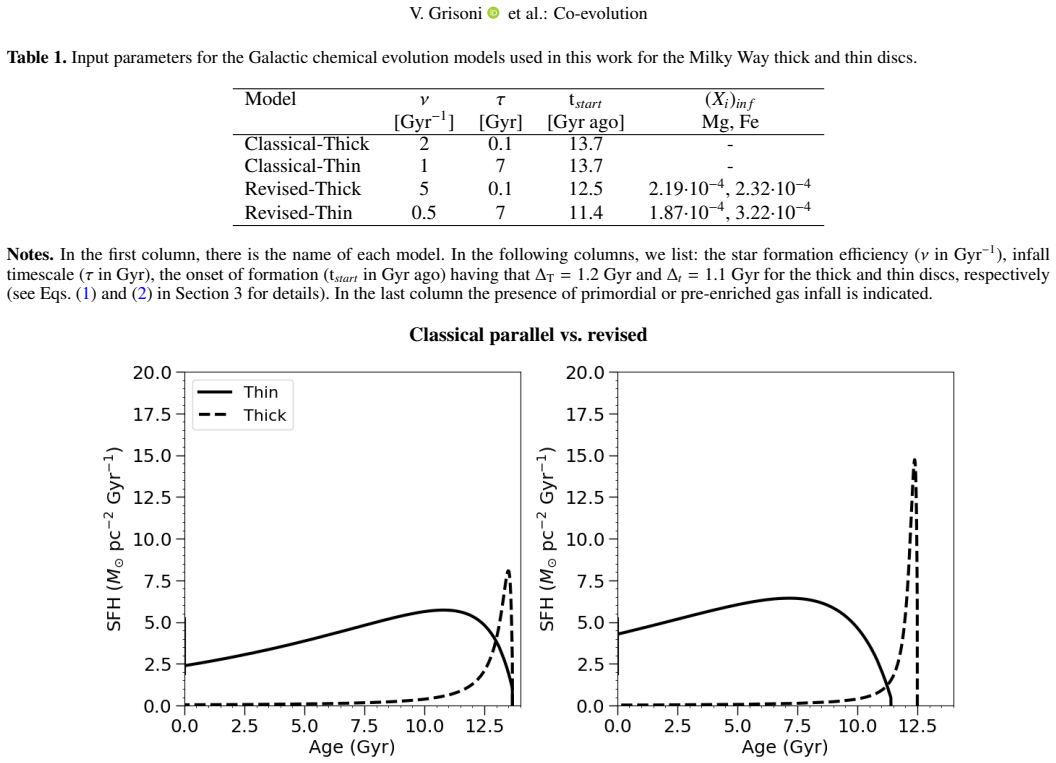
The revised parallel scenario of two distinct infall episodes of slightly pre-enriched extragalactic gas, with the second episode delayed by roughly 1 Gyr and its star formation triggered by Sagittarius passages.
If this is right
- The model simultaneously fits the [alpha/Fe] versus [Fe/H] diagram from APOGEE DR17 and the age distributions of kinematically selected thick- and thin-disc stars.
- It predicts only a short co-evolution phase between the two sequences.
- It accounts for the observed old low-alpha stars without requiring separate formation channels.
- The chemical and chronological data are linked through a single delayed-infall timeline rather than two fully independent histories.
Where Pith is reading between the lines
- The pre-enrichment level required by the model offers a potential chemical signature of the Gaia-Enceladus merger that could be searched for in other thin-disc stars.
- Future Gaia or ground-based surveys with better age precision could tighten the allowed range for the delay time and enrichment of the second infall.
- The same two-infall framework with a brief co-evolution window may be testable in other disc galaxies that experienced comparable late mergers.
Load-bearing premise
The second infall gas must arrive already slightly pre-enriched by a prior massive dwarf-galaxy merger and star formation must be triggered by Sagittarius passages, with the exact delay and enrichment level chosen to match the data.
What would settle it
A large sample of stars with precise ages showing either no old low-alpha objects or a gap much longer than 1 Gyr between the high-alpha and low-alpha age distributions would falsify the model's timing and enrichment assumptions.
Figures


read the original abstract
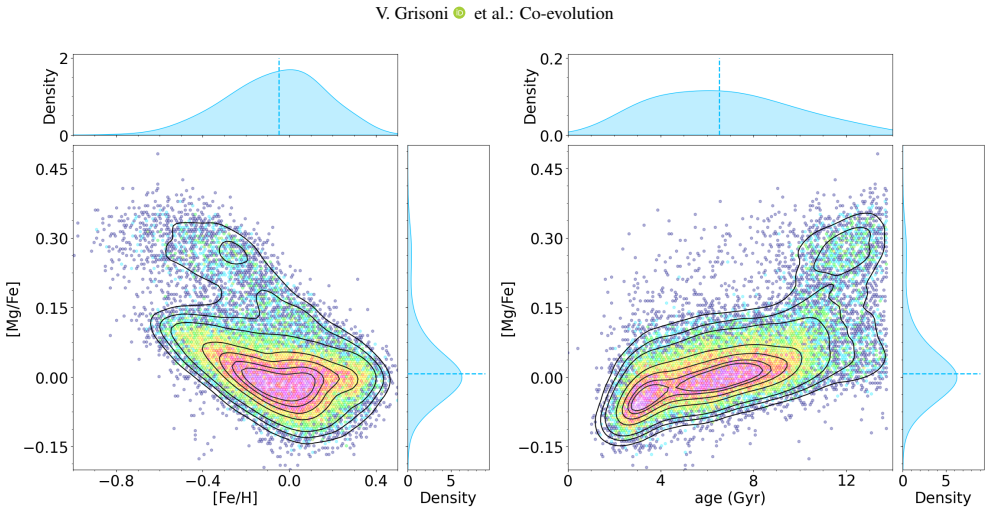
Observational data have revealed a clear dichotomy in the [{\alpha}/Fe] vs. [Fe/H] diagram of the Milky Way thick and thin disc stars. Many recent studies have shown evidences of a co-evolution phase between the high- and low-{\alpha} disc sequences as well as the presence of very old low-{\alpha} stars. We aim to revise the parallel chemical evolution model that assumes two parallel histories of star formation for the two discs, by considering a pre-enriched delayed second infall episode in our revised scenario. By means of our chemical evolution models, we aim to explore the effects of a phase of co-evolution and the presence of old low-{\alpha} stars, as recently observed. We consider a new version of the parallel scenario for the Milky Way thick and thin disc formation, which consists into two distinct infall episodes of slightly pre-enriched gas. The gas is considered to be extragalactic but possibly contaminated by chemically enriched gas of a massive dwarf galaxy as Gaia-Enceladus, which merged with the Milky Way at least 10 Gyrs ago. Moreover, we test in our model observationally derived star formation histories of kinematically selected thick and thin discs, suggesting that the star formation is triggered by the passages of the Sagittarius galaxy. Our models can well explain the [{\alpha}/Fe] vs. [Fe/H] diagram from APOGEE DR17. Our revised chemical evolution model with a pre-enriched and delayed (roughly 1 Gyr) second infall episode, explains not only the abundance patterns of high- and low-{\alpha} stars but also stellar age distributions for the selected observational sample. We predict a short co-evolution period in between the two phases and we can explain the observed old low-{\alpha} stars, but still further data for precise stellar ages would be needed to put more stringent constraints on their physical nature.
Editorial analysis
A structured set of objections, weighed in public.
Referee Report
Summary. The manuscript revises the parallel chemical evolution model for the Milky Way thick and thin discs by introducing two distinct infall episodes of slightly pre-enriched gas, with the second infall delayed by roughly 1 Gyr and possibly contaminated by a Gaia-Enceladus-like merger. Star formation is assumed to be triggered by Sagittarius passages using observationally derived SFHs. The models are claimed to reproduce the [α/Fe]–[Fe/H] abundance patterns from APOGEE DR17, match stellar age distributions for the selected sample, predict a short co-evolution phase between the sequences, and explain the presence of old low-α stars.
Significance. If the reproduction holds with parameters independently constrained rather than tuned, the work would advance models of Milky Way disc formation by linking chemical patterns, ages, and external perturbations in a unified way. The incorporation of observationally motivated SFHs and the attempt to address old low-α stars are strengths. However, the overall significance is limited by the reliance on adjustable parameters for the delay and enrichment level, which reduces the predictive power for the co-evolution phase and old low-α population.
major comments (2)
- [Abstract and model setup] Abstract and model description: The delay time (~1 Gyr) and pre-enrichment level of the second infall are treated as free parameters adjusted to reproduce the APOGEE DR17 [α/Fe]–[Fe/H] locus and age distributions. This renders the claimed prediction of a short co-evolution period and the explanation of old low-α stars a fitted outcome by construction, rather than an emergent feature from independent constraints on merger timing or Sagittarius-induced triggers. An a-priori calculation or external justification for these values is required to support the central claim.
- [Results section] Results and discussion: No quantitative details are provided on the fitting procedure (e.g., χ² minimization, handling of observational errors, or parameter optimization), sensitivity tests to variations in the delay time or pre-enrichment, or direct comparisons with error bars on the observed age distributions. This absence makes it impossible to evaluate the robustness of the claimed reproduction of abundance patterns and ages.
minor comments (3)
- [Abstract] The abstract and introduction could more clearly distinguish between fitted parameters and genuine predictions to avoid potential misinterpretation by readers.
- [Figures] Figure captions and axis labels for the [α/Fe]–[Fe/H] diagrams should explicitly state the model parameters used and any observational selection criteria applied to the APOGEE sample.
- [Discussion] A brief discussion of how the model compares to alternative scenarios (e.g., radial migration or single-infall models) would strengthen the context, even if not central to the claims.
Simulated Author's Rebuttal
We thank the referee for the thoughtful and constructive report. We address each major comment in detail below. Revisions have been made to the manuscript to provide additional justification, quantitative details, and sensitivity tests as requested.
read point-by-point responses
-
Referee: [Abstract and model setup] Abstract and model description: The delay time (~1 Gyr) and pre-enrichment level of the second infall are treated as free parameters adjusted to reproduce the APOGEE DR17 [α/Fe]–[Fe/H] locus and age distributions. This renders the claimed prediction of a short co-evolution period and the explanation of old low-α stars a fitted outcome by construction, rather than an emergent feature from independent constraints on merger timing or Sagittarius-induced triggers. An a-priori calculation or external justification for these values is required to support the central claim.
Authors: We agree that the specific numerical values for the delay (~1 Gyr) and pre-enrichment were adjusted to reproduce the observed abundance locus and age distributions. However, these choices are not arbitrary but are guided by independent observational constraints. The second infall is physically linked to the Gaia-Enceladus merger, which literature dates to at least 10 Gyr ago, providing a natural timescale; the delay is consistent with dynamical timescales for gas accretion following such an event. The star formation histories are taken directly from observationally derived SFHs that associate triggers with Sagittarius passages. In the revised manuscript we have expanded the model description section with explicit references to merger timing studies and dynamical simulations to provide this external justification. We have also added a sensitivity analysis varying the delay by ±0.5 Gyr and pre-enrichment by ±0.1 dex, demonstrating that the short co-evolution phase and old low-α population remain robust within the observationally allowed range. We have revised the abstract and discussion to describe these outcomes as consistent with the model rather than strict a-priori predictions. revision: yes
-
Referee: [Results section] Results and discussion: No quantitative details are provided on the fitting procedure (e.g., χ² minimization, handling of observational errors, or parameter optimization), sensitivity tests to variations in the delay time or pre-enrichment, or direct comparisons with error bars on the observed age distributions. This absence makes it impossible to evaluate the robustness of the claimed reproduction of abundance patterns and ages.
Authors: We acknowledge that the original manuscript did not include sufficient quantitative information on the fitting process or robustness checks. In the revised version we have added a dedicated subsection describing the parameter selection: values were iteratively adjusted within ranges motivated by the Gaia-Enceladus timing and Sagittarius SFH constraints, with the final choice providing the best visual match to the APOGEE DR17 locus. We now present sensitivity tests for the delay time and pre-enrichment level, showing their effects on both the [α/Fe]–[Fe/H] plane and the age distributions. Direct comparisons of model age histograms with the observational sample now include error bars derived from the APOGEE age uncertainties. A formal χ² minimization was not performed because the chemical evolution code is not optimized for statistical fitting and the goal is to reproduce the overall bimodal structure and trends rather than individual data points; we have clarified this methodological choice and its limitations in the text. revision: yes
Circularity Check
Tuned 1 Gyr delay and pre-enrichment level make co-evolution and old low-α stars outputs by construction
specific steps
-
fitted input called prediction
[Abstract]
"Our revised chemical evolution model with a pre-enriched and delayed (roughly 1 Gyr) second infall episode, explains not only the abundance patterns of high- and low-α stars but also stellar age distributions for the selected observational sample. We predict a short co-evolution period in between the two phases and we can explain the observed old low-α stars"
The delay duration and pre-enrichment level are free parameters adjusted to match the data; once set, the short co-evolution interval and the existence of old low-α stars are automatic consequences of those choices rather than independent predictions from first principles or external constraints.
full rationale
The paper's revised parallel model introduces a delayed, pre-enriched second infall whose timing (~1 Gyr) and enrichment level are explicitly chosen to reproduce the APOGEE [α/Fe]–[Fe/H] locus and the observed age distribution of the sample. Once these parameters are fixed by hand, the short co-evolution phase and the presence of old low-α stars follow directly from the input choices rather than from any independent dynamical calculation of merger timing or Sagittarius-triggered star formation. The abstract and model description present these outcomes as predictions, but they reduce to the fitted inputs. No self-citation chain or ansatz smuggling is required for the circularity; the reduction is internal to the parameter adjustment described in the text.
Axiom & Free-Parameter Ledger
free parameters (2)
- second infall delay time =
roughly 1 Gyr
- pre-enrichment level of second infall gas
axioms (2)
- domain assumption Two distinct infall episodes of slightly pre-enriched gas for thick and thin discs
- domain assumption Star formation triggered by Sagittarius galaxy passages
Lean theorems connected to this paper
-
IndisputableMonolith/Cost/FunctionalEquation.leanwashburn_uniqueness_aczel unclearOur revised chemical evolution model with a pre-enriched and delayed (roughly 1 Gyr) second infall episode... the delay time and enrichment level chosen to fit observations.
-
IndisputableMonolith/Foundation/RealityFromDistinction.leanreality_from_one_distinction unclearWe consider a new version of the parallel scenario... two distinct infall episodes of slightly pre-enriched gas.
Reference graph
Works this paper leans on
- [1]
-
[2]
Adibekyan, V . Z., Sousa, S. G., Santos, N. C., et al. 2012, A&A, 545, A32
work page 2012
-
[3]
Agertz, O., Renaud, F., Feltzing, S., et al. 2021, MNRAS, 503, 5826
work page 2021
-
[4]
2025, arXiv e-prints, arXiv:2511.10092
Alinder, S., Bensby, T., & McMillan, P. 2025, arXiv e-prints, arXiv:2511.10092
-
[5]
Ardern-Arentsen, A., Monari, G., Queiroz, A. B. A., et al. 2024, MNRAS, 530, 3391
work page 2024
-
[6]
Argast, D., Samland, M., Gerhard, O. E., & Thielemann, F.-K. 2000, A&A, 356, 873 Beraldo e Silva, L., Debattista, V . P., Nidever, D., Amarante, J. A. S., & Garver, B. 2021, MNRAS, 502, 260
work page 2000
-
[7]
2025, arXiv e-prints, arXiv:2512.15812
Bergemann, M., Kordopatis, G., Casali, G., et al. 2025, arXiv e-prints, arXiv:2512.15812
-
[8]
Bono, G., Braga, V . F., Fabrizio, M., et al. 2026, arXiv e-prints, arXiv:2601.16523
- [9]
- [10]
- [11]
-
[12]
2023, arXiv e-prints, arXiv:2305.06396
Casali, G., Grisoni, V ., Miglio, A., et al. 2023, arXiv e-prints, arXiv:2305.06396
-
[13]
Casali, G., Montalbán, J., Miglio, A., et al. 2025, MNRAS, 541, 2631
work page 2025
-
[14]
2023, arXiv e- prints, arXiv:2306.03126
Cerqui, V ., Haywood, M., Di Matteo, P., Katz, D., & Royer, F. 2023, arXiv e- prints, arXiv:2306.03126
-
[15]
Cerqui, V ., Haywood, M., Snaith, O., Di Matteo, P., & Casamiquela, L. 2025, A&A, 699, A277
work page 2025
- [16]
- [17]
-
[18]
Chen, B., Hayden, M. R., Sharma, S., et al. 2023, MNRAS, 523, 3791
work page 2023
- [19]
-
[20]
2009, in The Galaxy Disk in Cosmological Context, ed
Chiappini, C. 2009, in The Galaxy Disk in Cosmological Context, ed. J. Ander- sen, Nordströara, B. m, & J. Bland-Hawthorn, V ol. 254, 191–196
work page 2009
- [21]
-
[22]
1997, ApJ, 477, 765 Ciuc˘a, I., Kawata, D., Miglio, A., Davies, G
Chiappini, C., Matteucci, F., & Gratton, R. 1997, ApJ, 477, 765 Ciuc˘a, I., Kawata, D., Miglio, A., Davies, G. R., & Grand, R. J. J. 2021, MNRAS, 503, 2814
work page 1997
-
[23]
Clarke, A. J., Debattista, V . P., Nidever, D. L., et al. 2019, MNRAS, 484, 3476
work page 2019
-
[24]
Crestani, J., Braga, V . F., Fabrizio, M., et al. 2021, ApJ, 914, 10 D’Orazi, V ., Braga, V ., Bono, G., et al. 2025, A&A, 694, A158
work page 2021
-
[25]
Dubay, L. O., Johnson, J. A., Johnson, J. W., & Roberts, J. D. 2025, arXiv e- prints, arXiv:2508.00988 Fernández-Alvar, E., Ruiz-Lara, T., Gallart, C., et al. 2025, A&A, 704, A258
-
[26]
1992, ApJ, 387, 138 François, P., Matteucci, F., Cayrel, R., et al
Ferrini, F., Matteucci, F., Pardi, C., & Penco, U. 1992, ApJ, 387, 138 François, P., Matteucci, F., Cayrel, R., et al. 2004, A&A, 421, 613
work page 1992
-
[27]
2024, A&A, 687, A168 García Pérez, A
Gallart, C., Surot, F., Cassisi, S., et al. 2024, A&A, 687, A168 García Pérez, A. E., Allende Prieto, C., Holtzman, J. A., et al. 2016, AJ, 151, 144
work page 2024
-
[28]
R., Eitner, P., Serenelli, A., et al
Gent, M. R., Eitner, P., Serenelli, A., et al. 2024, A&A, 683, A74
work page 2024
- [29]
-
[30]
Goswami, S., Slemer, A., Marigo, P., et al. 2021, A&A, 650, A203
work page 2021
-
[31]
Grand, R. J. J., Bustamante, S., Gómez, F. A., et al. 2018, MNRAS, 474, 3629
work page 2018
-
[32]
2024, in Memorie della Societa Astronomica Italiana, V ol
Grisoni, V . 2024, in Memorie della Societa Astronomica Italiana, V ol. 95, 41
work page 2024
-
[33]
Grisoni, V ., Chiappini, C., Miglio, A., et al. 2024, A&A, 683, A111
work page 2024
-
[34]
Grisoni, V ., Matteucci, F., & Romano, D. 2021, MNRAS, 508, 719
work page 2021
-
[35]
Grisoni, V ., Matteucci, F., Romano, D., & Fu, X. 2019, MNRAS, 489, 3539
work page 2019
- [36]
-
[37]
Grisoni, V ., Spitoni, E., & Matteucci, F. 2018, MNRAS, 481, 2570
work page 2018
-
[38]
Grisoni, V ., Spitoni, E., Matteucci, F., et al. 2017, MNRAS, 472, 3637
work page 2017
-
[39]
Gunn, J. E., Siegmund, W. A., Mannery, E. J., et al. 2006, AJ, 131, 2332
work page 2006
-
[40]
Gustafsson, B., Edvardsson, B., Eriksson, K., et al. 2008, A&A, 486, 951
work page 2008
-
[41]
Hayden, M. R., Bovy, J., Holtzman, J. A., et al. 2015, ApJ, 808, 132
work page 2015
-
[42]
R., Recio-Blanco, A., de Laverny, P., Mikolaitis, S., & Worley, C
Hayden, M. R., Recio-Blanco, A., de Laverny, P., Mikolaitis, S., & Worley, C. C. 2017, A&A, 608, L1 Article number, page 11 of 14 A&A proofs:manuscript no. aa
work page 2017
-
[43]
Haywood, M., Di Matteo, P., Lehnert, M. D., Katz, D., & Gómez, A. 2013, A&A, 560, A109
work page 2013
-
[44]
Haywood, M., Lehnert, M. D., Di Matteo, P., et al. 2016, A&A, 589, A66
work page 2016
- [45]
-
[46]
Iwamoto, K., Brachwitz, F., Nomoto, K., et al. 1999, ApJS, 125, 439
work page 1999
-
[47]
Johnson, J. W., Feuillet, D. K., Bonaca, A., & de Brito Silva, D. 2025, arXiv e-prints, arXiv:2510.08688
-
[48]
Johnson, J. W., Weinberg, D. H., Vincenzo, F., et al. 2021, MNRAS, 508, 4484 Jönsson, H., Holtzman, J. A., Allende Prieto, C., et al. 2020, AJ, 160, 120
work page 2021
-
[49]
Karakas, A. I. 2010, MNRAS, 403, 1413
work page 2010
-
[50]
Kennicutt, Jr., R. C. 1998, ApJ, 498, 541
work page 1998
-
[51]
Khoperskov, S., Haywood, M., Snaith, O., et al. 2021, MNRAS, 501, 5176
work page 2021
- [52]
-
[53]
Kobayashi, C., Umeda, H., Nomoto, K., Tominaga, N., & Ohkubo, T. 2006, ApJ, 653, 1145
work page 2006
- [54]
-
[55]
Kubryk, M., Prantzos, N., & Athanassoula, E. 2013, MNRAS, 436, 1479
work page 2013
-
[56]
Kubryk, M., Prantzos, N., & Athanassoula, E. 2015, A&A, 580, A126
work page 2015
-
[57]
Laporte, C. F. P., Belokurov, V ., Koposov, S. E., Smith, M. C., & Hill, V . 2020, MNRAS, 492, L61
work page 2020
-
[58]
Mackereth, J. T., Crain, R. A., Schiavon, R. P., et al. 2018, MNRAS, 477, 5072
work page 2018
-
[59]
Mainieri, V ., Anderson, R. I., Brinchmann, J., et al. 2024, arXiv e-prints, arXiv:2403.05398
-
[60]
Majewski, S. R., Schiavon, R. P., Frinchaboy, P. M., et al. 2017, AJ, 154, 94
work page 2017
-
[61]
Martig, M., Rix, H.-W., Silva Aguirre, V ., et al. 2015, MNRAS, 451, 2230
work page 2015
-
[62]
2001, The chemical evolution of the Galaxy, V ol
Matteucci, F. 2001, The chemical evolution of the Galaxy, V ol. 253
work page 2001
-
[63]
2012, Chemical Evolution of Galaxies
Matteucci, F. 2012, Chemical Evolution of Galaxies
work page 2012
- [64]
- [65]
- [66]
-
[67]
Matteucci, F., Grisoni, V ., Spitoni, E., et al. 2019, MNRAS, 487, 5363
work page 2019
-
[68]
Micali, A., Matteucci, F., & Romano, D. 2013, MNRAS, 436, 1648
work page 2013
-
[69]
2021b, Experimental Astronomy, 51, 963 Mikolaitis, Š., de Laverny, P., Recio-Blanco, A., et al
Miglio, A., Girardi, L., Grundahl, F., et al. 2021b, Experimental Astronomy, 51, 963 Mikolaitis, Š., de Laverny, P., Recio-Blanco, A., et al. 2017, A&A, 600, A22
work page 2017
-
[70]
2013, A&A, 558, A9 Montalbán, J., Mackereth, J
Minchev, I., Chiappini, C., & Martig, M. 2013, A&A, 558, A9 Montalbán, J., Mackereth, J. T., Miglio, A., et al. 2021, Nature Astronomy, 5, 640
work page 2013
- [71]
- [72]
-
[73]
Nykytyuk, T. V . & Mishenina, T. V . 2006, A&A, 456, 969
work page 2006
- [74]
-
[75]
Palla, M., Matteucci, F., Spitoni, E., Vincenzo, F., & Grisoni, V . 2020, MNRAS, 498, 1710
work page 2020
-
[76]
Palla, M., Santos-Peral, P., Recio-Blanco, A., & Matteucci, F. 2022, A&A, 663, A125
work page 2022
-
[77]
C., Ferrini, F., & Matteucci, F
Pardi, M. C., Ferrini, F., & Matteucci, F. 1995, ApJ, 444, 207
work page 1995
-
[78]
Prantzos, N., Abia, C., Chen, T., et al. 2023, MNRAS, 523, 2126
work page 2023
-
[79]
Prudil, Z., Dékány, I., Grebel, E. K., & Kunder, A. 2020, MNRAS, 492, 3408
work page 2020
-
[80]
Queiroz, A. B. A., Anders, F., Chiappini, C., et al. 2023, A&A, 673, A155
work page 2023
discussion (0)
Sign in with ORCID, Apple, or X to comment. Anyone can read and Pith papers without signing in.