Recognition: no theorem link
Inherent Altermagnetism on regular hyperbolic lattices
Pith reviewed 2026-05-12 04:24 UTC · model grok-4.3
The pith
Next-nearest-neighbor hopping induces altermagnetism in certain hyperbolic lattices.
A machine-rendered reading of the paper's core claim, the machinery that carries it, and where it could break.
Core claim
By including next-nearest neighbor hopping in tight-binding models on regular hyperbolic lattices defined on a discretized Poincaré disk, we show that spin splitting is induced in an entire family and a special case of bipartite lattices. Hyperbolic crystallography and band theory establish that altermagnetism is therefore inherent to certain hyperbolic lattices. The at least four-dimensional momentum space permits classification of the leading spin-splitting harmonics using four-dimensional atomic orbitals.
What carries the argument
Tight-binding model on regular hyperbolic lattices with next-nearest-neighbor hopping, analyzed through hyperbolic band theory
Load-bearing premise
The discretized Poincaré-disk tight-binding model with next-nearest-neighbor hopping accurately captures the low-energy electronic structure of real or realizable hyperbolic lattices.
What would settle it
Fabricating a hyperbolic lattice and measuring its band structure to find no momentum-dependent spin splitting when next-nearest-neighbor hopping is present would falsify the central claim.
Figures
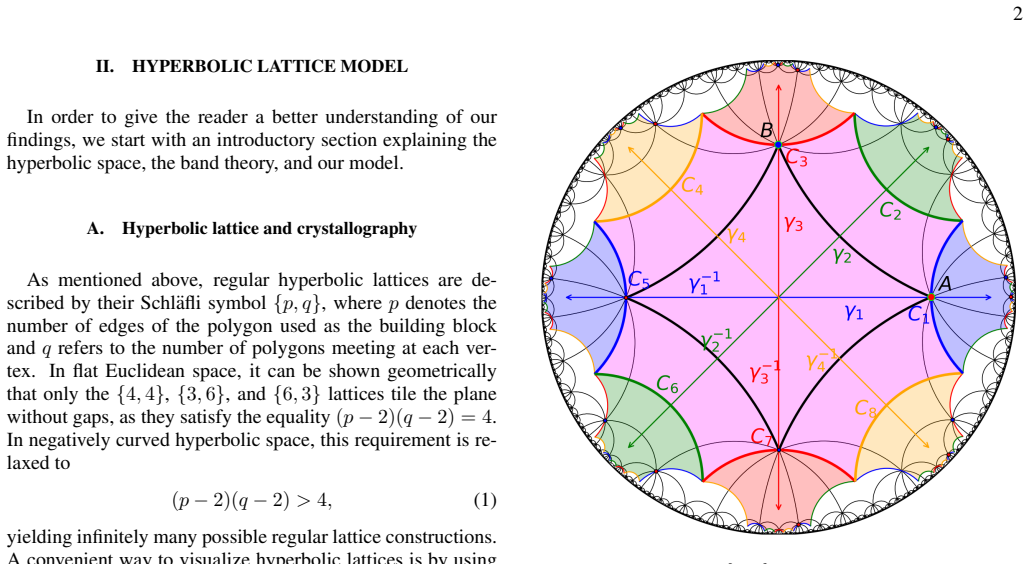


read the original abstract
Altermagnets are a novel class of magnetic systems characterized by their momentum-dependent spin splitting without net magnetization. In this work, we extend established Euclidean tight-binding models of altermagnets to regular hyperbolic lattices in two spatial dimensions defined on a discretized Poincar\'e disk. Using hyperbolic crystallography and hyperbolic band theory, we show that the inclusion of next-nearest neighbor hopping is sufficient to induce spin splitting in bipartite hyperbolic lattices. While certain families and special cases of hyperbolic lattices remain antiferromagnetic, we identify an entire family and a special case that show spin splitting in this framework. Hence, altermagnetism is inherent to certain hyperbolic lattices. Since hyperbolic band theory yields a momentum space that is at least four-dimensional, we classify the leading spin-splitting harmonics using four-dimensional atomic orbitals.
Editorial analysis
A structured set of objections, weighed in public.
Referee Report
Summary. The manuscript extends Euclidean tight-binding models of altermagnets to regular hyperbolic lattices defined on a discretized Poincaré disk. Using hyperbolic crystallography and band theory, it shows that next-nearest-neighbor hopping induces momentum-dependent spin splitting (with zero net magnetization) in bipartite hyperbolic lattices for an entire family and one special case, while other families remain antiferromagnetic. The four-dimensional momentum space native to hyperbolic geometry is then used to classify the leading spin-splitting harmonics via four-dimensional atomic orbitals. The central claim is that altermagnetism is inherent to certain hyperbolic lattices.
Significance. If the explicit band-structure calculations and symmetry analysis hold, the work provides a concrete realization of altermagnetism in non-Euclidean geometry. This leverages the higher-dimensional momentum space of hyperbolic lattices to produce spin-splitting harmonics that have no direct Euclidean analog, potentially enabling new platforms for momentum-space spintronics in artificial or metamaterial systems. The systematic classification of 4D harmonics is a useful technical contribution.
major comments (2)
- [§3] §3 (or equivalent model-construction section): the claim that next-nearest-neighbor hopping alone is sufficient to produce the reported spin splitting rests on the specific choice of hopping amplitude and the bipartite nature of the lattice; the manuscript should explicitly demonstrate that the splitting vanishes identically when this term is removed, to confirm it is not an artifact of the chosen parameter value.
- [§4] §4 (harmonic classification): the mapping of the leading spin-splitting terms onto four-dimensional atomic orbitals is presented as complete, but the manuscript does not show the explicit decomposition of the 4D harmonics or verify orthogonality with respect to the hyperbolic Brillouin zone; this step is load-bearing for the claim that the classification is exhaustive.
minor comments (2)
- Figure captions for the band-structure plots should state the numerical value of the next-nearest-neighbor hopping amplitude used and whether it is in units of the nearest-neighbor hopping.
- The abstract states that 'certain families and special cases remain antiferromagnetic'; the main text should tabulate which specific hyperbolic lattices (by Schläfli symbol or vertex figure) fall into each category.
Simulated Author's Rebuttal
We thank the referee for their positive evaluation of our work and for the constructive comments, which we address point by point below. We have prepared a revised manuscript incorporating the suggested clarifications.
read point-by-point responses
-
Referee: [§3] §3 (or equivalent model-construction section): the claim that next-nearest-neighbor hopping alone is sufficient to produce the reported spin splitting rests on the specific choice of hopping amplitude and the bipartite nature of the lattice; the manuscript should explicitly demonstrate that the splitting vanishes identically when this term is removed, to confirm it is not an artifact of the chosen parameter value.
Authors: We agree that an explicit demonstration strengthens the claim. In the revised manuscript we will add a direct comparison of the spin-resolved band structures for the relevant lattices (both the identified family and the special case) computed with the next-nearest-neighbor hopping amplitude set identically to zero. These calculations confirm that the momentum-dependent spin splitting vanishes throughout the hyperbolic Brillouin zone, leaving only conventional antiferromagnetic degeneracy. The new panels will be placed in §3 immediately following the finite-hopping results, together with a brief statement that the splitting is induced solely by the next-nearest-neighbor term for any nonzero amplitude. revision: yes
-
Referee: [§4] §4 (harmonic classification): the mapping of the leading spin-splitting terms onto four-dimensional atomic orbitals is presented as complete, but the manuscript does not show the explicit decomposition of the 4D harmonics or verify orthogonality with respect to the hyperbolic Brillouin zone; this step is load-bearing for the claim that the classification is exhaustive.
Authors: We acknowledge that the explicit decomposition and orthogonality check were omitted for brevity. In the revised version we will expand §4 to include (i) the explicit linear combinations expressing the leading spin-splitting harmonics in the four-dimensional atomic-orbital basis and (ii) a verification that these harmonics are mutually orthogonal when integrated over the hyperbolic Brillouin zone (computed via the appropriate inner product on the discretized Poincaré disk). These additions will be presented as a short table and accompanying paragraph, confirming that the classification is exhaustive within the symmetry-allowed channels. revision: yes
Circularity Check
No significant circularity detected
full rationale
The paper constructs a tight-binding Hamiltonian on regular hyperbolic lattices via hyperbolic crystallography and band theory, then demonstrates that next-nearest-neighbor hopping produces momentum-dependent spin splitting (zero net magnetization) for specific families. This follows directly from symmetry-allowed terms in the model and explicit diagonalization in the native higher-dimensional momentum space; no parameter is fitted to the target spin-splitting data and then re-labeled as a prediction, no self-definitional loop appears in the altermagnetism definition, and load-bearing steps rely on standard Euclidean altermagnet precedents plus independent hyperbolic geometry results rather than self-citation chains. The derivation remains self-contained and externally falsifiable.
Axiom & Free-Parameter Ledger
free parameters (1)
- next-nearest-neighbor hopping amplitude
axioms (2)
- domain assumption Hyperbolic band theory correctly describes the momentum-space structure of regular hyperbolic lattices on the discretized Poincaré disk
- domain assumption Bipartite hyperbolic lattices admit a well-defined tight-binding description with nearest- and next-nearest-neighbor terms
Reference graph
Works this paper leans on
-
[1]
L. ˇSmejkal, J. Sinova, and T. Jungwirth, Beyond Conventional Ferromagnetism and Antiferromagnetism: A Phase with Non- relativistic Spin and Crystal Rotation Symmetry, Phys. Rev. X 12, 031042 (2022)
work page 2022
- [2]
-
[3]
L. ˇSmejkal, R. Gonz ´alez-Hern´andez, T. Jungwirth, and J. Sinova, Crystal time-reversal symmetry breaking and spon- taneous Hall effect in collinear antiferromagnets, Sci. Adv.6, eaaz8809 (2020)
work page 2020
-
[4]
L.-D. Yuan, Z. Wang, J.-W. Luo, E. I. Rashba, and A. Zunger, Giant momentum-dependent spin splitting in centrosymmetric low-Zantiferromagnets, Phys. Rev. B102, 014422 (2020)
work page 2020
-
[5]
P. A. McClarty and J. G. Rau, Landau Theory of Altermag- netism, Phys. Rev. Lett.132, 176702 (2024)
work page 2024
-
[6]
S. Bhowal and N. A. Spaldin, Ferroically Ordered Magnetic Octupoles ind-Wave Altermagnets, Phys. Rev. X14, 011019 (2024)
work page 2024
-
[7]
L. ˇSmejkal, J. Sinova, and T. Jungwirth, Emerging Research Landscape of Altermagnetism, Phys. Rev. X12, 040501 (2022)
work page 2022
-
[8]
L. ˇSmejkal, A. B. Hellenes, R. Gonz´alez-Hern´andez, J. Sinova, and T. Jungwirth, Giant and Tunneling Magnetoresistance in Unconventional Collinear Antiferromagnets with Nonrelativis- tic Spin-Momentum Coupling, Phys. Rev. X12, 011028 (2022)
work page 2022
-
[9]
O. Fedchenko, J. Min´ar, A. Akashdeep, S. W. D’Souza, D. Vasi- lyev, O. Tkach, L. Odenbreit, Q. Nguyen, D. Kutnyakhov, N. Wind, L. Wenthaus, M. Scholz, K. Rossnagel, M. Hoesch, M. Aeschlimann, B. Stadtm ¨uller, M. Kl ¨aui, G. Sch ¨onhense, T. Jungwirth, A. B. Hellenes, G. Jakob, L. ˇSmejkal, J. Sinova, and H.-J. Elmers, Observation of time-reversal symmet...
work page 2024
-
[10]
J. Liu, J. Zhan, T. Li, J. Liu, S. Cheng, Y . Shi, L. Deng, M. Zhang, C. Li, J. Ding, Q. Jiang, M. Ye, Z. Liu, Z. Jiang, S. Wang, Q. Li, Y . Xie, Y . Wang, S. Qiao, J. Wen, Y . Sun, and D. Shen, Absence of Altermagnetic Spin Splitting Character in Rutile OxideRuO 2, Phys. Rev. Lett.133, 176401 (2024)
work page 2024
-
[11]
I. I. Mazin, Altermagnetism in MnTe: Origin, predicted mani- festations, and routes to detwinning, Phys. Rev. B107, L100418 (2023)
work page 2023
-
[12]
S. Lee, S. Lee, S. Jung, J. Jung, D. Kim, Y . Lee, B. Seok, J. Kim, B. G. Park, L. ˇSmejkal, C.-J. Kang, and C. Kim, Broken Kramers Degeneracy in Altermagnetic MnTe, Phys. Rev. Lett. 132, 036702 (2024)
work page 2024
-
[13]
S. Reimers, L. Odenbreit, L. ˇSmejkal, V . N. Strocov, P. Con- stantinou, A. B. Hellenes, R. Jaeschke Ubiergo, W. H. Campos, V . K. Bharadwaj, A. Chakraborty, T. Denneulin, W. Shi, R. E. Dunin-Borkowski, S. Das, M. Kl¨aui, J. Sinova, and M. Jourdan, Direct observation of altermagnetic band splitting in CrSb thin films, Nat. Commun.15, 2116 (2024)
work page 2024
-
[14]
J. Ding, Z. Jiang, X. Chen, Z. Tao, Z. Liu, T. Li, J. Liu, J. Sun, J. Cheng, J. Liu, Y . Yang, R. Zhang, L. Deng, W. Jing, Y . Huang, Y . Shi, M. Ye, S. Qiao, Y . Wang, Y . Guo, D. Feng, and D. Shen, Large Band Splitting ing-Wave Altermagnet CrSb, Phys. Rev. Lett.133, 206401 (2024)
work page 2024
-
[15]
H. Reichlova, R. Lopes Seeger, R. Gonz ´alez-Hern´andez, I. Kounta, R. Schlitz, D. Kriegner, P. Ritzinger, M. Lam- mel, M. Leivisk ¨a, A. Birk Hellenes, K. Olejn ´ık, V . Petˇriˇcek, P. Dole ˇzal, L. Horak, E. Schmoranzerova, A. Badura, S. Bertaina, A. Thomas, V . Baltz, L. Michez, J. Sinova, S. T. B. Goennenwein, T. Jungwirth, and L. ˇSmejkal, Observatio...
work page 2024
-
[16]
J. Rial, M. Leivisk ¨a, G. Skobjin, A. Bad’ura, G. Gaudin, F. Dis- dier, R. Schlitz, I. Kounta, S. Beckert, D. Kriegner, A. Thomas, E. Schmoranzerov ´a, L. ˇSmejkal, J. Sinova, T. Jungwirth, L. Michez, H. Reichlov´a, S. T. B. Goennenwein, O. Gomonay, and V . Baltz, Altermagnetic variants in thin films ofMn 5Si3, Phys. Rev. B110, L220411 (2024)
work page 2024
-
[17]
C.-C. Wei, X. Li, S. Hatt, X. Huai, J. Liu, B. Singh, K.-M. Kim, R. M. Fernandes, P. Cardon, L. Zhao, T. T. Tran, B. A. Frand- sen, K. S. Burch, F. Liu, and H. Ji,La 2O3Mn2Se2: A corre- lated insulating layered d-wave altermagnet, Phys. Rev. Mater. 9, 024402 (2025)
work page 2025
-
[18]
L. Garcia-Gassull, A. Razpopov, P. P. Stavropoulos, I. I. Mazin, and R. Valent´ı, Microscopic origin of the magnetic in- teractions and their experimental signatures in altermagnetic La2O3Mn2Se2, npj Spintronics4, 9 (2026)
work page 2026
-
[19]
J. Krempask ´y, L. ˇSmejkal, S. W. D’Souza, M. Hajlaoui, G. Springholz, K. Uhl ´ıˇrov´a, F. Alarab, P. C. Constantinou, V . Strocov, D. Usanov, W. R. Pudelko, R. Gonz´alez-Hern´andez, A. Birk Hellenes, Z. Jansa, H. Reichlov´a, Z. ˇSob´aˇn, R. D. Gon- zalez Betancourt, P. Wadley, J. Sinova, D. Kriegner, J. Min ´ar, J. H. Dil, and T. Jungwirth, Altermagneti...
work page 2024
-
[20]
L. Han, X. Fu, R. Peng, X. Cheng, J. Dai, L. Liu, Y . Li, Y . Zhang, W. Zhu, H. Bai, Y . Zhou, S. Liang, C. Chen, Q. Wang, X. Chen, L. Yang, Y . Zhang, C. Song, J. Liu, and F. Pan, Elec- trical 180° switching of N ´eel vector in spin-splitting antiferro- magnet, Sci. Adv.10, adn0479 (2024)
work page 2024
-
[21]
N. Biniskos, M. dos Santos Dias, S. Agrestini, D. Svit ´ak, K.-J. Zhou, J. Posp´ıˇsil, and P. ˇCerm´ak, Systematic mapping of alter- magnetic magnons by resonant inelastic X-ray circular dichro- 13 ism, Nat. Commun.16, 9311 (2025)
work page 2025
-
[22]
P. Das, V . Leeb, J. Knolle, and M. Knap, Realizing Altermag- netism in Fermi-Hubbard Models with Ultracold Atoms, Phys. Rev. Lett.132, 263402 (2024)
work page 2024
-
[23]
M. Roig, A. Kreisel, Y . Yu, B. M. Andersen, and D. F. Agter- berg, Minimal models for altermagnetism, Phys. Rev. B110, 144412 (2024)
work page 2024
-
[24]
V . Leeb, A. Mook, L.ˇSmejkal, and J. Knolle, Spontaneous For- mation of Altermagnetism from Orbital Ordering, Phys. Rev. Lett.132, 236701 (2024)
work page 2024
-
[25]
E. H. Lieb, Two theorems on the Hubbard model, Phys. Rev. Lett.62, 1201 (1989)
work page 1989
- [26]
- [27]
-
[28]
K. Leraand, K. Mæland, and A. Sudbø, Phonon-mediated spin- polarized superconductivity in altermagnets, Phys. Rev. B112, 104510 (2025)
work page 2025
-
[29]
N. Kaushal and M. Franz, Altermagnetism in Modified Lieb Lattice Hubbard Model, Phys. Rev. Lett.135, 156502 (2025)
work page 2025
-
[30]
M. D ¨urrnagel, H. Hohmann, A. Maity, J. Seufert, M. Klett, L. Klebl, and R. Thomale, Altermagnetic Phase Transition in a Lieb Metal, Phys. Rev. Lett.135, 036502 (2025)
work page 2025
- [31]
-
[32]
P.-H. Chang, K. D. Belashchenko, and I. I. Mazin, Inverse Lieb materials: altermagnetism and more, npj Quantum Materials 10.1038/s41535-026-00880-w (2026)
-
[33]
E. Petermann, K. Mæland, and B. Trauzettel, Spin-resolved quasiparticle interference patterns on altermagnets via non- spin-resolved scanning tunneling microscopy, Phys. Rev. B 112, 214450 (2025)
work page 2025
-
[34]
J. Maciejko and S. Rayan, Hyperbolic band theory, Sci. Adv.7, eabe9170 (2021)
work page 2021
-
[35]
J. Maciejko and S. Rayan, Automorphic Bloch theorems for hyperbolic lattices, Proc. Natl. Acad. Sci. U.S.A.119, e2116869119 (2022)
work page 2022
-
[36]
I. Boettcher, A. V . Gorshkov, A. J. Koll ´ar, J. Maciejko, S. Rayan, and R. Thomale, Crystallography of hyperbolic lat- tices, Phys. Rev. B105, 125118 (2022)
work page 2022
-
[37]
A. Chen, Y . Guan, P. M. Lenggenhager, J. Maciejko, I. Boettcher, and T. Bzdu ˇsek, Symmetry and topology of hy- perbolic Haldane models, Phys. Rev. B108, 085114 (2023)
work page 2023
-
[38]
A. J. Koll ´ar, M. Fitzpatrick, and A. A. Houck, Hyperbolic lattices in circuit quantum electrodynamics, Nature571, 45 (2019)
work page 2019
- [39]
- [40]
-
[41]
D. M. Urwyler, P. M. Lenggenhager, I. Boettcher, R. Thomale, T. Neupert, and T. Bzdu ˇsek, Hyperbolic Topological Band In- sulators, Phys. Rev. Lett.129, 246402 (2022)
work page 2022
- [42]
- [43]
-
[44]
T. Tummuru, A. Chen, P. M. Lenggenhager, T. Neupert, J. Ma- ciejko, and T. Bzdu ˇsek, Hyperbolic Non-Abelian Semimetal, Phys. Rev. Lett.132, 206601 (2024)
work page 2024
-
[45]
D. Wang, T. Zhu, and Z. Yang, Hyperbolic altermagnets with high-fold spin splitting, Phys. Rev. B113, 064424 (2026)
work page 2026
-
[46]
M. Schrauth, Y . Thurn, F. Dusel, F. Goth, D. Herth, and J. S. E. Portela, hypertiling (2023), version 1.2 [git.physik.uni- wuerzburg.de/hypertiling/hypertiling]
work page 2023
-
[47]
X. Zhu, X. Huo, S. Feng, S.-B. Zhang, S. A. Yang, and H. Guo, Design of Altermagnetic Models from Spin Clusters, Phys. Rev. Lett.134, 166701 (2025)
work page 2025
- [48]
-
[49]
Hosoya, Number and shapes of the atomic orbitals of four and higher dimensional atoms, J
H. Hosoya, Number and shapes of the atomic orbitals of four and higher dimensional atoms, J. Mol. Struct.352-353, 561 (1995)
work page 1995
-
[50]
L. Cong, V . Savinov, Y . K. Srivastava, S. Han, and R. Singh, A Metamaterial Analog of the Ising Model, Adv. Mater.30, 1804210 (2018)
work page 2018
-
[51]
V . R. Tuz, P. Yu, V . Dmitriev, and Y . S. Kivshar, Magnetic Dipole Ordering in Resonant Dielectric Metasurfaces, Phys. Rev. Appl.13, 044003 (2020)
work page 2020
discussion (0)
Sign in with ORCID, Apple, or X to comment. Anyone can read and Pith papers without signing in.