Recognition: 2 theorem links
· Lean TheoremSparse Signal Recovery using Log-Sum Regularization and Adaptive Smoothing
Pith reviewed 2026-05-12 04:32 UTC · model grok-4.3
The pith
Log-sum regularization with adaptive smoothing yields accurate state-evolution predictions for sparse recovery and outperforms l1 at low densities.
A machine-rendered reading of the paper's core claim, the machinery that carries it, and where it could break.
Core claim
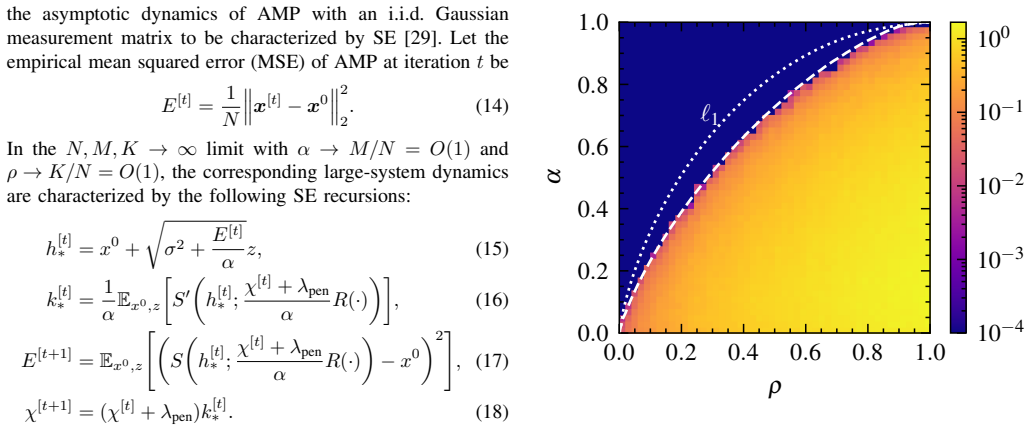
Adaptive smoothing keeps the proximal operator of the log-sum penalty continuous. This permits formulation of an AMP algorithm and derivation of its state evolution, which predicts final MSE and the noiseless exact-recovery phase transition. ADMM experiments show the empirical success boundary agrees with the predicted phase transition, AMP follows the SE in noisy cases, and log-sum regularization is beneficial over l1 in low-density or high-measurement-rate regimes.
What carries the argument
Adaptive smoothing strategy that sets the smoothing parameter to ensure the scalar proximal operator of the log-sum penalty remains continuous.
If this is right
- The state evolution predicts the exact-recovery phase transition in the noiseless limit.
- AMP performance in noisy settings closely follows the state evolution prediction.
- ADMM reproduces the state-evolution-predicted dependence of MSE on the regularization parameter.
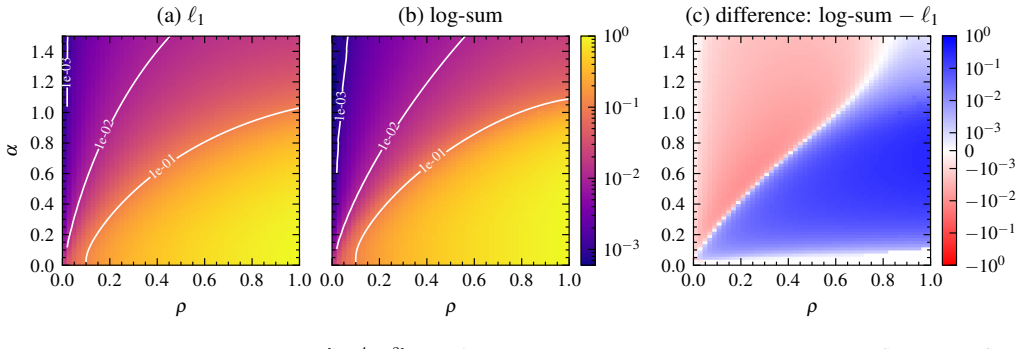
- Log-sum regularization outperforms l1 regularization in low-density or high-measurement-rate regimes.
Where Pith is reading between the lines
- State evolution can guide selection of the regularization parameter for practical use of the algorithm.
- The adaptive smoothing technique may generalize to stabilize other nonconvex penalties within message passing frameworks.
- The performance gain of log-sum regularization highlights the importance of reducing shrinkage bias when signals are very sparse.
Load-bearing premise
The adaptive smoothing strategy determines the smoothing parameter so that the scalar proximal operator remains continuous, allowing stable use inside AMP and derivation of the corresponding state evolution.
What would settle it
A numerical experiment in which the fraction of successful recoveries by ADMM in the noiseless setting falls substantially below the curve predicted by state evolution would falsify the claimed agreement.
Figures


read the original abstract
We study sparse signal recovery from noisy linear observations using nonconvex log-sum regularization. The log-sum penalty reduces the shrinkage bias of $\ell_1$ regularization and more closely approximates the $\ell_0$ regularization, but its nonconvexity can make reconstruction algorithms unstable. To mitigate this instability, we use an adaptive smoothing strategy that determines the smoothing parameter so that the scalar proximal operator remains continuous. Using this proximal operator, we formulate the approximate message passing (AMP) algorithm and derive the corresponding state evolution (SE) recursion. The fixed point of the SE recursion predicts the final mean squared error (MSE) and, in the noiseless limit, the exact-recovery phase transition. To further investigate finite-dimensional reconstruction behavior, we implement an alternating direction method of multipliers (ADMM) algorithm. In the noiseless setting, we find that the empirical success boundary of ADMM closely agrees with the SE-predicted phase transition. In the noisy setting, we observe that AMP closely follows the SE prediction, whereas ADMM qualitatively reproduces the SE-predicted dependence of the final MSE on the regularization parameter. A comparison with $\ell_1$ regularization shows that log-sum regularization is beneficial in low-density or high-measurement-rate regimes, whereas $\ell_1$ regularization remains preferable at higher densities and lower measurement rates.
Editorial analysis
A structured set of objections, weighed in public.
Referee Report
Summary. The manuscript studies sparse signal recovery from noisy linear observations using nonconvex log-sum regularization. An adaptive smoothing strategy is introduced to ensure the scalar proximal operator remains continuous, enabling stable use in an approximate message passing (AMP) algorithm whose state evolution (SE) recursion is derived to predict the fixed-point MSE and, in the noiseless limit, the exact-recovery phase transition. Finite-dimensional behavior is investigated via an ADMM implementation; simulations show that ADMM success boundaries match the SE-predicted phase transition in the noiseless case, AMP tracks SE predictions in the noisy case, and log-sum regularization outperforms ℓ1 in low-density or high-measurement-rate regimes.
Significance. If the SE derivation remains valid under the adaptive smoothing, the work supplies a concrete theoretical tool for predicting performance of a nonconvex penalty that better approximates ℓ0 than ℓ1, together with reproducible empirical confirmation across noiseless and noisy regimes. The explicit regime-dependent comparison with ℓ1 regularization is a practical contribution that could inform regularizer selection in compressed sensing.
major comments (1)
- [SE derivation and AMP formulation] The SE recursion is derived from the proximal operator of the smoothed log-sum penalty (as stated in the abstract and the derivation of the AMP algorithm). Because the smoothing parameter is chosen adaptively at each iteration to enforce continuity of the proximal operator, the effective denoiser is iteration-dependent and signal-dependent. This appears to violate the fixed-form, Lipschitz denoiser assumption underlying standard AMP/SE analysis (Gaussianity and decoupling). The manuscript does not clarify how the adaptivity is folded into the recursion or whether the fixed-point MSE and phase-transition predictions remain rigorous; this is load-bearing for the central claim that SE predictions match empirical AMP and ADMM behavior.
minor comments (2)
- [Abstract and results] The abstract and results section describe log-sum benefits in 'low-density or high-measurement-rate regimes' without citing specific density or rate thresholds or referencing the corresponding figures/tables; adding these would make the comparison with ℓ1 more quantitative.
- [Adaptive smoothing strategy] The adaptive update rule for the smoothing parameter is described only at a high level; an explicit equation or pseudocode for its iteration-dependent selection would improve reproducibility of both the proximal operator and the SE derivation.
Simulated Author's Rebuttal
We thank the referee for the careful reading, positive assessment of the work's significance, and constructive feedback. We address the major comment below and will revise the manuscript to improve clarity on the state evolution derivation.
read point-by-point responses
-
Referee: The SE recursion is derived from the proximal operator of the smoothed log-sum penalty (as stated in the abstract and the derivation of the AMP algorithm). Because the smoothing parameter is chosen adaptively at each iteration to enforce continuity of the proximal operator, the effective denoiser is iteration-dependent and signal-dependent. This appears to violate the fixed-form, Lipschitz denoiser assumption underlying standard AMP/SE analysis (Gaussianity and decoupling). The manuscript does not clarify how the adaptivity is folded into the recursion or whether the fixed-point MSE and phase-transition predictions remain rigorous; this is load-bearing for the central claim that SE predictions match empirical AMP and ADMM behavior.
Authors: We appreciate this observation on the technical assumptions. In the revised manuscript we will expand the derivation section to explicitly show how the adaptive smoothing parameter is incorporated. The parameter is chosen at each iteration from the current estimate to enforce continuity of the proximal operator. In the large-system limit, the SE tracks the relevant statistics of the estimate (effective noise variance), so the smoothing parameter becomes a deterministic function of the current state variables. The SE recursion is then written with this state-dependent denoiser by evaluating the required expectations conditionally on the tracked state. This extends the standard fixed-denoiser AMP framework to a state-dependent case. We acknowledge that a complete rigorous proof of Gaussianity and decoupling under the signal-dependent adaptivity is not supplied in the current manuscript and that the central claims rest in part on the observed agreement between SE predictions and both AMP and ADMM simulations. The revision will add this clarification together with a brief discussion of the assumptions and their empirical support. revision: yes
- A fully rigorous justification of the Gaussianity and decoupling assumptions for the state evolution under the adaptive, signal-dependent smoothing (beyond the derivation and empirical validation provided).
Circularity Check
No significant circularity; SE derivation is independent of empirical verification
full rationale
The paper derives the state evolution recursion directly from the proximal operator of the adaptively smoothed log-sum penalty, then uses the fixed point of that recursion to predict MSE and the noiseless phase transition. This prediction is obtained by iterating the derived recursion rather than by fitting parameters to the same simulation data later used for comparison. AMP and ADMM implementations are run separately to check agreement with the SE predictions, providing an independent empirical check. No load-bearing step reduces to a self-citation, a fitted input renamed as prediction, or a definitional tautology; the adaptive smoothing is introduced to ensure continuity of the proximal map, after which standard AMP/SE analysis applies to the resulting denoiser. The workflow is self-contained against external benchmarks.
Axiom & Free-Parameter Ledger
axioms (1)
- domain assumption Standard assumptions underlying state evolution for approximate message passing hold for the smoothed nonconvex penalty.
Lean theorems connected to this paper
-
IndisputableMonolith/Cost/FunctionalEquation.leanwashburn_uniqueness_aczel unclear?
unclearRelation between the paper passage and the cited Recognition theorem.
We use an adaptive smoothing strategy that determines the smoothing parameter so that the scalar proximal operator remains continuous... derive the corresponding state evolution (SE) recursion.
-
IndisputableMonolith/Foundation/RealityFromDistinction.leanreality_from_one_distinction unclear?
unclearRelation between the paper passage and the cited Recognition theorem.
The fixed point of the SE recursion predicts the final mean squared error (MSE) and, in the noiseless limit, the exact-recovery phase transition.
What do these tags mean?
- matches
- The paper's claim is directly supported by a theorem in the formal canon.
- supports
- The theorem supports part of the paper's argument, but the paper may add assumptions or extra steps.
- extends
- The paper goes beyond the formal theorem; the theorem is a base layer rather than the whole result.
- uses
- The paper appears to rely on the theorem as machinery.
- contradicts
- The paper's claim conflicts with a theorem or certificate in the canon.
- unclear
- Pith found a possible connection, but the passage is too broad, indirect, or ambiguous to say the theorem truly supports the claim.
Reference graph
Works this paper leans on
-
[1]
D. L. Donoho, “Compressed sensing,”IEEE Trans. Inf. Theory, vol. 52, no. 4, pp. 1289–1306, Apr. 2006
work page 2006
-
[2]
Stable signal recovery from incomplete and inaccurate measurements,
E. J. Cand `es, J. K. Romberg, and T. Tao, “Stable signal recovery from incomplete and inaccurate measurements,”Commun. Pure Appl. Math., vol. 59, no. 8, pp. 1207–1223, Aug. 2006
work page 2006
-
[3]
Compressed sensing imaging techniques for radio interferometry,
Y . Wiaux, L. Jacques, G. Puy, A. M. M. Scaife, and P. Vandergheynst, “Compressed sensing imaging techniques for radio interferometry,”Mon. Not. R. Astron. Soc., vol. 395, no. 3, pp. 1733–1742, 21 May 2009
work page 2009
-
[4]
Non-parametric seismic data recovery with curvelet frames,
F. J. Herrmann and G. Hennenfent, “Non-parametric seismic data recovery with curvelet frames,”Geophys. J. Int., vol. 173, no. 1, pp. 233–248, 1 Apr. 2008
work page 2008
-
[5]
Sparse representation for wireless communications: A compressive sensing approach,
Z. Qin, J. Fan, Y . Liu, Y . Gao, and G. Y . Li, “Sparse representation for wireless communications: A compressive sensing approach,”IEEE Signal Processing Magazine, vol. 35, no. 3, pp. 40–58, 2018
work page 2018
-
[6]
Sparse MRI: The application of compressed sensing for rapid MR imaging,
M. Lustig, D. Donoho, and J. M. Pauly, “Sparse MRI: The application of compressed sensing for rapid MR imaging,”Magn. Reson. Med., vol. 58, no. 6, pp. 1182–1195, Dec. 2007
work page 2007
-
[7]
Regression shrinkage and selection via the lasso,
R. Tibshirani, “Regression shrinkage and selection via the lasso,”J. R. Stat. Soc. Series B Stat. Methodol., vol. 58, no. 1, pp. 267–288, 1 Jan. 1996
work page 1996
-
[8]
Asymptotic analysis of MAP estimation via the replica method and compressed sensing,
S. Rangan, V . Goyal, and A. K. Fletcher, “Asymptotic analysis of MAP estimation via the replica method and compressed sensing,” inAdvances in Neural Information Processing Systems, Y . Bengio, D. Schuurmans, J. Lafferty, C. Williams, and A. Culotta, Eds., vol. 22. Curran Associates, Inc., 2009
work page 2009
-
[9]
A typical reconstruction limit for compressed sensing based onLp-norm minimization,
Y . Kabashima, T. Wadayama, and T. Tanaka, “A typical reconstruction limit for compressed sensing based onLp-norm minimization,”J. Stat. Mech., vol. 2009, no. 09, p. L09003, 21 Sep. 2009
work page 2009
-
[10]
Statistical mechanics of compressed sensing,
S. Ganguli and H. Sompolinsky, “Statistical mechanics of compressed sensing,”Phys. Rev. Lett., vol. 104, no. 18, p. 188701, 7 May 2010
work page 2010
-
[11]
Statistical-physics-based reconstruction in compressed sensing,
F. Krzakala, M. M ´ezard, F. Sausset, Y . F. Sun, and L. Zdeborov ´a, “Statistical-physics-based reconstruction in compressed sensing,”Phys. Rev. X., vol. 2, no. 2, p. 021005, 11 May 2012
work page 2012
-
[12]
Variable selection via nonconcave penalized likelihood and its oracle properties,
J. Fan and R. Li, “Variable selection via nonconcave penalized likelihood and its oracle properties,”J. Am. Stat. Assoc., vol. 96, no. 456, pp. 1348– 1360, Dec. 2001
work page 2001
-
[13]
The adaptive lasso and its oracle properties,
H. Zou, “The adaptive lasso and its oracle properties,”J. Am. Stat. Assoc., vol. 101, no. 476, pp. 1418–1429, 1 Dec. 2006
work page 2006
-
[14]
Exact reconstruction of sparse signals via nonconvex minimization,
R. Chartrand, “Exact reconstruction of sparse signals via nonconvex minimization,”IEEE Signal Processing Letters, vol. 14, no. 10, pp. 707– 710, Oct. 2007
work page 2007
-
[15]
Iteratively reweighted algorithms for com- pressive sensing,
R. Chartrand and W. Yin, “Iteratively reweighted algorithms for com- pressive sensing,” in2008 IEEE International Conference on Acoustics, Speech and Signal Processing. IEEE, 4 Mar. 2008, pp. 3869–3872
work page 2008
-
[16]
Enhancing sparsity by reweightedℓ 1 minimization,
E. J. Cand `es, M. B. Wakin, and S. P. Boyd, “Enhancing sparsity by reweightedℓ 1 minimization,”J F ourier Anal Appl, vol. 14, no. 5-6, pp. 877–905, 15 Dec. 2008
work page 2008
-
[17]
Exact reconstruction analysis of log- sum minimization for compressed sensing,
Y . Shen, J. Fang, and H. Li, “Exact reconstruction analysis of log- sum minimization for compressed sensing,”IEEE Signal Process. Lett., vol. 20, no. 12, pp. 1223–1226, Dec. 2013
work page 2013
-
[18]
The proximity operator of the log-sum penalty,
A. Prater-Bennette, L. Shen, and E. E. Tripp, “The proximity operator of the log-sum penalty,”J. Sci. Comput., vol. 93, no. 3, p. 67, 25 Dec. 2022
work page 2022
-
[19]
Nearly unbiased variable selection under minimax con- cave penalty,
C.-H. Zhang, “Nearly unbiased variable selection under minimax con- cave penalty,”Ann. Stat., vol. 38, no. 2, pp. 894–942, 1 Apr. 2010
work page 2010
-
[20]
WEEP: A differen- tiable nonconvex sparse regularizer via weakly-convex envelope,
T. Furuhashi, H. Hontani, Q. Zhao, and T. Yokota, “WEEP: A differen- tiable nonconvex sparse regularizer via weakly-convex envelope,”arXiv [cs.LG], 19 Jan. 2026
work page 2026
-
[21]
Restricted isometry properties and non- convex compressive sensing,
R. Chartrand and V . Staneva, “Restricted isometry properties and non- convex compressive sensing,”Inverse Probl., vol. 24, no. 3, p. 035020, 1 Jun. 2008
work page 2008
-
[22]
Sparsest solutions of underdetermined linear systems viaℓ q-minimization for0< q≤1,
S. Foucart and M.-J. Lai, “Sparsest solutions of underdetermined linear systems viaℓ q-minimization for0< q≤1,”Appl. Comput. Harmon. Anal., vol. 26, no. 3, pp. 395–407, May 2009
work page 2009
-
[23]
A. Sakata and Y . Xu, “Approximate message passing for nonconvex sparse regularization with stability and asymptotic analysis,”J. Stat. Mech., vol. 2018, no. 3, p. 033404, 13 Mar. 2018
work page 2018
-
[24]
A. Sakata and T. Obuchi, “Perfect reconstruction of sparse signals with piecewise continuous nonconvex penalties and nonconvexity control,”J. Stat. Mech., vol. 2021, no. 9, p. 093401, 1 Sep. 2021
work page 2021
-
[25]
X. Gu, A. Sakata, and T. Obuchi, “Perfect reconstruction of sparse signals using nonconvexity control and one-step RSB message passing,” arXiv [stat.ML], 19 Dec. 2025
work page 2025
-
[26]
Phase transition in compressed sensing using log-sum penalty and adaptive smoothing,
K. Morita, F. Ricci-Tersenghi, and M. Ohzeki, “Phase transition in compressed sensing using log-sum penalty and adaptive smoothing,” arXiv [cs.IT], 15 Apr. 2026
work page 2026
-
[27]
M. Mezard, G. Parisi, and M. A. Virasoro,Spin glass theory and beyond: An introduction to the replica method and its applications: An introduction to the replica method and its applications, ser. World Scientific Lecture Notes In Physics. Singapore, Singapore: World Scientific Publishing, 11 Jan. 1987
work page 1987
-
[28]
Message-passing algo- rithms for compressed sensing,
D. L. Donoho, A. Maleki, and A. Montanari, “Message-passing algo- rithms for compressed sensing,”Proc. Natl. Acad. Sci. U. S. A., vol. 106, no. 45, pp. 18 914–18 919, 10 Nov. 2009
work page 2009
-
[29]
The dynamics of message passing on dense graphs, with applications to compressed sensing,
M. Bayati and A. Montanari, “The dynamics of message passing on dense graphs, with applications to compressed sensing,”IEEE Trans. Inf. Theory, vol. 57, no. 2, pp. 764–785, Feb. 2011
work page 2011
-
[30]
R. Piessens, E. D. Doncker-Kapenga, C. Uberhuber, and D. K. Kahaner, Quadpack: A subroutine package for automatic integration, ser. Springer Series in Computational Mathematics. Berlin, Germany: Springer, 1 Jul. 1983
work page 1983
-
[31]
S. Boyd, “Distributed optimization and statistical learning via the alternating direction method of multipliers,”F ound. Trends® Mach. Learn., vol. 3, no. 1, pp. 1–122, 2010
work page 2010
-
[32]
Regularization and variable selection via the elastic net,
H. Zou and T. Hastie, “Regularization and variable selection via the elastic net,”J. R. Stat. Soc. Series B Stat. Methodol., vol. 67, no. 2, pp. 301–320, 1 Apr. 2005
work page 2005
discussion (0)
Sign in with ORCID, Apple, or X to comment. Anyone can read and Pith papers without signing in.