Recognition: no theorem link
Physical relevance of time-independent scattering predictions in periodic mathcal{PT}-symmetric chains
Pith reviewed 2026-05-12 04:05 UTC · model grok-4.3
The pith
PT-symmetric chains support physical scattering only below a gain-loss threshold that vanishes for large N.
A machine-rendered reading of the paper's core claim, the machinery that carries it, and where it could break.
Core claim
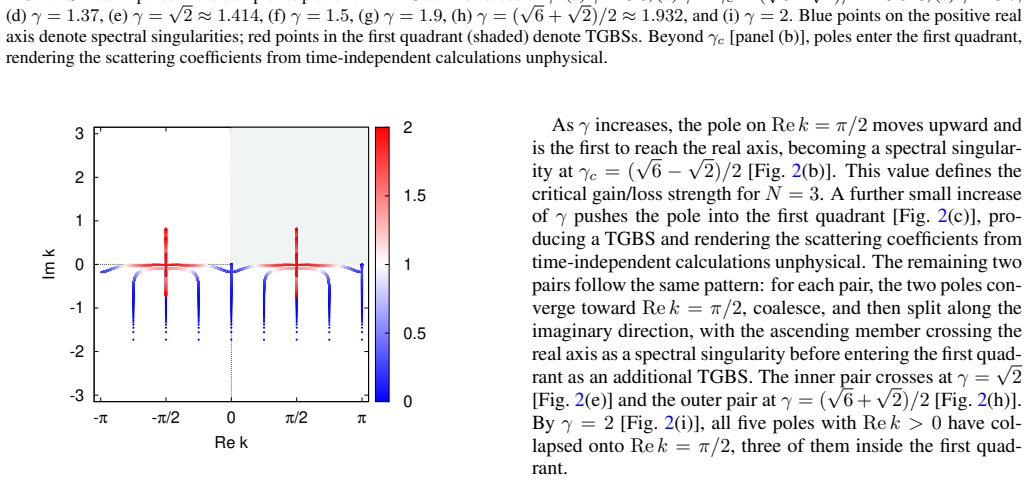
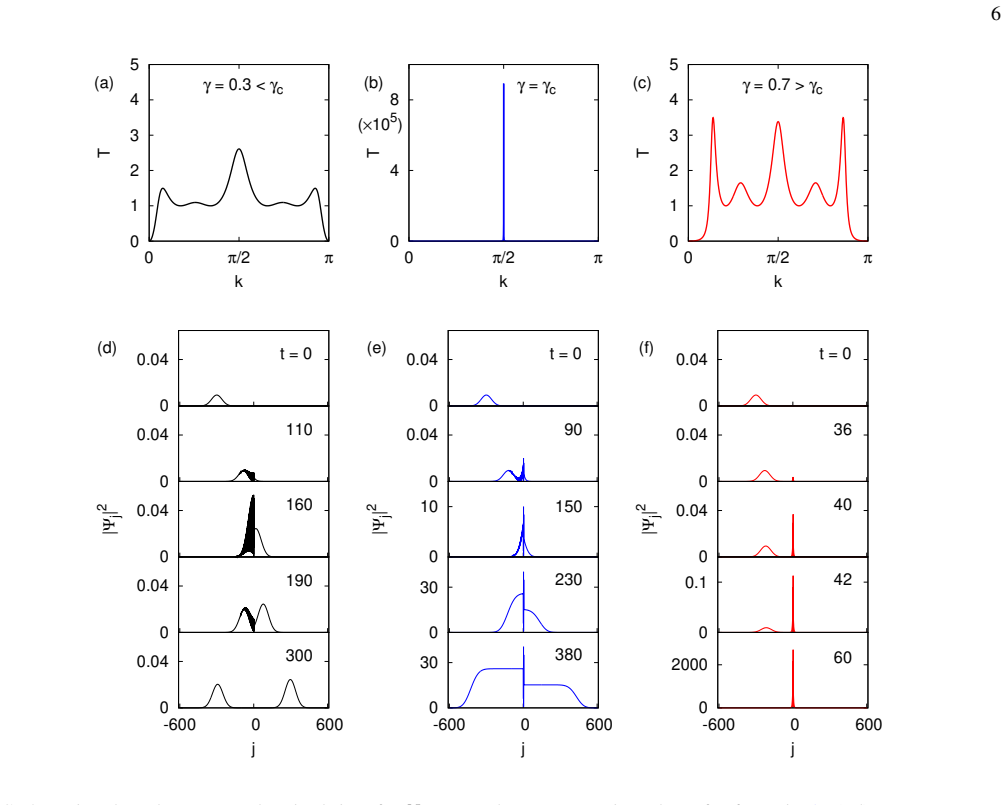
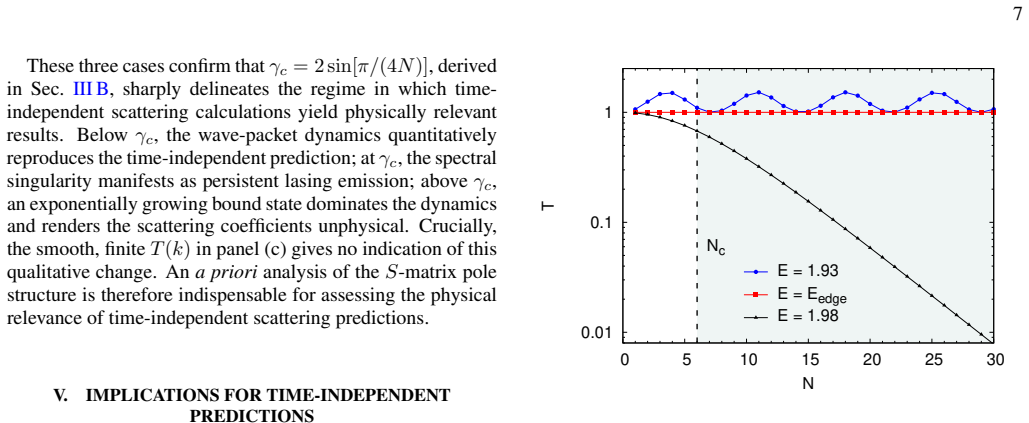
For a PT-symmetric chain of N unit cells with gain/loss strength gamma, the region of physical relevance for time-independent scattering is bounded by the TGBS onset threshold gamma_c = 2 sin[pi/(4N)]. This threshold scales as pi/(2N) for large N and vanishes in the thermodynamic limit. Enlarging the structure thus enriches stationary scattering phenomenology but inevitably triggers TGBSs at weaker gain/loss. Many previously reported predictions of gain-loss-induced localization, reflectionless transport, and coherent perfect absorbers and lasers in large periodic structures therefore fall outside the physically relevant regime.
What carries the argument
The TGBS onset threshold gamma_c = 2 sin[pi/(4N)], determined by the condition for S-matrix poles entering the first quadrant of the complex wave-number plane.
Load-bearing premise
That S-matrix poles in the first quadrant of the complex wave-number plane correspond exactly to time-growing bound states that render all time-independent scattering predictions unphysical.
What would settle it
A time-dependent simulation or experiment showing stable non-growing wave-packet evolution in the presence of a first-quadrant S-matrix pole would disprove the claimed direct link between such poles and unphysical behavior.
Figures




read the original abstract
Time-independent scattering methods are widely used to analyze transport in periodic $\mathcal{PT}$-symmetric systems. However, their predictions become unphysical when the system supports time-growing bound states (TGBSs), which manifest as $S$-matrix poles in the first quadrant of the complex wave-number plane. Here, we analytically delineate the region of physical relevance for a $\mathcal{PT}$-symmetric chain of $N$ unit cells with gain/loss strength $\gamma$. We derive the TGBS onset threshold $\gamma_c = 2\sin[\pi/(4N)]$, which scales as $\pi/(2N)$ for large $N$ and vanishes in the thermodynamic limit. Enlarging the structure thus enriches stationary scattering phenomenology but inevitably triggers TGBSs at weaker gain/loss. Time-dependent wave-packet simulations confirm this analytical boundary quantitatively. Applying this criterion, we show that many previously reported predictions of gain-loss-induced localization, reflectionless transport, and coherent perfect absorbers and lasers in large periodic structures fall outside the physically relevant regime. $S$-matrix pole analysis is therefore an indispensable prerequisite for interpreting time-independent scattering predictions in periodic non-Hermitian systems.
Editorial analysis
A structured set of objections, weighed in public.
Referee Report
Summary. The manuscript derives an exact threshold γ_c = 2 sin[π/(4N)] for the onset of time-growing bound states (TGBSs) in a finite periodic PT-symmetric chain of N unit cells. It shows via S-matrix pole analysis that time-independent scattering predictions become unphysical above this threshold, which scales as π/(2N) for large N and vanishes in the thermodynamic limit. Time-dependent wave-packet simulations are used to quantitatively confirm the boundary, and the criterion is applied to argue that many prior predictions of gain-loss-induced localization, reflectionless transport, and coherent perfect absorption/lasing in large structures lie outside the physically relevant regime.
Significance. If the central result holds, the work supplies a concrete, size-dependent criterion that limits the applicability of stationary scattering methods in non-Hermitian periodic systems. The combination of an analytic, parameter-free threshold with direct numerical verification of the pole-to-growth mapping is a clear strength. This finding implies that enlarging the structure enriches the stationary phenomenology only at the cost of introducing unphysical TGBSs at progressively weaker gain/loss, which has direct consequences for interpreting existing and future literature on PT-symmetric transport.
minor comments (3)
- Abstract: the statement of the threshold γ_c = 2 sin[π/(4N)] is given without any indication of the derivation route or the quantitative level of simulation agreement; a single additional clause would improve standalone readability.
- When the criterion is applied to prior literature, the manuscript should list the specific N and γ values (or ranges) used in the cited works so that readers can immediately verify that those points lie above γ_c.
- The large-N asymptotic γ_c ∼ π/(2N) follows directly from the small-angle expansion of the sine; a brief parenthetical remark confirming this approximation would remove any ambiguity for readers.
Simulated Author's Rebuttal
We thank the referee for the careful reading, positive evaluation, and recommendation of minor revision. The provided summary accurately reflects the central results and implications of the manuscript.
Circularity Check
No significant circularity; analytic derivation independently verified
full rationale
The central result is an analytic derivation of the TGBS threshold γ_c = 2 sin[π/(4N)] obtained by locating the onset of first-quadrant S-matrix poles in the finite-N PT-symmetric chain. This follows directly from the characteristic equation of the transfer matrix or recurrence relation for the periodic structure and is not defined in terms of the target quantity, fitted to data, or imported via self-citation. Independent time-dependent wave-packet simulations quantitatively confirm the same boundary, providing external validation rather than a self-referential loop. Application of the threshold to prior literature is a straightforward comparison once the new criterion is accepted; no load-bearing step reduces to a prior result by the authors or to a renamed empirical pattern. The derivation chain is therefore self-contained against external benchmarks.
Axiom & Free-Parameter Ledger
axioms (1)
- domain assumption S-matrix poles in the first quadrant of the complex wave-number plane correspond to time-growing bound states that make time-independent predictions unphysical
invented entities (1)
-
Time-growing bound states (TGBSs)
no independent evidence
Reference graph
Works this paper leans on
-
[1]
These two cases differ qualitatively when judged against the TGBS onset condition
ForN= 2 [panel (b)], an additional pair of Fabry-P ´erot resonances ap- pears atE=E FP =±1, where bothR L andR R vanish. These two cases differ qualitatively when judged against the TGBS onset condition. The parameters(N, γ) = (1,1) and(2,1)are marked by the blue square and red triangle in Fig. 4. ForN= 1,γ c = √ 2≈1.414andγ= 1lies inside the TGBS-free re...
-
[2]
R. El-Ganainy, K. G. Makris, M. Khajavikhan, Z. H. Mus- slimani, S. Rotter, and D. N. Christodoulides, Non-Hermitian physics and PT symmetry, Nat. Phys.14, 11 (2018)
work page 2018
-
[3]
S ¸. K.¨Ozdemir, S. Rotter, F. Nori, and L. Yang, Parity–time sym- metry and exceptional points in photonics, Nat. Mater.18, 783 (2019)
work page 2019
- [4]
-
[5]
E. J. Bergholtz, J. C. Budich, and F. K. Kunst, Exceptional topology of non-Hermitian systems, Rev. Mod. Phys.93, 015005 (2021)
work page 2021
-
[6]
Rotter, A non-Hermitian Hamilton operator and the physics of open quantum systems, J
I. Rotter, A non-Hermitian Hamilton operator and the physics of open quantum systems, J. Phys. A: Math. Theor.42, 153001 (2009)
work page 2009
-
[7]
Moiseyev,Non-Hermitian Quantum Mechanics(Cambridge University Press, Cambridge, England, 2011)
N. Moiseyev,Non-Hermitian Quantum Mechanics(Cambridge University Press, Cambridge, England, 2011)
work page 2011
-
[8]
C. M. Bender, Making sense of non-Hermitian Hamiltonians, Rep. Prog. Phys.70, 947 (2007)
work page 2007
-
[9]
W. D. Heiss, The physics of exceptional points, J. Phys. A: Math. Theor.45, 444016 (2012)
work page 2012
-
[10]
M.-A. Miri and A. Al `u, Exceptional points in optics and pho- tonics, Science363, eaar7709 (2019)
work page 2019
-
[11]
T. E. Lee, Anomalous edge state in a non-Hermitian lattice, Phys. Rev. Lett.116, 133903 (2016)
work page 2016
- [12]
-
[13]
F. K. Kunst, E. Edvardsson, J. C. Budich, and E. J. Bergholtz, Biorthogonal bulk-boundary correspondence in non-Hermitian systems, Phys. Rev. Lett.121, 026808 (2018)
work page 2018
- [14]
-
[15]
H. Shen, B. Zhen, and L. Fu, Topological band theory for non- Hermitian Hamiltonians, Phys. Rev. Lett.120, 146402 (2018)
work page 2018
-
[16]
S. Yao, F. Song, and Z. Wang, Non-Hermitian Chern bands, Phys. Rev. Lett.121, 136802 (2018)
work page 2018
-
[17]
K. Takata and M. Notomi, Photonic topological insulating phase induced solely by gain and loss, Phys. Rev. Lett.121, 213902 (2018)
work page 2018
-
[18]
Z. Gong, Y . Ashida, K. Kawabata, K. Takasan, S. Higashikawa, and M. Ueda, Topological phases of non-Hermitian systems, Phys. Rev. X8, 031079 (2018)
work page 2018
-
[19]
K. Kawabata, K. Shiozaki, M. Ueda, and M. Sato, Symmetry and topology in non-Hermitian physics, Phys. Rev. X9, 041015 (2019)
work page 2019
-
[20]
T. Liu, Y .-R. Zhang, Q. Ai, Z. Gong, K. Kawabata, M. Ueda, and F. Nori, Second-order topological phases in non-Hermitian 10 systems, Phys. Rev. Lett.122, 076801 (2019)
work page 2019
-
[21]
L. Feng, R. El-Ganainy, and L. Ge, Non-Hermitian photonics based on parity–time symmetry, Nat. Photonics11, 752 (2017)
work page 2017
-
[22]
X. Zhu, H. Ramezani, C. Shi, J. Zhu, and X. Zhang,PT- symmetric acoustics, Phys. Rev. X4, 031042 (2014)
work page 2014
- [23]
-
[24]
S. A. Cummer, J. Christensen, and A. Al `u, Controlling sound with acoustic metamaterials, Nat. Rev. Mater.1, 16001 (2016)
work page 2016
-
[25]
Y . Aur´egan and V . Pagneux,PT-symmetric scattering in flow duct acoustics, Phys. Rev. Lett.118, 174301 (2017)
work page 2017
-
[26]
J. Schindler, A. Li, M. C. Zheng, F. M. Ellis, and T. Kottos, Ex- perimental study of active LRC circuits withPTsymmetries, Phys. Rev. A84, 040101 (2011)
work page 2011
-
[27]
Y . Choi, C. Hahn, J. W. Yoon, and S. H. Song, Observation of an anti-PT-symmetric exceptional point and energy-difference conserving dynamics in electrical circuit resonators, Nat. Com- mun.9, 2182 (2018)
work page 2018
-
[28]
M. Sakhdari, M. Hajizadegan, Q. Zhong, D. N. Christodoulides, R. El-Ganainy, and P.-Y . Chen, Experi- mental observation ofP Tsymmetry breaking near divergent exceptional points, Phys. Rev. Lett.123, 193901 (2019)
work page 2019
-
[29]
W. Chen, M. Abbasi, Y . N. Joglekar, and K. W. Murch, Quan- tum jumps in the non-Hermitian dynamics of a superconducting qubit, Phys. Rev. Lett.127, 140504 (2021)
work page 2021
-
[30]
W. Chen, M. Abbasi, B. Ha, S. Erdamar, Y . N. Joglekar, and K. W. Murch, Decoherence-induced exceptional points in a dis- sipative superconducting qubit, Phys. Rev. Lett.128, 110402 (2022)
work page 2022
- [31]
-
[32]
Z.-Z. Li, W. Chen, M. Abbasi, K. W. Murch, and K. B. Whaley, Speeding up entanglement generation by proximity to higher- order exceptional points, Phys. Rev. Lett.131, 100202 (2023)
work page 2023
-
[33]
C. M. Bender and S. Boettcher, Real spectra in non-Hermitian Hamiltonians havingPTsymmetry, Phys. Rev. Lett.80, 5243 (1998)
work page 1998
-
[34]
C. M. Bender, D. C. Brody, and H. F. Jones, Complex extension of quantum mechanics, Phys. Rev. Lett.89, 270401 (2002)
work page 2002
-
[35]
C. M. Bender and D. W. Hook,PT-symmetric quantum me- chanics, Rev. Mod. Phys.96, 045002 (2024)
work page 2024
-
[36]
K. G. Makris, R. El-Ganainy, D. N. Christodoulides, and Z. H. Musslimani, Beam dynamics inPTsymmetric optical lattices, Phys. Rev. Lett.100, 103904 (2008)
work page 2008
-
[37]
Longhi,PT-symmetric laser absorber, Phys
S. Longhi,PT-symmetric laser absorber, Phys. Rev. A82, 031801 (2010)
work page 2010
-
[38]
Y . D. Chong, L. Ge, and A. D. Stone,PT-symmetry breaking and laser-absorber modes in optical scattering systems, Phys. Rev. Lett.106, 093902 (2011)
work page 2011
-
[39]
Z. Lin, H. Ramezani, T. Eichelkraut, T. Kottos, H. Cao, and D. N. Christodoulides, Unidirectional invisibility induced byPT-symmetric periodic structures, Phys. Rev. Lett.106, 213901 (2011)
work page 2011
-
[40]
L. Feng, Y .-L. Xu, W. S. Fegadolli, M.-H. Lu, J. E. B. Oliveira, V . R. Almeida, Y .-F. Chen, and A. Scherer, Experi- mental demonstration of a unidirectional reflectionless parity- time metamaterial at optical frequencies, Nat. Mater.12, 108 (2013)
work page 2013
- [41]
- [42]
-
[43]
B. Zhu, R. L ¨u, and S. Chen,PT-symmetry breaking for the scattering problem in a one-dimensional non-Hermitian lattice model, Phys. Rev. A93, 032129 (2016)
work page 2016
- [44]
-
[45]
J. Y . Lee and P.-Y . Chen, Optical forces and directionality in one-dimensionalPT-symmetric photonics, Phys. Rev. B104, 245426 (2021)
work page 2021
-
[46]
O. V ´azquez-Candanedo, J. C. Hern ´andez-Herrej´on, F. M. Izrailev, and D. N. Christodoulides, Gain- or loss-induced local- ization in one-dimensionalPT-symmetric tight-binding mod- els, Phys. Rev. A89, 013832 (2014)
work page 2014
-
[47]
V . Achilleos, Y . Aur´egan, and V . Pagneux, Scattering by fi- nite periodicPT-symmetric structures, Phys. Rev. Lett.119, 243904 (2017)
work page 2017
-
[48]
J. Y . Lee and P.-Y . Chen, Wave propagation, bi-directional reflectionless, and coherent perfect absorption-lasing in finite periodic PT-symmetric photonic systems, Nanophotonics12, 3099 (2023)
work page 2023
-
[49]
O. V ´azquez-Candanedo, F. Izrailev, and D. Christodoulides, Spectral and transport properties of the PT-symmetric dimer model, Phys. E (Amsterdam, Neth.)72, 7 (2015)
work page 2015
-
[50]
O. V . Shramkova and G. P. Tsironis, Scattering properties of PT- symmetric layered periodic structures, J. Opt. (Bristol, U. K.)18, 105101 (2016)
work page 2016
-
[51]
A. Perez-Garrido, P. Guo, V . Gasparian, and E. J ´odar, Polar magneto-optic Kerr and Faraday effects in finite periodicPT- symmetric systems, Phys. Rev. A107, 053504 (2023)
work page 2023
- [52]
-
[53]
H. Wu, X. Yang, Y . Tang, X. Tang, D. Deng, H. Liu, and Z. Wei, The scattering problem in PT-symmetric periodic struc- tures of 1D two-material waveguide networks, Ann. Phys.531, 1900120 (2019)
work page 2019
-
[54]
B. P. Nguyen and K. Kim, Transport and localization of waves in ladder-shaped lattices with locallyPT-symmetric potentials, Phys. Rev. A94, 062122 (2016)
work page 2016
-
[55]
L. Moreno-Rodr´ıguez, F. Izrailev, and J. M´endez-Berm´udez, PT –symmetric tight-binding model with asymmetric couplings, Phys. Lett. A384, 126495 (2020)
work page 2020
-
[56]
E. Lazo and F. R. Humire, Characterization of unidirectional and bidirectional transparencies inPT-symmetric quantum and classical systems, Phys. Scr.98, 035028 (2023)
work page 2023
-
[57]
L. Moreno-Rodr´ıguez, J. M´endez-Berm´udez, and F. Izrailev, PT - symmetric tight-binding 1D chains: Coupling to the contin- uum and superradiance transition, Opt. Commun.561, 130500 (2024)
work page 2024
-
[58]
J. Y . Lee, Unidirectional polarization beam splitter via an ex- ceptional point and finite periodicity of non-HermitianPT symmetry, Phys. Rev. A110, 033521 (2024)
work page 2024
-
[59]
H. Wu, X. Yang, D. Deng, and H. Liu, Reflectionless phenomenon inPT-symmetric periodic structures of one- dimensional two-material optical waveguide networks, Phys. Rev. A100, 033832 (2019)
work page 2019
- [60]
-
[61]
P. Guo, V . Gasparian, E. J´odar, and C. Wisehart, Tunneling time inPT-symmetric systems, Phys. Rev. A107, 032210 (2023)
work page 2023
-
[62]
P. Markoˇs and C. M. Soukoulis,Wave Propagation: From Elec- trons to Photonic Crystals and Left-Handed Materials(Prince- 11 ton University Press, Princeton, 2008)
work page 2008
-
[63]
C. Zheng, Physical relevance of time-independent scattering calculations in non-Hermitian systems: The role of time- growing bound states, Phys. Rev. A112, 042228 (2025)
work page 2025
-
[64]
L. Ge, Y . D. Chong, and A. D. Stone, Conservation relations and anisotropic transmission resonances in one-dimensionalPT- symmetric photonic heterostructures, Phys. Rev. A85, 023802 (2012)
work page 2012
- [65]
-
[66]
N. Hatano and G. Ordonez, Time-reversal symmetric resolu- tion of unity without background integrals in open quantum systems, J. Math. Phys.55, 122106 (2014)
work page 2014
-
[67]
A. J. F. Siegert, On the derivation of the dispersion formula for nuclear reactions, Phys. Rev.56, 750 (1939)
work page 1939
-
[68]
A. Mostafazadeh, Spectral singularities of complex scattering potentials and infinite reflection and transmission coefficients at real energies, Phys. Rev. Lett.102, 220402 (2009)
work page 2009
-
[69]
Longhi, Spectral singularities in a non-Hermitian Friedrichs- Fano-Anderson model, Phys
S. Longhi, Spectral singularities in a non-Hermitian Friedrichs- Fano-Anderson model, Phys. Rev. B80, 165125 (2009)
work page 2009
-
[70]
H. Ramezani, H.-K. Li, Y . Wang, and X. Zhang, Unidirectional spectral singularities, Phys. Rev. Lett.113, 263905 (2014)
work page 2014
-
[71]
P. Wang, L. Jin, G. Zhang, and Z. Song, Wave emission and absorption at spectral singularities, Phys. Rev. A94, 053834 (2016)
work page 2016
- [72]
-
[73]
Y . D. Chong, L. Ge, H. Cao, and A. D. Stone, Coherent perfect absorbers: Time-reversed lasers, Phys. Rev. Lett.105, 053901 (2010)
work page 2010
-
[74]
H. Li, S. Suwunnarat, R. Fleischmann, H. Schanz, and T. Kot- tos, Random matrix theory approach to chaotic coherent perfect absorbers, Phys. Rev. Lett.118, 044101 (2017)
work page 2017
-
[75]
D. G. Baranov, A. Krasnok, T. Shegai, A. Al `u, and Y . Chong, Coherent perfect absorbers: Linear control of light with light, Nat. Rev. Mater.2, 17064 (2017)
work page 2017
-
[76]
M. A. Sim ´on, A. Buend´ıa, A. Kiely, A. Mostafazadeh, and J. G. Muga,S-matrix pole symmetries for non-Hermitian scattering Hamiltonians, Phys. Rev. A99, 052110 (2019)
work page 2019
-
[77]
Jin, Asymmetric lasing at spectral singularities, Phys
L. Jin, Asymmetric lasing at spectral singularities, Phys. Rev. A 97, 033840 (2018)
work page 2018
discussion (0)
Sign in with ORCID, Apple, or X to comment. Anyone can read and Pith papers without signing in.