Recognition: 2 theorem links
· Lean TheoremScalable Mamba-Based Message-Passing Neural Decoder for Error-Correcting Codes
Pith reviewed 2026-05-12 04:22 UTC · model grok-4.3
The pith
The Mamba message-passing decoder combines local Tanner-graph updates with bidirectional state-space blocks to decode long error-correcting codes without attention's quadratic costs.
A machine-rendered reading of the paper's core claim, the machinery that carries it, and where it could break.
Core claim
MMPD retains the Tanner-graph structure of a message-passing decoder by performing local pairwise aggregation along variable-check edges, then combines these local updates with bidirectional Mamba state-space blocks to enable efficient long-range information propagation in a syndrome-based neural decoder for binary linear codes, avoiding dense attention matrices and thereby scaling more favorably for long codes in both memory and computation.
What carries the argument
Local pairwise aggregation along Tanner-graph edges integrated with bidirectional Mamba state-space blocks that replace attention for long-range propagation.
If this is right
- MMPD scales more favorably than attention-based decoders in memory and computation as code length increases.
- It delivers a 0.45 dB gain over the CrossMPT decoder at the target bit error rate on the (1056, 880) LDPC code.
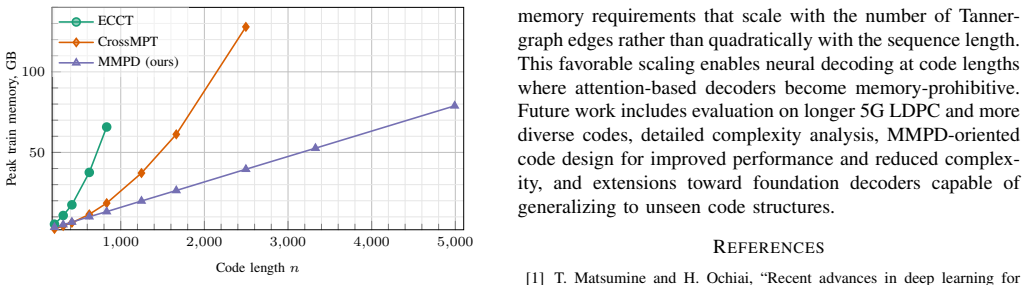
- Memory consumption drops by a factor of 1.5 on the tested code, with the reduction growing substantially for longer codes.
- The decoder remains applicable to any binary linear code through its syndrome-based message-passing design.
Where Pith is reading between the lines
- The same local-plus-Mamba pattern could be tested on other graph-structured inference tasks where long-range dependencies must be handled efficiently without attention.
- Because the method avoids code-specific tuning on the single tested LDPC code, it may generalize to different code families and lengths used in wireless and storage systems.
- Lower memory footprint could allow neural decoders to run on edge devices for real-time error correction in latency-sensitive links.
Load-bearing premise
The local pairwise updates plus Mamba blocks will move information effectively across codes of arbitrary length without code-specific tuning or training instability.
What would settle it
Train and test MMPD on an LDPC code several times longer than 1056 bits and observe whether the performance gain over CrossMPT disappears, memory savings fail to grow, or training becomes unstable.
Figures




read the original abstract
Forward error correction is essential for reliable communication over noisy channels. Attention-based model-free neural decoders have shown strong performance for short codes, but their scalability to longer codes is limited by the quadratic memory and computational cost of attention. In this paper, we introduce the Mamba message-passing decoder (MMPD), an attention-free syndrome-based neural decoder for binary linear codes. MMPD retains the Tanner-graph structure of a message-passing decoder by performing local pairwise aggregation along variable-check edges. To enable efficient long-range information propagation, these local updates are combined with bidirectional Mamba state-space blocks. By avoiding dense attention matrices, MMPD scales more favorably for long codes in both memory and computation. Experiments on the (1056, 880) LDPC code show that MMPD achieves a 0.45 dB gain over the state-of-the-art CrossMPT decoder at a specified target bit error rate, while reducing memory consumption by a factor of 1.5. This reduction factor increases substantially for longer codes, demonstrating the applicability of MMPD to scalable neural decoding of practical long codes.
Editorial analysis
A structured set of objections, weighed in public.
Referee Report
Summary. The paper introduces the Mamba Message-Passing Decoder (MMPD), an attention-free syndrome-based neural decoder for binary linear codes. It retains the Tanner-graph structure via local pairwise aggregation along variable-check edges and augments this with bidirectional Mamba state-space blocks for long-range propagation. The central empirical claim is that MMPD achieves a 0.45 dB gain over the CrossMPT decoder at a target BER on the (1056,880) LDPC code while reducing memory by a factor of 1.5, with the memory advantage asserted to grow for longer codes.
Significance. If the scalability claims hold, MMPD would provide a concrete route to neural decoding of practical-length codes by replacing quadratic attention with linear-complexity Mamba blocks while preserving graph locality. The architecture is defined independently of the performance numbers and avoids obvious circularity. The reported memory reduction on the tested code is a tangible engineering advantage, but the absence of results on longer or varied codes leaves the broader significance unestablished.
major comments (2)
- [Experiments] Experiments section: All quantitative results (0.45 dB gain, 1.5× memory reduction) are reported for a single (1056,880) LDPC code. No ablation studies, statistical error bars, training details, or results on longer block lengths or other code families are provided, which directly undermines the claim that the memory reduction “increases substantially for longer codes” and that Mamba propagation remains effective without code-specific retuning.
- [Method] Method section: The integration of bidirectional Mamba blocks with local pairwise aggregation is described at a high level, but no analysis, bound, or empirical test addresses whether the Mamba state propagation avoids information bottlenecks or vanishing gradients on Tanner graphs whose diameter grows with block length. This is load-bearing for the scalability argument.
minor comments (2)
- [Abstract] Abstract: The specific target bit-error-rate value at which the 0.45 dB gain is measured should be stated explicitly rather than left as “a specified target bit error rate.”
- [Experiments] The paper would benefit from a short table comparing parameter counts, training epochs, and optimizer settings against CrossMPT to allow readers to assess whether the gain could be explained by hyperparameter differences.
Simulated Author's Rebuttal
We thank the referee for the thorough review and valuable comments. We address each major comment below and indicate planned revisions to the manuscript.
read point-by-point responses
-
Referee: [Experiments] Experiments section: All quantitative results (0.45 dB gain, 1.5× memory reduction) are reported for a single (1056,880) LDPC code. No ablation studies, statistical error bars, training details, or results on longer block lengths or other code families are provided, which directly undermines the claim that the memory reduction “increases substantially for longer codes” and that Mamba propagation remains effective without code-specific retuning.
Authors: We agree that the reported results are confined to the (1056,880) LDPC code, selected to permit direct comparison with prior attention-based decoders. In the revision we will include training hyperparameters, ablation studies isolating the contribution of the bidirectional Mamba blocks versus local aggregation, and error bars from multiple independent training runs. The claim that memory reduction grows with code length follows directly from the O(N) complexity of Mamba versus quadratic attention; however, we will qualify this statement to note that it is supported by complexity analysis rather than additional empirical results, as generating data for substantially longer codes requires resources beyond the present study. revision: partial
-
Referee: [Method] Method section: The integration of bidirectional Mamba blocks with local pairwise aggregation is described at a high level, but no analysis, bound, or empirical test addresses whether the Mamba state propagation avoids information bottlenecks or vanishing gradients on Tanner graphs whose diameter grows with block length. This is load-bearing for the scalability argument.
Authors: The bidirectional Mamba blocks are chosen precisely because their selective state-space mechanism provides linear-time propagation with built-in mechanisms (input-dependent gating and stable recurrence) that mitigate vanishing gradients on long sequences. We will augment the method section with a concise discussion of these properties, supported by references to the Mamba literature, and explain why the combination with local Tanner-graph aggregation preserves locality while enabling long-range flow. A formal bound on information flow is outside the scope of this work, but we will add a short empirical check of gradient norms during training on the evaluated code to address the concern. revision: yes
- Empirical results on block lengths substantially longer than 1056 bits or on additional code families are not present in the manuscript and cannot be supplied without new large-scale experiments.
Circularity Check
No circularity; architecture and empirical results are independent
full rationale
The paper defines MMPD via local pairwise aggregation on Tanner-graph edges combined with bidirectional Mamba blocks for long-range propagation. This architectural choice is stated directly and is independent of the reported performance numbers. The 0.45 dB gain and 1.5x memory reduction are presented as experimental outcomes on the (1056,880) LDPC code, not as quantities derived from or equivalent to any fitted parameter or self-referential normalization. No equations, uniqueness theorems, or ansatzes reduce the central claims to inputs by construction. Self-citations (if present for CrossMPT or Mamba) are not load-bearing for the core architecture or scalability argument, which rests on the explicit avoidance of quadratic attention costs. The derivation chain is therefore self-contained.
Axiom & Free-Parameter Ledger
free parameters (1)
- neural network weights
axioms (1)
- domain assumption Binary linear codes admit a Tanner-graph representation with variable and check nodes connected by edges.
Lean theorems connected to this paper
-
IndisputableMonolith/Cost/FunctionalEquation.leanwashburn_uniqueness_aczel unclear?
unclearRelation between the paper passage and the cited Recognition theorem.
MMPD retains the Tanner-graph structure ... local pairwise aggregation along variable-check edges ... combined with bidirectional Mamba state-space blocks
-
IndisputableMonolith/Foundation/RealityFromDistinction.leanreality_from_one_distinction unclear?
unclearRelation between the paper passage and the cited Recognition theorem.
Experiments on the (1056,880) LDPC code ... 0.45 dB gain ... memory consumption by a factor of 1.5
What do these tags mean?
- matches
- The paper's claim is directly supported by a theorem in the formal canon.
- supports
- The theorem supports part of the paper's argument, but the paper may add assumptions or extra steps.
- extends
- The paper goes beyond the formal theorem; the theorem is a base layer rather than the whole result.
- uses
- The paper appears to rely on the theorem as machinery.
- contradicts
- The paper's claim conflicts with a theorem or certificate in the canon.
- unclear
- Pith found a possible connection, but the passage is too broad, indirect, or ambiguous to say the theorem truly supports the claim.
Reference graph
Works this paper leans on
-
[1]
Recent advances in deep learning for channel coding: A survey,
T. Matsumine and H. Ochiai, “Recent advances in deep learning for channel coding: A survey,”IEEE Open Journal of the Communications Society, vol. 5, pp. 6443–6481, 2024
work page 2024
-
[2]
Graph neural networks for channel decoding,
S. Cammerer, J. Hoydis, F. A. Aoudia, and A. Keller, “Graph neural networks for channel decoding,” in2022 IEEE Globecom Workshops (GC Wkshps), 2022, pp. 486–491
work page 2022
-
[3]
Deep neural network based decoding of short 5G LDPC codes,
K. Andreev, A. Frolov, G. Svistunov, K. Wu, and J. Liang, “Deep neural network based decoding of short 5G LDPC codes,” in2021 XVII International Symposium ”Problems of Redundancy in Information and Control Systems” (REDUNDANCY), 2021, pp. 155–160
work page 2021
-
[4]
Deep learning for decod- ing of linear codes - a syndrome-based approach,
A. Bennatan, Y . Choukroun, and P. Kisilev, “Deep learning for decod- ing of linear codes - a syndrome-based approach,” inproc. of IEEE International Symposium on Information Theory (ISIT), June 2018, pp. 1595–1599
work page 2018
-
[5]
Iterative syndrome- based deep neural network decoding,
D. Artemasov, K. Andreev, P. Rybin, and A. Frolov, “Iterative syndrome- based deep neural network decoding,”IEEE Open Journal of the Communications Society, vol. 6, pp. 629–641, 2024
work page 2024
-
[6]
Error correction code transformer,
Y . Choukroun and L. Wolf, “Error correction code transformer,” inAdvances in Neural Information Processing Systems, vol. 35. Curran Associates, Inc., 2022, pp. 38 695–38 705. [Online]. Available: https://proceedings.neurips.cc/paper files/paper/ 2022/file/fcd3909db30887ce1da519c4468db668-Paper-Conference.pdf
work page 2022
-
[7]
CrossMPT: Cross-attention message-passing transformer for error correcting codes,
S.-J. Park, H.-Y . Kwak, S.-H. Kim, Y . Kim, and J.-S. No, “CrossMPT: Cross-attention message-passing transformer for error correcting codes,” inThe Thirteenth International Conference on Learning Representations, 2025. [Online]. Available: https://openreview.net/ forum?id=gFvRRCnQvX
work page 2025
-
[8]
Accelerating error correction code transformers,
M. Levy, Y . Choukroun, and L. Wolf, “Accelerating error correction code transformers,” 2024. [Online]. Available: https://arxiv.org/abs/ 2410.05911
-
[9]
Hybrid mamba- transformer decoder for error-correcting codes,
S. el Cohen, Y . Choukroun, and E. Nachmani, “Hybrid mamba- transformer decoder for error-correcting codes,” 2025. [Online]. Available: https://arxiv.org/abs/2505.17834
-
[10]
A foundation model for error correction codes,
Y . Choukroun and L. Wolf, “A foundation model for error correction codes,” inThe Twelfth International Conference on Learning Representations, 2024. [Online]. Available: https://openreview.net/ forum?id=7KDuQPrAF3
work page 2024
-
[11]
Cross- attention message-passing transformers for code-agnostic decoding in 6g networks,
S.-J. Park, H.-Y . Kwak, S.-H. Kim, Y . Kim, and J.-S. No, “Cross- attention message-passing transformers for code-agnostic decoding in 6g networks,” 2025. [Online]. Available: https://arxiv.org/abs/2507.01038
-
[12]
Denoising diffusion error correction codes,
Y . Choukroun and L. Wolf, “Denoising diffusion error correction codes,” 2022. [Online]. Available: https://arxiv.org/abs/2209.13533
-
[13]
Syndrome-flow consistency model achieves one-step denoising error correction codes,
H. Lei, C. W. Lau, K. Zhou, N. Guo, and F. Farnia, “Syndrome-flow consistency model achieves one-step denoising error correction codes,”
-
[14]
Available: https://arxiv.org/abs/2512.01389
[Online]. Available: https://arxiv.org/abs/2512.01389
-
[15]
Natural language inference by tree-based convolution and heuristic matching,
L. Mou, R. Men, G. Li, Y . Xu, L. Zhang, R. Yan, and Z. Jin, “Natural language inference by tree-based convolution and heuristic matching,” in Proceedings of the 54th Annual Meeting of the Association for Compu- tational Linguistics. Berlin, Germany: Association for Computational Linguistics, Aug. 2016, pp. 130–136
work page 2016
-
[16]
Factor graphs and the sum- product algorithm,
F. Kschischang, B. Frey, and H.-A. Loeliger, “Factor graphs and the sum- product algorithm,”IEEE Transactions on Information Theory, vol. 47, no. 2, pp. 498–519, 2001
work page 2001
-
[17]
5G NR Multiplexing and Channel Coding,
3GPP, “5G NR Multiplexing and Channel Coding,” 3rd Generation Partnership Project (3GPP), Technical Specification TS 38.212, 2020, version 16.11.0. Available: https://www.3gpp.org/ftp/Specs/archive/38 series/38.212
work page 2020
discussion (0)
Sign in with ORCID, Apple, or X to comment. Anyone can read and Pith papers without signing in.