Recognition: 2 theorem links
· Lean TheoremGinzburg-Landau Theory for Confined Thin-Film Superconductors
Pith reviewed 2026-05-13 06:40 UTC · model grok-4.3
The pith
Quantum confinement renormalizes the superconducting coherence length in thin films through changes to the density of states and Fermi energy.
A machine-rendered reading of the paper's core claim, the machinery that carries it, and where it could break.
Core claim
Starting from the microscopic BCS free energy and the confinement theory of metallic thin films, explicit analytical expressions are derived for the Ginzburg-Landau coefficients, coherence length, penetration depth, electronic mean free path, and Ginzburg-Landau parameter in confined geometries. The central result is that quantum confinement directly renormalizes the intrinsic superconducting coherence length through confinement-induced modifications of the electronic density of states and Fermi energy. As a consequence, confinement simultaneously suppresses the coherence length and enhances the penetration depth, thereby driving superconductors toward progressively stronger type-II behavior
What carries the argument
Ginzburg-Landau coefficients obtained by inserting confinement-modified density of states and Fermi energy into the BCS free-energy functional
If this is right
- Confinement suppresses the coherence length while enhancing the penetration depth.
- Superconductors are driven toward stronger type-II behavior as film thickness decreases.
- A crossover regime appears in which confinement renormalization and scattering effects become intertwined.
- The enhancement of penetration depth measured in thin aluminum films arises from the combined action of coherence-length renormalization and mean-free-path suppression.
Where Pith is reading between the lines
- Device models for nanoscale superconducting circuits will need to treat thickness as an intrinsic tuning parameter for the coherence length rather than only a source of scattering.
- The same renormalization mechanism could be tested in other confined geometries such as superconducting nanowires or multilayer stacks where density-of-states modifications are independently measurable.
- The theory suggests that critical current or vortex pinning in thin films may acquire an additional thickness dependence not captured by conventional dirty-limit formulas.
Load-bearing premise
The recently developed confinement theory of metallic thin films accurately supplies the modifications to density of states and Fermi energy when applied inside the superconducting BCS framework, with no additional corrections required for the superconducting state.
What would settle it
A measurement of the coherence length in a series of thin films of controlled thickness and low disorder that shows no thickness dependence beyond ordinary scattering effects would falsify the renormalization claim.
Figures
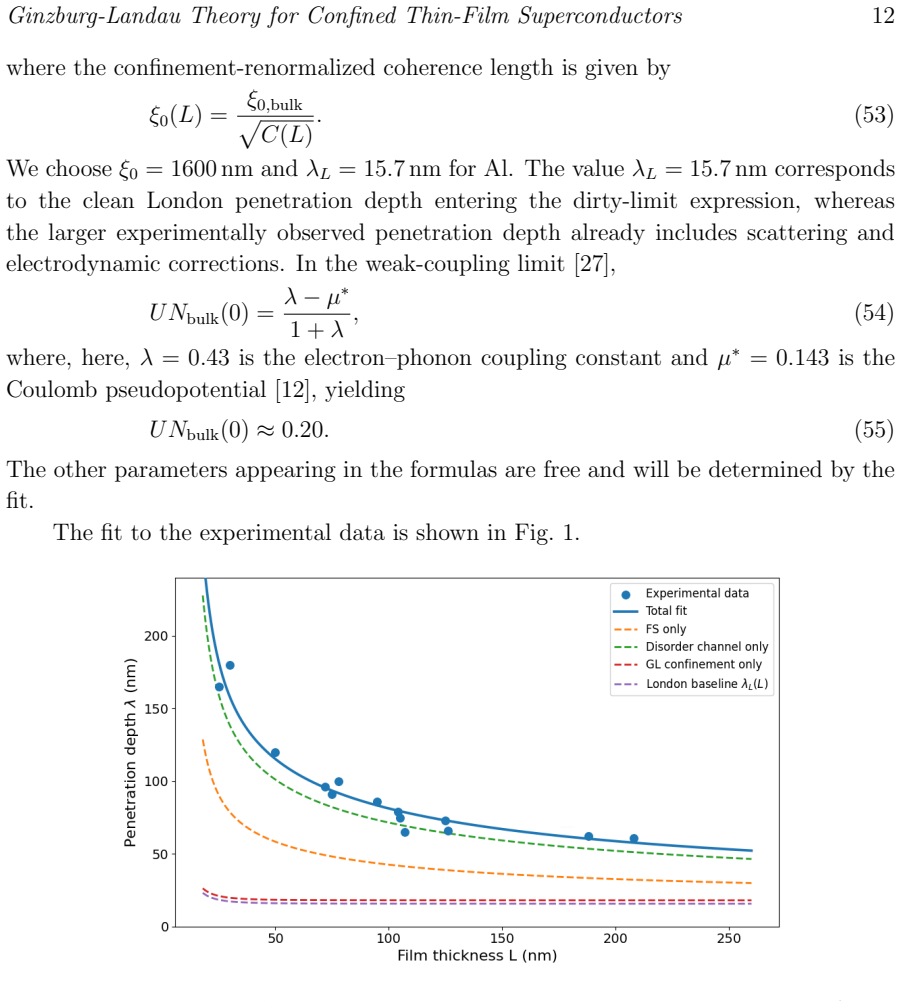
read the original abstract
We develop a Ginzburg--Landau theory for superconducting thin films under quantum confinement. Starting from the microscopic BCS free energy and the recently developed confinement theory of metallic thin films, explicit analytical expressions are derived for the Ginzburg--Landau coefficients, coherence length, penetration depth, electronic mean free path, and Ginzburg--Landau parameter in confined geometries. The central result is that quantum confinement directly renormalizes the intrinsic superconducting coherence length through confinement-induced modifications of the electronic density of states and Fermi energy. This effect is absent in conventional thin-film transport theories based solely on surface scattering. As a consequence, confinement simultaneously suppresses the coherence length and enhances the penetration depth, thereby driving superconductors toward progressively stronger type-II behavior with decreasing film thickness. The theory predicts a crossover regime in which confinement-induced renormalization of superconducting length scales and transport scattering become strongly intertwined. Comparison with recent penetration-depth measurements in Al thin films shows that the observed enhancement of the penetration depth originates from the interplay between confinement-induced renormalization of the coherence length and suppression of the effective mean free path by surface and disorder scattering. The results establish a direct connection between quantum confinement and superconducting electrodynamics in confined metallic films.
Editorial analysis
A structured set of objections, weighed in public.
Referee Report
Summary. The manuscript develops a Ginzburg-Landau theory for superconducting thin films under quantum confinement. It starts from the microscopic BCS free energy combined with a prior confinement model for metallic films and derives explicit analytical expressions for the GL coefficients, coherence length, penetration depth, electronic mean free path, and GL parameter. The central claim is that quantum confinement renormalizes the intrinsic coherence length via confinement-induced changes to the electronic density of states and Fermi energy (an effect absent in conventional surface-scattering theories), driving the system toward stronger type-II behavior with decreasing thickness; a crossover regime is predicted where confinement renormalization and transport scattering intertwine, with comparison to Al thin-film penetration-depth data.
Significance. If the central substitution holds, the work supplies a microscopic route from quantum confinement to renormalized superconducting length scales and electrodynamics, offering falsifiable predictions for the type-II crossover and a mechanism for observed penetration-depth enhancement beyond mean-free-path suppression alone. This could be relevant for modeling confined superconducting systems where subband structure matters.
major comments (1)
- [Abstract / central derivation] The load-bearing step is the direct insertion of normal-state confinement modifications to DOS and E_F into the BCS free-energy expansion (as stated in the abstract). This requires that no additional corrections arise in the pairing kernel, gap equation, or free-energy functional from subband wavefunctions or modified electron-phonon matrix elements; explicit derivation or justification of this substitution (including any assumptions about the confinement theory's applicability inside the superconducting state) is needed to support the claimed direct renormalization of the coherence length.
minor comments (1)
- [Comparison with experiment] The experimental comparison paragraph should specify the Al film thicknesses used, the quantitative decomposition between confinement-induced coherence-length renormalization and mean-free-path suppression, and any fitting parameters introduced.
Simulated Author's Rebuttal
We thank the referee for their careful reading and constructive comments on our manuscript. The concern regarding the justification for substituting normal-state confinement modifications directly into the BCS free-energy expansion is well taken, and we have revised the manuscript to provide the requested explicit derivation and discussion of assumptions.
read point-by-point responses
-
Referee: [Abstract / central derivation] The load-bearing step is the direct insertion of normal-state confinement modifications to DOS and E_F into the BCS free-energy expansion (as stated in the abstract). This requires that no additional corrections arise in the pairing kernel, gap equation, or free-energy functional from subband wavefunctions or modified electron-phonon matrix elements; explicit derivation or justification of this substitution (including any assumptions about the confinement theory's applicability inside the superconducting state) is needed to support the claimed direct renormalization of the coherence length.
Authors: We agree that this central substitution requires explicit justification. In the revised manuscript we have added a new subsection (II.B) that derives the BCS free-energy functional starting from the microscopic BCS Hamiltonian in the presence of the confinement potential. We demonstrate that, within the weak-coupling limit where the gap is much smaller than the subband spacing, the leading-order terms in the Ginzburg-Landau expansion receive corrections only through the renormalized density of states and Fermi energy; subband wavefunction overlaps and modifications to the electron-phonon matrix elements enter only at O(Δ³) and higher and can therefore be neglected near Tc. The confinement theory is assumed to remain applicable inside the superconducting state because the superconducting order parameter does not alter the confining potential or the subband structure to leading order. These additions clarify the assumptions and support the claimed renormalization of the coherence length. revision: yes
Circularity Check
One minor self-citation to confinement theory that is not load-bearing for the derivation
specific steps
-
self citation load bearing
[Abstract]
"Starting from the microscopic BCS free energy and the recently developed confinement theory of metallic thin films, explicit analytical expressions are derived for the Ginzburg--Landau coefficients, coherence length, penetration depth..."
The 'recently developed confinement theory' supplies the DOS and Fermi energy modifications inserted into BCS to obtain the renormalization of coherence length. If this is prior work by the same authors, the central claim relies on that input, but the present derivation performs an independent analytical insertion and does not reduce any output quantity to a tautology or redefinition by construction.
full rationale
The paper starts from the standard BCS free energy and applies a cited confinement theory for metallic films to modify DOS and E_F, then derives GL coefficients analytically. No step reduces a prediction to a fitted parameter defined by the paper itself, nor is there a self-definitional loop in the equations. The confinement theory is treated as an independent input, making the derivation self-contained against external benchmarks like BCS theory. This warrants a low score of 2 for the presence of self-citation without it being the sole justification for the central claim.
Axiom & Free-Parameter Ledger
axioms (2)
- domain assumption The BCS free energy functional remains valid for the quantum-confined thin-film geometry
- domain assumption The recently developed confinement theory of metallic thin films supplies the correct modifications to electronic density of states and Fermi energy
Lean theorems connected to this paper
-
IndisputableMonolith/Cost/FunctionalEquation.leanwashburn_uniqueness_aczel unclear?
unclearRelation between the paper passage and the cited Recognition theorem.
α₀ = N(0); b = 7ζ(3) N(0) / (8π² (k_B T_c)²); ξ(0) = ℏ / (2√(m α₀)); λ = λ_L √(1 + ξ₀/ℓ) with ℓ = C ℓ_bulk
-
IndisputableMonolith/Foundation/AlexanderDuality.leanalexander_duality_circle_linking unclear?
unclearRelation between the paper passage and the cited Recognition theorem.
C(L) = (1 + 2π/(3n L³))^{1/3} (weak) or 2^{6/3} (L/L_c)^{1/2} (strong); ε_F,film = C² ε_F,bulk
What do these tags mean?
- matches
- The paper's claim is directly supported by a theorem in the formal canon.
- supports
- The theorem supports part of the paper's argument, but the paper may add assumptions or extra steps.
- extends
- The paper goes beyond the formal theorem; the theorem is a base layer rather than the whole result.
- uses
- The paper appears to rely on the theorem as machinery.
- contradicts
- The paper's claim conflicts with a theorem or certificate in the canon.
- unclear
- Pith found a possible connection, but the passage is too broad, indirect, or ambiguous to say the theorem truly supports the claim.
Reference graph
Works this paper leans on
-
[1]
Introduction The superconducting properties of metallic thin films undergo substantial modifications when the film thickness becomes comparable to characteristic electronic length scales such as the Fermi wavelength, the electron mean free path, and the superconducting coherence length. In this regime, quantum confinement alters the distribution of access...
-
[2]
Ginzburg–Landau Free Energy The Ginzburg–Landau free-energy density is written as Fs(T) =F n +α(T)|ψ| 2 + b 2 |ψ|4,(1) whereF n is the normal-state free energy,ψis the superconducting order parameter and the coefficientsα(T) andbare determined microscopically. Close to the superconducting transition temperature one writes α(T) =α 0 T−T c Tc .(2) Within mi...
-
[3]
Quantum Confinement and Density of States In the confinement theory of thin metallic films, confinement along one spatial direction suppresses low-energy states in momentum space. The resulting modification of the available Fermi volume changes the density of states and shifts the Fermi energy. The density of states becomes confinement dependent, Nfilm(0)...
-
[4]
Electronic Mean Free Path The electronic mean free path is written as ℓ=v F τ,(11) whereτis the scattering time and the Fermi velocity is vF = r 2εF m .(12) Ginzburg-Landau Theory for Confined Thin-Film Superconductors6 Assuming that the scattering time remains approximately unchanged by confinement to leading order (but as we will see this approximation ...
-
[5]
Coherence Length Within Ginzburg–Landau theory the superconducting coherence length is defined as ξ(T) = s ℏ2 2m|α(T)| .(16) Substituting the temperature dependence ofα(T) gives ξ(T) = ℏp 2m|α0| Tc T−T c 1/2 .(17) At zero temperature, ξ(0) = ℏ 2√mα0 .(18) Since α0 ∝N(0),(19) one immediately obtains the confinement-renormalized coherence length: ξfilm(0) =...
-
[6]
London Penetration Depth In the dirty limit the penetration depth is given by λ=λ L r 1 + ξ0 ℓ ,(23) whereλ L is the clean-limit London penetration depth,ξ 0 is the BCS coherence length andℓis the electronic mean free path. Applying the confinement corrections derived above gives λfilm =λ L Tc,film Tc,bulk s 1 + ξ0,bulk C √ Cℓbulk .(24) This expression co...
-
[7]
Ginzburg–Landau Parameter The Ginzburg–Landau parameter is defined as κ= λ ξ .(27) Substituting the confinement-renormalized expressions for the penetration depth and coherence length yields κfilm =κ bulk Tc,film Tc,bulk √ C s 1 + ξ0,bulk C √ Cℓbulk · Cℓbulk +ξ 0/ √ C Cℓbulk .(28) In the weak-confinement regime the Ginzburg–Landau parameter increases as t...
-
[8]
Explicit Thickness Dependence of Physical Quantities We define the confinement crossover thickness as Lc = 2π n 1/3 ,(29) wheren=N/Vis the electronic carrier density. The confinement factor is C(L)≡ Nfilm(0) Nbulk(0) .(30) ForL > L c, C(L) = 1 + 2π 3nL3 1/3 ,(31) whereas forL < L c, C(L) = 2 61/3 L Lc 1/2 .(32) The Fermi energy is therefore εF (L) = ...
-
[9]
Discussion The present framework provides a unified description of the superconducting properties of confined metallic thin films. The theory directly connects the microscopic confinement-induced reconstruction of the Fermi surface to macroscopic superconducting observables. Several general trends emerge naturally from the theory: (i) confinement enhances...
-
[10]
Comparison with Experimental Data In order to assess the validity of the proposed framework, the theory was compared against experimental measurements of the penetration depth in superconducting Al thin films reported by Forn-D´ ıaz and collaborators [3]. A first attempt based solely on confinement-induced renormalization of the density of states proved i...
-
[11]
Conclusion We have developed a Ginzburg–Landau framework for confined superconducting thin films based on the recently developed quantum confinement theory of metallic thin films. Explicit analytical expressions were derived for the superconducting coherence length, penetration depth, mean free path, and Ginzburg–Landau parameter in terms of the confineme...
-
[12]
Blais A, Grimsmo A L, Girvin S M and Wallraff A 2021Rev. Mod. Phys.93025005 Ginzburg-Landau Theory for Confined Thin-Film Superconductors16
-
[13]
Brooks M 2023Nature617S1–S3
-
[14]
Lopez-Nunez D, Torras-Coloma A, Portell-Montserrat Q, Bertoldo E, Cozzolino L, Ummarino G A, Zaccone A, Rius G, Martinez M and Forn-Diaz P 2025Supercond. Sci. Technol.38095004
-
[15]
Forn-Diaz P, Lisenfeld J, Marcos D, Garcia-Ripoll J J, Solano E, Harmans C J P M and Mooij J E 2010Phys. Rev. Lett.105237001
-
[16]
Tinkham M 1996Introduction to Superconductivity2nd ed (McGraw–Hill)
-
[17]
de Gennes P G 1999Superconductivity of Metals and Alloys(Westview Press)
- [18]
- [19]
-
[20]
Mayadas A F and Shatzkes M 1970Phys. Rev. B11382–1389
-
[21]
Zhang C and Liu Y 2024ACS Nano
-
[22]
Travaglino R and Zaccone A 2023J. Appl. Phys.133033901
- [23]
-
[24]
Zaccone A 2025J. Phys. Mater.8031001
-
[25]
Ummarino G A and Zaccone A 2024Physical Review Materials8L101801
-
[26]
Ummarino G A and Zaccone A 2025Condensed Matter1017
-
[27]
Ummarino G A and Zaccone A 2026Journal of Physics: Condensed Matter38143003
-
[28]
Mirigliano M and Milani P 2021Advances in Physics: X61908847
-
[29]
Carlstrom J, Babaev E and Speight M 2011Phys. Rev. B83174509
-
[30]
Silaev M and Babaev E 2011Phys. Rev. B84094515
- [31]
- [32]
-
[33]
Deshpande A, Pusskeiler J, Prange C, Rogge U, Dressel M and Scheffler M 2025J. Appl. Phys. 137013902
-
[34]
Zaccone A and Fomin V M 2024Phys. Rev. B109144520
-
[35]
Zaccone A, Ummarino G A, Braggio A and Giazotto F 2025Phys. Rev. B111174528
-
[36]
Ummarino G A, Zaccone A, Braggio A and Giazotto F 2025Phys. Rev. Materials9104803
-
[37]
Zaccone A 2025Phys. Rev. Materials9046001
-
[38]
Carbotte J P 1990Rev. Mod. Phys.621027
discussion (0)
Sign in with ORCID, Apple, or X to comment. Anyone can read and Pith papers without signing in.