Recognition: 2 theorem links
· Lean TheoremWhen 'For You' Isn't For You: Measuring User Agency in TikTok's Algorithmic Feed
Pith reviewed 2026-05-12 05:00 UTC · model grok-4.3
The pith
TikTok users struggle to permanently exclude unwanted videos from their For You feed.
A machine-rendered reading of the paper's core claim, the machinery that carries it, and where it could break.
Core claim
The FYP algorithm changes the volume of personalized content it delivers when accounts provide explicit disinterest marks or alter implicit engagement patterns. The most reliable explicit signal, however, requires opening a menu to select 'Not Interested,' an option that is not surfaced on the main video view. Once accounts stop supplying these signals, the feed frequently reverts to showing high volumes of the same topics the user had previously tried to remove.
What carries the argument
Controlled experiments using researcher-owned TikTok accounts that issue explicit 'Not Interested' marks and implicit watch-time signals to measure resulting shifts in For You Page content composition.
If this is right
- Users must keep sending disinterest signals to maintain a feed free of unwanted topics.
- The current interface placement of the 'Not Interested' control reduces how often people will use it.
- Implicit signals alone are less effective than combined explicit and implicit signals for steering the feed.
- The algorithm appears to treat absence of recent negative signals as permission to reintroduce previously disliked content.
Where Pith is reading between the lines
- Platforms could increase user agency by moving the strongest control to the primary video screen.
- Similar buried controls may limit agency on other short-form video apps that rely on implicit signals at signup.
- Design changes that keep signals active longer could reduce the need for repeated user effort.
Load-bearing premise
That the behavior seen in researcher-controlled accounts with planned signal patterns matches how the algorithm responds to ordinary users who interact naturally over long periods.
What would settle it
A long-term study of real users who mark videos 'Not Interested' only once and then stop all signals, checking whether the excluded topics stay out of the feed for weeks.
Figures



read the original abstract
The short-form video-sharing service TikTok has become an important platform in the social media landscape, with much of its popularity owed to its algorithmically-driven "For You Page" (FYP). This feature serves as the "home screen" for the platform and provides a personalized feed of content for each user. Unlike other social media services-where new users start their journey by explicitly signaling whom they choose to friend or follow-the TikTok FYP algorithm instead begins making inferences based on implicit signals, such as how long they watch particular videos. As a result, users have less explicit control over what content they see, and concerns have been raised about the impact on users (e.g., the delivery of potentially harmful content). In this work, we investigate the extent to which users have control over the content they see on the FYP on TikTok. We first develop novel techniques to study the TikTok mobile app, introducing a new avenue for conducting controlled experiments that enable us to send both explicit and implicit signals on the app. We then use these techniques to study the FYP algorithm based on accounts we control. We find that the FYP algorithm is sensitive to both types of signals, changing the amount of personalized content the account sees. However, we find that users may have difficulty convincing the FYP algorithm to stop showing content the user wishes to no longer see: the most effective explicit signal-marking a video as 'Not Interested'-is unintuitively buried in the interface. Worse, we find that once accounts cease to indicate disinterest in a topic, many find their feeds dominated by such content again.
Editorial analysis
A structured set of objections, weighed in public.
Referee Report
Summary. The paper develops novel techniques for controlled experiments on the TikTok mobile app that allow sending both explicit and implicit signals to the For You Page (FYP) algorithm. Using researcher-controlled accounts, it reports that the algorithm responds to these signals by altering the amount of personalized content shown, but finds that the most effective explicit signal ('Not Interested') is buried in the UI and that feeds tend to revert to previously suppressed topics once such signaling stops.
Significance. If the results hold under more rigorous validation, the work would contribute empirical evidence on limited user agency in black-box recommendation systems, with practical implications for platform interface design and regulatory discussions around algorithmic control. A clear strength is the introduction of app-based experimental methods that enable reproducible, signal-controlled studies of production algorithms, which could be extended to other platforms.
major comments (2)
- [Abstract / Methods] Abstract and experimental description: no sample sizes, number of accounts, session lengths, statistical tests, error bars, or validation procedures for account control and signal delivery are provided. This directly affects assessment of the claims that the FYP is 'sensitive to both types of signals' and that reversion occurs 'once accounts cease to indicate disinterest.'
- [Results / Discussion] Central reversion finding: the observation that feeds become 'dominated by such content again' after stopping disinterest signals is load-bearing for the agency claim, yet rests entirely on deliberate, repeated signals from researcher accounts. No comparison to organic, lower-density, longer-horizon user logs is described, leaving open whether reversion is an artifact of the experimental regime rather than a stable algorithmic property.
Simulated Author's Rebuttal
Thank you for the opportunity to respond to the referee's report. We have addressed the major comments by enhancing the methodological details and expanding the discussion of the experimental limitations.
read point-by-point responses
-
Referee: [Abstract / Methods] Abstract and experimental description: no sample sizes, number of accounts, session lengths, statistical tests, error bars, or validation procedures for account control and signal delivery are provided. This directly affects assessment of the claims that the FYP is 'sensitive to both types of signals' and that reversion occurs 'once accounts cease to indicate disinterest.'
Authors: We acknowledge this gap in the original manuscript. The revised version now includes a detailed Experimental Design subsection that reports the use of multiple researcher-controlled accounts, specific session lengths, the statistical tests applied to measure signal sensitivity (with associated p-values and error bars), and procedures used to validate that signals were correctly delivered and accounts remained isolated. These additions directly support evaluation of the sensitivity and reversion findings. revision: yes
-
Referee: [Results / Discussion] Central reversion finding: the observation that feeds become 'dominated by such content again' after stopping disinterest signals is load-bearing for the agency claim, yet rests entirely on deliberate, repeated signals from researcher accounts. No comparison to organic, lower-density, longer-horizon user logs is described, leaving open whether reversion is an artifact of the experimental regime rather than a stable algorithmic property.
Authors: This is a fair critique of the scope of our evidence. Our controlled experiments were designed to isolate the effect of signal cessation in a reproducible manner, which is challenging with passive organic logs. We have added text in the Discussion section explicitly noting this limitation and the potential for future studies to validate with user log data where ethically obtainable. We maintain that the observed reversion under controlled conditions provides evidence of the algorithm's response to the withdrawal of disinterest signals, supporting our claims about user agency. revision: partial
Circularity Check
Empirical measurement study exhibits no circularity
full rationale
This paper performs controlled experiments on researcher-managed TikTok accounts to observe how explicit and implicit signals affect the FYP algorithm's output. It introduces interface techniques for sending signals and reports direct measurements of content changes and reversion effects. No equations, fitted parameters, derivations, or self-citation chains appear in the work; all claims rest on experimental observations rather than quantities defined in terms of other quantities from the same paper. The central results are therefore independent of any internal reduction and qualify as non-circular.
Axiom & Free-Parameter Ledger
Lean theorems connected to this paper
-
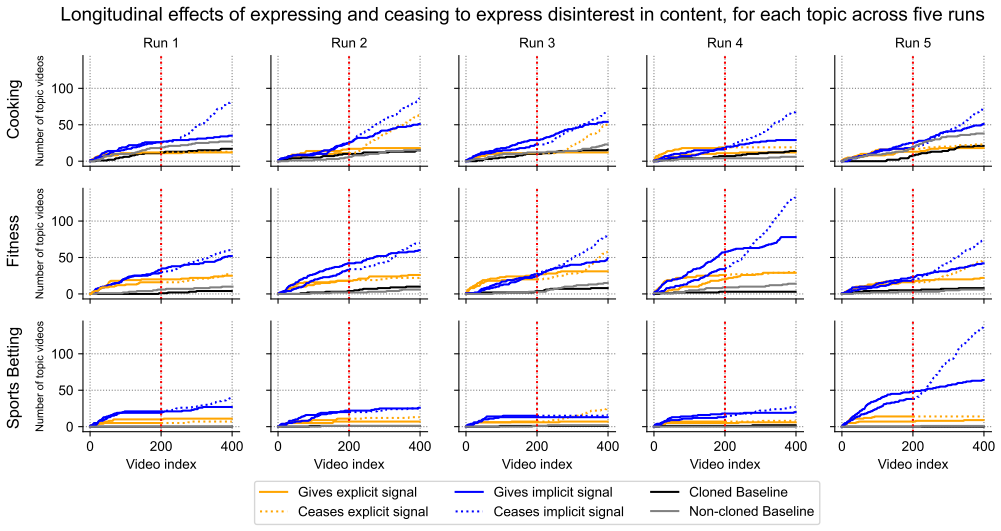
IndisputableMonolith/Cost/FunctionalEquation.leanwashburn_uniqueness_aczel unclearWe first develop novel techniques to study the TikTok mobile app... sock-puppet accounts called 'cloning'... Gives Implicit Signal... Gives Explicit Signal... Ceases Implicit Signal
-
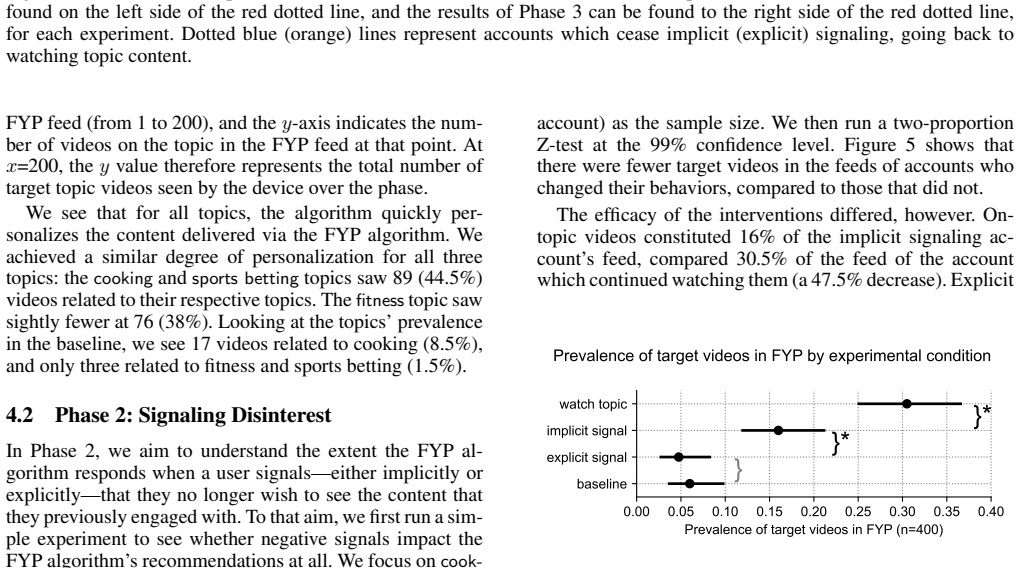
IndisputableMonolith/Foundation/RealityFromDistinction.leanreality_from_one_distinction unclearPhase 2... Phase 3... two-proportion Z-test at the 99% confidence level... relapse effect
Reference graph
Works this paper leans on
-
[1]
Proceedings of the ACM Web Conference 2022 , pages=
An empirical investigation of personalization factors on tiktok , author=. Proceedings of the ACM Web Conference 2022 , pages=
work page 2022
-
[2]
Proceedings of the 22nd international conference on World Wide Web , pages=
Measuring personalization of web search , author=. Proceedings of the 22nd international conference on World Wide Web , pages=
-
[3]
TikTok SSL Pinning Bypass , author=
-
[4]
Mitmproxy , howpublished=
-
[5]
Fastest Growing Social Media Networks 2022-23 , howpublished=
work page 2022
-
[6]
Investigation: How TikTok's Algorithm Figures Out Your Deepest Desires , year=
-
[7]
Command-line tools , author=
-
[8]
Android Debug Bridge (adb) , author=
-
[9]
UIAutomator2 , author=
-
[10]
Square Wire Java Protobuf Decompiler , author=
-
[11]
Alan Agresti and Brent A. Coull , journal =. Approximate Is Better than "Exact" for Interval Estimation of Binomial Proportions , urldate =
-
[12]
Proceedings of the International AAAI Conference on Web and Social Media , volume=
Auditing Algorithmic Explanations of Social Media Feeds: A Case Study of TikTok Video Explanations , author=. Proceedings of the International AAAI Conference on Web and Social Media , volume=
-
[13]
Health Promotion Journal of Australia , volume=
Communication of nutrition information by influencers on social media: A scoping review , author=. Health Promotion Journal of Australia , volume=. 2022 , publisher=
work page 2022
-
[14]
Communitainment on Instagram: Fitness content and community-driven communication as social media entertainment , author=. Sage Open , volume=. 2020 , publisher=
work page 2020
-
[15]
TikTok on the clock but the\# fitspo don’t stop: The impact of TikTok fitspiration videos on women’s body image concerns , author=. Body image , volume=. 2022 , publisher=
work page 2022
-
[16]
2nd International Conference on Language, Art and Cultural Exchange (ICLACE 2021) , pages=
The influence of the body image presented through TikTok trend-videos and its possible reasons , author=. 2nd International Conference on Language, Art and Cultural Exchange (ICLACE 2021) , pages=. 2021 , organization=
work page 2021
-
[17]
Fitspiration: Social Media's Fitness Culture and its Effect on Body Image , author=
-
[18]
Eating and Weight Disorders-Studies on Anorexia, Bulimia and Obesity , volume=
Effects of fitspiration content on body image: a systematic review , author=. Eating and Weight Disorders-Studies on Anorexia, Bulimia and Obesity , volume=. 2022 , publisher=
work page 2022
-
[19]
AI agency vs. human agency: understanding human--AI interactions on TikTok and their implications for user engagement , author=. Journal of Computer-Mediated Communication , volume=. 2022 , publisher=
work page 2022
- [20]
- [21]
-
[22]
The Creepy TikTok Algorithm Doesn’t Know You , howpublished =. 2022 , author =
work page 2022
-
[23]
J. Richard Landis and Gary G. Koch , journal =. The Measurement of Observer Agreement for Categorical Data , urldate =
-
[24]
Natasa Gisev and J. Simon Bell and Timothy F. Chen , keywords =. Interrater agreement and interrater reliability: Key concepts, approaches, and applications , journal =. 2013 , issn =. doi:https://doi.org/10.1016/j.sapharm.2012.04.004 , url =
-
[25]
Regulated Goods and Commercial Activities , howpublished =. 2024 , author =
work page 2024
-
[26]
TikTok CEO Shou Chew's Opening Statement , howpublished =. 2024 , author =
work page 2024
-
[27]
TikTok CEO Shou Chew's Opening Statement - Senate Judiciary Committee Hearing on Online Child Sexual Exploitation Crisis - January 31, 2024 , howpublished =. 2024 , author =
work page 2024
-
[28]
Most popular short video platform and features worldwide 1st quarter 2024, average video views , howpublished =. 2024 , author =
work page 2024
-
[29]
Algorithms of Trauma 2: Stuck in a ``doomscrolling trap'' on Facebook? The platform will not let you escape , howpublished =. 2023 , author =
work page 2023
-
[30]
Algorithms of trauma: new case study shows that Facebook doesn’t give users real control over disturbing surveillance ads , howpublished =. 2021 , author =
work page 2021
-
[31]
Investigation: how TikTok’s algorithm figures out your deepest desires , author=. Wall Street Journal , year=
-
[32]
Nature human behaviour , volume=
A consensus-based transparency checklist , author=. Nature human behaviour , volume=. 2020 , publisher=
work page 2020
-
[33]
Communications of the ACM , volume=
Datasheets for datasets , author=. Communications of the ACM , volume=. 2021 , publisher=
work page 2021
-
[34]
Centre for the Governance of AI
A guide to writing the NeurIPS impact statement , author=. Centre for the Governance of AI. URL: https://perma. cc/B5R8-2B9V , year=
-
[35]
Understanding Ethics in NLP Authoring and Reviewing , author=. Proceedings of the 17th Conference of the European Chapter of the Association for Computational Linguistics: Tutorial Abstracts , pages=
-
[36]
NeurIPS 2021 Paper Checklist Guidelines
NeurIPS. NeurIPS 2021 Paper Checklist Guidelines
work page 2021
- [37]
-
[38]
Journal of Marketing Research , volume=
Down a rabbit hole: how prior media consumption shapes subsequent media consumption , author=. Journal of Marketing Research , volume=. 2022 , publisher=
work page 2022
-
[39]
“Down the rabbit hole” of vaccine misinformation on YouTube: Network exposure study , author=. Journal of Medical Internet Research , volume=. 2021 , publisher=
work page 2021
- [40]
-
[41]
Current addiction reports , volume=
Online gambling addiction: the relationship between internet gambling and disordered gambling , author=. Current addiction reports , volume=. 2015 , publisher=
work page 2015
-
[42]
‘I literally can’t stop.’ The descent of a modern sports fan , howpublished =
Jason Quick , year =. ‘I literally can’t stop.’ The descent of a modern sports fan , howpublished =
-
[43]
Journal of Behavioral Addictions , volume=
Situational features of smartphone betting are linked to sports betting harm: An ecological momentary assessment study , author=. Journal of Behavioral Addictions , volume=. 2023 , publisher=
work page 2023
-
[44]
Henry Belot , year =. TikTok removes video critical of gambling advertising while increasing wagering content , howpublished =
-
[45]
How TikTok’s algorithm made it a success: ‘It pushes the boundaries’ , howpublished =
Alex Hern , year =. How TikTok’s algorithm made it a success: ‘It pushes the boundaries’ , howpublished =
-
[46]
How TikTok recommends videos \#ForYou , howpublished =
TikTok , year =. How TikTok recommends videos \#ForYou , howpublished =
-
[47]
National Collegiate Athletic Association , court =
Murphy v. National Collegiate Athletic Association , court =. 2018 , docket =
work page 2018
-
[48]
Journal of Gambling Studies , volume=
How the Internet is changing gambling: Findings from an Australian prevalence survey , author=. Journal of Gambling Studies , volume=. 2015 , publisher=
work page 2015
-
[49]
Sports-betting-related gambling disorder: Clinical features and correlates of cognitive behavioral therapy outcomes , author=. Addictive Behaviors , volume=. 2022 , publisher=
work page 2022
-
[50]
Proceedings of the ACM on Human-Computer Interaction , volume=
A comparative study of dark patterns across web and mobile modalities , author=. Proceedings of the ACM on Human-Computer Interaction , volume=. 2021 , publisher=
work page 2021
-
[51]
Proceedings of the ACM on Human-Computer Interaction , volume=
The distressing ads that persist: Uncovering the harms of targeted weight-loss ads among users with histories of disordered eating , author=. Proceedings of the ACM on Human-Computer Interaction , volume=. 2022 , publisher=
work page 2022
-
[52]
Proceedings of the ACM on Human-Computer Interaction , volume=
Identifying user needs for advertising controls on Facebook , author=. Proceedings of the ACM on Human-Computer Interaction , volume=. 2022 , publisher=
work page 2022
-
[53]
Zannettou, Savvas and Nemes-Nemeth, Olivia and Ayalon, Oshrat and Goetzen, Angelica and Gummadi, Krishna P. and Redmiles, Elissa M. and Roesner, Franziska , title =. 2024 , isbn =. doi:10.1145/3613904.3642433 , booktitle =
-
[54]
Proceedings of the ACM on Web Conference 2024 , pages=
TikTok and the Art of Personalization: Investigating Exploration and Exploitation on Social Media Feeds , author=. Proceedings of the ACM on Web Conference 2024 , pages=
work page 2024
-
[55]
Data and discrimination: converting critical concerns into productive inquiry , volume=
Auditing algorithms: Research methods for detecting discrimination on internet platforms , author=. Data and discrimination: converting critical concerns into productive inquiry , volume=
-
[56]
Proceedings of the acm on human-computer interaction , volume=
Problematic machine behavior: A systematic literature review of algorithm audits , author=. Proceedings of the acm on human-computer interaction , volume=. 2021 , publisher=
work page 2021
-
[57]
A mixed-method study on user assumptions about the TikTok algorithm , author=
Trick and please. A mixed-method study on user assumptions about the TikTok algorithm , author=. Proceedings of the 13th ACM Web Science Conference 2021 , pages=
work page 2021
-
[58]
The App That Knows You Better than You Know Yourself: An Analysis of the TikTok Algorithm , author=
-
[59]
Proceedings of the ACM on human-computer interaction , volume=
For you, or for "you"? Everyday LGBTQ+ encounters with TikTok , author=. Proceedings of the ACM on human-computer interaction , volume=. 2021 , publisher=
work page 2021
-
[60]
The playful politics of memes , pages=
‘\# OkBoomer, time to meet the Zoomers’: Studying the memefication of intergenerational politics on TikTok , author=. The playful politics of memes , pages=. 2023 , publisher=
work page 2023
-
[61]
Companion Proceedings of the ACM on Web Conference 2024 , pages=
Comprehensively Auditing the TikTok Mobile App , author=. Companion Proceedings of the ACM on Web Conference 2024 , pages=
work page 2024
-
[62]
Clinical Child Psychology and Psychiatry , volume=
Using TikTok for public and youth mental health--A systematic review and content analysis , author=. Clinical Child Psychology and Psychiatry , volume=. 2023 , publisher=
work page 2023
-
[63]
Studies in conflict & terrorism , volume=
Research note: Spreading hate on TikTok , author=. Studies in conflict & terrorism , volume=. 2023 , publisher=
work page 2023
-
[64]
Journal of Adolescent Health , volume=
Dissemination of mask effectiveness misinformation using TikTok as a medium , author=. Journal of Adolescent Health , volume=. 2021 , publisher=
work page 2021
-
[65]
Exploring the Consistency and Variability of Algorithmic Filter Bubbles: A Comparative Analysis of Instagram Reels and TikTok , author=. 2024 , school=
work page 2024
-
[66]
How Social Media Can Solve the Problem of “Filter Bubbles” Under the NewMedia Algorithm Recommendation Mechanism the Example of Tik Tok , author=. 2023 2nd International Conference on Social Sciences and Humanities and Arts (SSHA 2023) , pages=. 2023 , organization=
work page 2023
- [67]
-
[68]
New Features Bring TikTok's Handheld Magic to Desktop , howpublished =. 2025 , author =
work page 2025
- [69]
-
[70]
Social Media+ Society , volume=
You can (not) say what you want: Using algospeak to contest and evade algorithmic content moderation on TikTok , author=. Social Media+ Society , volume=. 2023 , publisher=
work page 2023
-
[71]
You can’t say that on TikTok: cxnsxrshxp, algorithmic (in) visibility, and the threat of representation , author=. 2024 , school=
work page 2024
-
[72]
“This is not pro-ana”: Denial and disguise in pro-anorexia online spaces , author=. Fat Studies , volume=. 2017 , publisher=
work page 2017
-
[73]
Proceedings of the 2016 cHI conference on human factors in computing systems , pages=
First I" like" it, then I hide it: Folk Theories of Social Feeds , author=. Proceedings of the 2016 cHI conference on human factors in computing systems , pages=
work page 2016
-
[74]
Proceedings of the ACM on Human-Computer Interaction , volume=
How transfeminine TikTok creators navigate the algorithmic trap of visibility via folk theorization , author=. Proceedings of the ACM on Human-Computer Interaction , volume=. 2022 , publisher=
work page 2022
-
[75]
Honestly, I Think TikTok has a Vendetta Against Black Creators
" Honestly, I Think TikTok has a Vendetta Against Black Creators": Understanding Black Content Creator Experiences on TikTok , author=. Proceedings of the ACM on Human-Computer Interaction , volume=. 2023 , publisher=
work page 2023
-
[76]
Proceedings of the ACM on human-computer interaction , volume=
Algorithmic folk theories and identity: How TikTok users co-produce Knowledge of identity and engage in algorithmic resistance , author=. Proceedings of the ACM on human-computer interaction , volume=. 2021 , publisher=
work page 2021
discussion (0)
Sign in with ORCID, Apple, or X to comment. Anyone can read and Pith papers without signing in.