Recognition: 2 theorem links
· Lean TheoremSqueezing Enhancement Through Resonant Interference in Multi-ring Resonators
Pith reviewed 2026-05-12 05:01 UTC · model grok-4.3
The pith
Coupled microring resonators suppress parasitic four-wave mixing via hybridization to achieve near-unit fidelity squeezing.
A machine-rendered reading of the paper's core claim, the machinery that carries it, and where it could break.
Core claim
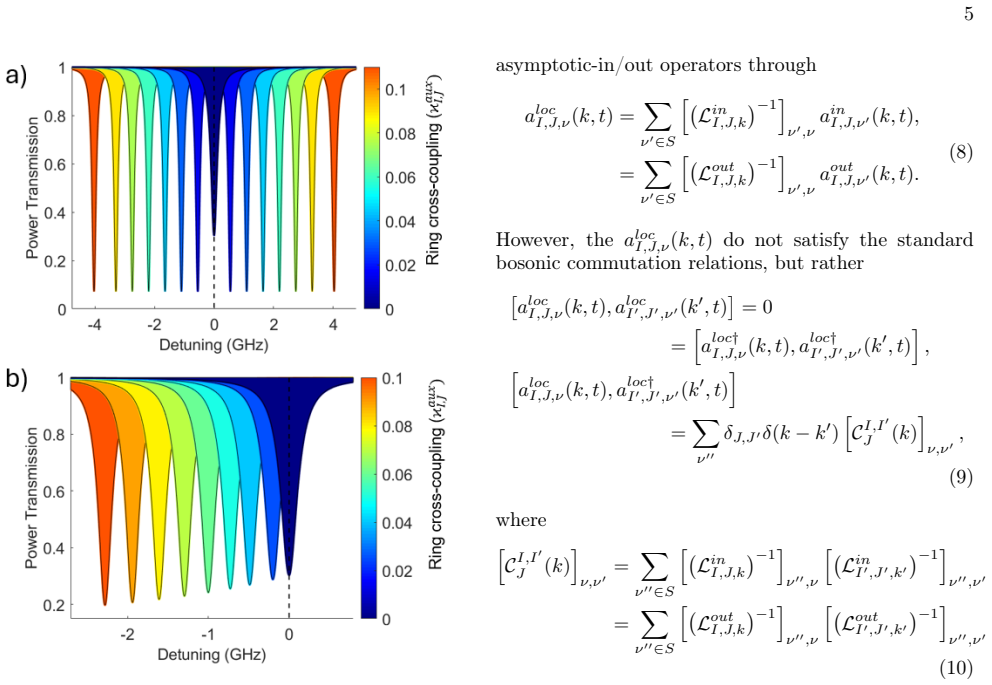
For sufficiently strong coupling between the resonators, near complete suppression of parasitic four-wave mixing processes occurs, resulting in near unit fidelities with the corresponding output state that would arise were the parasitic interactions neglected. In the other case, the hybridization effectively shifts a pump resonance, realigning the desired dual-pump four-wave mixing process and leading to a significant enhancement of the signal generation and output squeezing.
What carries the argument
Resonance hybridization arising from coupling between microring resonators, which splits or shifts specific resonances to control parasitic and desired nonlinear processes.
If this is right
- Parasitic four-wave mixing contributions can be nearly eliminated for strong coupling, removing their thermal noise from the squeezed state.
- The generated state approaches the ideal output that would exist if parasitic interactions were entirely absent.
- Pump resonance realignment compensates for group velocity dispersion and increases both signal generation rate and the degree of squeezing.
- The same hybridization mechanism works in lossy structures and can be modeled non-perturbatively for arbitrary numbers of coupled rings.
Where Pith is reading between the lines
- Arrays of more than two coupled rings could use the same splitting mechanism to protect multiple desired processes simultaneously.
- The approach may allow higher squeezing levels in integrated devices where dispersion and unwanted resonances are otherwise limiting.
- Similar hybridization strategies could be tested in other nonlinear resonator geometries to reduce unwanted mixing terms.
Load-bearing premise
The five resonance approximation is sufficient to capture the relevant dynamics in the lossy two-ring structure without significant contributions from additional resonances or higher-order processes.
What would settle it
An experiment that measures the output state fidelity or squeezing level as inter-resonator coupling is increased and finds that fidelity remains well below unity or that squeezing shows no enhancement once coupling exceeds a threshold.
Figures



read the original abstract
We develop a non-perturbative description of squeezed light generation in an arbitrary lossy structure consisting of multiple coupled microring resonators. This is applied to two ring photonic molecules where the interference of the fields in the coupled rings leads to a modification in the resonance spectrum near a shared resonance. Considering a dual-pump degenerate squeezing scheme under a five resonance approximation, we investigate two methods to suppress parasitic four-wave mixing contributions and compensate for group velocity dispersion within a primary resonator through hybridization effects with a second auxiliary resonator. In the former case, this comes from an effective splitting of the unwanted resonances supporting parasitic four-wave mixing interactions that add thermal noise to the desired degenerate squeezed state. For sufficiently strong coupling between the resonators, we demonstrate near complete suppression of such parasitic processes, resulting in near unit fidelities with the corresponding output state that would arise were the parasitic interactions neglected. In the latter case, the hybridization effectively shifts a pump resonance, realigning the desired dual-pump four-wave mixing process and leading to a significant enhancement of the signal generation and output squeezing.
Editorial analysis
A structured set of objections, weighed in public.
Referee Report
Summary. The paper develops a non-perturbative model for squeezed-light generation in arbitrary lossy multi-ring resonator structures. Applied to two-ring photonic molecules under a dual-pump degenerate four-wave-mixing scheme and a five-resonance truncation, it shows that sufficiently strong inter-resonator coupling splits unwanted resonances, suppressing parasitic FWM processes to yield near-unit fidelity with the ideal dual-pump squeezed state, while hybridization also shifts a pump resonance to compensate dispersion and enhance signal generation and output squeezing.
Significance. If the truncation remains valid in the strong-coupling regime, the work supplies a concrete design principle for mitigating parasitic noise and GVD in integrated squeezers via auxiliary-resonator hybridization. The non-perturbative treatment of lossy coupled structures and the explicit demonstration of near-unit fidelity are strengths that could inform scalable quantum-photonic sources.
major comments (2)
- [five-resonance approximation] Five-resonance approximation (abstract and model section): the central claims of near-complete parasitic suppression and near-unit fidelity are obtained exclusively under this truncation. The manuscript does not quantify the truncation error as a function of inter-resonator coupling strength; when coupling is increased to the level needed for resonance splitting, additional hybridized modes may enter the dynamics and reintroduce loss or noise channels, undermining the reported fidelity and squeezing enhancement.
- [numerical demonstrations] Validation of numerical results: the abstract states that suppression and enhancement are demonstrated, yet no comparison to full multi-mode simulations, convergence checks with respect to the number of retained resonances, or error bars on the reported fidelities appear in the provided description. Without such checks the quantitative claims remain unverified.
minor comments (2)
- [abstract] The abstract is information-dense; separating the two hybridization mechanisms (parasitic suppression versus pump realignment) into distinct sentences would improve readability.
- [notation] Notation for coupling rates, detunings, and loss coefficients should be defined once and used consistently; a short table of symbols would help.
Simulated Author's Rebuttal
We thank the referee for their careful reading and constructive feedback, which highlights both the potential of our non-perturbative approach and areas where additional validation would strengthen the manuscript. We address each major comment below.
read point-by-point responses
-
Referee: [five-resonance approximation] Five-resonance approximation (abstract and model section): the central claims of near-complete parasitic suppression and near-unit fidelity are obtained exclusively under this truncation. The manuscript does not quantify the truncation error as a function of inter-resonator coupling strength; when coupling is increased to the level needed for resonance splitting, additional hybridized modes may enter the dynamics and reintroduce loss or noise channels, undermining the reported fidelity and squeezing enhancement.
Authors: We agree that explicit quantification of the truncation error versus coupling strength is needed to support the claims of near-unit fidelity. In the revised manuscript we will add a dedicated analysis (including supplementary figures) that estimates the detuning of additional hybridized modes as a function of inter-resonator coupling and shows that their contribution to the dynamics remains negligible for the coupling values at which resonance splitting suppresses the parasitic processes. This will confirm that the five-resonance truncation remains valid in the regime of interest. revision: yes
-
Referee: [numerical demonstrations] Validation of numerical results: the abstract states that suppression and enhancement are demonstrated, yet no comparison to full multi-mode simulations, convergence checks with respect to the number of retained resonances, or error bars on the reported fidelities appear in the provided description. Without such checks the quantitative claims remain unverified.
Authors: We acknowledge the absence of these validation elements. We will incorporate convergence plots demonstrating that the reported fidelities and squeezing values stabilize when the number of retained resonances is increased beyond five, together with error bars derived from numerical tolerances. While a complete simulation retaining every possible resonance is computationally prohibitive within the non-perturbative framework, we will provide comparisons against an extended basis that includes the nearest additional hybridized modes to verify robustness. revision: partial
Circularity Check
No significant circularity; derivation is self-contained
full rationale
The paper constructs a non-perturbative model of coupled microring resonators and applies it under an explicit five-resonance truncation to derive hybridization-induced splitting and resonance shifts. The reported suppression of parasitic FWM and squeezing enhancement are direct numerical or analytic consequences of solving the coupled-mode equations with the stated coupling strength and loss parameters; no fitted quantities are relabeled as predictions, no self-citation chain supplies a uniqueness theorem or ansatz, and the five-resonance cutoff is declared as an approximation rather than derived from the target result. The central claims therefore reduce to the model dynamics rather than to any input by construction.
Axiom & Free-Parameter Ledger
axioms (1)
- domain assumption Five resonance approximation for the dual-pump degenerate squeezing scheme
Reference graph
Works this paper leans on
-
[1]
Carlton M. Caves. Quantum-mechanical noise in an interferometer.Phys. Rev. D, 23:1693–1708, Apr 1981
work page 1981
-
[2]
J. Asi, J. Abadie, and B. et al Abbott. Enhanced sen- sitivity of the LIGO gravitational wave detector by us- ing squeezed states of light.Nature Photon, 7:613–619, 2013
work page 2013
-
[3]
J. Eli Bourassa, Rafael N. Alexander, Michael Vasmer, Ashlesha Patil, Ilan Tzitrin, Takaya Matsuura, Daiqin Su, Ben Q. Baragiola, Saikat Guha, Guillaume Dauphi- nais, Krishna K. Sabapathy, Nicolas C. Menicucci, and Ish Dhand. Blueprint for a Scalable Photonic Fault- Tolerant Quantum Computer.Quantum, 5:392, Febru- ary 2021
work page 2021
-
[4]
J. M. Arrazola, V. Bergholm, K. Brádler, et al. Quan- tum circuits with many photons on a programmable nanophotonic chip.Nature, 591(7848):54–60, Mar 2021
work page 2021
-
[5]
JeremyC.Adcock, CaterinaVigliar, RaffaeleSantagati, Joshua W. Silverstone, and Mark G. Thompson. Pro- grammable four-photon graph states on a silicon chip. Nature Communications, 10(1):3528, Aug 2019
work page 2019
-
[6]
Daniel Llewellyn, Yunhong Ding, Imad I. Faruque, Ste- fano Paesani, Davide Bacco, Raffaele Santagati, Yan- Jun Qian, Yan Li, Yun-Feng Xiao, Marcus Huber, Mehul Malik, Gary F. Sinclair, Xiaoqi Zhou, Karsten Rottwitt, Jeremy L. O’Brien, John G. Rarity, Qihuang Gong, Leif K. Oxenlowe, Jianwei Wang, and Mark G. Thompson. Chip-to-chip quantum teleportation and...
work page 2020
-
[7]
Hamilton, Regina Kruse, Linda Sansoni, Sonja Barkhofen, Christine Silberhorn, and Igor Jex
Craig S. Hamilton, Regina Kruse, Linda Sansoni, Sonja Barkhofen, Christine Silberhorn, and Igor Jex. Gaus- sian boson sampling.Phys. Rev. Lett., 119:170501, Oct 2017
work page 2017
-
[8]
M. V. Larsen, J. E. Bourassa, S. Kocsis, et al. In- tegrated photonic source of gottesman–kitaev–preskill qubits.Nature, 642(8068):587–591, Jun 2025
work page 2025
-
[9]
Myers, and Krishna Kumar Saba- pathy
Daiqin Su, Casey R. Myers, and Krishna Kumar Saba- pathy. Conversion of gaussian states to non-gaussian states using photon-number-resolving detectors.Phys. Rev. A, 100:052301, Nov 2019
work page 2019
-
[10]
Sylvain Fasel, Olivier Alibart, Sébastien Tanzilli, Pas- cal Baldi, Alexios Beveratos, Nicolas Gisin, and Hugo Zbinden. High-quality asynchronous heralded single- photon source at telecom wavelength.New Journal of Physics, 6(1):163, nov 2004
work page 2004
-
[11]
High-spectral- purity photon generation from a dual-interferometer- coupled silicon microring.Opt
Yingwen Liu, Chao Wu, Xiaowen Gu, Yuechan Kong, Xinxin Yu, Renyou Ge, Xinlun Cai, Xiaogang Qiang, Junjie Wu, Xuejun Yang, and Ping Xu. High-spectral- purity photon generation from a dual-interferometer- coupled silicon microring.Opt. Lett., 45(1):73–76, Jan 2020
work page 2020
-
[12]
Wim Bogaerts, Daniel Pérez, José Capmany, David A. B. Miller, Joyce Poon, Dirk Englund, Francesco Morichetti, and Andrea Melloni. Programmable pho- tonic circuits.Nature, 586(7828):207–216, Oct 2020
work page 2020
-
[13]
M. G. Banaee and Jeff F. Young. Squeezed state gen- eration in photonic crystal microcavities.Opt. Express, 16(25):20908–20919, Dec 2008. 20
work page 2008
- [14]
-
[15]
N. Quesada, L. G. Helt, M. Menotti, M. Liscidini, and J. E. Sipe. Beyond photon pairs—nonlinear quantum photonics in the high-gain regime: a tutorial.Adv. Opt. Photon., 14(3):291–403, Sep 2022
work page 2022
-
[16]
Colin Vendromin and Marc M. Dignam. Optimiza- tion of a lossy microring resonator system for the gen- eration of quadrature-squeezed states.Phys. Rev. A, 102:023705, Aug 2020
work page 2020
-
[17]
V.D.Vaidya, B.Morrison, L.G.Helt, R.Shahrokshahi, D. H. Mahler, M. J. Collins, K. Tan, J. Lavoie, A. Re- pingon, M. Menotti, N. Quesada, R. C. Pooser, A. E. Lita, T. Gerrits, S. W. Nam, and Z. Vernon. Broadband quadrature-squeezed vacuum and nonclassical photon number correlations from a nanophotonic device.Sci- ence Advances, 6(39):eaba9186, 2020
work page 2020
-
[18]
Jang, Xingchen Ji, Michal Lipson, and Alexander L
Yun Zhao, Yoshitomo Okawachi, Jae K. Jang, Xingchen Ji, Michal Lipson, and Alexander L. Gaeta. Near- degenerate quadrature-squeezed vacuum generation on a silicon-nitride chip.Phys. Rev. Lett., 124:193601, May 2020
work page 2020
- [19]
-
[20]
H. Seifoory, Z. Vernon, D. H. Mahler, M. Menotti, Y. Zhang, and J. E. Sipe. Degenerate squeezing in a dual-pumped integrated microresonator: Parasitic pro- cesses and their suppression.Phys. Rev. A, 105:033524, Mar 2022
work page 2022
-
[21]
Fontaine, Colin Vendromin, Trevor J
Samuel E. Fontaine, Colin Vendromin, Trevor J. Steiner, Amirali Atrli, Lillian Thiel, Joshua Castro, Galan Moody, John Bowers, Marco Liscidini, and J. E. Sipe. Photon-pair generation via down-conversion in iii-v semiconductor microrings: Modal dispersion and quasi-phase-matching.Phys. Rev. A, 111:023705, Feb 2025
work page 2025
-
[22]
Photon con- version and interaction in a quasi-phase-matched mi- croresonator.Phys
Jia-YangChen, ZhanLi, ZhaohuiMa, ChaoTang, Heng Fan, Yong Meng Sua, and Yu-Ping Huang. Photon con- version and interaction in a quasi-phase-matched mi- croresonator.Phys. Rev. Appl., 16:064004, Dec 2021
work page 2021
-
[23]
Edgars Nitiss, Jianqi Hu, Anton Stroganov, and Camille-Sophie Brès. Optically reconfigurable quasi- phase-matching in silicon nitride microresonators.Na- ture Photonics, 16(2):134–141, Feb 2022
work page 2022
-
[24]
Gentry, Xiaoge Zeng, and Miloš A
Cale M. Gentry, Xiaoge Zeng, and Miloš A. Popović. Tunable coupled-mode dispersion compensation and its application to on-chip resonant four-wave mixing.Opt. Lett., 39(19):5689–5692, Oct 2014
work page 2014
-
[25]
Federico Andrea Sabattoli, Houssein El Dirani, Lau- rène Youssef, Francesco Garrisi, Davide Grassani, Luca Zatti, Camille Petit-Etienne, Erwine Pargon, J. E. Sipe, Marco Liscidini, Corrado Sciancalepore, Daniele Bajoni, and Matteo Galli. Suppression of parasitic nonlinear processes in spontaneous four-wave mixing with linearly uncoupled resonators.Phys. R...
work page 2021
-
[26]
Luca Zatti, J. E. Sipe, and Marco Liscidini. Generation of photon pairs by spontaneous four-wave mixing in lin- early uncoupled resonators.Phys. Rev. A, 107:013514, Jan 2023
work page 2023
-
[27]
Squeezing enhancement by suppression of noise through a resonant interferometric coupler.Opt
Alice Viola, Francesco Malaspina, and Marco Lisci- dini. Squeezing enhancement by suppression of noise through a resonant interferometric coupler.Opt. Lett., 49(19):5611–5614, Oct 2024
work page 2024
- [28]
-
[29]
New theory of partial coherence in the space–frequency domain
Emil Wolf. New theory of partial coherence in the space–frequency domain. part i: spectra and cross spec- traofsteady-statesources.J. Opt. Soc. Am., 72(3):343– 351, Mar 1982
work page 1982
-
[30]
Kopylov, Torsten Meier, and Polina R
Denis A. Kopylov, Torsten Meier, and Polina R. Shara- pova. Theory of Multimode Squeezed Light Generation in Lossy Media.Quantum, 9:1621, February 2025
work page 2025
-
[31]
G. Breit and H. A. Bethe. Ingoing waves in final state of scattering problems.Phys. Rev., 93:888–890, Feb 1954
work page 1954
-
[32]
M. Liscidini, L. G. Helt, and J. E. Sipe. Asymptotic fields for a hamiltonian treatment of nonlinear electro- magnetic phenomena.Phys. Rev. A, 85:013833, Jan 2012
work page 2012
-
[33]
and Wanner G.Solving Ordinary Differential Equations II: Stiff and Differential-Algebraic Problems
Hairer E. and Wanner G.Solving Ordinary Differential Equations II: Stiff and Differential-Algebraic Problems. Springer, Berlin, Heidelberg, 1996
work page 1996
-
[34]
Gh.-S. Paraoanu and Horia Scutaru. Fidelity for multi- modethermalsqueezedstates.Phys. Rev. A,61:022306, Jan 2000
work page 2000
-
[35]
John Williamson. On the algebraic problem concerning the normal forms of linear dynamical systems.Ameri- can Journal of Mathematics, 58(1):141–163, 1936
work page 1936
-
[36]
Martin Houde, Will McCutcheon, and Nicolás Que- sada. Matrix decompositions in quantum optics: Takagi/autonne, bloch–messiah/euler, iwasawa, and williamson.Canadian Journal of Physics, 102(10):497– 507, 2024
work page 2024
-
[37]
Alessio Serafini.Quantum Continuous Variables: A Primer of Theoretical Methods. CRC Press, 2 edition, 2024
work page 2024
-
[38]
AndreasChrist, KaisaLaiho, AndreasEckstein, Katiús- cia N Cassemiro, and Christine Silberhorn. Probing multimode squeezing with correlation functions.New Journal of Physics, 13(3):033027, mar 2011
work page 2011
-
[39]
Hossein Seifoory, Sean Doutre, Marc. M. Dignam, and J. E. Sipe. Squeezed thermal states: the result of para- metric down conversion in lossy cavities.J. Opt. Soc. Am. B, 34(8):1587–1596, Aug 2017
work page 2017
-
[40]
Z. Vernon and J. E. Sipe. Strongly driven nonlinear quantum optics in microring resonators.Phys. Rev. A, 92:033840, Sep 2015
work page 2015
-
[41]
Compact narrow-linewidth integrated laser based on a low-loss silicon nitride ring resonator.Opt
Brian Stern, Xingchen Ji, Avik Dutt, and Michal Lip- son. Compact narrow-linewidth integrated laser based on a low-loss silicon nitride ring resonator.Opt. Lett., 42(21):4541–4544, Nov 2017
work page 2017
-
[42]
Cambridge University Press, 2004
Christopher Gerry and Peter Knight.Introductory Quantum Optics. Cambridge University Press, 2004
work page 2004
-
[43]
D. T. H. Tan, K. Ikeda, P. C. Sun, and Y. Fainman. Group velocity dispersion and self phase modulation in silicon nitride waveguides.Applied Physics Letters, 96(6):061101, 02 2010
work page 2010
-
[44]
J. B. Pendry, D. Schurig, and D. R. Smith. Controlling 21 electromagnetic fields.Science, 312(5781):1780–1782, 2006
work page 2006
-
[45]
Nathan B. Kundtz, David R. Smith, and John B. Pendry. Electromagnetic design with transformation optics.Proceedings of the IEEE, 99(10):1622–1633, 2011
work page 2011
-
[46]
Gianluca Guerra, Seyed Mohammad Abokhamis Mousavi, Austin Taranta, Eric Numkam Fokoua, Marco Santagiustina, Andrea Galtarossa, Francesco Poletti, and Luca Palmieri. Unified coupled-mode theory for geometric and material perturbations in optical waveg- uides.Journal of Lightwave Technology, 40(14):4714– 4727, 2022
work page 2022
-
[47]
Transformation-optics modeling of 3d-printed freeform waveguides.Opt
Aleksandar Nesic, Matthias Blaicher, Emilio Orlan- dini, Tudor Olariu, Maria Paszkiewicz, Fernando Ne- gredo, Pascal Kraft, Mariia Sukhova, Andreas Hof- mann, Willy Dörfler, Carsten Rockstuhl, Wolfgang Freude, and Christian Koos. Transformation-optics modeling of 3d-printed freeform waveguides.Opt. Ex- press, 30(21):38856–38879, Oct 2022
work page 2022
-
[48]
Coupled-mode theory for opti- cal waveguides: an overview.J
Wei-Ping Huang. Coupled-mode theory for opti- cal waveguides: an overview.J. Opt. Soc. Am. A, 11(3):963–983, Mar 1994
work page 1994
-
[49]
Van.Optical Microring Resonators: Theory, Tech- niques, and applications (1st ed.)
V. Van.Optical Microring Resonators: Theory, Tech- niques, and applications (1st ed.). CRC Press, 2016
work page 2016
-
[50]
J. R. Magnus and H. Neudecker.Matrix Differential Calculus with Applications in Statistics and Economet- rics. John Wiley & Sons Ltd, West Sussex, England, 3 edition, 2007. Appendix A: Asymptotic Fields In this appendix, we motivate the decomposition of the asymptotic field amplitudes as shown in equation (2). We do this by partitioning the system into a ...
work page 2007
-
[51]
as ∂ηaV ′ τ J (η, ω, t) =−iM V ′ τ J (η;ω)a V ′ τ J (η, ω, t),(A4) wherea V ′ τ J (η, ω, t)is a vector of the operators aV ′ τ I,J (η, ω, t)for a fixedJand a given ordering of the spatial modesI, andM V ′ τ J (η;ω)contains both terms re- lated to the propagation phase and coupling between the modes. Consequently, we can write aV ′ τ I,J (η, ω, t) = X I ′ ...
discussion (0)
Sign in with ORCID, Apple, or X to comment. Anyone can read and Pith papers without signing in.