Recognition: 2 theorem links
· Lean TheoremMatching-with-Contracts for the AI-RAN Market: AIGC-as-a-Service for Teleoperation
Pith reviewed 2026-05-12 04:37 UTC · model grok-4.3
The pith
A matching-with-contracts framework lets multiple AI-RAN operators design latency-price contracts and match users dynamically, raising their total utility by at least 56.8 percent in AIGC teleoperation markets.
A machine-rendered reading of the paper's core claim, the machinery that carries it, and where it could break.
Core claim
By extending the static matching-with-contracts model to jointly characterize contract design by multiple competitive operators, user-operator matching, and dynamic market evolution, the framework allows effective incentive mechanisms where each contract item consists of an AI service latency agreement and price, derived from queueing theory without full user utility knowledge.
What carries the argument
The mixed stable matching-with-contracts algorithm that jointly updates user-side matching decisions and operator-side contract menus based on latency violation probabilities from queueing models.
If this is right
- AI-RAN operators can offer incentive mechanisms without complete knowledge of user utility functions.
- The dynamic evolution of the market state is accounted for through repeated matching updates.
- Latency agreements are enforceable using bounds from queueing theory and the Chernoff bound.
- Total utility for operators increases substantially under representative settings for teleoperation AIGC.
Where Pith is reading between the lines
- This approach could extend to other competitive edge computing markets with similar information asymmetries.
- Operators might achieve better robustness by incorporating real-time feedback into the matching process.
- Further analysis could explore the impact of more than three queues or correlated service processes.
Load-bearing premise
The AI service can be accurately modeled as three independent queues with latency violation probabilities given precisely by queueing theory and the Chernoff bound.
What would settle it
Deploy the system in a real teleoperation AIGC setup and check if the measured utility improvement falls below 56.8% or if actual latency violations significantly exceed the Chernoff bound predictions.
Figures


read the original abstract
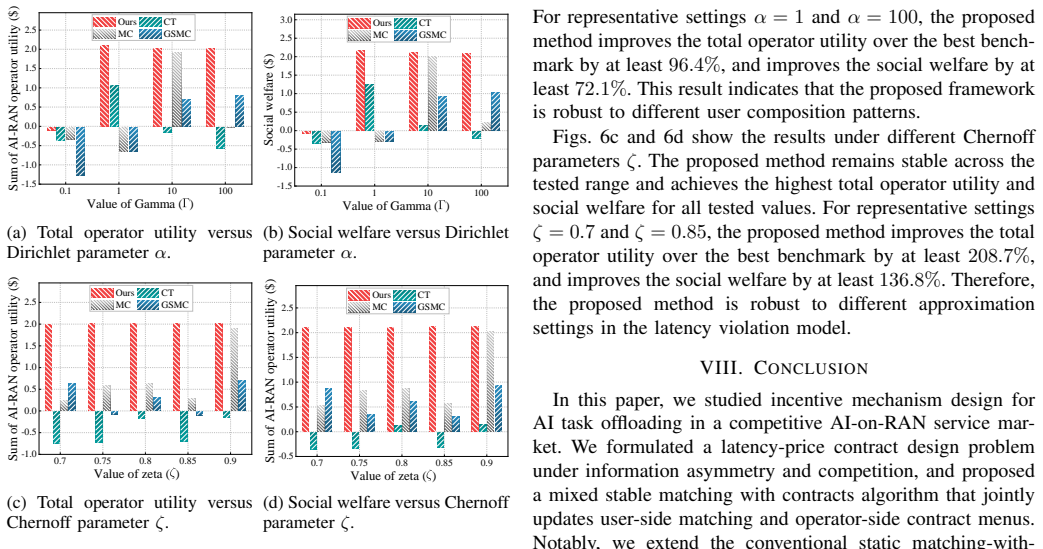
Artificial intelligence radio access networks (AI-RANs) are a promising architecture for bolstering the prosperity of the edge AI ecosystem. A well-designed incentive mechanism can further ensure the sustainable development of this ecosystem. However, incentive mechanism design faces two major challenges: 1) information asymmetry, where AI-RAN operators have only partial knowledge of AI users' utility functions, and 2) competition, as multiple AI-RAN operators coexist in real-world markets. Remarkably, chaotic and adversarial competition might compromise AI-RAN operators' utility. To this end, we develop a matching-with-contracts framework for incentive mechanism design in AI-RAN service markets. The framework extends the static matching-with-contracts model by jointly characterizing the contract design of multiple competitive operators, user-operator matching, and dynamic evolution of the market state. Specifically, the incentive mechanism offered by each AI-RAN operator takes the form of a contract menu, where each contract item consists of an AI service latency agreement and a corresponding price. We model the AI service process as three independent queues and characterize the violation probability of the latency agreement using queueing theory and the Chernoff bound. To derive an effective incentive mechanism, we further propose a mixed stable matching-with-contracts algorithm that jointly updates user-side matching decisions and operator-side contract menus. Simulation results for a teleoperation-oriented AIGC service demonstrate the effectiveness and robustness of the proposed method. Compared with benchmark schemes, our method improves the total utility of AI-RAN operators by at least 56.8\% under representative settings.
Editorial analysis
A structured set of objections, weighed in public.
Referee Report
Summary. The paper proposes a matching-with-contracts framework for incentive mechanism design in AI-RAN markets offering AIGC-as-a-Service for teleoperation. It models the service process as three independent queues, derives latency violation probabilities using queueing theory and the Chernoff bound to define contract menus (latency agreement and price pairs), and introduces a mixed stable matching-with-contracts algorithm that jointly updates user matching decisions and operator contract menus under information asymmetry and multi-operator competition. Dynamic market evolution is incorporated. Simulations for teleoperation scenarios report that the method improves total AI-RAN operator utility by at least 56.8% over benchmark schemes.
Significance. If the queueing model holds, the work provides a concrete mechanism for competitive contract design and stable matching in AI-RAN ecosystems, extending static matching-with-contracts models to handle multiple operators, partial utility information, and dynamics. The simulation evidence of substantial utility gains under representative settings offers a starting point for mechanism design in edge AI services. The joint optimization of contracts and matching is a clear technical contribution.
major comments (1)
- §III.B (AI Service Process Modeling) and §IV (Contract Design): The latency violation probability for each contract item is obtained by modeling the service as three independent queues and applying the Chernoff bound to their product-form tail probabilities. This probability directly parametrizes the feasible contract set and enters the operator utility function that the mixed stable matching algorithm optimizes. If the stages (AIGC generation, edge inference, radio transmission) share buffers, compute, or exhibit correlated arrivals—as is common in real teleoperation pipelines—the independence assumption fails, the product-form expression and Chernoff tail become invalid, and both the derived contract menus and the reported 56.8% utility gain are no longer guaranteed. A sensitivity study or explicit justification for independence under the simulated loads is required to support the main
minor comments (1)
- The simulation section should report the exact queue parameters, arrival rates, Chernoff deviation parameters, and number of Monte-Carlo runs together with confidence intervals so that the 56.8% figure can be reproduced and the robustness claim evaluated.
Simulated Author's Rebuttal
We thank the referee for the constructive comments on our modeling assumptions. We address the concern regarding the independence of the queues point by point below and commit to revisions that strengthen the manuscript.
read point-by-point responses
-
Referee: §III.B (AI Service Process Modeling) and §IV (Contract Design): The latency violation probability for each contract item is obtained by modeling the service as three independent queues and applying the Chernoff bound to their product-form tail probabilities. This probability directly parametrizes the feasible contract set and enters the operator utility function that the mixed stable matching algorithm optimizes. If the stages (AIGC generation, edge inference, radio transmission) share buffers, compute, or exhibit correlated arrivals—as is common in real teleoperation pipelines—the independence assumption fails, the product-form expression and Chernoff tail become invalid, and both the derived contract menus and the reported 56.8% utility gain are no longer guaranteed. A sensitivity study or explicit justification for independence under the simulated loads is required to support the main
Authors: We agree that the independence assumption is central to deriving the closed-form latency violation probabilities and thus to the contract menus and utility optimization. In Section III.B we explicitly state that the AI service process is modeled as three independent queues (AIGC generation, edge inference, radio transmission) with dedicated resources and Poisson arrivals per stage, enabling the product-form solution and Chernoff bound. This modeling choice is made for analytical tractability while reflecting typical edge AI deployments where stages use separate compute and communication resources. We will revise the manuscript to add an explicit justification paragraph in Section III.B, grounded in the teleoperation architecture (distinct hardware provisioning for each stage under the simulated loads). We will also incorporate a sensitivity study in Section V that introduces controlled correlation between stages and shows that the reported utility gains remain above 50% for moderate correlation levels consistent with the evaluated parameter regimes. These additions will be included in the revised version. revision: yes
Circularity Check
No significant circularity; simulation-validated proposal under explicit modeling assumptions.
full rationale
The paper's chain consists of (1) stating an incentive mechanism as contract menus with latency-price pairs, (2) adopting the modeling assumption that AI service is three independent queues whose latency violation probability is given by queueing theory plus Chernoff bound, (3) proposing a mixed stable matching-with-contracts algorithm that updates contracts and assignments, and (4) reporting simulation outcomes (56.8% utility gain) against benchmarks. None of these steps reduces by construction to its own inputs, fitted parameters, or self-citation chains; the latency model is an exogenous assumption, the algorithm is newly proposed, and the headline performance number is an empirical simulation result rather than an algebraic identity or renamed fit. The derivation therefore remains self-contained against external benchmarks.
Axiom & Free-Parameter Ledger
axioms (1)
- domain assumption AI service process modeled as three independent queues
Lean theorems connected to this paper
-
IndisputableMonolith/Cost/FunctionalEquation.leanwashburn_uniqueness_aczel unclearWe model the AI service process as three independent queues and characterize the violation probability of the latency agreement using queueing theory and the Chernoff bound.
-
IndisputableMonolith/Foundation/AbsoluteFloorClosure.leanabsolute_floor_iff_bare_distinguishability unclearWe model each stage as an independent M/M/c queue... apply the Chernoff bound to derive a convex upper-bound approximation
Reference graph
Works this paper leans on
-
[1]
Ai-ran in 6g networks: State-of-the-art and challenges,
N. A. Khan and S. Schmid, “Ai-ran in 6g networks: State-of-the-art and challenges,”IEEE Open Journal of the Communications Society, vol. 5, Dec. 2023
work page 2023
-
[2]
Intelli- gence and learning in o-ran for data-driven nextg cellular networks,
L. Bonati, S. D’Oro, M. Polese, S. Basagni, and T. Melodia, “Intelli- gence and learning in o-ran for data-driven nextg cellular networks,” IEEE Communications Magazine, vol. 59, no. 10, Oct. 2021
work page 2021
-
[3]
A. Giannopoulos, S. Spantideas, N. Kapsalis, P. Gkonis, L. Sarakis, C. Capsalis, M. Vecchio, and P. Trakadas, “Supporting intelligence in disaggregated open radio access networks: Architectural principles, ai/ml workflow, and use cases,”IEEE Access, vol. 10, Apr. 2022
work page 2022
-
[4]
AI-RAN: Transforming RAN with AI-driven computing infrastructure,
L. Kundu, X. Lin, R. Gadiyar, J.-F. Lacasse, and S. Chowdhury, “Ai- ran: Transforming ran with ai-driven computing infrastructure,”arXiv preprint arXiv:2501.09007, Jan. 2025
-
[5]
Ran resource slicing in 5g using multi-agent correlated q-learning,
H. Zhou, M. Elsayed, and M. Erol-Kantarci, “Ran resource slicing in 5g using multi-agent correlated q-learning,” inIEEE 32nd Annual International Symposium on Personal, Indoor and Mobile Radio Com- munications (PIMRC), Helsinki, Finland, Sep. 2021
work page 2021
-
[6]
Actor-critic network for o-ran resource allocation: xapp design, deployment, and analysis,
M. Kouchaki and V . Marojevic, “Actor-critic network for o-ran resource allocation: xapp design, deployment, and analysis,” inIEEE Globecom Workshops (GC Wkshps), Rio de Janeiro, Brazil, Dec. 2022, pp. 968– 973
work page 2022
-
[7]
A multi-agent deep rein- forcement learning approach for ran resource allocation in o-ran,
F. Rezazadeh, L. Zanzi, F. Devoti, S. Barrachina-Munoz, E. Zeydan, X. Costa-Perez, and J. Mangues-Bafalluy, “A multi-agent deep rein- forcement learning approach for ran resource allocation in o-ran,” in IEEE INFOCOM Workshops, Hoboken, NJ, May. 2023
work page 2023
-
[8]
C.-H. Lai, L.-H. Shen, and K.-T. Feng, “Intelligent load balancing and resource allocation in o-ran: A multi-agent multi-armed bandit approach,” inIEEE International Symposium on Personal, Indoor and Mobile Radio Communications (PIMRC), Toronto, Canada, Oct. 2023
work page 2023
-
[9]
Data-driven approach for optimising resource allocation of o-ran networks,
H. Mahmoud, M. N. I. Farooqui, D. Mi, L. Guo, C. Lu, Y . Gan, Z. Gao, Z. Wang, and Y . Zhang, “Data-driven approach for optimising resource allocation of o-ran networks,” inInternational Joint Conference on Neural Networks (IJCNN), Yokohama, Japan, Jun-Jul, 2024
work page 2024
-
[10]
Intelligible protocol learning for resource allocation in 6g o-ran slicing,
F. Rezazadeh, H. Chergui, S. Siddiqui, J. Mangues, H. Song, W. Saad, and M. Bennis, “Intelligible protocol learning for resource allocation in 6g o-ran slicing,”IEEE Wireless Communications, vol. 31, no. 5, pp. 192–199, Oct. 2024
work page 2024
-
[11]
A. Filali, B. Nour, S. Cherkaoui, and A. Kobbane, “Communication and computation o-ran resource slicing for urllc services using deep reinforcement learning,”IEEE Communications Standards Magazine, vol. 7, no. 1, pp. 66–73, Mar. 2023
work page 2023
-
[12]
S. F. Abedin, A. Mahmood, N. H. Tran, Z. Han, and M. Gidlund, “Elastic o-ran slicing for industrial monitoring and control: A distributed match- ing game and deep reinforcement learning approach,”IEEE Transactions on Vehicular Technology, vol. 71, no. 10, pp. 10 808–10 822, Oct. 2022
work page 2022
-
[13]
J. W. Hatfield and P. R. Milgrom, “Matching with contracts,”American Economic Review, vol. 95, no. 4, pp. 913–935, Sep. 2005
work page 2005
-
[14]
Z. Zhou, P. Liu, J. Feng, Y . Zhang, S. Mumtaz, and J. Rodriguez, “Computation resource allocation and task assignment optimization in vehicular fog computing: A contract-matching approach,”IEEE Trans- actions on Vehicular Technology, vol. 68, no. 4, pp. 3113–3125, Jan. 2019
work page 2019
-
[15]
C. Su, F. Ye, T. Liu, Y . Tian, and Z. Han, “Computation offloading in hierarchical multi-access edge computing based on contract theory and bayesian matching game,”IEEE Transactions on Vehicular Technology, vol. 69, no. 11, pp. 13 686–13 701, Sep. 2020
work page 2020
-
[16]
Matching with contracts-based resource trading and price negotiation in multi-access edge computing,
C. Su, F. Ye, Y . Zha, T. Liu, Y . Zhang, and Z. Han, “Matching with contracts-based resource trading and price negotiation in multi-access edge computing,”IEEE Wireless Communications Letters, vol. 10, no. 4, pp. 892–896, Jan. 2021
work page 2021
-
[17]
W. Y . B. Lim, J. Huang, Z. Xiong, J. Kang, D. Niyato, X.-S. Hua, C. Leung, and C. Miao, “Towards federated learning in uav-enabled internet of vehicles: A multi-dimensional contract-matching approach,” IEEE Transactions on Intelligent Transportation Systems, vol. 22, no. 8, pp. 5140–5154, Aug. 2021
work page 2021
-
[18]
Quality-aware incentive mechanism design based on matching game for hierarchical federated learning,
D. Hui, L. Zhuo, and X. Chen, “Quality-aware incentive mechanism design based on matching game for hierarchical federated learning,” in IEEE INFOCOM Workshops, New York, NY , May. 2022
work page 2022
-
[19]
Contract theory based incentive mechanism for clustered vehicular federated learning,
S. Wang, H. Zhao, W. Wen, W. Xia, B. Wang, and H. Zhu, “Contract theory based incentive mechanism for clustered vehicular federated learning,”IEEE Transactions on Intelligent Transportation Systems, vol. 25, no. 7, pp. 8134–8147, Jul. 2024
work page 2024
-
[20]
Y . Yao, G. Li, H. Chen, and H. Chen, “Incentive mechanism design for semi-asynchronous federated learning based on contract theory: A learning approach,”IEEE Internet of Things Journal, vol. 12, no. 15, pp. 30 901–30 920, Aug. 2025
work page 2025
-
[21]
D. Ye, S. Cai, H. Du, J. Kang, Y . Liu, R. Yu, and D. Niyato, “Optimizing aigc services by prompt engineering and edge computing: A generative diffusion model-based contract theory approach,”IEEE Transactions on Vehicular Technology, vol. 74, no. 1, pp. 571–586, Jan. 2025
work page 2025
-
[22]
X. Zhou, D. Niyato, and C. Yuen, “Age-of-information-driven task allocation for periodic updating crowdsensing: A contract theory-based approach,”IEEE Internet of Things Journal, vol. 12, no. 7, pp. 8288– 8303, Apr. 2025
work page 2025
-
[23]
A matching game for llm layer deployment in heterogeneous edge networks,
B. Picano, D. T. Hoang, and D. N. Nguyen, “A matching game for llm layer deployment in heterogeneous edge networks,”IEEE Open Journal of the Communications Society, vol. 6, pp. 3795–3805, Apr. 2025
work page 2025
-
[24]
J. Li, D. Niyato, and Z. Han,Cryptoeconomics: Economic Mechanisms behind Blockchains. Cambridge University Press, 2023
work page 2023
-
[25]
L. Lov ´asz and M. D. Plummer,Matching theory. American Mathe- matical Soc., 2009
work page 2009
-
[26]
M. J. Rostek and N. Yoder,Matching with multilateral contracts. SSRN, 2019
work page 2019
-
[27]
Agency theory meets matching theory,
I. Macho-Stadler and D. P ´erez-Castrillo, “Agency theory meets matching theory,”SERIEs, vol. 12, no. 1, pp. 1–33, May. 2020
work page 2020
-
[28]
{EdgeRIC}: Empowering real-time intelligent optimization and control in{NextG}cellular networks,
W.-H. Ko, U. Ghosh, U. Dinesha, R. Wu, S. Shakkottai, and D. Bhara- dia, “{EdgeRIC}: Empowering real-time intelligent optimization and control in{NextG}cellular networks,” in21st USENIX Symposium on Networked Systems Design and Implementation (NSDI), Santa Clara, CA, Apr. 2024, pp. 1315–1330
work page 2024
-
[29]
The interplay of AI-and- RAN: Dynamic resource allocation for converged 6G platform,
S. D. A. Shah, Z. Nezami, M. Hafeez, and S. A. R. Zaidi, “The interplay of ai-and-ran: Dynamic resource allocation for converged 6g platform,” arXiv preprint arXiv:2503.07420, Mar. 2025
-
[30]
Diffusion model-based incentive mechanism with prospect theory for edge aigc services in 6g iot,
J. Wen, J. Nie, Y . Zhong, C. Yi, X. Li, J. Jin, Y . Zhang, and D. Niyato, “Diffusion model-based incentive mechanism with prospect theory for edge aigc services in 6g iot,”IEEE Internet Things Journal, vol. 11, no. 21, pp. 34 187–34 201, Nov. 2024
work page 2024
-
[31]
Distributionally robust contract theory for edge aigc services in teleoperation,
Z. Zhan, Y . Dong, D. M. Doe, Y . Hu, S. Li, S. Cao, L. Fan, and Z. Han, “Distributionally robust contract theory for edge aigc services in teleoperation,”IEEE Transactions on Mobile Computing, vol. 24, no. 11, pp. 12 567–12 579, Nov. 2025
work page 2025
-
[32]
Cost-minimized computation offloading and user association in hybrid cloud and edge computing,
J. Bi, Z. Wang, H. Yuan, J. Zhang, and M. Zhou, “Cost-minimized computation offloading and user association in hybrid cloud and edge computing,”IEEE Internet of Things Journal, vol. 11, no. 9, pp. 16 672– 16 683, May. 2024
work page 2024
-
[33]
State occupancy estimations for shared channel concept,
3GPP, “State occupancy estimations for shared channel concept,” https://www.3gpp.org/ftp/tsg ran/wg1 rl1/TSGR1 02/Docs/pdfs/R1- 99066.pdf, 1999, (Accessed on 12/14/2025)
work page 1999
-
[34]
Z. Liao, J. Peng, B. Xiong, and J. Huang, “Adaptive offloading in mobile-edge computing for ultra-dense cellular networks based on genetic algorithm,”Journal of Cloud Computing, vol. 10, no. 1, pp. 15–31, Feb. 2021
work page 2021
-
[35]
Beyond connectivity: An open architecture for AI-RAN convergence in 6G,
M. Polese, N. Mohamadi, S. D’Oro, L. Bonati, and T. Melodia, “Beyond connectivity: An open architecture for ai-ran convergence in 6g,”arXiv preprint arXiv:2507.06911, Jul. 2025
-
[36]
L. Takacs, “On erlang’s formula,”The annals of mathematical statistics, vol. 40, no. 1, pp. 71–78, Feb. 1969
work page 1969
-
[37]
Probability of error, equivocation, and the chernoff bound,
M. Hellman and J. Raviv, “Probability of error, equivocation, and the chernoff bound,”IEEE Transactions on Information Theory, vol. 16, no. 4, pp. 368–372, Jul. 1970
work page 1970
-
[38]
Y . Liu, H. Du, D. Niyato, J. Kang, Z. Xiong, D. I. Kim, and A. Jamalipour, “Deep generative model and its applications in efficient wireless network management: A tutorial and case study,”IEEE Wireless Communications, vol. 31, no. 4, pp. 199–207, Aug. 2024
work page 2024
-
[39]
J. Kang, Z. Xiong, D. Niyato, D. Ye, D. I. Kim, and J. Zhao, “Toward secure blockchain-enabled internet of vehicles: Optimizing consensus management using reputation and contract theory,”IEEE Transactions on Vehicular Technology, vol. 68, no. 3, pp. 2906–2920, Mar. 2019
work page 2019
-
[40]
Learning to incentivize: Llm-empowered contract for aigc offloading in teleoperation,
Z. Zhan, Y . Dong, D. M. Doe, Y . Hu, S. Li, S. Cao, and Z. Han, “Learning to incentivize: Llm-empowered contract for aigc offloading in teleoperation,”arXiv preprint arXiv:2508.03464, Aug. 2025
-
[41]
J. Li, T. Liu, D. Niyato, P. Wang, J. Li, and Z. Han, “Contract-theoretic pricing for security deposits in sharded blockchain with internet of things (iot),”IEEE Internet of Things Journal, vol. 8, no. 12, pp. 10 052–10 070, Jun. 2021
work page 2021
-
[42]
A multi- dimensional contract approach for data rewarding in mobile networks,
Z. Xiong, J. Kang, D. Niyato, P. Wang, H. V . Poor, and S. Xie, “A multi- dimensional contract approach for data rewarding in mobile networks,” IEEE Transactions on Wireless Communications, vol. 19, no. 9, pp. 5779–5793, Sep. 2020
work page 2020
-
[43]
Vision language model-empowered contract theory for aigc task allocation in teleoperation,
Z. Zhan, Y . Dong, D. M. Doe, Y . Hu, S. Li, S. Cao, and Z. Han, “Vision language model-empowered contract theory for aigc task allocation in teleoperation,”IEEE Transactions on Mobile Computing, vol. 24, no. 8, pp. 7742–7756, Aug. 2025
work page 2025
-
[44]
C. T. Kelley,Iterative Methods for Linear and Nonlinear Equations. Society for Industrial and Applied Mathematics, 1995
work page 1995
-
[45]
Rate control for communication networks: Shadow prices, proportional fairness and stability,
F. P. Kelly, A. K. Maulloo, and D. K. H. Tan, “Rate control for communication networks: Shadow prices, proportional fairness and stability,”Journal of the Operational Research Society, vol. 49, no. 3, pp. 237–252, Mar. 1998
work page 1998
-
[46]
Optimization by simulated annealing,
S. Kirkpatrick, C. D. Gelatt, and M. P. Vecchi, “Optimization by simulated annealing,”Science, vol. 220, no. 4598, pp. 671–680, May. 1983
work page 1983
-
[47]
I. L. Glicksberg, “A further generalization of the kakutani fixed point theorem, with application to nash equilibrium points,”Proceedings of the American Mathematical Society, vol. 3, no. 1, pp. 170–174, Feb. 1952
work page 1952
-
[48]
5g; nr; physical channels and modulation,
ETSI, “5g; nr; physical channels and modulation,” European Telecommunications Standards Institute, Tech. Rep. ETSI TS 138 211 V16.2.0, Jul. 2020. [Online]. Available: https://www.etsi.org/deliver/ etsi ts/138200 138299/138211/16.02.00 60/ts 138211v160200p.pdf
work page 2020
-
[49]
5g; nr; base station (bs) radio transmission and reception,
——, “5g; nr; base station (bs) radio transmission and reception,” European Telecommunications Standards Institute, Tech. Rep. ETSI TS 138 104 V17.18.0, Jul. 2025. [Online]. Available: https://www.etsi.org/deliver/etsi ts/138100 138199/138104/ 17.18.00 60/ts 138104v171800p.pdf
work page 2025
discussion (0)
Sign in with ORCID, Apple, or X to comment. Anyone can read and Pith papers without signing in.