Recognition: 2 theorem links
· Lean TheoremOn the KAK Decomposition and Equivalence Classes
Pith reviewed 2026-05-12 04:37 UTC · model grok-4.3
The pith
For SU(4), local equivalence classes under SU(2) tensor SU(2) are geometrically distinct from the Weyl chamber used in the literature.
A machine-rendered reading of the paper's core claim, the machinery that carries it, and where it could break.
Core claim
We prove a general KAK decomposition theorem for connected compact semisimple Lie groups and derive the explicit decomposition for SU(4). We show that local equivalence classes under multiplication by SU(2)⊗SU(2) are not represented by the usual Weyl chamber; the Weyl chamber appears only for the projective-local equivalence that disregards global phases. We develop complete criteria for equivalence and uniqueness in both settings.
What carries the argument
The KAK decomposition, which writes a group element as a product of two elements from a fixed subgroup K sandwiching an element from a maximal abelian subgroup A, thereby parametrizing the double cosets.
If this is right
- Two-qubit gates must be classified with a geometry that differs from the Weyl chamber whenever global phases are retained.
- Circuit optimization and gate counting inherit the corrected region rather than the projective one.
- Uniqueness statements for decompositions now split cleanly into phase-sensitive and phase-insensitive cases.
- The same general theorem applies directly to other connected compact semisimple groups beyond SU(4).
Where Pith is reading between the lines
- Compilation routines that treat global phases as physical would operate on a different set of canonical representatives.
- The distinction supplies a concrete test for whether a given quantum gate library respects or ignores overall phases.
- Similar double-coset versus projective comparisons could be carried out for larger SU(2^n) to classify multi-qubit gates.
Load-bearing premise
The chosen definitions of double-coset versus projective equivalence, together with the assumption that the group is connected, compact, and semisimple, suffice to produce the geometric distinction for SU(4).
What would settle it
Take the matrix for the controlled-NOT gate, compute its double-coset representative under SU(2)⊗SU(2), and check whether its parameters lie inside the coordinate bounds conventionally assigned to the Weyl chamber.
Figures




read the original abstract
The KAK decomposition is a fundamental tool in Lie theory and quantum computing. Despite its widespread use, the mathematical foundations remain incomplete, particularly regarding the precise conditions for the decomposition and the characterization of equivalence classes under multiplication by elements of $K$. Here, we present a mathematical theory of the KAK decomposition for connected compact semisimple Lie groups and derive the decomposition for $\mathrm{SU}(4)$. In particular, we clarify the relationship between various definitions of a Cartan decomposition in the literature and give a complete proof of a general KAK decomposition theorem. We then distinguish two distinct notions of KAK equivalence classes, double coset equivalence and projective equivalence, thereby addressing mathematical inconsistencies regarding KAK classification in the literature. Specifically, for $\mathrm{SU}(4)$, we show that local equivalence classes under multiplication by $\mathrm{SU}(2)\otimes \mathrm{SU}(2)$ are geometrically represented not by the usual "Weyl chamber" as claimed in the existing literature. Instead, the "Weyl chamber" is only recovered by the projective-local equivalence which disregards global phases. We develop a systematic theory for determining equivalence and uniqueness for both notions of equivalence. Our work establishes a rigorous Lie-theoretic foundation for the theory of quantum gates and circuits.
Editorial analysis
A structured set of objections, weighed in public.
Referee Report
Summary. The manuscript develops a Lie-theoretic framework for the KAK decomposition applicable to connected compact semisimple Lie groups. It supplies a general decomposition theorem with a complete proof, specializes the result to SU(4), and distinguishes double-coset equivalence from projective equivalence under local unitaries. For SU(4) it argues that local equivalence classes under SU(2)⊗SU(2) are not geometrically represented by the standard Weyl chamber; the Weyl chamber appears only under the projective-local equivalence that ignores global phases. The work supplies a systematic theory for equivalence and uniqueness under both notions and positions the results as a rigorous foundation for quantum gates and circuits.
Significance. If the proofs hold, the paper supplies a needed clarification of the precise conditions for the KAK decomposition and resolves inconsistencies in the literature on equivalence classes of two-qubit gates. The explicit distinction between double-coset and projective equivalence, together with the geometric correction for SU(4), would strengthen the mathematical basis for quantum circuit theory and gate classification.
minor comments (3)
- The abstract states that the work 'clarifies the relationship between various definitions of a Cartan decomposition in the literature,' yet the introduction does not list the specific prior definitions being reconciled; a short comparative table or explicit citations would improve readability.
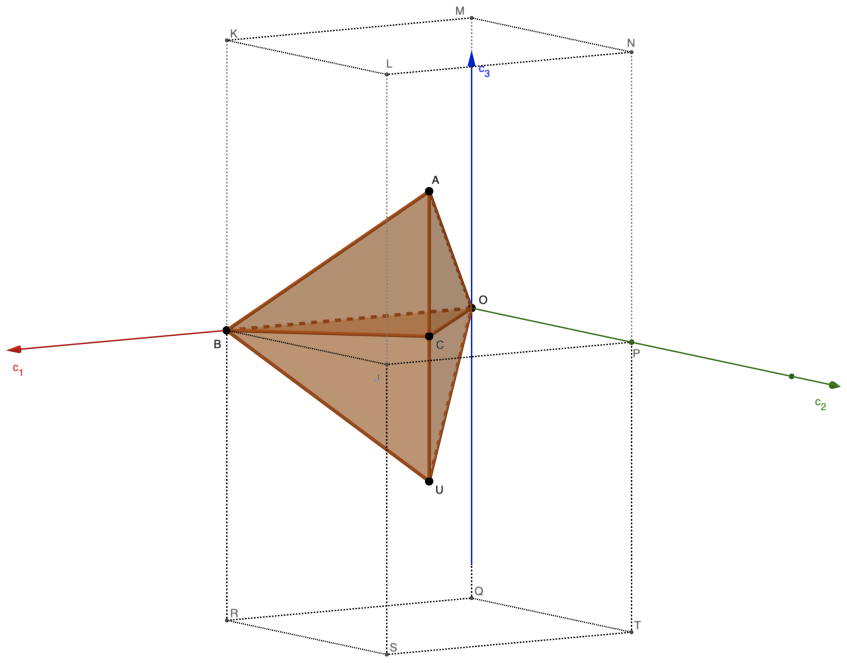
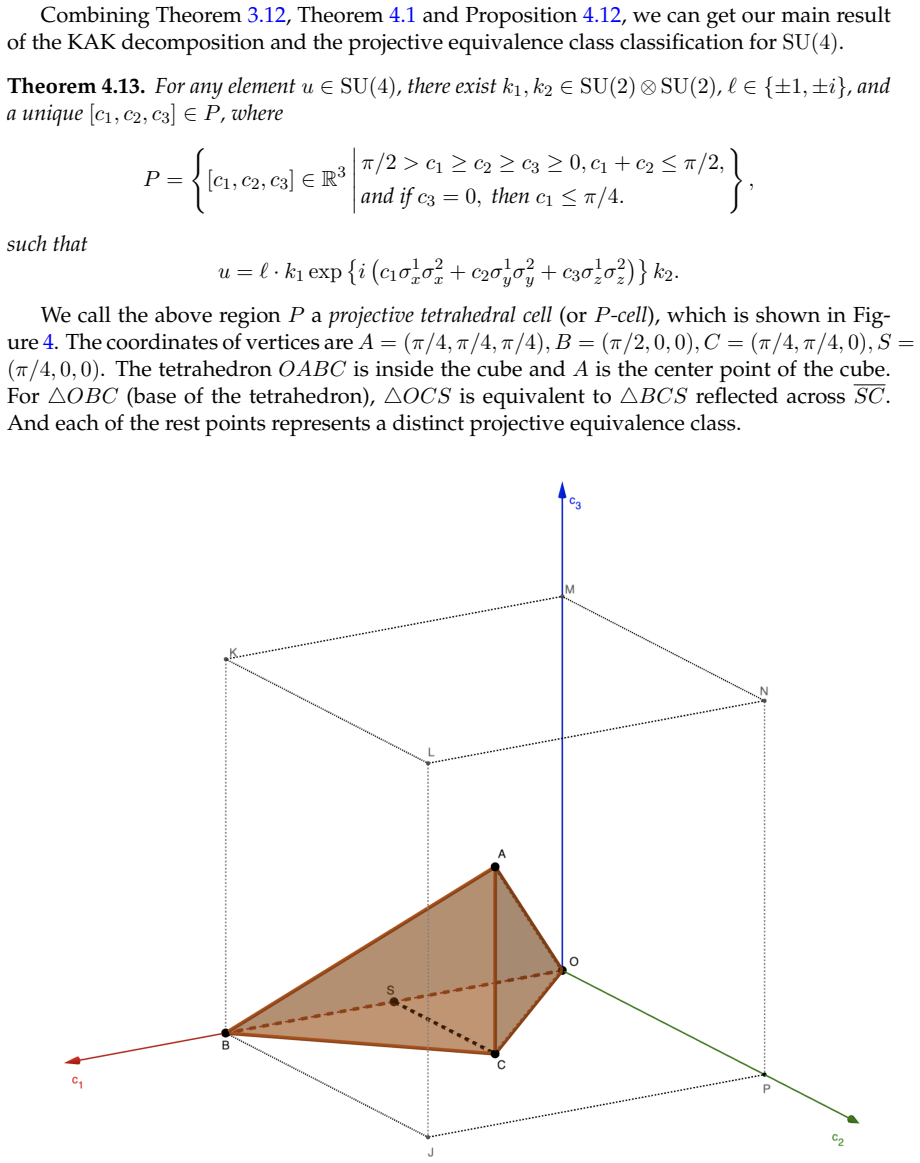
- The geometric claim for SU(4) equivalence classes would be easier to follow if the manuscript included a figure contrasting the double-coset region with the projective Weyl chamber.
- Notation for the two equivalence relations (double-coset versus projective) is introduced in the text but not summarized in a single definition box; adding such a box would aid readers who consult only the SU(4) section.
Simulated Author's Rebuttal
We thank the referee for the positive and constructive assessment of our manuscript. The recommendation for minor revision is appreciated, and we will prepare a revised version incorporating any necessary clarifications.
Circularity Check
No significant circularity; derivation rests on standard Lie-group axioms and explicit proofs
full rationale
The paper presents a self-contained mathematical proof of the KAK decomposition theorem for connected compact semisimple Lie groups, including a complete derivation for SU(4) and a distinction between double-coset and projective equivalence classes. All load-bearing steps invoke standard definitions of Cartan decompositions, connectedness, compactness, and semisimplicity rather than any fitted parameters, self-referential definitions, or unverified self-citations. The geometric claims for SU(4) follow directly from the chosen equivalence notions and the standing group-theoretic assumptions, with no reduction of outputs to inputs by construction. External literature is referenced only for context and inconsistencies, not as load-bearing justification for the core theorems.
Axiom & Free-Parameter Ledger
axioms (1)
- standard math Connected compact semisimple Lie groups admit a Cartan decomposition with the stated properties
Lean theorems connected to this paper
-
IndisputableMonolith/Foundation/AlexanderDuality.leanalexander_duality_circle_linking unclear?
unclearRelation between the paper passage and the cited Recognition theorem.
We then distinguish two distinct notions of KAK equivalence classes—double coset equivalence and projective equivalence... for SU(4), we show that local equivalence classes under multiplication by SU(2)⊗SU(2) are geometrically represented not by the usual 'Weyl chamber'
What do these tags mean?
- matches
- The paper's claim is directly supported by a theorem in the formal canon.
- supports
- The theorem supports part of the paper's argument, but the paper may add assumptions or extra steps.
- extends
- The paper goes beyond the formal theorem; the theorem is a base layer rather than the whole result.
- uses
- The paper appears to rely on the theorem as machinery.
- contradicts
- The paper's claim conflicts with a theorem or certificate in the canon.
- unclear
- Pith found a possible connection, but the passage is too broad, indirect, or ambiguous to say the theorem truly supports the claim.
Reference graph
Works this paper leans on
-
[1]
Helgason, Sigurdur , year =. Differential. doi:10.1090/gsm/034 , url =
- [2]
-
[3]
Canonical Decompositions of N-Qubit Quantum Computations and Concurrence , author =. 2004 , month = jun, journal =. doi:10.1063/1.1723701 , url =
-
[4]
Sur Une Classe Remarquable d'espaces de Riemann , author =. 1926 , journal =. doi:10.24033/bsmf.1105 , url =
- [5]
-
[6]
Birgitta and Sastry, Shankar , title =
Zhang, Jun and Vala, Jiri and Whaley, K. Birgitta and Sastry, Shankar , title =. Physical Review A , volume =. 2003 , doi =. quant-ph/0209120 , archivePrefix =
-
[7]
Fixed-depth two-qubit circuits and the monodromy polytope , author=. Quantum , volume=. 2020 , publisher=
work page 2020
-
[8]
Wierichs, David , title =
-
[9]
IBM Qiskit SDK , title =
-
[10]
Google Cirq SDK , title =
-
[11]
Groups and Geometric Analysis , author =. doi:10.1090/surv/083 , url =
-
[12]
Journal of Physics A: Mathematical and Theoretical , volume =
A General Framework for Recursive Decompositions of Unitary Quantum Evolutions , author =. Journal of Physics A: Mathematical and Theoretical , volume =. 2008 , publisher =. doi:10.1088/1751-8113/41/15/155302 , url =
-
[13]
Journal of Physics A: Mathematical and Theoretical , volume =
D'Alessandro, Domenico and Albertini, Francesca , title =. Journal of Physics A: Mathematical and Theoretical , volume =. 2007 , doi =. quant-ph/0504044 , archivePrefix =
-
[14]
Science in China, Series G: Physics Mechanics and Astronomy , shortjournal =
Cartan Decomposition of a Two-Qutrit Gate , author =. Science in China, Series G: Physics Mechanics and Astronomy , shortjournal =. doi:10.1007/s11433-008-0157-8 , url =
- [15]
-
[16]
A Constructive Algorithm for the Cartan Decomposition of
S. A Constructive Algorithm for the Cartan Decomposition of. Journal of Mathematical Physics , volume =. 2005 , doi =. quant-ph/0505128 , archivePrefix =
- [17]
-
[18]
Wierichs, David and West, Maxwell and Forestano, Roy T. and Cerezo, M. and Killoran, Nathan , title =. arXiv preprint arXiv:2503.19014 , year =. 2503.19014 , archivePrefix =
-
[19]
Watts, Paul and O'Connor, Maurice and Vala, Jiri , title =. Entropy , volume =. 2013 , doi =. 1306.2811 , archivePrefix =
-
[20]
arXiv preprint arXiv:2411.04898 , year =
Kong, Linghang and Li, Zimu and Liu, Zi-Wen , title =. arXiv preprint arXiv:2411.04898 , year =. 2411.04898 , archivePrefix =
discussion (0)
Sign in with ORCID, Apple, or X to comment. Anyone can read and Pith papers without signing in.