Recognition: 2 theorem links
· Lean TheoremEmergence of synthetic twist defects in the surface code under local perturbation
Pith reviewed 2026-05-12 04:19 UTC · model grok-4.3
The pith
Local perturbations on the surface code create synthetic twist defects that emerge at a quantum phase transition.
A machine-rendered reading of the paper's core claim, the machinery that carries it, and where it could break.
Core claim
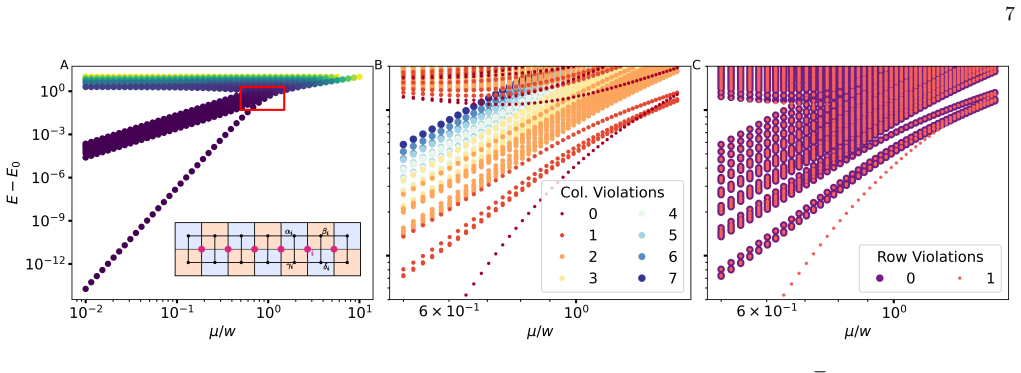
Synthetic twist defects emerge in the surface code under local perturbation, with their appearance driven by a quantum phase transition. Alternative representations in spin and Majorana languages simplify the problem by revealing emergent virtual symmetries and a direct connection to the Majorana chain. These simplifications enable numerical calculations that indicate the location of the phase transition in finite-size systems.
What carries the argument
The local perturbation on the surface code, reformulated in spin and Majorana languages, where virtual symmetries constrain the spectrum and a mapping to the Majorana chain allows numerical location of the driving quantum phase transition.
If this is right
- The spin-language virtual symmetries reduce the effective Hilbert space and simplify exact diagonalization for moderate sizes.
- The Majorana-chain mapping supplies an analytic reference for the expected spectral signatures of the defects.
- Locating the phase transition gives the parameter window in which the synthetic defects are expected to form.
- The construction applies to finite systems, directly relevant for near-term hardware implementations.
Where Pith is reading between the lines
- Tuning the perturbation strength across the transition could allow defects to be turned on and off on demand in a physical device.
- The same simplifications might extend to studying braiding operations or error rates once the defects are present.
- Mapping the problem to a one-dimensional chain suggests possible generalizations to other lattices or higher-dimensional codes.
Load-bearing premise
The chosen local perturbation protocol actually produces defects with the expected non-Abelian statistics, and the finite-size energy spectra reflect the bulk phase transition without being dominated by boundary artifacts.
What would settle it
Numerical computation of the low-energy spectrum for increasing system size under varying perturbation strength, checking whether degeneracy patterns or gap closings appear at the predicted transition point and sharpen in the thermodynamic limit.
Figures



read the original abstract
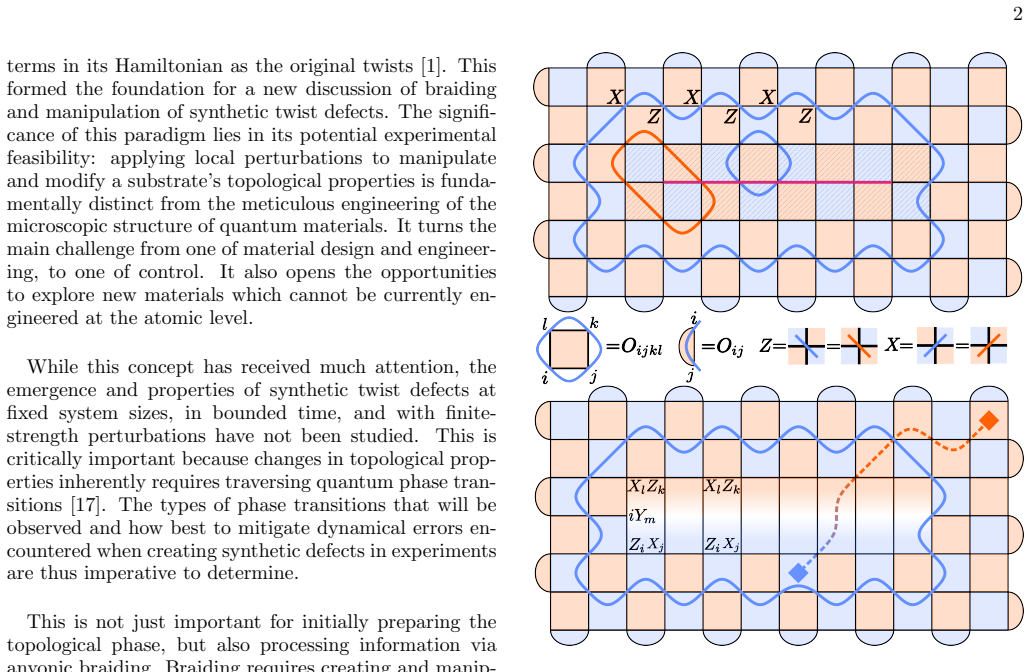
Topologically-ordered quantum states with Abelian excitations can host defects that obey effective non-Abelian statistics, in principle allowing for quantum information processing via defect braiding. These extrinsic defects (or twists) are typically studied as static features of the lattice. However, an alternative proposal considers how an underlying topologically ordered quantum substrate can be locally perturbed to create and manipulate synthetic defects \cite{you_synthetic_2013}. Unfortunately, while largely referenced, elements of this proposal were never systematically studied. Understanding the energy spectrum is particularly important in finite size and finitely perturbed systems, which are crucial for experimental realizations. In this work we announce a significant step in this direction by explicitly constructing, simplifying, and numerically studying the spectral properties of synthetic defects in a model system. First, we introduce two alternative representations of this problem in both spin and Majorana languages. In the former we describe emergent virtual symmetries which constrain and simplify the problem and in the latter we show a direct connection to Kitaev's well-known Majorana chain. We utilize these simplifications to perform numerical calculations to indicate the location of the quantum phase transition driving the emergence of the synthetic defects. We conclude by discussing key steps for future work to more clearly and completely study this phenomena.
Editorial analysis
A structured set of objections, weighed in public.
Referee Report
Summary. The paper claims to explicitly construct synthetic twist defects in the surface code via local perturbations on a topologically ordered substrate, introduce simplifying spin and Majorana representations (including emergent virtual symmetries and a direct mapping to the Kitaev Majorana chain), and use numerical spectral calculations on these representations to indicate the location of the quantum phase transition that drives the emergence of these defects.
Significance. If the numerical indication of the transition is placed on firmer footing, the work would constitute a useful step toward realizing and controlling synthetic non-Abelian defects in lattice models, bridging the 2013 proposal with concrete spectral diagnostics that could guide experimental implementations. The dual spin/Majorana simplifications are a clear technical contribution that may facilitate future analytic or numerical progress.
major comments (2)
- [Numerical calculations] Numerical calculations section: the manuscript indicates the location of the quantum phase transition solely from finite-size spectra but provides no system sizes, Hamiltonian parameters, convergence checks, error bars, or finite-size scaling analysis. Because the central claim is that these calculations locate the thermodynamic transition driving defect emergence, the absence of extrapolation or order-parameter diagnostics leaves the reported transition point provisional and vulnerable to boundary or finite-size artifacts.
- [Construction of synthetic defects] § on the local perturbation protocol (referencing the 2013 construction): the spectral properties are studied under the assumption that the perturbation produces defects with the claimed non-Abelian statistics, yet no additional verification (e.g., braiding or topological degeneracy diagnostics) is performed within the simplified models. This assumption is load-bearing for interpreting the phase transition as the emergence of synthetic twists.
minor comments (2)
- [Abstract] The abstract would be strengthened by briefly stating the concrete model Hamiltonian, perturbation range, and lattice sizes employed in the numerics.
- [Spin representation] Notation for the emergent virtual symmetries in the spin representation could be illustrated with a small explicit example to improve readability.
Simulated Author's Rebuttal
We thank the referee for their careful reading of our manuscript and for the constructive comments, which help clarify the presentation of our results on synthetic twist defects. We address each major comment below and will revise the manuscript to incorporate improvements where feasible.
read point-by-point responses
-
Referee: [Numerical calculations] Numerical calculations section: the manuscript indicates the location of the quantum phase transition solely from finite-size spectra but provides no system sizes, Hamiltonian parameters, convergence checks, error bars, or finite-size scaling analysis. Because the central claim is that these calculations locate the thermodynamic transition driving defect emergence, the absence of extrapolation or order-parameter diagnostics leaves the reported transition point provisional and vulnerable to boundary or finite-size artifacts.
Authors: We appreciate this observation and agree that additional documentation is warranted to strengthen the numerical evidence. In the revised manuscript, we will expand the numerical calculations section to explicitly report the system sizes employed in the spin and Majorana representations (including chains up to length 24 in the Majorana model), the precise values of the local perturbation strength and other Hamiltonian parameters, convergence criteria for the exact diagonalization routines, and numerical precision estimates. We will also include a finite-size scaling analysis of the spectral gap to extrapolate the transition point toward the thermodynamic limit and discuss potential boundary effects, thereby placing the reported transition on firmer footing. revision: yes
-
Referee: [Construction of synthetic defects] § on the local perturbation protocol (referencing the 2013 construction): the spectral properties are studied under the assumption that the perturbation produces defects with the claimed non-Abelian statistics, yet no additional verification (e.g., braiding or topological degeneracy diagnostics) is performed within the simplified models. This assumption is load-bearing for interpreting the phase transition as the emergence of synthetic twists.
Authors: We acknowledge that our analysis assumes the non-Abelian character of the synthetic twists as established in the 2013 proposal, without performing explicit braiding or degeneracy diagnostics in the simplified models. Our focus is on the spectral signatures of the driving phase transition in the spin and Majorana representations, which directly connect to the emergence of the defects. In the revision we will add a dedicated paragraph clarifying this reliance on the prior construction, noting that the observed gap closing is consistent with defect formation, and identifying explicit braiding simulations as an important direction for future work. This addresses the interpretive assumption without altering the core results. revision: partial
Circularity Check
No significant circularity; derivation and numerics are self-contained
full rationale
The paper constructs explicit spin and Majorana representations of the locally perturbed surface-code Hamiltonian, identifies emergent virtual symmetries, and maps to the Kitaev chain as independent simplifications. Numerical spectra are computed directly on these representations to locate the QPT. The 2013 proposal is treated as external input rather than a self-citation chain, and no fitted parameters are renamed as predictions. All load-bearing steps (model construction, symmetry identification, and finite-size diagonalization) remain independent of the target claim and do not reduce to the inputs by definition.
Axiom & Free-Parameter Ledger
Lean theorems connected to this paper
-
IndisputableMonolith/Foundation/AlexanderDuality.leanalexander_duality_circle_linking unclearWe utilize these simplifications to perform numerical calculations to indicate the location of the quantum phase transition driving the emergence of the synthetic defects.
-
IndisputableMonolith/Cost/FunctionalEquation.leanwashburn_uniqueness_aczel unclearthe effective block Hamiltonian describes ... Kitaev chain in a Majorana Fermion representation
Reference graph
Works this paper leans on
-
[1]
Yi-Zhuang You, Chao-Ming Jian, and Xiao-Gang Wen. Synthetic non-Abelian statistics by Abelian anyon con- densation.Physical Review B, 87(4):045106, January
-
[2]
Publisher: American Physical Society
-
[3]
Barbara M. Terhal. Quantum error correction for quan- tum memories.Reviews of Modern Physics, 87(2):307– 346, April 2015
work page 2015
-
[4]
Jos´ e Lebreuilly, Kyungjoo Noh, Chiao-Hsuan Wang, Steven M. Girvin, and Liang Jiang. Autonomous quantum error correction and quantum computation. arXiv:2103.05007 [quant-ph], March 2021. arXiv: 2103.05007
-
[5]
Stanescu.Introduction to Topological Quantum Matter & Quantum Computation
Tudor D. Stanescu.Introduction to Topological Quantum Matter & Quantum Computation. CRC Press, December
-
[6]
Google-Books-ID: LZa DQAAQBAJ
-
[7]
Simon, Ady Stern, Michael Freedman, and Sankar Das Sarma
Chetan Nayak, Steven H. Simon, Ady Stern, Michael Freedman, and Sankar Das Sarma. Non-Abelian anyons and topological quantum computation.Reviews of Mod- ern Physics, 80(3):1083–1159, September 2008
work page 2008
-
[8]
Xiao-Gang Wen. Choreographed entanglement dances: Topological states of quantum matter.Science, 363(6429):eaal3099, February 2019
work page 2019
-
[9]
Quantum spin liquid states.Reviews of Modern Physics, 89(2), April 2017
Yi Zhou, Kazushi Kanoda, and Tai-Kai Ng. Quantum spin liquid states.Reviews of Modern Physics, 89(2), April 2017
work page 2017
-
[10]
Quantum spin liquids: a review.Reports on Progress in Physics, 80(1):016502, January 2017
Lucile Savary and Leon Balents. Quantum spin liquids: a review.Reports on Progress in Physics, 80(1):016502, January 2017
work page 2017
-
[11]
H. Bombin. Topological Order with a Twist: Ising Anyons from an Abelian Model.Physical Review Letters, 105(3):030403, July 2010. Publisher: American Physical Society
work page 2010
-
[12]
Benjamin J. Brown, Stephen D. Bartlett, Andrew C. Doherty, and Sean D. Barrett. Topological Entangle- ment Entropy with a Twist.Physical Review Letters, 111(22):220402, November 2013. Publisher: American Physical Society
work page 2013
-
[13]
Bowen Yan, Penghua Chen, and Shawn X. Cui. General- ized Kitaev spin liquid model and emergent twist defect. Annals of Physics, 466:169682, July 2024
work page 2024
-
[14]
Kesselring, Fernando Pastawski, Jens Eisert, and Benjamin J
Markus S. Kesselring, Fernando Pastawski, Jens Eisert, and Benjamin J. Brown. The boundaries and twist de- fects of the color code and their applications to topo- logical quantum computation.Quantum, 2:101, October
- [15]
-
[16]
Non-Abelian defects in fracton phases of matter.Physical Review B, 100(7):075148, August 2019
Yizhi You. Non-Abelian defects in fracton phases of matter.Physical Review B, 100(7):075148, August 2019. Publisher: American Physical Society
work page 2019
-
[17]
Maissam Barkeshli, Parsa Bonderson, Meng Cheng, and Zhenghan Wang. Symmetry fractionalization, defects, and gauging of topological phases.Physical Review B, 100(11):115147, September 2019
work page 2019
-
[18]
Topological phase transi- tion on the edge of two-dimensionalZ 2 topological order
Wei-Qiang Chen, Chao-Ming Jian, Liang Kong, Yi- Zhuang You, and Hao Zheng. Topological phase transi- tion on the edge of two-dimensionalZ 2 topological order. Physical Review B, 102(4):045139, July 2020. Publisher: American Physical Society
work page 2020
-
[19]
Yi-Zhuang You and Xiao-Gang Wen. Projective non- Abelian statistics of dislocation defects in aZ N rotor model.Physical Review B, 86(16):161107, October 2012. Publisher: American Physical Society
work page 2012
-
[20]
Xie Chen, Zheng-Cheng Gu, and Xiao-Gang Wen. Lo- cal unitary transformation, long-range quantum entan- glement, wave function renormalization, and topological order.Physical Review B, 82(15):155138, October 2010
work page 2010
-
[21]
Anyons in an exactly solved model and beyond.Annals of Physics, 321(1):2–111, January 2006
Alexei Kitaev. Anyons in an exactly solved model and beyond.Annals of Physics, 321(1):2–111, January 2006
work page 2006
-
[22]
Pablo Bonilla Ataides, David K
J. Pablo Bonilla Ataides, David K. Tuckett, Stephen D. Bartlett, Steven T. Flammia, and Benjamin J. Brown. The XZZX surface code.Nature Communications, 12(1):2172, April 2021
work page 2021
-
[23]
Jacob C Bridgeman and Christopher T Chubb. Hand- waving and interpretive dance: an introductory course on tensor networks.Journal of Physics A: Mathematical and Theoretical, 50(22):223001, June 2017
work page 2017
-
[24]
Tensor networks for complex quantum sys- tems.Nature Reviews Physics, 1(9):538–550, September
Rom´ an Or´ us. Tensor networks for complex quantum sys- tems.Nature Reviews Physics, 1(9):538–550, September
-
[25]
Number: 9 Publisher: Nature Publishing Group
-
[26]
Jianlong Fu, Johannes Knolle, and Natalia B. Perkins. Three types of representation of spin in terms of Majo- rana fermions and an alternative solution of the Kitaev honeycomb model.Physical Review B, 97(11):115142, March 2018. Publisher: American Physical Society
work page 2018
-
[27]
Unpaired majorana fermions in quantum wires.Physics-uspekhi, 44(10S):131, 2001
A Yu Kitaev. Unpaired majorana fermions in quantum wires.Physics-uspekhi, 44(10S):131, 2001
work page 2001
-
[28]
Norbert Schuch and Bela Bauer. Matrix product state algorithms for Gaussian fermionic states.Physical Review B, 100(24):245121, December 2019
work page 2019
-
[29]
Ruben Verresen, Roderich Moessner, and Frank Poll- mann. One-dimensional symmetry protected topolog- ical phases and their transitions.Physical Review B, 96(16):165124, October 2017
work page 2017
-
[30]
Efficiently preparing GHZ, topologi- cal and fracton states by measuring cold atoms
Ruben Verresen, Nathanan Tantivasadakarn, and Ashvin Vishwanath. Efficiently preparing GHZ, topologi- cal and fracton states by measuring cold atoms. arXiv:2112.03061 [cond-mat, physics:quant-ph], Decem- ber 2021. arXiv: 2112.03061
-
[31]
Wen-Long You, Ying-Wai Li, and Shi-Jian Gu. Fidelity, dynamic structure factor, and susceptibility in critical phenomena.Physical Review E, 76(2):022101, August 2007
work page 2007
-
[32]
Shi-Jian Gu. Fidelity approach to quantum phase transitions.International Journal of Modern Physics B, 24(23):4371–4458, September 2010. arXiv:0811.3127 [quant-ph]
-
[33]
Fidelity in topological quantum phases of matter.Physical Review A, 79(3):032302, March 2009
Silvano Garnerone, Damian Abasto, Stephan Haas, and Paolo Zanardi. Fidelity in topological quantum phases of matter.Physical Review A, 79(3):032302, March 2009
work page 2009
-
[34]
Unveiling quantum phase transitions by fidelity mapping
Ho-Kin Tang, Mohamad Ali Marashli, and Wing Chi Yu. Unveiling quantum phase transitions by fidelity mapping. Physical Review B, 104(7):075142, August 2021
work page 2021
-
[35]
Paolo Zanardi, Paolo Giorda, and Marco Cozzini. Information-Theoretic Differential Geometry of Quan- tum Phase Transitions.Physical Review Letters, 99(10), September 2007
work page 2007
discussion (0)
Sign in with ORCID, Apple, or X to comment. Anyone can read and Pith papers without signing in.