Recognition: no theorem link
Improving search efficiency via adaptive acquisition function selection in discrete black-box optimization
Pith reviewed 2026-05-12 04:00 UTC · model grok-4.3
The pith
A hybrid method for discrete black-box optimization switches from BOCS to an adaptive Gaussian process on stagnation to find better solutions than random addition.
A machine-rendered reading of the paper's core claim, the machinery that carries it, and where it could break.
Core claim
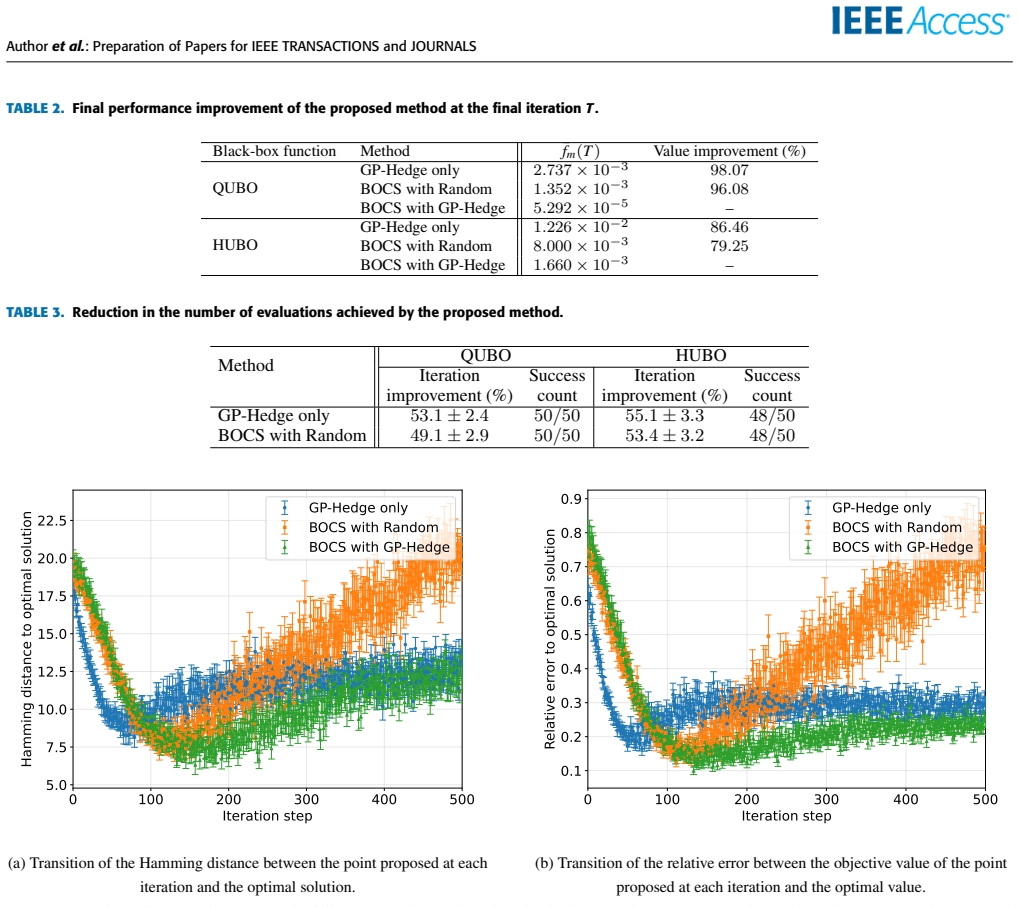
The paper claims that its hybrid method, employing BOCS as the primary search and activating a Gaussian process with adaptively selected LCB acquisition functions upon detecting stagnation, generates alternative unevaluated points that lead to solutions with superior objective values compared to the random-point addition strategy in fully connected QUBO and HUBO black-box optimizations. Additional analyses indicate that the advantage arises from promoting progress within Hamming-distance neighborhoods and that retaining near-fully connected surrogate capacity is important for quantum annealer applications.
What carries the argument
Stagnation detection that triggers a switch from the BOCS parametric model to a Gaussian process surrogate with adaptively chosen Lower Confidence Bound acquisition functions for proposing new points.
If this is right
- The hybrid finds solutions with better objective values than random-point addition on fully connected QUBO and HUBO black-box functions.
- Its advantage comes from selecting points that promote search progress inside Hamming-distance neighborhoods rather than simply adding low-energy points near known good solutions.
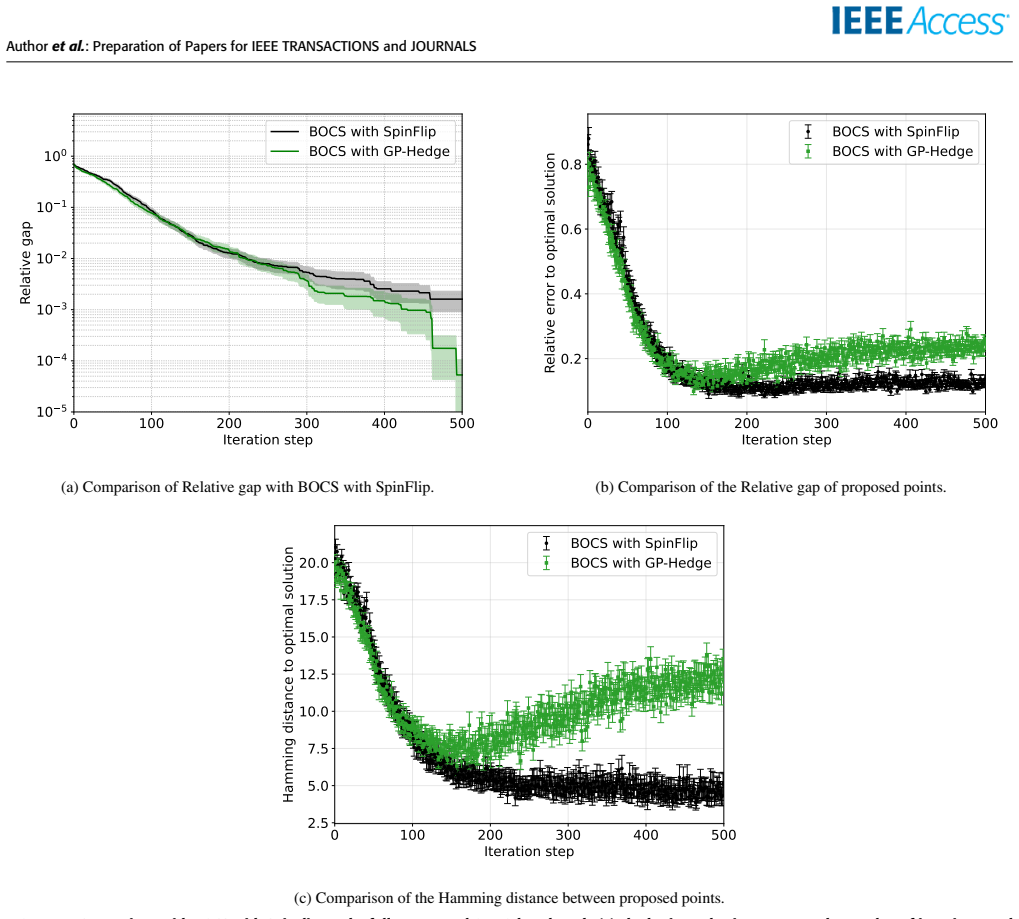
- Sparse surrogate models retain value for quantum annealer applications only when they preserve near-fully connected representational capacity.
- Adaptive selection among multiple LCB functions dynamically adjusts the exploitation-exploration balance during the fallback phase.
Where Pith is reading between the lines
- The stagnation-triggered switch could be tested in other surrogate-based discrete optimizers that suffer from repetition once data accumulates.
- Direct runs on quantum annealing hardware would check whether the observed benefit of full connectivity holds in physical settings.
- Similar detection-plus-adaptive-fallback logic might reduce stagnation in continuous Bayesian optimization without requiring changes to the core model.
Load-bearing premise
Detecting search stagnation and switching to the Gaussian process with adaptive LCB selection will reliably produce useful unevaluated points that advance the search without introducing new stagnation or bias.
What would settle it
Apply both the hybrid method and the random-point addition baseline to identical fully connected QUBO instances for a fixed evaluation budget and compare final objective values; consistent failure of the hybrid to achieve lower values would falsify the performance claim.
Figures


read the original abstract
In discrete-variable black-box optimization, the number of candidate solutions grows combinatorially, while each evaluation is often expensive. Therefore, it is important to identify promising solutions efficiently within a limited number of trials. Bayesian Optimization of Combinatorial Structures (BOCS), an existing parametric method, works effectively when only a small amount of data is available. However, as the number of observations increases, BOCS tends to repeatedly propose points that have already been evaluated, which leads to search stagnation. A random-point addition strategy has been proposed to address this issue when an evaluated point is proposed, but it cannot sufficiently exploit information from promising data obtained so far. In this study, we propose a hybrid method that uses BOCS as the main search framework and generates alternative unevaluated points using a Gaussian process only when search stagnation is detected. In the Gaussian-process-based component, multiple Lower Confidence Bound (LCB) acquisition functions are adaptively selected to dynamically control the balance between exploitation and exploration. Numerical experiments using fully connected Quadratic Unconstrained Binary Optimization (QUBO) and Higher-order Unconstrained Binary Optimization (HUBO) as black-box functions show that the proposed method finds solutions with better objective values than the conventional random-point addition method in both settings. Additional analyses show that its effectiveness comes from selecting points that promote search progress within Hamming-distance neighborhoods, rather than simply adding low-energy points near promising solutions. Experiments with sparse surrogate models for quantum annealer applications further suggest the importance of retaining near-fully connected representational capacity.
Editorial analysis
A structured set of objections, weighed in public.
Referee Report
Summary. The paper proposes a hybrid method for discrete black-box optimization that employs BOCS as the primary search framework and, upon detecting stagnation (repeated proposals of already-evaluated points), falls back to a Gaussian process surrogate that adaptively selects among multiple Lower Confidence Bound (LCB) acquisition functions to generate alternative unevaluated points. Numerical experiments on fully connected QUBO and HUBO instances report that the hybrid approach achieves better objective values than the conventional random-point addition baseline; additional post-hoc analyses link the gains to progress within Hamming-distance neighborhoods rather than simple proximity to low-energy points, and sparse-surrogate experiments underscore the value of retaining near-fully-connected representational capacity for quantum-annealer applications.
Significance. If the reported performance gains are statistically robust, the hybrid strategy offers a practical way to mitigate stagnation in combinatorial optimization without sacrificing the data-efficiency of parametric models such as BOCS. The adaptive LCB mechanism and the Hamming-neighborhood analysis provide concrete insight into how surrogate-based alternatives can advance search beyond random injection, with potential relevance to quantum-annealing workflows that rely on sparse or dense surrogate models.
major comments (2)
- [Numerical experiments] The central empirical claim—that the hybrid method finds solutions with better objective values than random-point addition on QUBO and HUBO—rests on numerical experiments whose statistical details (number of independent trials, error bars, significance tests, or data-exclusion criteria) are not reported. Without these, the magnitude and reliability of the reported improvements cannot be assessed.
- [Gaussian-process-based component] The manuscript presents adaptive selection among multiple LCB acquisition functions as the mechanism that dynamically balances exploitation and exploration in the GP fallback, yet no ablation is provided that isolates this adaptivity against a fixed (non-adaptive) LCB or a purely random GP proposal within the same hybrid BOCS framework. Consequently it remains unclear whether the observed advantage over random-point addition is attributable to the adaptive rule or simply to the presence of any GP-based alternative.
minor comments (2)
- [Additional analyses] The abstract and later sections refer to “post-hoc analyses on Hamming neighborhoods” and “promoting search progress within Hamming-distance neighborhoods”; these should be accompanied by explicit quantitative metrics (e.g., average Hamming distance of accepted points, fraction of neighborhood improvements) and a clear description of how the neighborhoods are defined and sampled.
- [Sparse surrogate models] The sparse-surrogate experiments for quantum-annealer applications are mentioned only briefly; a direct side-by-side comparison of objective-value trajectories or stagnation frequency between the sparse and dense surrogates would strengthen the claim that near-fully-connected capacity is important.
Simulated Author's Rebuttal
We thank the referee for the constructive comments on our manuscript. We address each major point below and will revise the paper to incorporate the suggested improvements to the empirical validation.
read point-by-point responses
-
Referee: [Numerical experiments] The central empirical claim—that the hybrid method finds solutions with better objective values than random-point addition on QUBO and HUBO—rests on numerical experiments whose statistical details (number of independent trials, error bars, significance tests, or data-exclusion criteria) are not reported. Without these, the magnitude and reliability of the reported improvements cannot be assessed.
Authors: We agree that the statistical details of the experiments require more explicit reporting. In the revised manuscript we will state the number of independent trials performed, add error bars to all relevant figures, include the results of statistical significance tests comparing the hybrid method to the baseline, and confirm that no data were excluded from the reported results. These changes will allow readers to properly evaluate the robustness of the observed improvements. revision: yes
-
Referee: [Gaussian-process-based component] The manuscript presents adaptive selection among multiple LCB acquisition functions as the mechanism that dynamically balances exploitation and exploration in the GP fallback, yet no ablation is provided that isolates this adaptivity against a fixed (non-adaptive) LCB or a purely random GP proposal within the same hybrid BOCS framework. Consequently it remains unclear whether the observed advantage over random-point addition is attributable to the adaptive rule or simply to the presence of any GP-based alternative.
Authors: The referee correctly notes the absence of an ablation isolating the adaptive LCB rule. While the current experiments demonstrate the overall hybrid method's advantage over random-point addition, we will add an ablation study in the revision. This will compare the adaptive LCB selection against both a fixed (non-adaptive) LCB and random GP proposals, all embedded in the same hybrid BOCS framework, to clarify the specific contribution of the adaptivity mechanism. revision: yes
Circularity Check
No significant circularity; empirical method with independent experimental validation
full rationale
The paper proposes a hybrid algorithmic procedure (BOCS primary search with GP-based fallback using adaptive LCB selection upon detected stagnation) and validates it solely through numerical experiments on QUBO/HUBO black-box instances, comparing objective values against a random-point-addition baseline. No derivation chain, first-principles prediction, or fitted-parameter result is claimed; performance assertions rest on direct empirical comparison rather than any equation or self-citation that reduces to the method's own inputs by construction. The approach is therefore self-contained against external benchmarks.
Axiom & Free-Parameter Ledger
Reference graph
Works this paper leans on
-
[1]
M. Doi, Y . Nakao, T. Tanaka, M. Sako, and M. Ohzeki, ‘‘Exploration of new chemical materials using black-box optimization with the D-Wave quantum annealer,’’Frontiers in Computer Science, vol. 5, p. 1286226,
-
[2]
Available: https://doi.org/10.3389/fcomp.2023.1286226
[Online]. Available: https://doi.org/10.3389/fcomp.2023.1286226
- [3]
-
[4]
A. Tučs, F. Berenger, A. Y umoto, R. Tamura, T. Uzawa, and K. Tsuda, ‘‘Quantum annealing designs nonhemolytic antimicrobial peptides in a discrete latent space,’’ACS Medicinal Chemistry Letters, vol. 14, pp. 577– 582, 2023
work page 2023
-
[5]
D. R. Jones, M. Schonlau, and W. J. Welch, ‘‘Efficient global optimiza- tion of expensive black-box functions,’’Journal of Global Optimization, vol. 13, no. 4, pp. 455–492, 1998
work page 1998
-
[6]
B. Shahriari, K. Swersky, Z. Wang, R. P . Adams, and N. de Freitas, ‘‘Taking the human out of the loop: A review of bayesian optimization,’’ Proceedings of the IEEE, vol. 104, no. 1, pp. 148–175, 2016
work page 2016
-
[7]
R. Baptista and M. Poloczek, ‘‘Bayesian optimization of combinatorial structures,’’ inProceedings of the 35th International Conference on Machine Learning, ser. Proceedings of Machine Learning Research, J. Dy and A. Krause, Eds., vol. 80. PMLR, 2018, pp. 462–471. [Online]. Available: https://proceedings.mlr.press/v80/baptista18a.html
work page 2018
-
[8]
K. Morita, Y . Nishikawa, and M. Ohzeki, ‘‘Random postprocessing for combinatorial bayesian optimization,’’Journal of the Physical Society of Japan, vol. 92, no. 12, p. 123801, 2023. [Online]. Available: https://doi.org/10.7566/JPSJ.92.123801
-
[9]
C. E. Rasmussen and C. K. I. Williams,Gaussian Processes for Machine Learning. Cambridge, MA: The MIT Press, 2006
work page 2006
- [10]
-
[11]
S. Kirkpatrick, C. D. Gelatt, and M. P . V ecchi, ‘‘Optimization by simulated annealing,’’Science, vol. 220, no. 4598, pp. 671–680, 1983
work page 1983
-
[12]
T. Kadowaki and H. Nishimori, ‘‘Quantum annealing in the transverse ising model,’’Physical Review E, vol. 58, no. 5, pp. 5355–5363, 1998. [Online]. Available: https://doi.org/10.1103/PhysRevE.58.5355
-
[13]
M. W. Johnson, M. H. S. Amin, S. Gildert, T. Lanting, F. Hamze, N. Dickson, R. Harris, A. J. Berkley, J. Johansson, P . Bunyk, E. M. VOLUME 11, 2023 9 Authoret al.: Preparation of Papers for IEEE TRANSACTIONS and JOURNALS Chapple, J. Enderud, J. P . Hilton, K. Karimi, E. Ladizinsky, N. Ladizinsky, T. Oh, I. Perminov, C. Rich, M. C. Thom, E. Tolkacheva, C....
-
[14]
A. S. Koshikawa, M. Ohzeki, T. Kadowaki, and K. Tanaka, ‘‘Benchmark test of black-box optimization using D-Wave quantum annealer,’’Journal of the Physical Society of Japan, vol. 90, no. 6, p. 064001, 2021. [Online]. Available: https://doi.org/10.7566/JPSJ.90.064001
-
[15]
M. Otsuka, K. Kodama, K. Morita, and M. Ohzeki, ‘‘Filtering out mislabeled training instances using black-box optimization and quantum annealing,’’Scientific Reports, vol. 15, p. 37892, 2025. [Online]. Available: https://doi.org/10.1038/s41598-025-21686-z
-
[16]
Quantum knots and the number of knot mosaics
V . Choi, ‘‘Minor-embedding in adiabatic quantum computation: I. the pa- rameter setting problem,’’Quantum Information Processing, vol. 7, no. 5, pp. 193–209, 2008. [Online]. Available: https://doi.org/10.1007/s11128- 008-0082-9
-
[17]
B. Tasseff, T. Albash, Z. Morrell, M. Vuffray, A. Y . Lokhov, S. Misra, and C. Coffrin, ‘‘On the emerging potential of quantum annealing hardware for combinatorial optimization,’’Journal of Heuristics, vol. 30, no. 5–6, pp. 325–358, 2024. [Online]. Available: https://doi.org/10.1007/s10732- 024-09530-5
-
[18]
N. Srinivas, A. Krause, S. M. Kakade, and M. Seeger, ‘‘Gaussian process optimization in the bandit setting: No regret and experimental design,’’ in Proceedings of the 27th International Conference on Machine Learning, 2010, pp. 1015–1022
work page 2010
-
[19]
Gurobi Optimization, ‘‘Gurobi optimizer reference manual,’’ 2026
L. Gurobi Optimization, ‘‘Gurobi optimizer reference manual,’’ 2026. [Online]. Available: https://www.gurobi.com
work page 2026
-
[20]
K. Nishimura, Y . Sakamoto, T. Shimizu, K. Suzuki, and Y . Y amashiro, ‘‘Openjij,’’ Oct. 2025, version 0.11.6. [Online]. Available: https://github.com/Jij-Inc/OpenJij 10 VOLUME 11, 2023
work page 2025
discussion (0)
Sign in with ORCID, Apple, or X to comment. Anyone can read and Pith papers without signing in.