Recognition: 2 theorem links
· Lean TheoremThe Solar System as a lab for the Law of Universal Gravitation
Pith reviewed 2026-05-12 04:00 UTC · model grok-4.3
The pith
Students can deduce the inverse-square form of the law of gravity from online data on planetary orbits.
A machine-rendered reading of the paper's core claim, the machinery that carries it, and where it could break.
Core claim
By gathering orbital data for the planets from reliable online sources and examining how orbital period relates to distance, it is possible to deduce that the gravitational attraction must decrease with the square of the distance in order to account for the observed motions.
What carries the argument
Collection and direct comparison of planetary semi-major axes and orbital periods drawn from public internet databases to test the functional dependence of gravitational force on distance.
If this is right
- The law of gravitation appears in the curriculum as a result derived from observation rather than an axiom supplied by Newton.
- Classroom activities can shift from memorizing an equation to carrying out a data-based deduction.
- The same approach supplies a concrete example of how scientific laws are established from measurements.
- Educators gain a ready-made exercise that uses only free, existing data sources.
Where Pith is reading between the lines
- The method could be extended to other inverse-power laws or to motion under different central forces using the same public datasets.
- Students might next test whether the deduced law still holds for moons, comets, or artificial satellites using additional online records.
- The exercise makes explicit the difference between knowing a formula and knowing how the formula was obtained from evidence.
Load-bearing premise
Publicly available internet data on planetary orbits is accurate, complete, and free of hidden assumptions that would prevent students from uniquely recovering the inverse-square form without prior knowledge of the law.
What would settle it
A student following the paper's recommended online sources and analysis steps obtains an exponent for the distance dependence that is not uniquely equal to minus two, or finds that multiple different exponents fit the data equally well.
Figures

read the original abstract
The Law of Universal Gravitation is part of middle and high school's general physics and astronomy curricula. This topic is included in the most popular physics textbooks available as a fact whose origin remains in the detailed work of Sir Isaac Newton 300 years ago. Consequently, its mathematical form is presented as an equation without any deductive process. Nevertheless, deduction of the mathematical form of this law is an opportunity to discuss how a deductive process can be performed using the data available on the Internet from reliable sources.
Editorial analysis
A structured set of objections, weighed in public.
Referee Report
Summary. The manuscript proposes an educational activity in which middle- and high-school students use publicly available internet data on planetary orbital periods and semi-major axes to deduce the inverse-square form of Newton's law of universal gravitation, framing this as a deductive process rather than an accepted fact.
Significance. If the derivation can be shown to proceed from model-independent data without circular embedding of Kepler's third law, the activity would usefully illustrate scientific deduction in the classroom. The absence of any concrete steps, data tables, or error analysis in the provided text prevents assessment of whether this goal is achieved.
major comments (2)
- [Abstract] Abstract: the claim that students can 'uniquely deduce' the inverse-square form from internet data is not supported by any derivation steps, tabulated values, or discussion of how periods and distances are converted to forces; without these the central educational claim cannot be evaluated.
- [Data sources] Data sources (implied throughout): standard tables (NASA, Wikipedia) list periods and semi-major axes already consistent with T²/a³ = constant because those values are selected or computed under Newtonian inverse-square assumptions; this embeds the target relation and converts the exercise into verification rather than independent deduction.
minor comments (1)
- The manuscript should add a dedicated section with explicit data sources, the exact sequence of calculations, and a sample error analysis to allow replication.
Simulated Author's Rebuttal
We thank the referee for their constructive comments, which identify key areas for improving the clarity and rigor of the proposed educational activity. We address each major comment below and will revise the manuscript to incorporate additional details and discussion.
read point-by-point responses
-
Referee: [Abstract] Abstract: the claim that students can 'uniquely deduce' the inverse-square form from internet data is not supported by any derivation steps, tabulated values, or discussion of how periods and distances are converted to forces; without these the central educational claim cannot be evaluated.
Authors: We agree that the manuscript lacks explicit derivation steps, sample data, and calculations, which limits evaluation of the central claim. The current text emphasizes the conceptual opportunity for deduction but does not include practical implementation details. In revision, we will add a new section with concrete steps: selecting NASA-sourced orbital periods and semi-major axes for the planets, computing centripetal accelerations as proxies for gravitational force (F ∝ 4π²a / T²), tabulating results, and showing via log-log plots or ratios that the force scales as 1/a². Example tables and error considerations will also be included to support the educational claim. revision: yes
-
Referee: [Data sources] Data sources (implied throughout): standard tables (NASA, Wikipedia) list periods and semi-major axes already consistent with T²/a³ = constant because those values are selected or computed under Newtonian inverse-square assumptions; this embeds the target relation and converts the exercise into verification rather than independent deduction.
Authors: We acknowledge the potential for perceived circularity when using modern tabulated values. Periods are observationally determined, while semi-major axes derive from geometric and ranging methods independent of the gravitational force law form. The deduction proceeds by combining these data with the centripetal force requirement for assumed circular orbits. To mitigate concerns, the revised manuscript will include explicit discussion of data provenance, reference Newton's use of Kepler's empirically derived third law (from pre-Newtonian observations), and note that the activity illustrates the logical steps of scientific inference rather than pure verification. We will also suggest supplementary use of historical datasets where feasible. revision: partial
Circularity Check
Orbital data tables already encode Kepler's third law derived from inverse-square gravity
specific steps
-
fitted input called prediction
[Abstract]
"deduction of the mathematical form of this law is an opportunity to discuss how a deductive process can be performed using the data available on the Internet from reliable sources."
The 'reliable sources' supply periods and semi-major axes that are not model-independent measurements but values already consistent with Kepler's third law (T²/a³ = constant). Kepler's law is itself derived from the inverse-square force law; therefore the input data already contains the functional dependence the paper claims to deduce, making the output equivalent to the input by construction.
full rationale
The paper presents a deductive process to recover the inverse-square form of Newton's law from publicly available internet data on planetary periods and semi-major axes. Standard sources (NASA, Wikipedia) publish values already selected or computed to satisfy T² ∝ a³, which is a direct mathematical consequence of central inverse-square force under the assumptions of negligible planet mass and two-body reduction. The derivation therefore starts from inputs that presuppose the target functional form, reducing the claimed deduction to a verification exercise rather than an independent recovery from raw observations.
Axiom & Free-Parameter Ledger
axioms (1)
- domain assumption Planetary orbital data from public sources accurately reflect Keplerian motion without significant perturbations or measurement error for the purpose of this exercise.
Lean theorems connected to this paper
-
IndisputableMonolith/Foundation/RealityFromDistinction.leanreality_from_one_distinction unclear?
unclearRelation between the paper passage and the cited Recognition theorem.
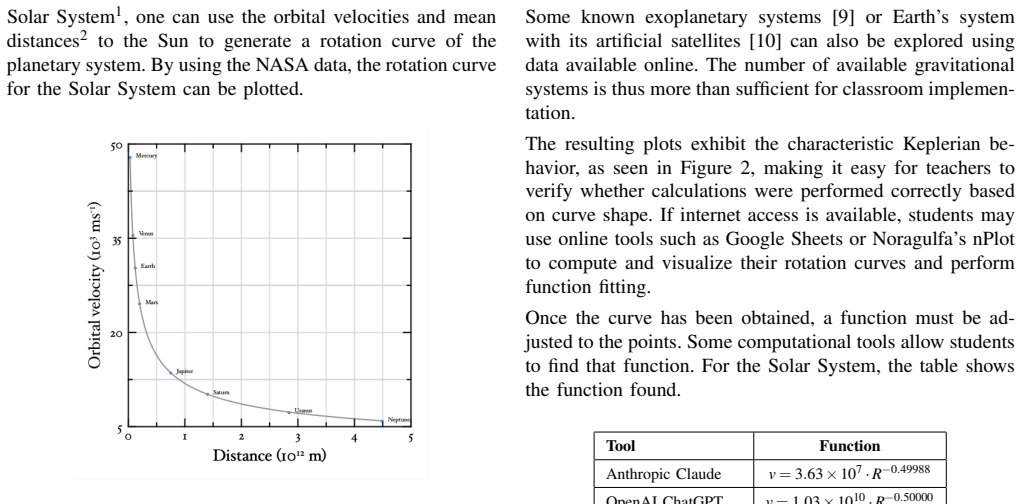
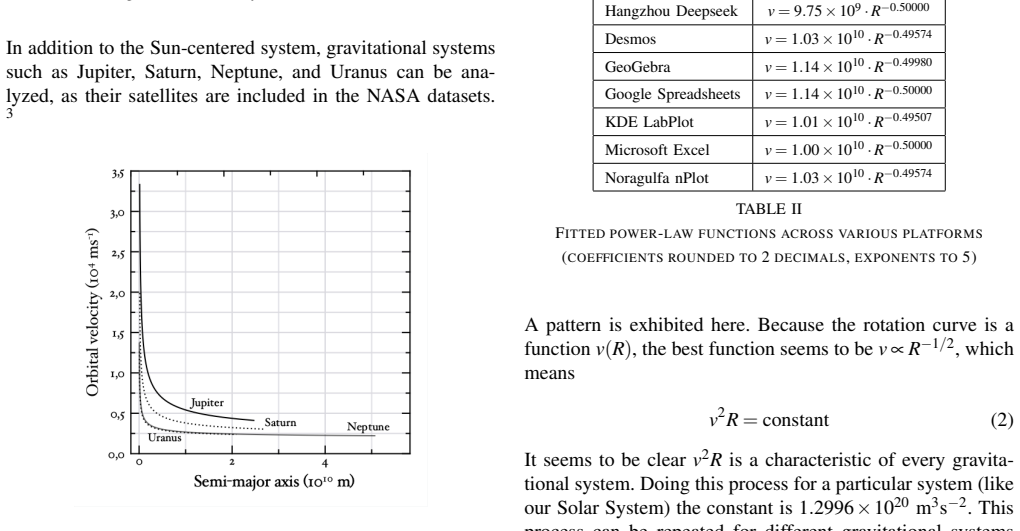
Once the curve has been obtained, a function must be adjusted... v ∝ R^{-1/2} ... v²R = constant ... Γ = 6.54×10^{-11} ... F = Γ·M·m / R²
-
IndisputableMonolith/Patterns/Gravity.leanzero-parameter gravity certificate unclear?
unclearRelation between the paper passage and the cited Recognition theorem.
the slope turns out to be the gravitational constant G
What do these tags mean?
- matches
- The paper's claim is directly supported by a theorem in the formal canon.
- supports
- The theorem supports part of the paper's argument, but the paper may add assumptions or extra steps.
- extends
- The paper goes beyond the formal theorem; the theorem is a base layer rather than the whole result.
- uses
- The paper appears to rely on the theorem as machinery.
- contradicts
- The paper's claim conflicts with a theorem or certificate in the canon.
- unclear
- Pith found a possible connection, but the passage is too broad, indirect, or ambiguous to say the theorem truly supports the claim.
Reference graph
Works this paper leans on
-
[1]
Leite, L. (2002). History of science in science education: Development and validation of a checklist for analysing the historical content of science textbooks.Science & Education, 11, 333–359
work page 2002
-
[2]
Carlson, J. E. (1989, October). Cavendish experiment.The Physics Teacher, 27(7), 562–564
work page 1989
-
[3]
Dousse, J., & Rh ˆeme, C. (1987, August). A student experiment for accurate measurements of the Newtonian gravitational constant. American Journal of Physics, 55(8), 706–711
work page 1987
-
[4]
J., Klein, S., Morrow, D., & Juliao, A
Kossler, W. J., Klein, S., Morrow, D., & Juliao, A. (2016, March). A simple Cavendish experimental apparatus.American Journal of Physics, 84(3), 234–239
work page 2016
-
[5]
Saulnier, M. S., & Frisch, D. (1989, May). Measurement of the gravitational constant without torsion.American Journal of Physics, 57(5), 417–420
work page 1989
-
[6]
Slisko, J., & Hadzibegovic, Z. (2011). Cavendish Experiment in Physics Textbooks: Why Do Authors Continue to Repeat a Denounced Error?European Journal of Physics Education, 2(3), 20–32
work page 2011
-
[7]
Rubin, V ., Thonnard, N., & Ford, W. K. Jr. (1980). Rotational Properties of 21 Sc Galaxies with a Large Range of Luminosities and Radii from NGC 4605 (R=4kpc) to UGC 2885 (R=122kpc).The Astrophysical Journal, 238, 471
work page 1980
-
[8]
Williams, D. R. (2025, March 18). Planetary Fact Sheet. NASA Space Science Data Coordinated Archive. Retrieved April 6, 2025, fromhttps://nssdc.gsfc.nasa.gov/planetary/ factsheet/
work page 2025
-
[9]
NASA Exoplanet Archive. (2021, April 17). Retrieved April 6, 2025, fromhttps://exoplanetarchive.ipac.caltech.edu/ cgi-bin/TblView/nph-tblView?app=ExoTbls&config= PS
work page 2021
-
[10]
Union of Concerned Scientists. (2023, May 1). Satellite Database. Retrieved April 6, 2025, fromhttps://www.ucs.org/ resources/satellite-database
work page 2023
-
[11]
National Institute of Standards and Technology. (2022). CODATA Value: Newtonian constant of gravitation. Retrieved April 6, 2025, fromhttps://physics.nist.gov/cgi-bin/cuu/Value? bg
work page 2022
-
[12]
Global Partnership for Education. (2020, January). 21st Century Skills Report. Retrieved April 6, 2025, from https://www.globalpartnership.org/node/ document/download?file=document/file/ 2020-01-GPE-21-century-skills-report.pdf
work page 2020
-
[13]
E., Mercier, J., & Beaudoin, E
Asghar, A., Sladeczek, I. E., Mercier, J., & Beaudoin, E. (2017). Learning in science, technology, engineering, and mathematics: Sup- porting students with learning disabilities.Canadian Psychology / Psychologie canadienne, 58(3), 238–249.https://doi.org/10. 1037/cap0000111
work page 2017
-
[14]
Freeman, I. M. (1962). Experimental Deduction of the Law of Cen- tripetal Force.American Journal of Physics, 30, 421–423.https: //doi.org/10.1119/1.1942056
discussion (0)
Sign in with ORCID, Apple, or X to comment. Anyone can read and Pith papers without signing in.