Recognition: no theorem link
Chromatic thresholds for pairs of graphs
Pith reviewed 2026-05-12 03:44 UTC · model grok-4.3
The pith
For any pair of 3-chromatic graphs, the two-color Ramsey chromatic threshold equals exactly one of five densities, classified by ordinary thresholds and embeddability into C5-type configurations.
A machine-rendered reading of the paper's core claim, the machinery that carries it, and where it could break.
Core claim
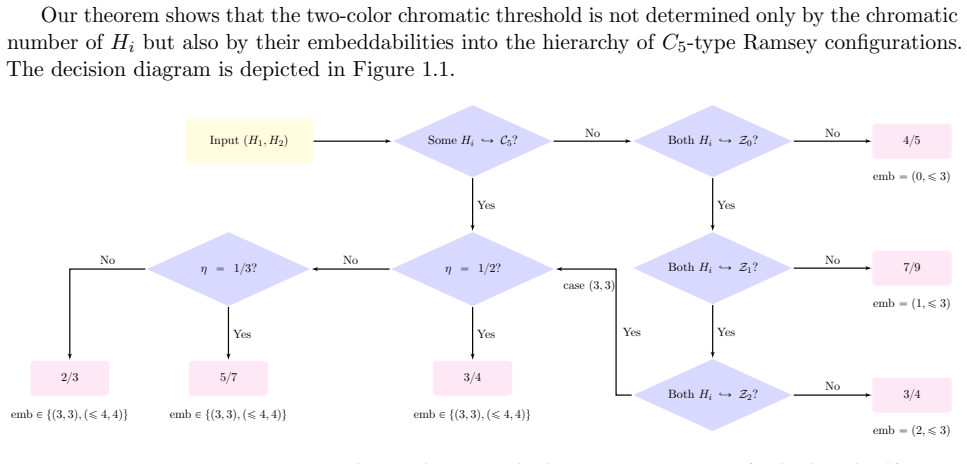
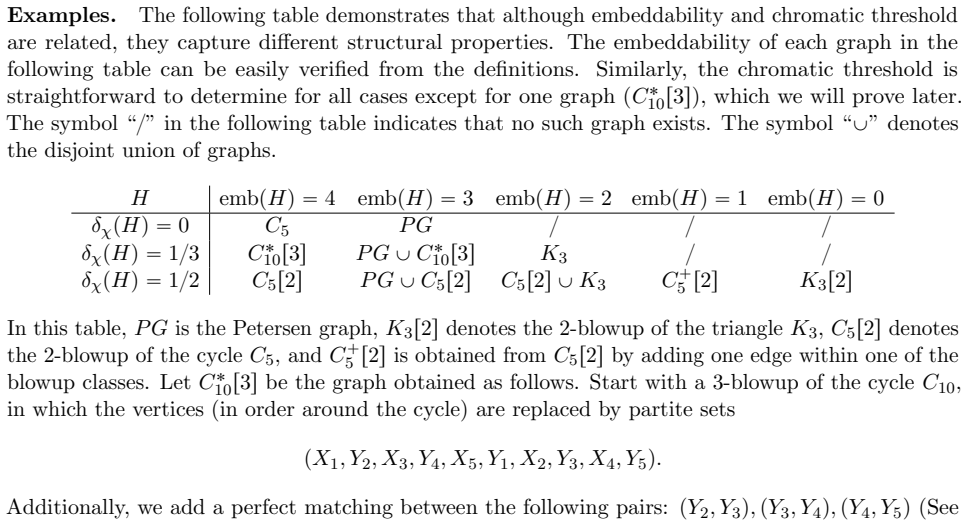
For any two 3-chromatic graphs H1 and H2, the minimum-degree density above which every graph that admits a red-blue edge-coloring with no red H1 and no blue H2 has bounded chromatic number is exactly one of 2/3, 5/7, 3/4, 7/9, or 4/5. The precise value for each pair is fixed by the ordinary chromatic thresholds of H1 and H2 together with whether each graph embeds into a hierarchy of C5-type Ramsey configurations.
What carries the argument
The two-color Ramsey chromatic threshold for a pair (H1, H2), which is the infimum density such that minimum-degree conditions plus the existence of an (H1, H2)-free coloring imply bounded chromatic number, classified via ordinary chromatic thresholds and embeddability into C5-type Ramsey configurations.
If this is right
- Every pair of 3-chromatic graphs falls into one of the five threshold classes.
- The ordinary chromatic threshold of each graph is an input that narrows the possible Ramsey thresholds.
- Embeddability into C5-type configurations decides the exact value when the ordinary thresholds alone leave ambiguity.
- The result supplies an exhaustive dictionary that assigns the correct threshold to any given 3-chromatic pair.
Where Pith is reading between the lines
- The same configuration hierarchy may produce only finitely many thresholds for pairs with higher chromatic number.
- The five densities likely arise from successive ratio-symmetric relations among the C5-type configurations.
- Explicit constructions of the C5-type configurations could be used to test embeddability for concrete families such as odd wheels or other 3-chromatic graphs.
Load-bearing premise
The complete classification assumes that embeddability of any 3-chromatic graph into the hierarchy of C5-type Ramsey configurations can be decided independently of the threshold calculation itself.
What would settle it
A single pair of 3-chromatic graphs whose two-color Ramsey chromatic threshold is not one of 2/3, 5/7, 3/4, 7/9, 4/5 or whose value fails to match the prediction from their ordinary thresholds and embeddability status.
Figures



read the original abstract
The chromatic threshold of a graph $H$ is the minimum-degree density above which every $H$-free graph has bounded chromatic number. We study a two-color Ramsey analogue: for graphs $H_1$ and $H_2$, we ask for the minimum-degree density above which every graph that admits a red-blue edge-coloring with no red copy of $H_1$ and no blue copy of $H_2$ has bounded chromatic number. We give a complete answer when both $H_1$ and $H_2$ are 3-chromatic. The threshold takes exactly one of the five values \[ \frac23,\quad \frac57,\quad \frac34,\quad \frac79,\quad \frac45, \] and we characterize precisely which pairs $(H_1,H_2)$ give each value. The classification is determined by the ordinary chromatic thresholds of $H_1$ and $H_2$ and by their embeddability into a hierarchy of $C_5$-type Ramsey configurations.
Editorial analysis
A structured set of objections, weighed in public.
Referee Report
Summary. The paper defines the two-color chromatic threshold for a pair of graphs (H1, H2) as the infimum over densities δ such that every n-vertex graph G with minimum degree at least δn that admits a red-blue edge-coloring with no red copy of H1 and no blue copy of H2 must have bounded chromatic number. For the case in which both H1 and H2 are 3-chromatic, the authors claim a complete classification: the threshold equals exactly one of the five values 2/3, 5/7, 3/4, 7/9 or 4/5, and they characterize precisely which pairs realize each value in terms of the ordinary (one-color) chromatic thresholds of H1 and H2 together with their embeddability into a stated hierarchy of C5-type Ramsey configurations.
Significance. If the classification is correct, the result supplies an exhaustive resolution of the two-color chromatic-threshold problem in the 3-chromatic case, extending the single-graph theory by exhibiting an explicit finite list of attainable densities and a structural criterion (embeddability) that determines the value for every pair. The explicit linkage between the pair threshold and the individual chromatic thresholds plus the C5-type configurations provides a concrete, falsifiable description that could serve as a template for analogous questions with more colors or higher chromatic numbers.
minor comments (3)
- The abstract and introduction refer to 'a hierarchy of C5-type Ramsey configurations' without giving an immediate definition or forward reference; a one-sentence description of the relevant constructions (or a pointer to the section where they are introduced) would make the characterization statement self-contained for readers who have not yet reached the technical sections.
- Notation for the two-color threshold (presumably denoted something like δ_χ(H1,H2) or similar) should be introduced explicitly in the first paragraph of the introduction, together with a brief comparison to the ordinary chromatic threshold δ_χ(H), to avoid any ambiguity when the classification is stated.
- The statement that the classification is 'determined by the ordinary chromatic thresholds of H1 and H2 and by their embeddability' would benefit from an explicit sentence listing the five cases and the precise embeddability conditions that distinguish them, even if the full proof appears later.
Simulated Author's Rebuttal
We thank the referee for their positive summary of our manuscript and for recommending minor revision. We address the referee's summary below.
read point-by-point responses
-
Referee: The paper defines the two-color chromatic threshold for a pair of graphs (H1, H2) as the infimum over densities δ such that every n-vertex graph G with minimum degree at least δn that admits a red-blue edge-coloring with no red copy of H1 and no blue copy of H2 must have bounded chromatic number. For the case in which both H1 and H2 are 3-chromatic, the authors claim a complete classification: the threshold equals exactly one of the five values 2/3, 5/7, 3/4, 7/9 or 4/5, and they characterize precisely which pairs realize each value in terms of the ordinary (one-color) chromatic thresholds of H1 and H2 together with their embeddability into a stated hierarchy of C5-type Ramsey configurations.
Authors: We agree with this summary of our results. The manuscript does indeed provide a complete classification for the two-color chromatic threshold when both graphs are 3-chromatic, with the threshold being precisely one of 2/3, 5/7, 3/4, 7/9, or 4/5, determined by the individual chromatic thresholds and the embeddability into the hierarchy of C5-type configurations. revision: no
Circularity Check
No significant circularity detected
full rationale
The paper's central result is an explicit classification of the two-color chromatic threshold for 3-chromatic pairs (H1, H2) into one of five explicit density values, with each pair assigned according to the independent ordinary chromatic thresholds of H1 and H2 together with the independently verifiable structural property of embeddability into a stated hierarchy of C5-type Ramsey configurations. No derivation step equates a claimed prediction to a fitted parameter by construction, renames a known result, or reduces the classification to a self-citation whose content is itself defined by the present work. The ordinary thresholds and embeddability checks are external inputs whose evaluation does not presuppose the target threshold values, rendering the derivation self-contained.
Axiom & Free-Parameter Ledger
axioms (2)
- standard math Standard definitions of chromatic number, minimum-degree density, H-free graphs, and edge-colorings avoiding monochromatic copies
- domain assumption Existence and well-definedness of ordinary chromatic thresholds for individual 3-chromatic graphs
Reference graph
Works this paper leans on
- [1]
-
[2]
P. Erd˝ os. Graph theory and probability.Canadian Journal of Mathematics, 11:34–38, 1959
work page 1959
-
[3]
P. Erd˝ os and M. Simonovits. On a valence problem in extremal graph theory.Discrete Mathe- matics, 5(4):323–334, 1973
work page 1973
-
[4]
W. Goddard and J. Lyle. Dense graphs with small clique number.Journal of Graph Theory, 66(4):319–331, 2011
work page 2011
- [5]
- [6]
-
[7]
J. Kim, Y. Kim, and H. Liu. Two conjectures in ramsey–tur´ an theory.SIAM Journal on Discrete Mathematics, 33(1):564–586, 2019
work page 2019
- [8]
-
[9]
J. Koml´ os and M. Simonovits. Szemer´ edi’s regularity lemma and its applications in graph theory, In: Combinatorics, Paul Erd˝ os is eighty, vol. 2 (Keszthely, 1993). volume 2 of Bolyai Soc. Math. Stud., pp. 295–352. J´ anos Bolyai Math. Soc., Budapest, 1996
work page 1993
- [10]
- [11]
-
[12]
T. Luczak and S. Thomass´ e. Coloring dense graphs via VC-dimension.arXiv:1007.1670, 2010
- [13]
- [14]
discussion (0)
Sign in with ORCID, Apple, or X to comment. Anyone can read and Pith papers without signing in.