Recognition: no theorem link
Effective, Efficient, and General Information Abstraction for Imperfect-Information Extensive-Form Games
Pith reviewed 2026-05-12 03:34 UTC · model grok-4.3
The pith
A small number of CFR warm-up iterations on the full game produces information abstractions that outperform equity-based and rank-based methods by reducing exploitability up to 80%.
A machine-rendered reading of the paper's core claim, the machinery that carries it, and where it could break.
Core claim
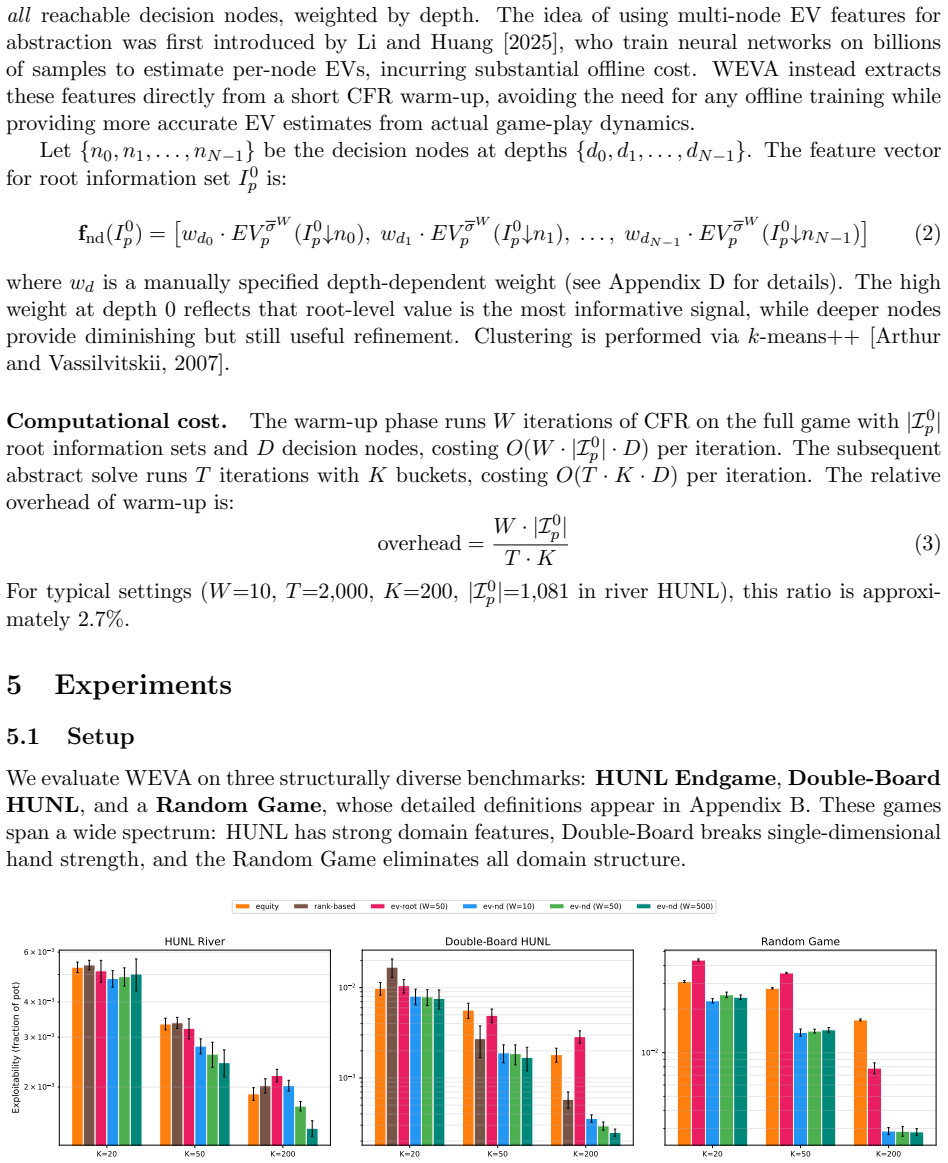
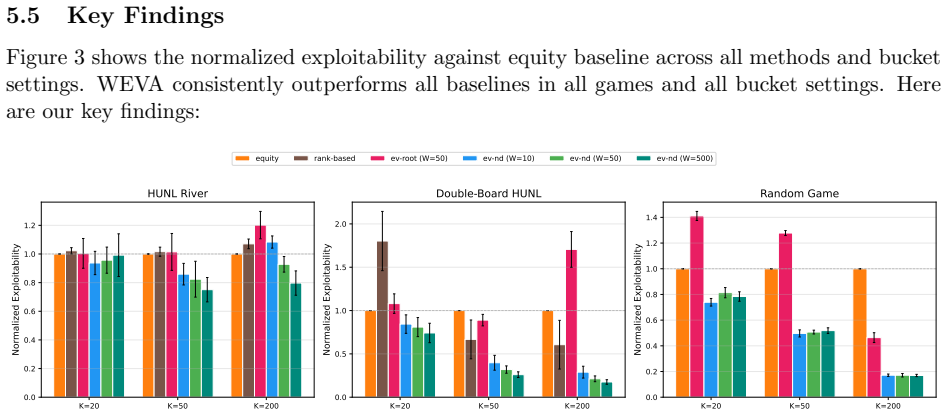
WEVA obtains an abstraction mapping by extracting per-hand expected value features after a short warm-up phase of CFR iterations on the full game, forming depth-weighted multi-node vectors, and applying k-means++ clustering, which produces abstractions that reduce exploitability by up to over 80% compared to equity and rank methods while requiring no domain knowledge.
What carries the argument
The depth-weighted multi-node expected value feature vector extracted after W CFR iterations, which serves as input to k-means++ for grouping information sets into abstract buckets.
If this is right
- Abstractions from as few as 10 warm-up iterations outperform existing methods in most settings.
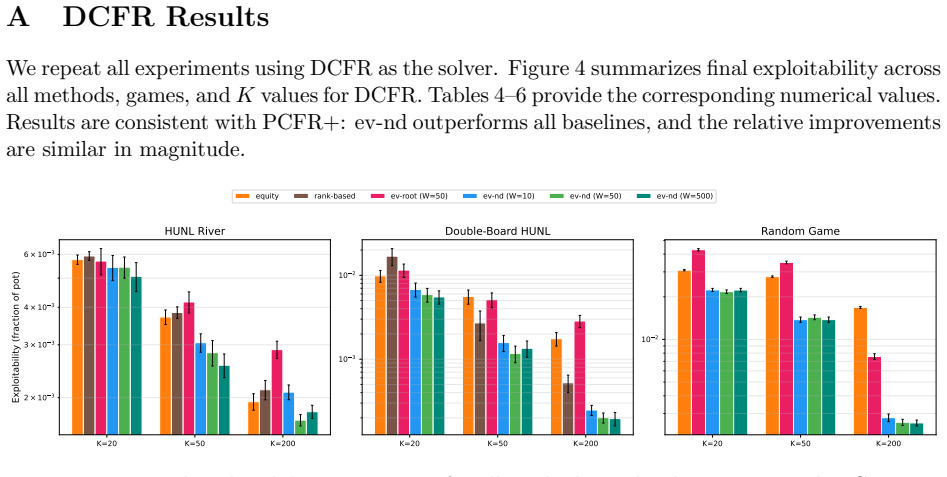
- WEVA works across structurally diverse games and with different CFR variants.
- The method incurs only small overhead beyond solving the abstract game.
- WEVA is applicable to games with non-standard payoff structures where rank or equity features do not apply.
Where Pith is reading between the lines
- WEVA could be combined with other abstraction techniques or used to initialize neural network training for further gains.
- Testing on larger games or real-world applications like poker variants would show scalability.
- Since it relies on CFR estimates, integrating it directly into ongoing CFR solves might reduce total computation further.
Load-bearing premise
That the expected value estimates computed after only a small number of CFR iterations are accurate enough to form useful clusters for abstraction without needing additional domain-specific information.
What would settle it
In a new game, compute abstractions using WEVA with W=10 and compare the exploitability of the solved abstract strategy against one using equity-based abstraction; if WEVA does not show lower exploitability, the claim fails.
Figures



read the original abstract
Information abstraction reduces the computational cost of solving imperfect-information games by clustering information sets into a smaller number of \emph{buckets}. Existing methods either rely on domain-specific features such as rank or equity, which are inapplicable to games with non-standard payoff structures, or require expensive offline neural-network training on billions of samples. We propose \textbf{Warm-up Expected Value-based Abstraction (WEVA)}, a simple yet effective alternative: run a small number of Counterfactual Regret Minimization (CFR) iterations on the full game as a \emph{warm-up} phase, extract per-hand expected value features at every decision node, form a depth-weighted multi-node feature vector, and apply $k$-means++ clustering to obtain the abstraction mapping. WEVA requires no domain knowledge, no pre-training, and incurs only a small overhead on top of the abstract-game solve. Experiments on three structurally diverse games, with different bucket numbers and CFR variants, show that WEVA consistently outperforms equity-based and rank-based abstractions, reducing exploitability by up to over $80\%$. Surprisingly, as few as $W{=}10$ warm-up iterations already produce abstractions that outperform existing information abstraction methods in most settings. These results establish WEVA as an \emph{effective, efficient, and general} approach to information abstraction in imperfect-information extensive-form games.
Editorial analysis
A structured set of objections, weighed in public.
Referee Report
Summary. The paper introduces Warm-up Expected Value-based Abstraction (WEVA) for imperfect-information extensive-form games. It runs a small number W of CFR iterations on the full game to extract per-information-set expected-value vectors, forms depth-weighted feature vectors, and applies k-means++ to cluster into buckets. The method requires no domain-specific features or pre-training. Experiments on three structurally diverse games with varying bucket counts and CFR variants claim consistent outperformance over equity-based and rank-based abstractions, with exploitability reductions up to over 80% and strong results even at W=10.
Significance. If the empirical results hold, WEVA offers a practical, general-purpose information-abstraction technique that avoids both hand-crafted domain features and expensive offline training. The low overhead (small W on top of the abstract-game solve) and applicability across game structures would make it a useful default tool for scaling CFR-based solvers to larger IIGs.
major comments (1)
- [Experimental Results (warm-up iterations)] The headline result that W=10 already yields abstractions outperforming existing methods rests on the unverified assumption that transient CFR value estimates after only 10 iterations are sufficiently close to equilibrium values to support reliable strategic clustering. No analysis, ablation, or correlation study with higher-iteration or ground-truth EVs is reported, which directly bears on the claim that the warm-up phase is informative across diverse games and horizons.
minor comments (1)
- [Abstract] The abstract states 'reducing exploitability by up to over 80%' but does not specify the baseline exploitability value or the exact game and bucket setting for the maximum reduction; this should be clarified with a table reference.
Simulated Author's Rebuttal
We thank the referee for the detailed and constructive feedback. We address the major comment point by point below and indicate the revisions we will make to strengthen the manuscript.
read point-by-point responses
-
Referee: The headline result that W=10 already yields abstractions outperforming existing methods rests on the unverified assumption that transient CFR value estimates after only 10 iterations are sufficiently close to equilibrium values to support reliable strategic clustering. No analysis, ablation, or correlation study with higher-iteration or ground-truth EVs is reported, which directly bears on the claim that the warm-up phase is informative across diverse games and horizons.
Authors: We agree that the manuscript would benefit from explicit analysis of the warm-up estimates. The current results demonstrate that WEVA with W=10 produces abstractions that reduce exploitability relative to equity- and rank-based baselines across three structurally different games, but we did not report a direct comparison of the transient EVs to converged values or an ablation over larger W. In the revision we will add: (i) performance curves for W in {10, 50, 100, 500} on all three domains, (ii) a correlation study between warm-up EVs and equilibrium EVs on the smallest game where full convergence is computationally feasible, and (iii) a brief discussion of why relative ordering information present after a few CFR iterations can still yield useful clusters even when absolute values remain noisy. These additions will directly address the concern about the reliability of the warm-up phase. revision: yes
Circularity Check
No significant circularity; empirical algorithmic method with independent validation
full rationale
The paper presents WEVA as a concrete algorithmic pipeline (run W CFR iterations on the full game, extract per-hand EV vectors at decision nodes, form depth-weighted feature vectors, apply k-means++ clustering) whose performance is measured by separate exploitability computations on the resulting abstract games versus equity/rank baselines. No step equates a claimed result to its own inputs by definition, renames a fitted quantity as a prediction, or relies on a load-bearing self-citation chain; the warm-up phase is an explicit, fixed component of the proposed procedure rather than a derived output. All reported gains (up to 80% exploitability reduction) are direct experimental outcomes on three games and are falsifiable without reference to the method's internal definitions.
Axiom & Free-Parameter Ledger
free parameters (2)
- warm-up iterations W
- number of buckets
axioms (2)
- domain assumption A small number of CFR iterations produces expected-value estimates informative enough for effective information-set clustering
- domain assumption k-means++ on depth-weighted EV vectors yields better abstractions than equity- or rank-based methods
Reference graph
Works this paper leans on
-
[1]
Advances in Neural Information Processing Systems 20 (NIPS) , year =
Regret Minimization in Games with Incomplete Information , author =. Advances in Neural Information Processing Systems 20 (NIPS) , year =
-
[2]
Advances in Neural Information Processing Systems 22 (NIPS) , year =
Monte Carlo Sampling for Regret Minimization in Extensive Games , author =. Advances in Neural Information Processing Systems 22 (NIPS) , year =
-
[3]
Solving Large Imperfect Information Games Using
Tammelin, Oskari , journal =. Solving Large Imperfect Information Games Using
-
[4]
Proceedings of the AAAI Conference on Artificial Intelligence , volume =
Solving Imperfect-Information Games via Discounted Regret Minimization , author =. Proceedings of the AAAI Conference on Artificial Intelligence , volume =
-
[5]
Proceedings of the AAAI Conference on Artificial Intelligence , volume =
Faster Game Solving via Predictive Blackwell Approachability: Connecting Regret Matching and Mirror Descent , author =. Proceedings of the AAAI Conference on Artificial Intelligence , volume =
- [6]
-
[7]
Lossless Abstraction of Imperfect Information Games , author =. Journal of the ACM , volume =
-
[8]
Evaluating State-Space Abstractions in Extensive-Form Games , author =. Proceedings of the International Conference on Autonomous Agents and Multi-Agent Systems (AAMAS) , year =
-
[9]
Proceedings of the ACM Conference on Economics and Computation (EC) , year =
Extensive-Form Game Abstraction with Bounds , author =. Proceedings of the ACM Conference on Economics and Computation (EC) , year =
-
[10]
Brown, Noam and Sandholm, Tuomas , booktitle =. Hierarchical Abstraction, Distributed Equilibrium Computation, and Post-Processing, with Application to a Champion No-Limit
-
[11]
Proceedings of the AAAI Conference on Artificial Intelligence , year =
Potential-Aware Imperfect-Recall Abstraction with Earth Mover's Distance in Imperfect-Information Games , author =. Proceedings of the AAAI Conference on Artificial Intelligence , year =
- [12]
- [13]
- [14]
-
[15]
Advances in Neural Information Processing Systems 30 (NIPS) , year =
Safe and Nested Subgame Solving for Imperfect-Information Games , author =. Advances in Neural Information Processing Systems 30 (NIPS) , year =
-
[16]
The Thirteenth International Conference on Learning Representations , year=
Efficient Online Pruning and Abstraction for Imperfect Information Extensive-Form Games , author=. The Thirteenth International Conference on Learning Representations , year=
-
[17]
Proceedings of the International Joint Conference on Artificial Intelligence (IJCAI) , year =
Approximating Game-Theoretic Optimal Strategies for Full-scale Poker , author =. Proceedings of the International Joint Conference on Artificial Intelligence (IJCAI) , year =
-
[18]
A Simple Adaptive Procedure Leading to Correlated Equilibrium , author =. Econometrica , volume =
-
[19]
Contributions to the Theory of Games , volume =
A Simplified Two-Person Poker , author =. Contributions to the Theory of Games , volume =
-
[20]
International Conference on Machine Learning , pages=
Opponent-limited online search for imperfect information games , author=. International Conference on Machine Learning , pages=. 2023 , organization=
work page 2023
-
[21]
The Fourteenth International Conference on Learning Representations , year=
General search techniques without common knowledge for imperfect-information games, and application to superhuman Fog of War chess , author=. The Fourteenth International Conference on Learning Representations , year=
-
[22]
The state of solving large incomplete-information games, and application to poker , author=. Ai Magazine , volume=
-
[23]
International Conference on Computers and Games , pages=
Abstraction methods for game theoretic poker , author=. International Conference on Computers and Games , pages=. 2000 , organization=
work page 2000
-
[24]
International conference on machine learning , pages=
Deep counterfactual regret minimization , author=. International conference on machine learning , pages=. 2019 , organization=
work page 2019
-
[25]
Encyclopedia of biostatistics , volume=
Spearman rank correlation , author=. Encyclopedia of biostatistics , volume=. 2005 , publisher=
work page 2005
-
[26]
David Arthur and Sergei Vassilvitskii , title =
-
[27]
Proceedings of the AAAI Conference on Artificial Intelligence , volume=
Abstraction for solving large incomplete-information games , author=. Proceedings of the AAAI Conference on Artificial Intelligence , volume=
-
[28]
Better automated abstraction techniques for imperfect information games, with application to Texas Hold'em poker , author=. Proceedings of the 6th international joint conference on Autonomous agents and multiagent systems , pages=
-
[29]
Proceedings of the National Conference on Artificial Intelligence , volume=
Potential-aware automated abstraction of sequential games, and holistic equilibrium analysis of Texas Hold'em poker , author=. Proceedings of the National Conference on Artificial Intelligence , volume=. 2007 , organization=
work page 2007
-
[30]
A heads-up no-limit Texas Hold'em poker player: Discretized betting models and automatically generated equilibrium-finding programs , author=. Proceedings of the 7th international joint conference on Autonomous agents and multiagent systems-Volume 2 , pages=
-
[31]
Proceedings of the 7th ACM conference on Electronic commerce , pages=
Finding equilibria in large sequential games of imperfect information , author=. Proceedings of the 7th ACM conference on Electronic commerce , pages=
- [32]
-
[33]
Proceedings of the 41st International Conference on Machine Learning , pages=
RL-CFR: improving action abstraction for imperfect information extensive-form games with reinforcement learning , author=. Proceedings of the 41st International Conference on Machine Learning , pages=
-
[34]
Proceedings of the AAAI Conference on Artificial Intelligence , volume=
Automated action abstraction of imperfect information extensive-form games , author=. Proceedings of the AAAI Conference on Artificial Intelligence , volume=
-
[35]
No-regret learning in extensive-form games with imperfect recall , author=. Proceedings of the 29th International Coference on International Conference on Machine Learning , pages=
-
[36]
Proceedings of the AAAI Conference on Artificial Intelligence , volume=
Using sliding windows to generate action abstractions in extensive-form games , author=. Proceedings of the AAAI Conference on Artificial Intelligence , volume=
-
[37]
Proceedings of the AAAI Conference on Artificial Intelligence , volume=
Regret transfer and parameter optimization , author=. Proceedings of the AAAI Conference on Artificial Intelligence , volume=
-
[38]
Simultaneous abstraction and equilibrium finding in games , author=. 2015 , publisher=
work page 2015
- [39]
-
[40]
Proceedings of the AAAI Conference on Artificial Intelligence , volume=
No-Regret Strategy Solving in Imperfect-Information Games via Pre-Trained Embedding , author=. Proceedings of the AAAI Conference on Artificial Intelligence , volume=
- [41]
- [42]
-
[43]
Deepstack: Expert-level artificial intelligence in heads-up no-limit poker , author=. Science , volume=. 2017 , publisher=
work page 2017
-
[44]
Advances in neural information processing systems , volume=
Depth-limited solving for imperfect-information games , author=. Advances in neural information processing systems , volume=
-
[45]
The Fourteenth International Conference on Learning Representations , year=
Look-ahead Reasoning with a Learned Model in Imperfect Information Games , author=. The Fourteenth International Conference on Learning Representations , year=
-
[46]
Accelerating best response calculation in large extensive games , author=. IJCAI , volume=
-
[47]
Advances in neural information processing systems , volume=
Regret-based pruning in extensive-form games , author=. Advances in neural information processing systems , volume=
-
[48]
Proceedings of the AAAI Conference on Artificial Intelligence , volume=
Fast payoff matrix sparsification techniques for structured extensive-form games , author=. Proceedings of the AAAI Conference on Artificial Intelligence , volume=
-
[49]
Advances in neural information processing systems , volume=
Combining deep reinforcement learning and search for imperfect-information games , author=. Advances in neural information processing systems , volume=
-
[50]
International conference on machine learning , pages=
Reduced space and faster convergence in imperfect-information games via pruning , author=. International conference on machine learning , pages=. 2017 , organization=
work page 2017
-
[51]
Proceedings of the AAAI Conference on Artificial Intelligence , volume=
Strategy-based warm starting for regret minimization in games , author=. Proceedings of the AAAI Conference on Artificial Intelligence , volume=
-
[52]
Openspiel: A framework for reinforcement learning in games.arXiv preprint arXiv:1908.09453, 2019
OpenSpiel: A framework for reinforcement learning in games , author=. arXiv preprint arXiv:1908.09453 , year=
-
[53]
arXiv preprint arXiv:2407.20351 , year=
LiteEFG: An efficient python library for solving extensive-form games , author=. arXiv preprint arXiv:2407.20351 , year=
-
[54]
Contributions to the Theory of Games , volume=
Extensive games and the problem of information , author=. Contributions to the Theory of Games , volume=. 1953 , publisher=
work page 1953
-
[55]
The Fourteenth International Conference on Learning Representations , year=
A Faster Parameter-Free Regret Matching Algorithm , author=. The Fourteenth International Conference on Learning Representations , year=
-
[56]
Student of games: A unified learning algorithm for both perfect and imperfect information games , author=. Science Advances , volume=. 2023 , publisher=
work page 2023
-
[57]
Perolat, Julien and Munos, Remi and Lespiau, Jean-Baptiste and Omidshafiei, Shayegan and Rowland, Mark and Ortega, Pedro and Burch, Neil and Anthony, Thomas and Balduzzi, David and De Vylder, Bart and others , booktitle=. From poincar. 2021 , organization=
work page 2021
-
[58]
Proceedings of the AAAI Conference on Artificial Intelligence , volume=
Solving imperfect information games using decomposition , author=. Proceedings of the AAAI Conference on Artificial Intelligence , volume=
discussion (0)
Sign in with ORCID, Apple, or X to comment. Anyone can read and Pith papers without signing in.