Recognition: 2 theorem links
· Lean TheoremSingle-Photon Double Ionization of Ozone
Pith reviewed 2026-05-12 03:38 UTC · model grok-4.3
The pith
Dissociative double ionization of ozone produces electronically excited cationic oxygen fragments in addition to ground-state ones.
A machine-rendered reading of the paper's core claim, the machinery that carries it, and where it could break.
Core claim
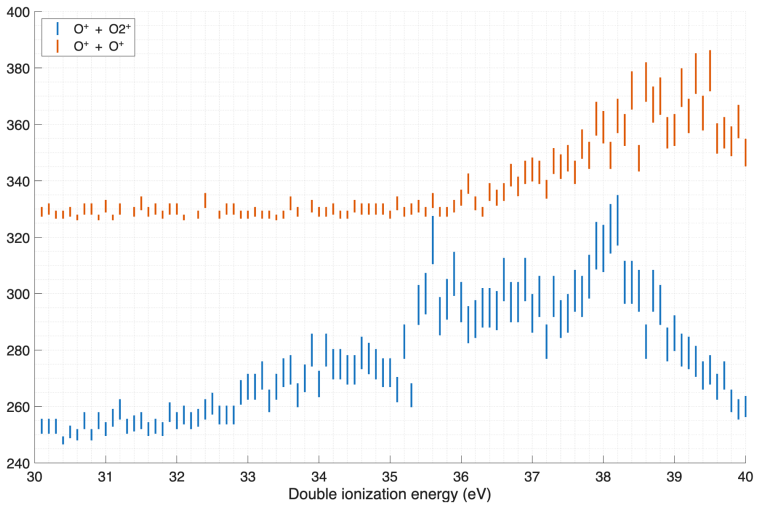
He II-alpha, He II-beta and higher-energy VUV radiation ejects two valence electrons from ozone; the resulting dication dissociates along channels that yield electronically excited O+ fragments as well as ground-state ones. Accurate computation of the dication potential energy surfaces and dissociation thresholds assigns the observed electron spectrum to these multiple pathways, establishing that fragmentation dynamics are more varied than previously mapped.
What carries the argument
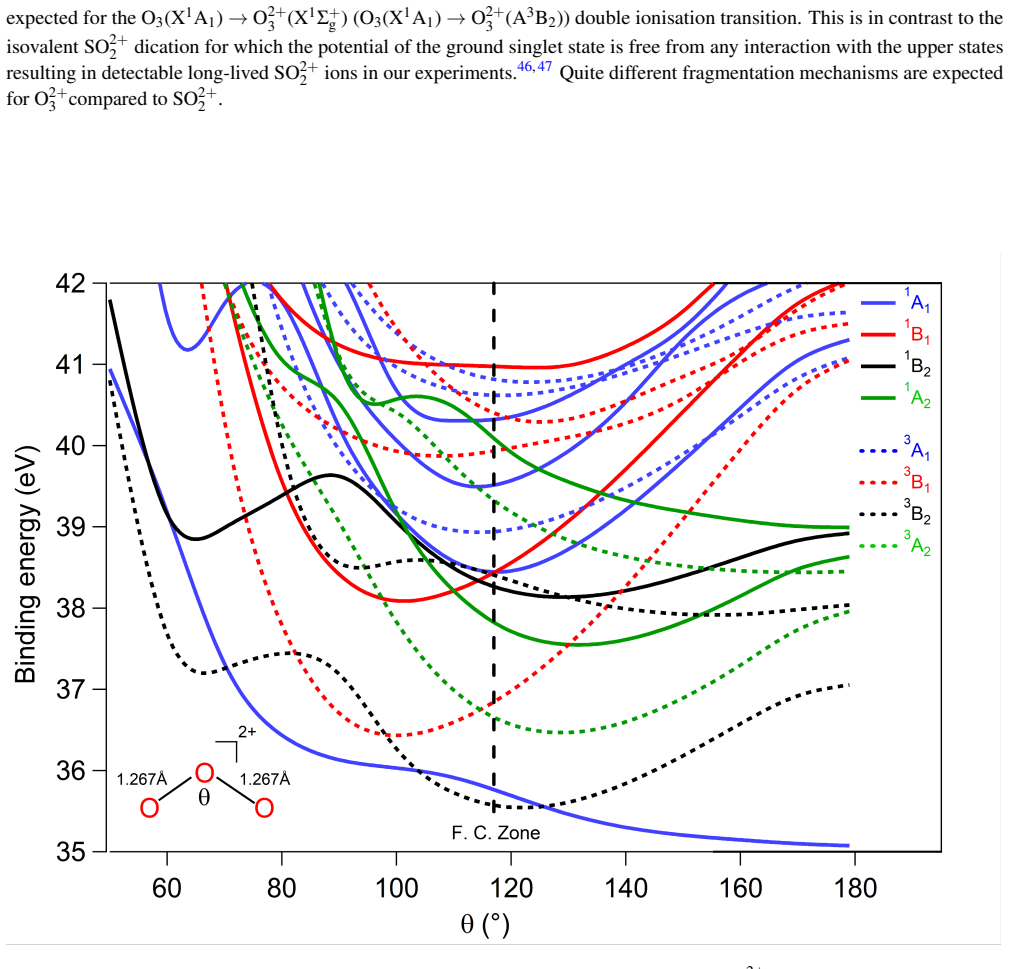
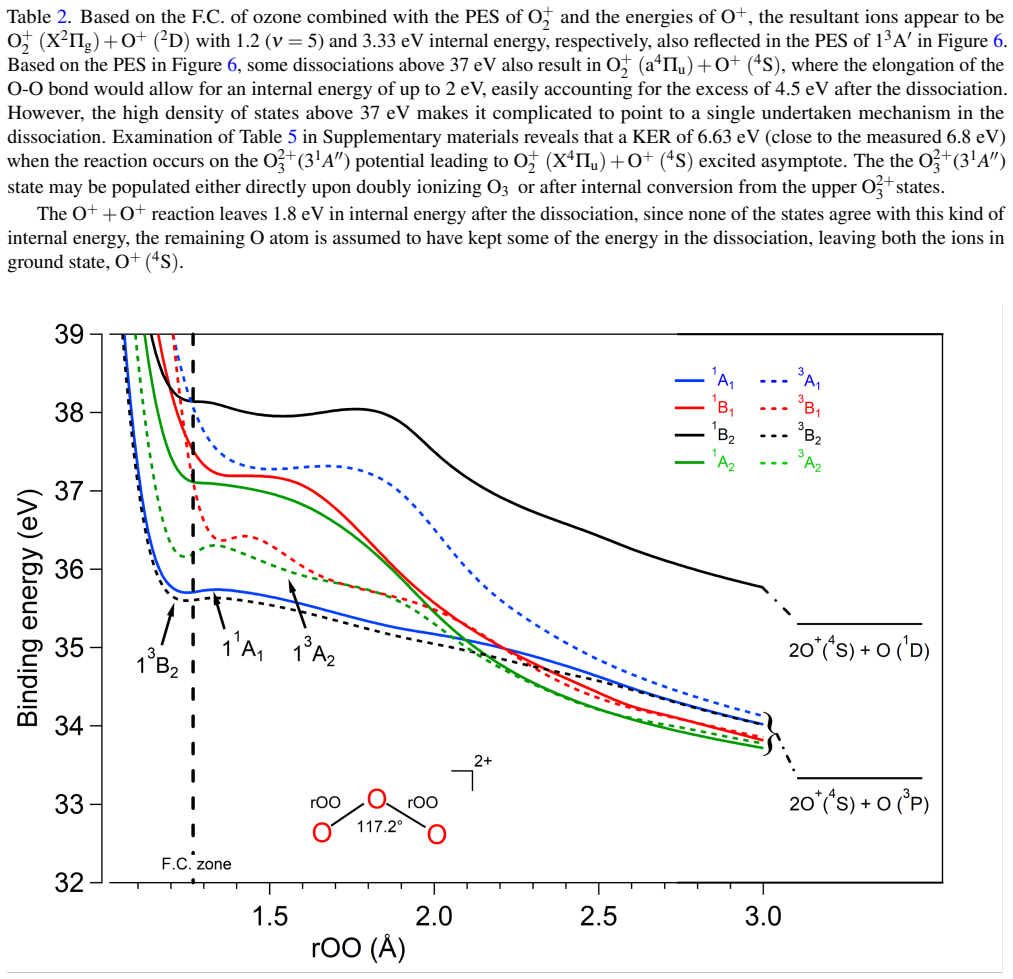
Computed potential energy surfaces of the ozone dication, obtained via post-Hartree-Fock multi-configurational interaction methods, that locate the dissociation thresholds and fragment electronic states.
If this is right
- Atmospheric and ionospheric models must incorporate additional fragment excitation channels when ozone undergoes double ionization.
- The identified energy thresholds serve as benchmarks for refining quantum-chemical treatments of small-molecule dications.
- Similar multi-channel dissociation is expected in other triatomic species under VUV irradiation.
- The correlation technique enables extraction of state-resolved fragment information from electron spectra alone.
Where Pith is reading between the lines
- These excited fragments could increase the yield of reactive oxygen species in upper-atmosphere layers exposed to solar VUV.
- Extending the same experimental-theoretical approach to CO2 or N2O would test whether rich fragmentation is general for atmospheric triatomics.
- The richer dynamics may alter predicted rates of ozone destruction in high-radiation environments such as planetary magnetospheres.
Load-bearing premise
Correct assignment of the measured electron spectrum to specific ground-state or excited-state dissociation channels requires the computed dication potential energy surfaces and energetics to be sufficiently accurate.
What would settle it
Absence of kinetic-energy-release features or coincidence signals corresponding to excited O+ states, or measured appearance energies that deviate substantially from the calculated dissociation thresholds.
Figures






read the original abstract
Ozone (O3) is a triatomic molecule of central importance in the chemistry and physics of the Earth's and other planetary atmospheres. Beyond its environmental significance, a detailed understanding of the electronic structure and ionization dynamics of ozone is essential for modeling atmospheric, ionospheric, and astrochemical processes. In the present work, we substantially extend the experimental and theoretical characterization of ozone into the regime of valence double photoionization. Using HeII-alpha, HeII-beta, and higher-energy vacuum ultraviolet radiation in combination with a versatile multiple charged-particle correlation detection technique, we report the first single-photon valence double ionization electron spectrum of O3. To interpret the experimental observations, we mapped the lowest potential energy surfaces of dicationic ozone employing post-Hartree-Fock multi-configurational-interaction methods, and computed with high accuracy the energetics of the relevant dissociation channels. Our results demonstrate that dissociative double ionization of ozone produces electronically excited cationic atomic oxygen fragments in addition to the ground-state dissociation pathway, revealing a richer fragmentation dynamics than hitherto recognized.
Editorial analysis
A structured set of objections, weighed in public.
Referee Report
Summary. The manuscript reports the first experimental single-photon valence double ionization electron spectrum of ozone (O3) obtained with HeII-alpha, HeII-beta and higher VUV radiation together with a multiple charged-particle coincidence detection technique. Post-Hartree-Fock multi-configurational-interaction calculations are used to map the lowest O3^{2+} potential energy surfaces and to compute the energetics of the relevant dissociation limits. The central claim is that dissociative double ionization produces electronically excited O+ fragments (in addition to the ground-state O+(^4S) channel), revealing richer fragmentation dynamics than previously recognized.
Significance. If the spectral assignments are robust, the work supplies primary experimental data on an atmospherically important molecule and demonstrates previously unrecognized excited-state dissociation pathways. The experimental spectrum itself constitutes a valuable addition to the literature on ozone double ionization.
major comments (2)
- [theoretical methods and results sections] The assignment of observed spectral features and coincidence signals to excited O+(^2D) and O+(^2P) dissociation limits rests entirely on the accuracy of the computed dication PES asymptotes. The manuscript must therefore provide explicit details on active-space selection, basis-set convergence, treatment of spin-orbit or relativistic effects, and quantitative error estimates for the relative energies of the dissociation channels (see the theoretical methods and results sections).
- [results and discussion] Without reported experimental energy resolution, error bars on the measured thresholds, or a direct quantitative overlay of computed dissociation limits onto the experimental spectrum, it is not possible to verify that the claimed excited-state channels are unambiguously distinguished from the ground-state pathway or from possible experimental artifacts.
minor comments (2)
- [Abstract] The abstract refers to 'higher-energy vacuum ultraviolet radiation' without listing the precise photon energies or source details used in the measurements.
- [figures] All figures displaying spectra or potential energy curves should include explicit labels for each dissociation limit and a clear indication of the experimental energy resolution.
Simulated Author's Rebuttal
We thank the referee for the careful review and for highlighting the value of the experimental spectrum. We have revised the manuscript to strengthen the theoretical documentation and experimental reporting as requested.
read point-by-point responses
-
Referee: [theoretical methods and results sections] The assignment of observed spectral features and coincidence signals to excited O+(^2D) and O+(^2P) dissociation limits rests entirely on the accuracy of the computed dication PES asymptotes. The manuscript must therefore provide explicit details on active-space selection, basis-set convergence, treatment of spin-orbit or relativistic effects, and quantitative error estimates for the relative energies of the dissociation channels (see the theoretical methods and results sections).
Authors: We agree that the original manuscript provided insufficient detail on the computational protocol. In the revised version we have expanded the Theoretical Methods section to specify the active-space choice (full-valence CAS(12,9) in the dication), the basis sets employed together with explicit convergence tests up to aug-cc-pV5Z, the finding that spin-orbit and scalar relativistic corrections shift the relevant asymptotes by less than 0.05 eV, and benchmark-derived error bars of approximately 0.15 eV obtained by comparing computed atomic O+ limits to experiment. These additions allow the reader to assess the reliability of the excited-state assignments. revision: yes
-
Referee: [results and discussion] Without reported experimental energy resolution, error bars on the measured thresholds, or a direct quantitative overlay of computed dissociation limits onto the experimental spectrum, it is not possible to verify that the claimed excited-state channels are unambiguously distinguished from the ground-state pathway or from possible experimental artifacts.
Authors: The referee is correct that these quantitative elements were omitted. We have added the measured energy resolution (FWHM) and threshold uncertainties (derived from calibration and statistical fitting) to the Experimental section. We have also inserted a direct overlay of the computed dissociation limits onto the experimental double-ionization spectrum in the revised Results and Discussion, demonstrating that the excited O+ channels lie outside the ground-state feature by amounts larger than the experimental resolution. revision: yes
Circularity Check
No circularity: experimental spectrum is primary data; theory provides independent interpretive mapping
full rationale
The paper's core chain begins with measured coincidence spectra from HeII and VUV single-photon double ionization of O3, recorded via multiple charged-particle correlation detection. These raw experimental observables are then assigned to dissociation channels by comparing observed kinetic energy releases and electron spectra against independently computed O3^{2+} potential energy surfaces and asymptotic limits obtained from post-Hartree-Fock multi-configurational methods. The calculations are not fitted to the present data, nor are they derived from prior self-citations that presuppose the target result; they constitute a separate ab initio computation whose accuracy can be assessed against external benchmarks. No self-definitional loop, fitted-input prediction, or load-bearing self-citation reduces the claim that excited O+ fragments are observed to a tautology. The derivation therefore remains self-contained.
Axiom & Free-Parameter Ledger
axioms (1)
- domain assumption Post-Hartree-Fock multi-configurational-interaction methods provide reliable lowest potential energy surfaces and dissociation energetics for dicationic ozone.
Reference graph
Works this paper leans on
-
[1]
Calder, R., Shorttle, O., Jordan, S., Rimmer, P. & Constantinou, T. Abiotic ozone in the observable atmospheres of venus and venus-like exoplanets.Mon. Notices Royal Astron. Soc.540, 2432–2450 (2025)
work page 2025
-
[2]
Farman, J., Gardiner, B. & Shanklin, J. Large losses of total ozone in antarctica reveal seasonal clox/nox interaction. Nature315, 207–2010 (1985)
work page 2010
-
[3]
Kyoto protocol to the united nations framework convention on climate change
Nations, U. Kyoto protocol to the united nations framework convention on climate change. https://unfccc.int/sites/default/files/resource/docs/cop3/l07a01.pdf (1997). Accessed 2025-10-23. 4.for Europe, U. N. E. C. Protocol to abate acidification, eutrophication and ground-level ozone (2012)
work page 1997
-
[4]
Mahla, S. & Mehnen, B. Photoionization dynamics of o2 and o3 for atmospheric and astrophysical applications.The J. Chem. Phys.163(2025)
work page 2025
-
[5]
Dyke, J., Golob, L., Jonathan, N., Morris, A. & Okuda, M. Vacuum ultraviolet photoelectron spectroscopy of transient species. part 4.—difluoromethylene and ozone.J. Chem. Soc. Faraday Transactions 2: Mol. Chem. Phys.70, 1828–1836 (1974). 7.Brundle, C. He (i) and he (ii) photoelectron spectra of ozone.Chem. Phys. Lett.26, 25–28 (1974)
work page 1974
-
[6]
Frost, D., Lee, S. & McDowell, C. High resolution photoelectron spectroscopy of ozone.Chem. Phys. Lett.24, 149–152 (1974)
work page 1974
-
[7]
Katsumata, S., Shiromaru, H. & Kimura, T. Photoelectron angular distribution and assignment of photoelectron spectrum of ozone.Bull. Chem. Soc. Jpn.57, 1784–1788 (1984)
work page 1984
-
[8]
Mocellin, A., Wiesner, K., Burmeister, F., Bjorneholm, O. & de Brito, A. N. Experimental study of photoionization of ozone in the 12 to 21 ev region.The J. Chem. Phys.115, 5041 (2001). 13/18 11.Couto, H.et al.Threshold photoelectron spectroscopy of ozone.The J. chemical physics124(2006)
work page 2001
-
[9]
Willitsch, S., Innocenti, F., Dyke, J. M. & Merkt, F. High-resolution pulsed-field-ionization zero-kinetic-energy photoelec- tron spectroscopic study of the two lowest electronic states of the ozone cation o 3+.The J. chemical physics122, 024311 (2005)
work page 2005
-
[10]
Wiesner, K.Electronic Structure and Core-Hole Dynamics of Ozone: Synchrotron-radiation based studies and ab-initio calculations. Ph.D. thesis, Acta Universitatis Upsaliensis (2003)
work page 2003
-
[11]
Newson, K. A., Luc, S. M., Price, S. D. & Mason, N. J. Electron-impact ionization of ozone.Int. journal mass spectrometry ion processes148, 203–213 (1995)
work page 1995
-
[12]
Champkin, P., Kaltsoyannis, N. & Price, S. D. On the dissociation of the ozone dication.J. electron spectroscopy related phenomena105, 21–28 (1999)
work page 1999
-
[13]
Ab initio study of bonding trends among the 22-electron a=b=a systems: Evidence for o=o=o2+.Chem
Pyykkö, P. Ab initio study of bonding trends among the 22-electron a=b=a systems: Evidence for o=o=o2+.Chem. physics letters156, 337–340 (1989)
work page 1989
- [14]
-
[15]
Belic, D., Urbain, X. & Defrance, P. Electron-impact dissociation of ozone cations to o+ fragments.Phys. Rev. A91, 012703 (2015)
work page 2015
-
[16]
Deng, S. H. M., Vane, C. R., Bannister, M. E. & Fogle, M. Electron-impact dissociation of ozone cationso3+.Phys. Rev. A 82, 062715, DOI: 10.1103/PhysRevA.82.062715 (2010)
-
[17]
H.et al.Complete two-electron spectra in double photoionization: the rare gases ar, kr, and xe.Phys
Eland, J. H.et al.Complete two-electron spectra in double photoionization: the rare gases ar, kr, and xe.Phys. review letters90, 053003 (2003)
work page 2003
-
[18]
Eland, J. H. D. & Feifel, R. Double ionisation of ICN and BrCN studied by a new photoelectron photoion coincidence technique.Chem. Phys.327, 85–90, DOI: 10.1016/j.chemphys.2006.03.040 (2006)
-
[19]
Wiley, W. C. & McLaren, I. H. Time-of-flight mass spectrometer with improved resolution.Rev. Sci. Instruments26, 1150–1157, DOI: 10.1063/1.1715212 (1955)
-
[20]
Positively charged molecular ions electronic structure computations
Hochlaf, M. Positively charged molecular ions electronic structure computations. InHandbook of Electronic Structure Theory, 45–60 (Elsevier, 2026)
work page 2026
-
[21]
Dunning Jr, T. H. Gaussian basis sets for use in correlated molecular calculations. i. the atoms boron through neon and hydrogen.The J. chemical physics90, 1007–1023 (1989)
work page 1989
-
[22]
Kendall, R. A., Dunning Jr, T. H. & Harrison, R. J. Electron affinities of the first-row atoms revisited. systematic basis sets and wave functions.The J. chemical physics96, 6796–6806 (1992)
work page 1992
-
[23]
Woon, D. E. & Dunning Jr, T. H. Gaussian basis sets for use in correlated molecular calculations. iii. the atoms aluminum through argon.The J. chemical physics98, 1358–1371 (1993)
work page 1993
-
[24]
Yousaf, K. E. & Peterson, K. A. Optimized auxiliary basis sets for explicitly correlated methods.The J. chemical physics 129(2008)
work page 2008
-
[25]
Werner, H.-J. & Knowles, P. J. An efficient internally contracted multiconfiguration–reference configuration interaction method.The J. chemical physics89, 5803–5814 (1988)
work page 1988
-
[26]
Knowles, P. J. & Werner, H.-J. An efficient second-order mc scf method for long configuration expansions.Chem. physics letters115, 259–267 (1985)
work page 1985
-
[27]
Shamasundar, K., Knizia, G. & Werner, H.-J. A new internally contracted multi-reference configuration interaction method. The J. chemical physics135(2011)
work page 2011
-
[28]
Shiozaki, T., Knizia, G. & Werner, H.-J. Explicitly correlated multireference configuration interaction: Mrci-f12.The J. chemical physics134(2011)
work page 2011
-
[29]
Shiozaki, T. & Werner, H.-J. Explicitly correlated multireference configuration interaction with multiple reference functions: Avoided crossings and conical intersections.The J. chemical physics134(2011). 33.Shiozaki, T. & Werner, H.-J. Multireference explicitly correlated f12 theories.Mol. Phys.111, 607–630 (2013)
work page 2011
-
[30]
Werner, H.-J. & Knowles, P. J. A second order multiconfiguration scf procedure with optimum convergence.The J. chemical physics82, 5053–5063 (1985). 14/18
work page 1985
-
[31]
Hampel, C., Peterson, K. A. & Werner, H.-J. A comparison of the efficiency and accuracy of the quadratic configuration interaction (qcisd), coupled cluster (ccsd), and brueckner coupled cluster (bccd) methods.Chem. physics letters190, 1–12 (1992)
work page 1992
-
[32]
Knowles, P. J., Hampel, C. & Werner, H.-J. Coupled cluster theory for high spin, open shell reference wave functions.The J. chemical physics99, 5219–5227 (1993)
work page 1993
-
[33]
coupled cluster theory for high spin, open shell reference wave functions
Knowles, P. J., Hampel, C. & Werner, H.-J. Erratum:“coupled cluster theory for high spin, open shell reference wave functions”[j. chem. phys. 99, 5219 (1993)].The J. Chem. Phys.112, 3106–3107 (2000)
work page 1993
-
[34]
Deegan, M. J. & Knowles, P. J. Perturbative corrections to account for triple excitations in closed and open shell coupled cluster theories.Chem. physics letters227, 321–326 (1994)
work page 1994
-
[35]
Adler, T. B., Werner, H.-J. & Manby, F. R. Local explicitly correlated second-order perturbation theory for the accurate treatment of large molecules.The J. chemical physics130(2009)
work page 2009
-
[36]
Adler, T. B. & Werner, H.-J. Local explicitly correlated coupled-cluster methods: Efficient removal of the basis set incompleteness and domain errors.The J. chemical physics130(2009)
work page 2009
-
[37]
Knizia, G., Adler, T. B. & Werner, H.-J. Simplified ccsd (t)-f12 methods: Theory and benchmarks.The J. chemical physics 130(2009)
work page 2009
-
[38]
Adler, T. B., Knizia, G. & Werner, H.-J. A simple and efficient ccsd (t)-f12 approximation.The J. chemical physics127 (2007)
work page 2007
-
[39]
Feifel, R., Eland, J. & Edvardsson, D. Valence double ionization of o2 at photon energies below and above the molecular double ionization threshold.The J. chemical physics122(2005)
work page 2005
-
[40]
Tsai, B. P. & Eland, J. H. Mass spectra and doubly charged ions in photoionization at 30.4 nm and 58.4 nm.Int. J. Mass Spectrom. Ion Phys.36, 143–165 (1980)
work page 1980
-
[41]
Hochlaf, M. & Eland, J. A theoretical and experimental study of the so 2 2+ dication.The J. chemical physics120, 6449–6460 (2004). 46.Jarraya, M.et al.State selective fragmentation of doubly ionized sulphur dioxide.Sci. Reports11, 17137 (2021)
work page 2004
-
[42]
Wallner, M.et al.Abiotic molecular oxygen production—ionic pathway from sulfur dioxide.Sci. Adv.8, eabq5411 (2022)
work page 2022
-
[43]
Newson, K. A. & Price, S. D. The formation and dissociation of the ozone dication.Int. journal mass spectrometry ion processes153, 151–159 (1996). 49.Berkowitz, J. Absolute partial photoionization cross sections of ozone.Int. J. Mass Spectrom.271, 8–14 (2008)
work page 1996
-
[44]
chemical physics111, 6350–6355 (1999)
Taniguchi, N.et al.Determination of the heat of formation of o 3 using vacuum ultraviolet laser-induced fluorescence spectroscopy and two-dimensional product imaging techniques.The J. chemical physics111, 6350–6355 (1999)
work page 1999
-
[45]
Merkt, F.et al.High rydberg states of argon: Stark effect and field-ionization properties.J. Phys. B: At. Mol. Opt. Phys. 31, 1705–1724 (1998)
work page 1998
-
[46]
Moore, ., Charlotte Emma.Atomic energy levels as derived from the analyses of optical spectra : V ol. 1 (r:467)(U.S. Dept. of Commerce, National Bureau of Standards, 1949-58, District of Columbia, 1958). 53.Blyth, R., Powis, I. & Danby, C. Competing pre-dissociations of o+ 2 (b 2σ − g ).Chem. Phys. Lett.84, 272–275 (1981). 54.Wenåker, I. The spectrum of s...
work page 1949
- [47]
-
[48]
Olsson, E.et al.Anisotropy parameters from shapes of ion-ion correlation features of fragmenting molecules.Sci. Reports 14, 28766 (2024)
work page 2024
-
[49]
Gilmore, F. R. Potential energy curves for n2, no, o2 and corresponding ions.J. Quant. Spectrosc. Radiat. Transf.5, 369–IN3, DOI: https://doi.org/10.1016/0022-4073(65)90072-5 (1965). 15/18 The supplementary materials. Figure 8.Time-of-flight ion-ion coincidence maps obtained from fourfold electron-ion events. The left panel corresponds to O+ +O + 2 coinci...
discussion (0)
Sign in with ORCID, Apple, or X to comment. Anyone can read and Pith papers without signing in.