Recognition: 2 theorem links
· Lean TheoremDemonstrating the Use of the Spherical Fourier Bessel Basis for Large Scale Clustering Systematics Discovery and Mitigation with eBOSS
Pith reviewed 2026-05-12 03:16 UTC · model grok-4.3
The pith
The Spherical Fourier-Bessel basis identifies a large-scale stellar contamination systematic in quasar clustering and an unknown systematic at plate scales.
A machine-rendered reading of the paper's core claim, the machinery that carries it, and where it could break.
Core claim
The Spherical Fourier-Bessel basis, by separating angular and radial modes, permits targeted identification and mitigation of systematics in clustering surveys while retaining more cosmological signal than traditional bases. Varying the selection of angular and radial modes in the eBOSS DR16 LRG and QSO samples produces inconsistencies in the inferred fNL value. In the QSO sample this yields evidence (p less than 0.005 compared to the same cuts on mocks) of a systematic afflicting large physical scales, consistent with residual stellar contamination; the analysis also finds evidence (p less than 0.05) for an unknown systematic in both the QSO and LRG samples at the approximate angular plate,
What carries the argument
The Spherical Fourier-Bessel (SFB) basis, which decomposes the density field into independent spherical-harmonic angular modes and spherical-Bessel radial modes so that contaminated scales can be isolated and removed.
If this is right
- Residual stellar contamination affects the large-scale clustering signal measured in the QSO sample.
- An unidentified systematic impacts both QSO and LRG clustering at the angular scale of the survey plates and imaging.
- The SFB basis allows removal of contaminated modes while preserving more cosmological signal than conventional bases.
- Inconsistencies in fNL across mode selections serve as a diagnostic for scale-dependent systematics in clustering data.
Where Pith is reading between the lines
- The same mode-selection test could be applied to future surveys to clean large-scale modes before measuring primordial non-Gaussianity.
- If imaging artifacts or stellar residuals are present at similar levels in other datasets, comparable fNL inconsistencies would be expected.
- Extending the test to a larger suite of mock realizations would help confirm whether the observed discrepancies arise from data features rather than simulation limitations.
Load-bearing premise
That inconsistencies in the inferred fNL value when different angular and radial modes are selected reliably indicate underlying systematics rather than statistical fluctuations or mismatches with the mocks.
What would settle it
Applying the same mode cuts to the mocks and finding p-values for fNL inconsistencies that match those seen in the data would falsify the interpretation that the inconsistencies signal real systematics in the observations.
Figures


read the original abstract
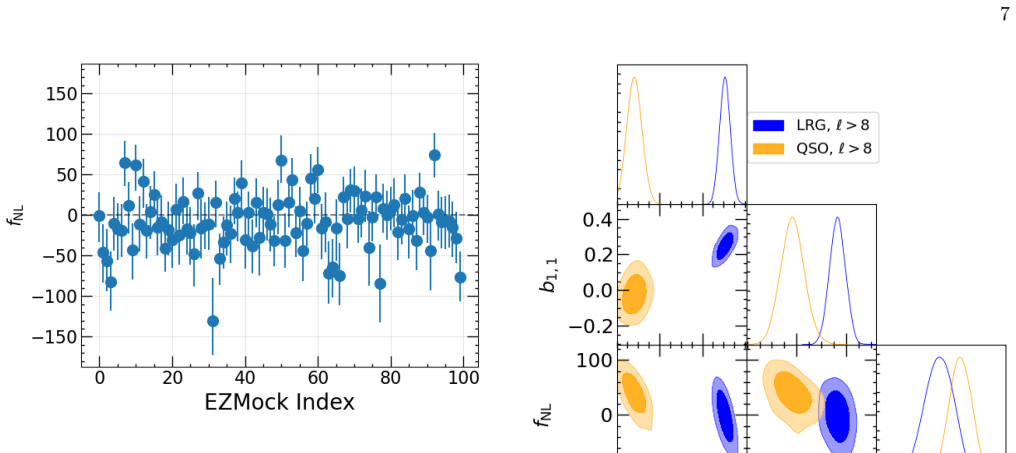
The Spherical Fourier-Bessel (SFB) basis, in separating the angular and radial modes of the power spectrum, permits a targeted identification and mitigation of systematics in clustering surveys while retaining more cosmological signal than traditional bases. We demonstrate this principle on the eBOSS DR16 LRG and QSO samples, identifying modes which may be contaminated by systematics. Our initial inference on the LRG sample yields an fNL value consistent with zero, while the QSO value is in slight tension with zero. Using the SFB basis, we vary the selection of angular and radial modes to search for inconsistencies in the inferred value of fNL, an indicator of underlying systematics. In the QSO sample, we find evidence (p < 0.005 compared to the same cuts on EZMocks) of a systematic afflicting large physical scales, which is consistent with residual stellar contamination; we also find evidence (p < 0.05) for an unknown systematic in the QSO and LRG samples at the approximate angular plate and imaging scale of eBOSS.
Editorial analysis
A structured set of objections, weighed in public.
Referee Report
Summary. The manuscript proposes the use of the Spherical Fourier-Bessel (SFB) basis for identifying and mitigating systematics in large-scale galaxy clustering measurements, as it separates angular and radial modes while potentially retaining more cosmological information than standard bases. Applied to the eBOSS DR16 LRG and QSO samples, the authors vary selections of angular and radial modes and use inconsistencies in the inferred local primordial non-Gaussianity parameter f_NL as a diagnostic for systematics. They report statistically significant evidence (p < 0.005 relative to EZMocks) for a large-scale systematic in the QSO sample consistent with residual stellar contamination, and evidence (p < 0.05) for an unknown systematic affecting both samples at the scale of eBOSS angular plates and imaging.
Significance. If the central claims hold after detailed validation, the SFB-based mode-variation approach could provide a useful diagnostic tool for systematics in future surveys (e.g., DESI, Euclid) where large-scale modes inform primordial non-Gaussianity and other cosmological parameters. The choice of f_NL as an independent diagnostic is a methodological strength, as is the explicit comparison to EZMocks. However, the overall significance remains provisional given the absence of full methodological details.
major comments (2)
- [Abstract] Abstract: The reported p < 0.005 (QSO large-scale) and p < 0.05 (plate-scale) evidence for systematics is load-bearing for the central claim, yet the abstract provides no information on the precise angular/radial mode cuts applied, the exact statistical procedure for the p-value calculation, the number of tests performed, or any multiple-comparison correction. Without these, it is impossible to assess whether the significances are robust or inflated.
- [Abstract] Abstract: The interpretation that f_NL inconsistencies under SFB mode selections reliably flag systematics (stellar contamination or unknown plate-scale effects) rather than statistical fluctuations, EZMocks mismatches, or post-selection biases is a key assumption. This requires explicit validation in the methods, including quantitative checks that SFB retains more signal than traditional bases and that the reported p-values survive verification of post-selection effects.
minor comments (1)
- [Abstract] Abstract: Adding brief context on sample sizes, redshift ranges, and the exact definition of the 'large physical scales' and 'angular plate scale' would improve clarity for readers unfamiliar with eBOSS specifics.
Simulated Author's Rebuttal
We thank the referee for their constructive feedback, which has helped us improve the clarity and robustness of our presentation. We address each major comment below and have revised the manuscript to incorporate additional details and validations where appropriate.
read point-by-point responses
-
Referee: [Abstract] Abstract: The reported p < 0.005 (QSO large-scale) and p < 0.05 (plate-scale) evidence for systematics is load-bearing for the central claim, yet the abstract provides no information on the precise angular/radial mode cuts applied, the exact statistical procedure for the p-value calculation, the number of tests performed, or any multiple-comparison correction. Without these, it is impossible to assess whether the significances are robust or inflated.
Authors: We agree that the abstract should provide sufficient information for readers to evaluate the statistical claims. In the revised manuscript, we have expanded the abstract to specify the angular and radial mode cuts (large-scale radial modes with k < 0.01 h/Mpc and angular modes corresponding to eBOSS plate scales), the p-value procedure (fraction of EZMocks yielding more extreme f_NL shifts under identical cuts), and clarified that the tests are a small number of targeted, pre-specified selections rather than an exhaustive search requiring multiple-comparison correction. The full procedural details remain in the methods section. revision: yes
-
Referee: [Abstract] Abstract: The interpretation that f_NL inconsistencies under SFB mode selections reliably flag systematics (stellar contamination or unknown plate-scale effects) rather than statistical fluctuations, EZMocks mismatches, or post-selection biases is a key assumption. This requires explicit validation in the methods, including quantitative checks that SFB retains more signal than traditional bases and that the reported p-values survive verification of post-selection effects.
Authors: We acknowledge that explicit validation strengthens the central claim. The manuscript already demonstrates that SFB retains additional cosmological information relative to traditional bases through direct comparison of f_NL constraints. We have added a new methods subsection with quantitative checks: (i) signal retention is quantified by comparing the variance of f_NL posteriors in SFB versus standard bases on the same data, and (ii) post-selection effects are tested by repeating the exact mode-variation procedure on EZMocks, confirming that the observed p-values do not arise from the selection process itself. These additions address the concern without altering the reported results. revision: partial
Circularity Check
No significant circularity
full rationale
The abstract presents the SFB basis as a tool for mode separation to detect systematics via inconsistencies in fNL inferences across angular/radial cuts, benchmarked against EZMocks with reported p-values. No derivation chain, fitted parameter, or self-citation is described that reduces the claimed evidence (stellar contamination at large scales, unknown effect at plate scale) to an input by construction. The diagnostic use of fNL is independent and externally compared, making the approach self-contained against the provided text.
Axiom & Free-Parameter Ledger
axioms (2)
- domain assumption The Spherical Fourier-Bessel basis separates angular and radial modes more effectively than traditional bases, permitting targeted systematics identification while retaining more cosmological signal.
- domain assumption Inconsistencies in inferred fNL across different selections of angular and radial modes indicate the presence of underlying systematics in the data.
Lean theorems connected to this paper
-
IndisputableMonolith/Foundation/AlexanderDuality.leanalexander_duality_circle_linking unclearThe Spherical Fourier-Bessel (SFB) basis, in separating the angular and radial modes of the power spectrum, permits a targeted identification and mitigation of systematics... We use the public code SuperFaB for estimating SFB power spectrum... Cℓnn′ = ∫ dq Wnℓ(q) Wn′ℓ(q) Pm,0(q)
-
IndisputableMonolith/Foundation/ArithmeticFromLogic.leanembed_strictMono_of_one_lt unclearIn the QSO sample, we find evidence (p < 0.005...) of a systematic afflicting large physical scales... at the approximate angular plate and imaging scale of eBOSS.
Reference graph
Works this paper leans on
-
[1]
are or will soon be measuring the 3-dimensional large-scale structure (LSS) of the Universe with unprece- dented statistical precision. Advances in technology, infrastructure, and in observational and computational techniques mean that these surveys will measureO(109) galaxies over an unparalleled cosmological volume. With such advances in statistical pre...
work page internal anchor Pith review Pith/arXiv arXiv 2002
-
[2]
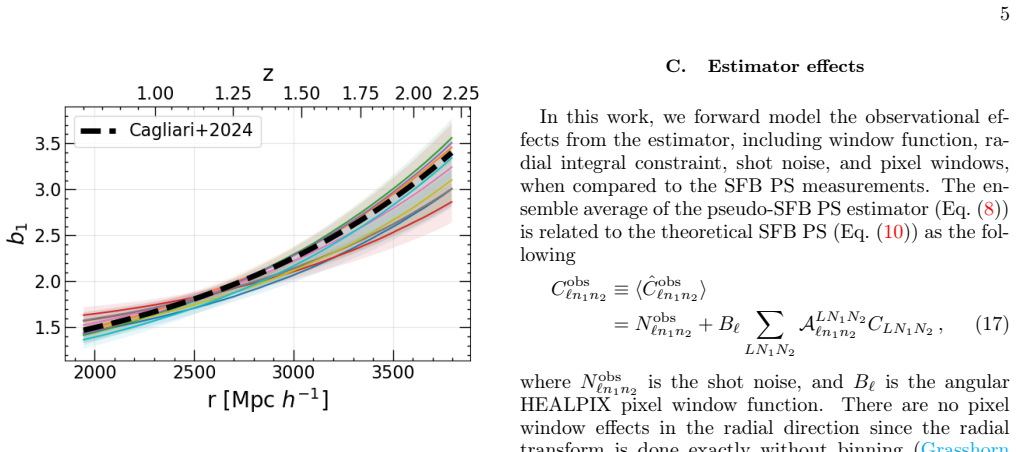
Chebyshev expansion The linear galaxy biasb1 is redshift-dependent for se- lected galaxy samples, and here we use the Chebyshev polynomialsT n up to theNth order to model its redshift evolution b1(z) = PN n=0 b1,nTn(˜x(z)) D(z) .(14) We performed the Chebyshev expansion over the nor- malized comoving distance˜x(x(z)) = (x(z)−x mid)/∆x wherex mid = 1 2(xma...
work page 2024
-
[3]
were constructed using the Effective Zel’dovich ap- proximation and a standard flatΛCDM cosmology with Ωm = 0.31. Both “complete” and “realistic” catalogs are provided, the former representing an ideal galaxy cat- alog observed perfectly, free from any observational ef- fects, and the latter representing catalogs which have had all known observational and...
work page 2024
-
[4]
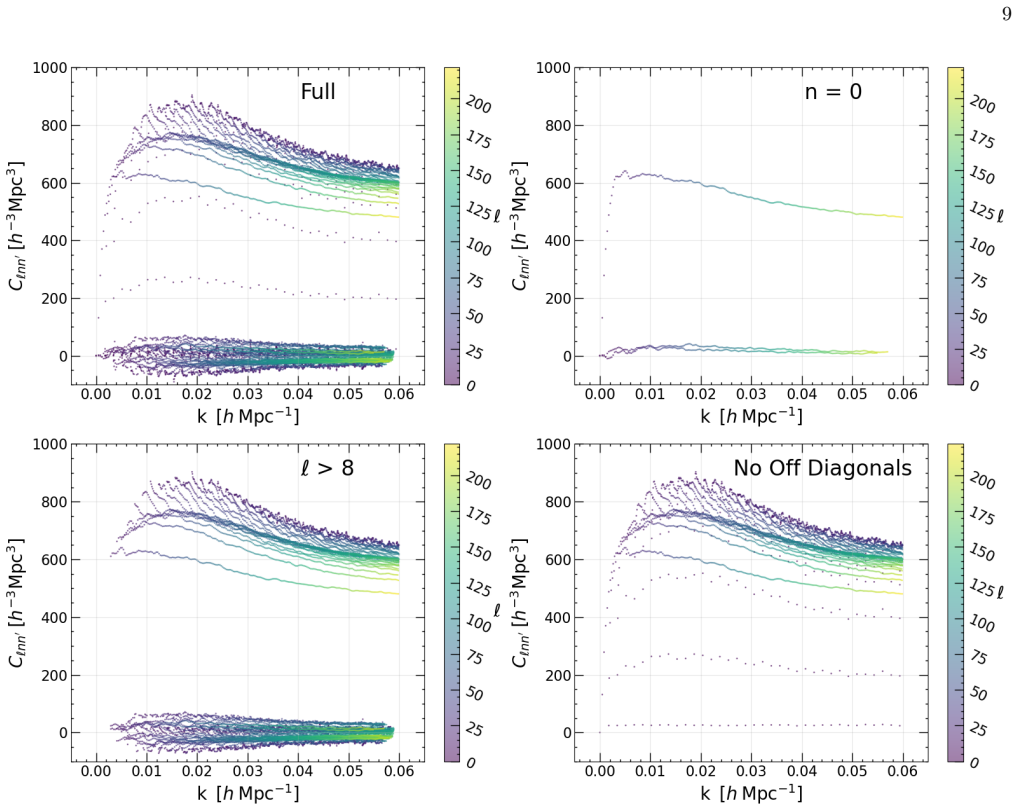
A givennmode expresses as a continuous “trace” in the SFB power spectrum withℓincreasing as effectivekincreases (the upper right panel shows the n=0 mode and its first two off-diagonals),
-
[5]
lowℓmodes tend to turn over and rapidly approach zero power acrossnmodes (compare the modes re- moved between the upper- and lower-left panels), a result of the integral constraint, and
-
[6]
off diagonals (n̸=n ′) tend to cluster near zero, a reflection of cosmological homogeneity (lower right panel) (Kheket al.2024). A. Radial Cuts We take one LRG EZMock and successively increase the lowestnkept in the data vector,nmin and inferfNL. Note that all of the cuts also include anℓmin = 8cut to remove modes which are too large to be probed by the s...
work page 2024
-
[7]
the lowℓrange is biased high and this bias is worse for the QSO sample and 2) removing then= 0mode from the QSO data vector removes a significant amount of this bias. Recalling the Wenet al.(2025) result that stellar con- tamination largely resides in the(n= 0, ℓ <∼ 50)modes, one possible source of this systematic may be residual stellar contamination in ...
-
[8]
cutting the off-diagonals from the data vector,
-
[9]
changing the assumedpvalue, and
-
[10]
allowing a more flexible FoG model and fitting its parameters
-
[11]
Off-Diagonals Unaccounted for radial inhomogeneities in the data would manifest as excess power in the off-diagonals of the SFB power spectrum. Such radial inhomogeneities, on the largest scales, could arise from , e.g., systematics or FoG model misspecification. As such, it is reasonable to try cutting the off-diagonals, which may be where prob- lematic ...
-
[12]
Changing the value ofp The value ofp, which, as described in Section IIB, characterizes the merger history of the tracer, controls the response of a tracer tofNL throughb ϕ, which is in turnfullydegeneratewiththevalueoff NL. QSOs, inpre- vious studies, are typically prescribed a value ofp= 1.6, adivergencefromtheuniversalityrelation, reflectingthat quasar...
work page 2024
-
[13]
FoG Modeling Finally, we consider that the FoG model has insuffi- cient complexity to describe the real behavior, which we hypothesize could lead to a bias in the inferredfNL. Totestthis, weallowmoreflexibilityintheFoGmodel, letting it evolve in redshift in the same manner that our bias model evolves (with Chebyshev polynomials, see Eq. (16)). With this n...
discussion (0)
Sign in with ORCID, Apple, or X to comment. Anyone can read and Pith papers without signing in.