Recognition: 2 theorem links
· Lean TheoremOverturning instability in forced ageostrophic oceanic flows
Pith reviewed 2026-05-13 06:32 UTC · model grok-4.3
The pith
Criteria for overturning instability in ocean flows must account for ageostrophic shear on forced boundaries rather than relying solely on geostrophic potential vorticity.
A machine-rendered reading of the paper's core claim, the machinery that carries it, and where it could break.
Core claim
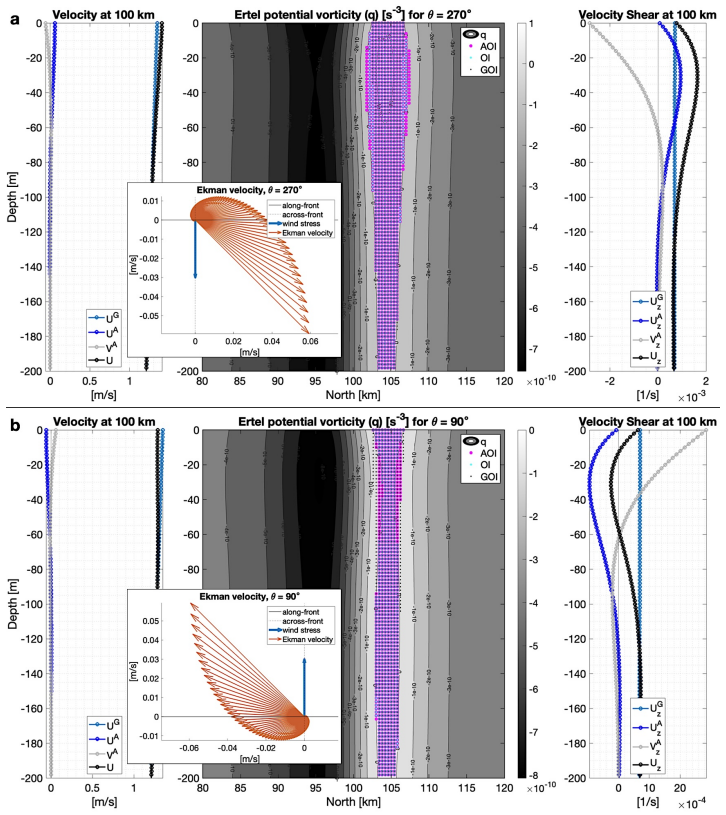
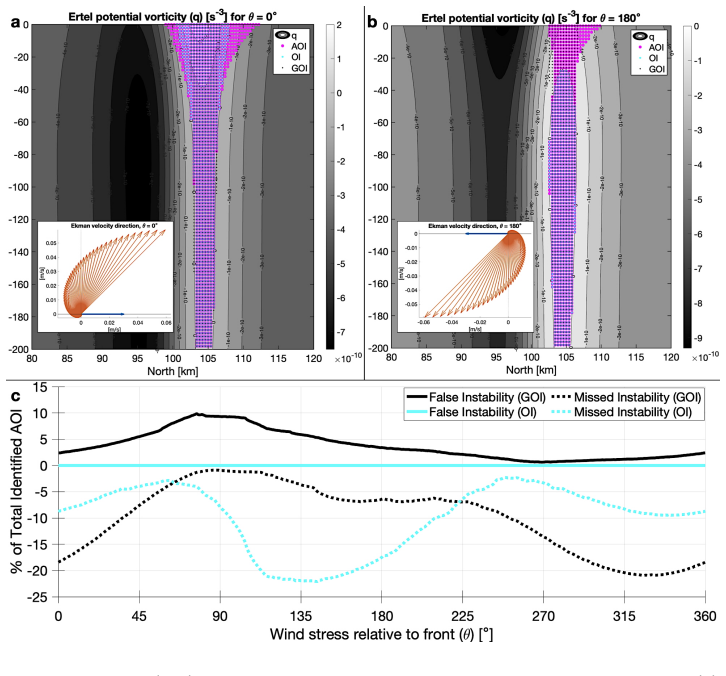
The authors derive criteria for overturning instability that account for stabilizing and destabilizing effects of ageostrophic shear on mechanically forced boundaries. This deviates from the geostrophically derived potential vorticity criterion qf < 0. In applications to a feature model and ROMS hindcast, ageostrophic forcing modifies stability from that implied by vertical PV structure, and ageostrophic shear increases overturning instability by up to 20% compared to a strictly geostrophic framework.
What carries the argument
The forced ageostrophic overturning instability (AOI) criteria that extend the geostrophic PV criterion by including ageostrophic shear effects on boundaries.
If this is right
- Ageostrophic shear increases overturning instability by up to 20% in wind-forced jets.
- Bulk surface boundary layer diagnostics based on vertical PV may have limited applicability in strongly forced regimes.
- Layer-resolved measures are needed to assess instability in intense frontal zones.
- Submesoscale frontal instabilities contribute to TKE in subpolar oceans with intense storm forcing.
Where Pith is reading between the lines
- Regional ocean models may underestimate turbulent kinetic energy production if they ignore ageostrophic contributions to frontal instability.
- These criteria could improve parameterizations of mixing in areas with complex littoral topography and strong mechanical forcing.
- Further validation in other ocean basins could reveal how widespread forced ageostrophic effects are in submesoscale dynamics.
Load-bearing premise
Ageostrophic forcing modifies stability from that implied by the vertical PV structure underlying bulk surface boundary layer diagnostics.
What would settle it
A direct comparison of instability growth rates in high-resolution simulations with and without resolved ageostrophic shear components, checking if the observed increase reaches 20% in forced jet setups.
Figures




read the original abstract
The subpolar oceans are characterized by intense storm forcing and complex littoral topography. Submesoscale frontal instabilities are significant sources of turbulent kinetic energy (TKE) in these regions. However, criteria for identifying and parameterizing these instabilities in regional models have predominantly relied on a geostrophic framework that neglects generalized ageostrophic shear. We derive criteria for overturning instability that account for stabilizing and destabilizing effects of ageostrophic shear on mechanically forced boundaries, deviating from the geostrophically derived potential vorticity (PV) criterion, $qf < 0$. Ageostrophic forcing modifies stability from that implied by the vertical PV structure underlying bulk surface boundary layer diagnostics, which may limit the applicability of such bulk criteria in strongly forced regimes and motivate the need for layer-resolved measures. We demonstrate their application using a feature model of a wind-forced jet, as well as a 1-km Regional Ocean Modeling System (ROMS) hindcast of the high North Atlantic, and assess the importance of forced ageostrophic overturning instability (AOI) in intense frontal zones. In the feature model, ageostrophic shear increases overturning instability by up to 20%, compared to a strictly geostrophic framework.
Editorial analysis
A structured set of objections, weighed in public.
Referee Report
Summary. The paper derives criteria for overturning instability in forced ageostrophic oceanic flows that incorporate stabilizing and destabilizing effects of ageostrophic shear on mechanically forced boundaries. These deviate from the standard geostrophic potential vorticity criterion qf < 0. In a feature model of a wind-forced jet, ageostrophic shear increases overturning instability by up to 20% relative to the geostrophic case. The criteria are further applied to a 1-km ROMS hindcast of the high North Atlantic to evaluate the role of forced ageostrophic overturning instability (AOI) in intense frontal zones. The work argues that ageostrophic forcing modifies stability relative to vertical PV structure, limiting the applicability of bulk surface boundary layer diagnostics in strongly forced regimes.
Significance. If the derivation is robust, the result provides a physically grounded refinement to submesoscale instability criteria that are central to turbulent kinetic energy generation in storm-forced subpolar oceans. The explicit 20% quantitative increase in the feature model, together with the ROMS demonstration, supplies a falsifiable benchmark for how much traditional geostrophic PV diagnostics may underestimate instability under mechanical forcing. The combination of an analytical modification to an existing criterion and its illustration in both idealized and realistic configurations is a clear strength.
major comments (2)
- Feature model section: the reported maximum 20% increase in overturning instability requires an explicit side-by-side comparison of the modified criterion against qf < 0, including the precise definition of the ageostrophic shear term and any sensitivity to the chosen wind stress or jet parameters.
- ROMS hindcast section: the assessment of AOI importance in frontal zones should include at least one quantitative metric (e.g., fraction of grid points where the modified criterion is satisfied versus the geostrophic one) rather than relying solely on qualitative description.
minor comments (2)
- Abstract: the phrase 'up to 20%' should be accompanied by a brief statement of the conditions (e.g., wind stress magnitude or shear strength) that produce the maximum value.
- Notation: ensure the modified instability criterion is written with all symbols defined at first use, particularly any new ageostrophic correction term.
Simulated Author's Rebuttal
We thank the referee for their constructive review and recommendation for minor revision. We have revised the manuscript to incorporate explicit comparisons and quantitative metrics as suggested, which we believe strengthen the presentation without altering the core conclusions.
read point-by-point responses
-
Referee: Feature model section: the reported maximum 20% increase in overturning instability requires an explicit side-by-side comparison of the modified criterion against qf < 0, including the precise definition of the ageostrophic shear term and any sensitivity to the chosen wind stress or jet parameters.
Authors: We agree that an explicit side-by-side comparison improves clarity. In the revised manuscript we add a dedicated panel (new Figure 3) that directly compares the modified overturning criterion to the geostrophic qf < 0 condition for the same wind-forced jet profiles. The ageostrophic shear term is now defined explicitly in the text preceding the figure as the contribution arising from the cross-front ageostrophic velocity component in the generalized shear expression (see revised Equation 8). We also include a short sensitivity subsection (Section 3.3) showing that the reported maximum 20% increase remains within 15–25% across a range of wind-stress magnitudes (0.1–0.5 N m⁻²) and jet widths (10–30 km) consistent with the feature-model setup. revision: yes
-
Referee: ROMS hindcast section: the assessment of AOI importance in frontal zones should include at least one quantitative metric (e.g., fraction of grid points where the modified criterion is satisfied versus the geostrophic one) rather than relying solely on qualitative description.
Authors: We accept this suggestion. The revised Section 4 now reports the fraction of grid points within identified frontal zones (defined by horizontal density gradient > 5 × 10⁻⁵ kg m⁻⁴) where the modified AOI criterion is satisfied versus the geostrophic qf < 0 criterion. Over the 30-day hindcast period this yields 28% of frontal-zone points satisfying the modified criterion compared with 19% for the geostrophic criterion, corresponding to an additional 9% of the domain area. These statistics are presented in a new table (Table 2) and briefly discussed in the text. revision: yes
Circularity Check
Derivation self-contained from fluid-dynamical principles with no circular reductions
full rationale
The manuscript derives modified overturning-instability criteria by extending the standard geostrophic PV criterion qf < 0 to include explicit ageostrophic shear terms on mechanically forced boundaries. This extension follows directly from the governing equations without any parameter fitting, self-referential definitions, or load-bearing self-citations that collapse the central result back to its inputs. The reported 20 % increase in instability measure is obtained by applying the derived criterion to an independent feature model and ROMS hindcast, not by construction from the same data used to define the criterion. No steps match the enumerated circularity patterns.
Axiom & Free-Parameter Ledger
axioms (1)
- standard math Potential vorticity is materially conserved in the absence of forcing and dissipation
Lean theorems connected to this paper
-
IndisputableMonolith/Foundation/AbsoluteFloorClosure.leanreality_from_one_distinction unclear?
unclearRelation between the paper passage and the cited Recognition theorem.
We derive criteria for overturning instability that account for stabilizing and destabilizing effects of ageostrophic shear... deviating from the geostrophically derived potential vorticity (PV) criterion, qf < 0.
-
IndisputableMonolith/Cost/FunctionalEquation.leanwashburn_uniqueness_aczel unclear?
unclearRelation between the paper passage and the cited Recognition theorem.
The condition for unstable modes to exist becomes M⁴ + 2M²n² + n⁴ − 4N²fζa > 0
What do these tags mean?
- matches
- The paper's claim is directly supported by a theorem in the formal canon.
- supports
- The theorem supports part of the paper's argument, but the paper may add assumptions or extra steps.
- extends
- The paper goes beyond the formal theorem; the theorem is a base layer rather than the whole result.
- uses
- The paper appears to rely on the theorem as machinery.
- contradicts
- The paper's claim conflicts with a theorem or certificate in the canon.
- unclear
- Pith found a possible connection, but the passage is too broad, indirect, or ambiguous to say the theorem truly supports the claim.
Reference graph
Works this paper leans on
-
[1]
Stamper, M. (2017). Frontal circulation and submesoscale variability during the formation of a southern ocean mesoscale eddy.J. Phys. Oceanogr.,47, 1737–1753
work page 2017
-
[2]
Bachman, S. D., Fox-Kemper, B., Taylor, J. R., & Thomas, L. N. (2017). Param- eterization of frontal symmetric instabilities. i: Theory for resolved fronts. Ocean Model.,109, 72–95
work page 2017
-
[3]
Boccaletti, G., Ferrari, R., & Fox-Kemper, B. (2007). Mixed layer instabilities and restratification.J. Phys. Oceanogr.,37, 2228–2250
work page 2007
-
[4]
Baschek, B., & Umlauf, L. (2020). Shear instability and turbulence within a submesoscale front following a storm.Geophys. Res. Lett.,47
work page 2020
-
[5]
Chor, T., & Wenegrat, J. O. (2024). The turbulent dynamics of anticyclonic sub- mesoscale headland wakes.EarthArXiv. (Available at:https://doi.org/10 .31223/X5570C) D’Asaro, E., Lee, C., Rainville, L., Thomas, L., & Harcourt, R. (2011). Enhanced turbulence and energy dissipation at ocean fronts.Science, 1201515
work page 2024
-
[6]
Dong, J., Fox-Kemper, B., Zhang, H., & Dong, C. (2021). The scale and activity of symmetric instability estimated from a global submesoscale-permitting ocean model.J. Phys. Oceanogr.,51, 1655–1670
work page 2021
-
[7]
Fairall, C. W., Bradley, E. F., Rogers, D. P., Edson, J. B., & Young, G. S. (1996). Bulk parameterization of air–sea fluxes for tropical ocean–global atmosphere coupled–ocean atmosphere response experiment.J. Geophys. Res.: Oceans, 101, 3747–3764
work page 1996
- [8]
-
[9]
A., Merrifield, S., Shroyer, E
Ferris, L., Gong, D., Clayson, C. A., Merrifield, S., Shroyer, E. L., Smith, M., & St. Laurent, L. (2022). Shear turbulence in the high-wind southern ocean using direct measurements.J. Phys. Oceanogr.,52(10), 2325–2341
work page 2022
-
[10]
Ferris, L., Gong, D., & Klinck, J. (2025). Topographic forcing of submesoscale insta- bility in the antarctic circumpolar current.Frontiers in Marine Science,12
work page 2025
- [11]
-
[12]
(2025).1-km roms model output for iceland basin (may 2018).doi: 10.25773/2EWW-DZ52
Ferris, L., & Simmons, H. (2025).1-km roms model output for iceland basin (may 2018).doi: 10.25773/2EWW-DZ52
-
[13]
Gangopadhyay, A., & Robinson, A. R. (2002). Feature-oriented regional modeling of oceanic fronts.Dyn. Atmos. Oceans,36(1-3), 201–232
work page 2002
-
[14]
Gelaro, R., & Coauthors. (2017). The modern-era retrospective analysis for research and applications, version 2 (merra-2).J. Clim.,30, 5419–5454
work page 2017
-
[15]
Haine, T. W., & Marshall, J. (1998). Gravitational, symmetric, and baroclinic insta- bility of the ocean mixed layer.J. Phys. Oceanogr.,28, 634–658
work page 1998
-
[16]
Hamlington, P. E., Van Roekel, L. P., Fox-Kemper, B., Julien, K., & Chini, G. P. (2014). Langmuir–submesoscale interactions: Descriptive analysis of multiscale frontal spindown simulations.J. Phys. Oceanogr.,44(9), 2249–2272
work page 2014
-
[17]
Haney, S., Fox-Kemper, B., Julien, K., & Webb, A. (2015). Symmet- ric and geostrophic instabilities in the wave-forced ocean mixed layer. J. Phys. Oceanogr.,45, 3033–3056
work page 2015
-
[18]
Hoskins, B. J. (1974). The role of potential vorticity in symmetric stability and in- stability.Q. J. R. Meteorol. Soc.,100, 480–482
work page 1974
-
[19]
Large, W. G., McWilliams, J. C., & Doney, S. C. (1994). Oceanic vertical mix- ing: A review and a model with a nonlocal boundary layer parameterization. Rev. Geophys.,32, 363–403
work page 1994
-
[20]
Large, W. G., & Pond, S. (1981). Open ocean momentum flux measurements in moderate to strong winds.J. Phys. Oceanogr.,11, 324–336
work page 1981
-
[21]
Mahadevan, A. (2006). Modeling vertical motion at ocean fronts: Are nonhydro- static effects relevant at submesoscales?Ocean Model.,14, 222–240. Naveira Garabato, A. C., & Coauthors. (2019). Rapid mixing and exchange of deep-ocean waters in an abyssal boundary current.Proc. Natl. Acad. Sci.,116, 13233–13238. –19–
work page 2006
-
[22]
Ooyama, K. (1966). On the stability of the baroclinic circular vortex: a sufficient criterion for instability.J. Atmos. Sci.,23, 43–53
work page 1966
-
[23]
Risien, C. M., & Chelton, D. B. (2008). A global climatology of surface wind and wind stress fields from eight years of quikscat scatterometer data. J. Phys. Oceanogr.,38, 2379–2414
work page 2008
-
[24]
Shakespeare, C. J. (2016). Curved density fronts: Cyclogeostrophic adjustment and frontogenesis.J. Phys. Oceanogr.,46, 3193–3207
work page 2016
-
[25]
Shchepetkin, A. F., & McWilliams, J. C. (2005). The regional oceanic modeling system (roms): a split-explicit, free-surface, topography-following-coordinate oceanic model.Ocean Model.,9, 347–404
work page 2005
-
[26]
D., Duncombe, J., & Samelson, R
Skyllingstad, E. D., Duncombe, J., & Samelson, R. M. (2017). Baroclinic frontal instabilities and turbulent mixing in the surface boundary layer. part ii: Forced simulations.J. Phys. Oceanogr.,47, 2429–2454
work page 2017
-
[27]
Skyllingstad, E. D., & Samelson, R. M. (2020). Instability processes in simulated finite-width ocean fronts.J. Phys. Oceanogr.,50, 2781–2796
work page 2020
-
[28]
Smyth, W. D., & Carpenter, J. R. (2019).Instability in geophysical flows. Cam- bridge University Press
work page 2019
-
[29]
Stamper, M. A., & Taylor, J. R. (2017). The transition from symmetric to baroclinic instability in the eady model.Ocean Dyn.,67, 65–80
work page 2017
-
[30]
Stone, P. H. (1966). On non-geostrophic baroclinic stability.J. Atmos. Sci.,23, 390–400
work page 1966
-
[31]
Stone, P. H. (1970). On non-geostrophic baroclinic stability: Part ii.J. Atmos. Sci., 27, 721–726
work page 1970
-
[32]
Taylor, J., & Ferrari, R. (2010). Buoyancy and wind-driven convection at mixed layer density fronts.J. Phys. Oceanogr., 1222–1242
work page 2010
-
[33]
Shcherbina, A. (2016). Symmetric instability, inertial oscillations, and tur- bulence at the gulf stream front.J. Phys. Oceanogr.,46, 197–217
work page 2016
-
[34]
Thomas, L. N., Taylor, J. R., Ferrari, R., & Joyce, T. M. (2013). Symmetric insta- bility in the gulf stream.Deep Sea Res. Part II Top. Stud.,91, 96–110
work page 2013
-
[35]
Todd, R., Owens, W., & Rudnick, D. (2016). Potential vorticity structure in the north atlantic western boundary current from underwater glider observations. Journal of Physical Oceanography,46(1), 327–348
work page 2016
-
[36]
Warner, J. C., Sherwood, C. R., Arango, H. G., & Signell, R. P. (2005). Perfor- mance of four turbulence closure models implemented using a generic length scale method.Ocean Model.,8(1-2), 81–113
work page 2005
-
[37]
Wenegrat, J. O., & Thomas, L. N. (2020). Centrifugal and symmetric instability during ekman adjustment of the bottom boundary layer.J. Phys. Oceanogr., 50, 1793–1812
work page 2020
-
[38]
Yankovsky, E., Legg, S., & Hallberg, R. (2021). Parameterization of submesoscale symmetric instability in dense flows along topography. J. Adv. Model. Earth Syst., 2020MS002264. –20–
work page 2021
discussion (0)
Sign in with ORCID, Apple, or X to comment. Anyone can read and Pith papers without signing in.