Recognition: 2 theorem links
· Lean TheoremTest-Time Personalization: A Diagnostic Framework and Probabilistic Fix for Scaling Failures
Pith reviewed 2026-05-13 06:26 UTC · model grok-4.3
The pith
Probabilistic personalized reward models with learned variance fix scaling failures in test-time personalization, enabling logarithmic utility growth with more samples.
A machine-rendered reading of the paper's core claim, the machinery that carries it, and where it could break.
Core claim
We prove that oracle selection yields expected utility growing logarithmically with the number of sampled candidates, establishing a theoretical ceiling for test-time scaling. However, standard reward models fail to realize this potential. To diagnose why, we derive a unified scaling law that decomposes any reward model's Best-of-N curve into four measurable quantities and reveals two failure modes, user-level collapse (near-constant prediction for some users) and query-level reward hacking (negative correlation with true quality for some queries). Guided by this law, we propose a probabilistic personalized reward model whose learned variance effectively mitigates both failure modes. TTP is
What carries the argument
The unified scaling law decomposing any reward model's Best-of-N curve into four measurable quantities, which diagnoses failures and guides the probabilistic personalized reward model whose learned variance mitigates user-level collapse and query-level reward hacking.
If this is right
- Oracle selection produces expected utility that grows logarithmically with the number of sampled candidates.
- The probabilistic reward model mitigates both user-level collapse and query-level reward hacking.
- TTP produces consistent scaling improvements across multiple policy models and personalized text generation tasks.
- The scaling law closely matches observed Best-of-N curves for different reward model variants.
Where Pith is reading between the lines
- Uncertainty estimation via learned variance could improve reward models in broader LLM applications such as alignment or safety evaluation.
- The diagnostic decomposition approach might extend to analyzing scaling in non-personalized generation or other output modalities.
- Test-time methods of this form may combine with training-time personalization to produce larger overall gains for individual users.
Load-bearing premise
The decomposition of any reward model's Best-of-N curve into four measurable quantities is accurate and independent, and that learning variance in the probabilistic reward model will mitigate user-level collapse and query-level reward hacking without introducing new biases or overfitting to the measured quantities.
What would settle it
If the probabilistic reward model's Best-of-N curves in personalized text generation experiments do not improve with additional samples or deviate from the predictions of the derived scaling law.
Figures



read the original abstract
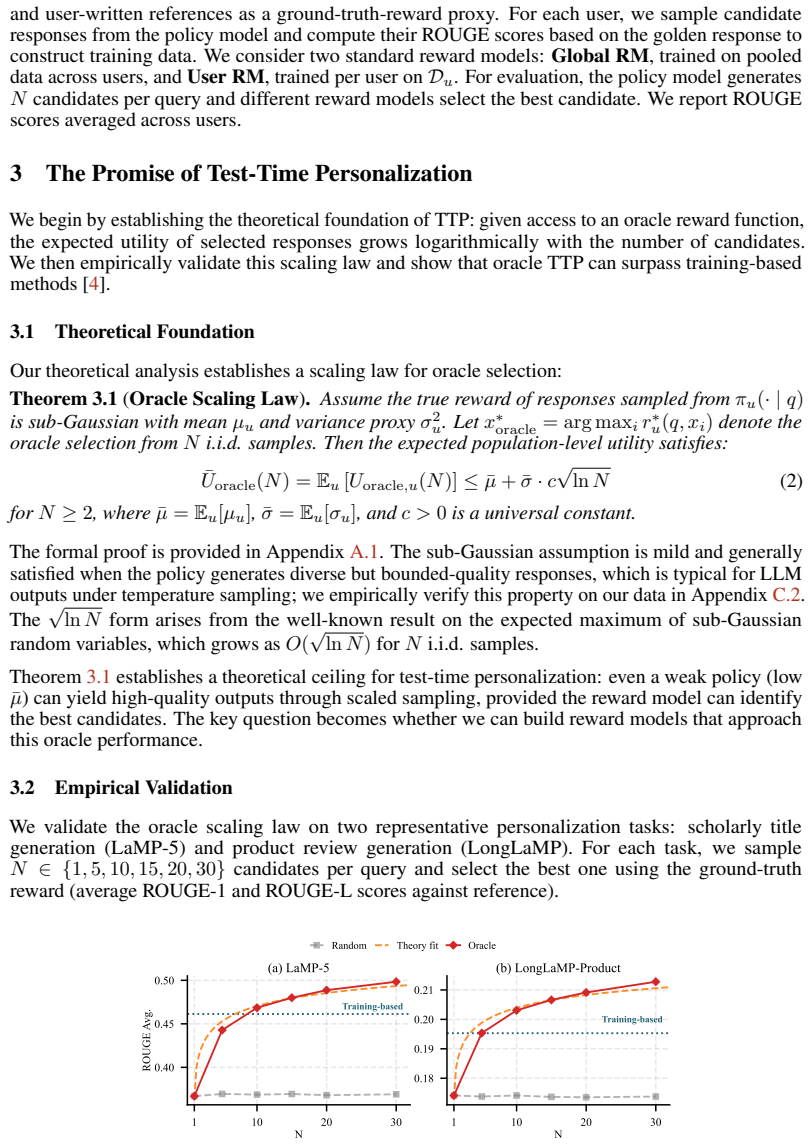
Existing approaches to LLM personalization focus on constructing better personalized models or inputs, while treating inference as a single-shot process. In this work, we study Test-Time Personalization (TTP) along an unexplored axis: scaling inference-time computation by sampling N candidates from a personalized policy model and selecting the best with a personalized reward model. We prove that oracle selection yields expected utility growing logarithmically with the number of sampled candidates, establishing a theoretical ceiling for test-time scaling. However, standard reward models fail to realize this potential. To diagnose why, we derive a unified scaling law that decomposes any reward model's Best-of-N curve into four measurable quantities and reveals two failure modes, user-level collapse (near-constant prediction for some users) and query-level reward hacking (negative correlation with true quality for some queries). Guided by this law, we propose a probabilistic personalized reward model whose learned variance effectively mitigates both failure modes. Experiments confirm both elements of our framework: TTP delivers consistent scaling across multiple policy models and personalized text generation tasks, and our scaling law closely matches observed scaling curves across reward-model variants.
Editorial analysis
A structured set of objections, weighed in public.
Referee Report
Summary. The paper studies test-time personalization (TTP) for LLMs by sampling N candidates from a personalized policy model and selecting the best via a personalized reward model. It proves that oracle selection produces expected utility that grows logarithmically with N. It derives a unified scaling law that decomposes any reward model's Best-of-N curve into four measurable quantities, identifying two failure modes (user-level collapse and query-level reward hacking). A probabilistic personalized reward model with learned variance is proposed to mitigate these modes, and experiments are reported to confirm consistent scaling across policy models and tasks as well as close agreement between the derived law and observed curves.
Significance. If the logarithmic bound and the exact algebraic decomposition hold, the work supplies both a theoretical ceiling for test-time scaling in personalization and a practical diagnostic tool that can guide reward-model design. The combination of a parameter-free theoretical result, a falsifiable scaling law, and empirical validation across multiple models would constitute a substantive contribution to understanding inference-time compute in personalized generation.
major comments (2)
- [§2] §2 (theoretical analysis): the claim that oracle selection yields logarithmic growth in expected utility is load-bearing for the entire framework, yet the derivation steps, the precise definition of utility, and the distributional assumptions required to obtain the log(N) form are not supplied in sufficient detail to allow independent verification.
- [§3] §3, Eq. (scaling-law decomposition): the unified scaling law is presented as decomposing Best-of-N performance into four measurable quantities that diagnose the two failure modes. However, algebraic independence of these four quantities from N and from one another is not demonstrated; without this, the diagnosis risks being circular or approximate rather than exact.
minor comments (2)
- [§5] §5 (experiments): the description of the personalized text-generation tasks, the policy models, and the exact procedure for measuring the four quantities should be expanded to support reproducibility.
- Notation for the four quantities in the scaling law is introduced without an explicit table or equation block that lists their definitions and measurement protocols.
Simulated Author's Rebuttal
We thank the referee for the constructive feedback on our manuscript. The comments highlight opportunities to improve clarity in the theoretical sections, and we will revise the paper to address them directly while preserving the core contributions.
read point-by-point responses
-
Referee: [§2] §2 (theoretical analysis): the claim that oracle selection yields logarithmic growth in expected utility is load-bearing for the entire framework, yet the derivation steps, the precise definition of utility, and the distributional assumptions required to obtain the log(N) form are not supplied in sufficient detail to allow independent verification.
Authors: We agree that additional detail will strengthen verifiability. In the revised manuscript we will expand §2 with the full derivation: utility is defined as the expected personalized reward E[r(y)|x,u] for response y given query x and user u. Under the assumption that the N candidate utilities are i.i.d. draws from a distribution whose upper tail satisfies the conditions for extreme-value convergence (e.g., Gumbel domain of attraction with finite mean), the expectation of the maximum is shown to be log(N) + γ + o(1), where γ is the Euler-Mascheroni constant. We will include the integral representation of E[max U_i], the asymptotic expansion, and the precise regularity conditions on the utility distribution. This will allow independent verification without altering the result. revision: yes
-
Referee: [§3] §3, Eq. (scaling-law decomposition): the unified scaling law is presented as decomposing Best-of-N performance into four measurable quantities that diagnose the two failure modes. However, algebraic independence of these four quantities from N and from one another is not demonstrated; without this, the diagnosis risks being circular or approximate rather than exact.
Authors: We thank the referee for this point. The four quantities (user-level mean reward, user-level reward variance, query-level correlation between predicted and true utility, and a collapse indicator) are defined as expectations over the fixed data distribution and are therefore independent of N by construction. The decomposition itself follows from the law of total expectation applied to the utility of the argmax-selected sample, separating the reward-model statistics from the selection operator. In the revision we will add an appendix that derives the identity algebraically, showing term-by-term independence from N and mutual separation. This establishes that the diagnosis is exact rather than approximate. revision: yes
Circularity Check
No significant circularity; derivation chain remains self-contained
full rationale
The abstract states a proof that oracle selection yields logarithmic expected utility growth with N candidates, followed by derivation of a unified scaling law decomposing Best-of-N curves into four measurable quantities. No equations are shown that reduce the law or the probabilistic reward model back to fitted parameters from the same data by construction. No self-citations are invoked as load-bearing for uniqueness or ansatz. The four-quantity decomposition is presented as derived rather than assumed or fitted, and the variance mitigation is proposed as a guided extension rather than a renaming of observed patterns. The chain therefore does not exhibit any of the enumerated circular patterns.
Axiom & Free-Parameter Ledger
Lean theorems connected to this paper
-
IndisputableMonolith/Cost/FunctionalEquation.leanwashburn_uniqueness_aczel unclear?
unclearRelation between the paper passage and the cited Recognition theorem.
Theorem 3.1 (Oracle Scaling Law) ... expected maximum ... O(√ln N) ... sub-Gaussian
-
IndisputableMonolith/Foundation/RealityFromDistinction.leanreality_from_one_distinction unclear?
unclearRelation between the paper passage and the cited Recognition theorem.
Proposition 4.4 (Unified Scaling Law) ... (1−α)·[(1−β)ρ̄+ − β|ρ̄−|] ... four measurable quantities
What do these tags mean?
- matches
- The paper's claim is directly supported by a theorem in the formal canon.
- supports
- The theorem supports part of the paper's argument, but the paper may add assumptions or extra steps.
- extends
- The paper goes beyond the formal theorem; the theorem is a base layer rather than the whole result.
- uses
- The paper appears to rely on the theorem as machinery.
- contradicts
- The paper's claim conflicts with a theorem or certificate in the canon.
- unclear
- Pith found a possible connection, but the passage is too broad, indirect, or ambiguous to say the theorem truly supports the claim.
Reference graph
Works this paper leans on
-
[1]
A survey of personalized large language models: Progress and future directions
Jiahong Liu, Zexuan Qiu, Zhongyang Li, Quanyu Dai, Wenhao Yu, Jieming Zhu, Minda Hu, Menglin Yang, Tat-Seng Chua, and Irwin King. A survey of personalized large language models: Progress and future directions, 2025. URLhttps://arxiv.org/abs/2502.11528
-
[2]
Integrating summarization and retrieval for enhanced personalization via large language models, 2023
Chris Richardson, Yao Zhang, Kellen Gillespie, Sudipta Kar, Arshdeep Singh, Zeynab Raeesy, Omar Zia Khan, and Abhinav Sethy. Integrating summarization and retrieval for enhanced personalization via large language models, 2023. URL https://arxiv.org/abs/2310. 20081
work page 2023
-
[3]
L a MP : When Large Language Models Meet Personalization
Alireza Salemi, Sheshera Mysore, Michael Bendersky, and Hamed Zamani. LaMP: When large language models meet personalization. In Lun-Wei Ku, Andre Martins, and Vivek Srikumar, editors,Proceedings of the 62nd Annual Meeting of the Association for Computational Linguistics (Volume 1: Long Papers), pages 7370–7392, Bangkok, Thailand, August 2024. Association ...
-
[4]
Democratiz- ing large language models via personalized parameter-efficient fine-tuning
Zhaoxuan Tan, Qingkai Zeng, Yijun Tian, Zheyuan Liu, Bing Yin, and Meng Jiang. Democratiz- ing large language models via personalized parameter-efficient fine-tuning. In Yaser Al-Onaizan, Mohit Bansal, and Yun-Nung Chen, editors,Proceedings of the 2024 Conference on Empirical Methods in Natural Language Processing, pages 6476–6491, Miami, Florida, USA, November
work page 2024
-
[5]
doi: 10.18653/v1/2024.emnlp-main.372
Association for Computational Linguistics. doi: 10.18653/v1/2024.emnlp-main.372. URLhttps://aclanthology.org/2024.emnlp-main.372/
-
[6]
Linhai Zhang, Jialong Wu, Deyu Zhou, and Yulan He. PROPER: A progressive learning framework for personalized large language models with group-level adaptation. In Wanxiang Che, Joyce Nabende, Ekaterina Shutova, and Mohammad Taher Pilehvar, editors,Proceedings of the 63rd Annual Meeting of the Association for Computational Linguistics (Volume 1: Long Paper...
-
[7]
Personalized soups: Per- sonalized large language model alignment via post-hoc parameter merging
Joel Jang, Seungone Kim, Bill Yuchen Lin, Yizhong Wang, Jack Hessel, Luke Zettlemoyer, Hannaneh Hajishirzi, Yejin Choi, and Prithviraj Ammanabrolu. Personalized soups: Per- sonalized large language model alignment via post-hoc parameter merging. InAdaptive Foundation Models: Evolving AI for Personalized and Efficient Learning, 2024. URL https://openreview...
work page 2024
-
[8]
Aligning LLMs by predicting preferences from user writing samples
Stéphane Aroca-Ouellette, Natalie Mackraz, Barry-John Theobald, and Katherine Metcalf. Aligning LLMs by predicting preferences from user writing samples. InForty-second Inter- national Conference on Machine Learning, 2025. URLhttps://openreview.net/forum? id=eUMGCipgtE
work page 2025
-
[9]
Inference scaling laws: An empirical analysis of compute-optimal inference for LLM problem-solving
Yangzhen Wu, Zhiqing Sun, Shanda Li, Sean Welleck, and Yiming Yang. Inference scaling laws: An empirical analysis of compute-optimal inference for LLM problem-solving. In The Thirteenth International Conference on Learning Representations, 2025. URL https: //openreview.net/forum?id=VNckp7JEHn
work page 2025
-
[10]
Scaling LLM test- time compute optimally can be more effective than scaling parameters for reasoning
Charlie Victor Snell, Jaehoon Lee, Kelvin Xu, and Aviral Kumar. Scaling LLM test- time compute optimally can be more effective than scaling parameters for reasoning. In The Thirteenth International Conference on Learning Representations, 2025. URL https: //openreview.net/forum?id=4FWAwZtd2n
work page 2025
-
[11]
Junhong Shen, Hao Bai, Lunjun Zhang, Yifei Zhou, Amrith Setlur, Shengbang Tong, Diego Caples, Nan Jiang, Tong Zhang, Ameet Talwalkar, and Aviral Kumar. Thinking vs. doing: Agents that reason by scaling test-time interaction. InWorkshop on Scaling Environments for Agents, 2025. URLhttps://openreview.net/forum?id=uhigrPHBm5
work page 2025
-
[12]
T-pop: Test-time personalization with online preference feedback, 2025
Zikun Qu, Min Zhang, Mingze Kong, Xiang Li, Zhiwei Shang, Zhiyong Wang, Yikun Ban, Shuang Qiu, Yao Shu, and Zhongxiang Dai. T-pop: Test-time personalization with online preference feedback, 2025. URLhttps://arxiv.org/abs/2509.24696. 10
-
[13]
P-genRM: Personalized generative reward model with test-time user-based scaling
Pinyi Zhang, Ting-En Lin, Yuchuan Wu, Jingyang Chen, Zongqi Wang, Hua Yang, Xu Ze, Fei Huang, Yongbin Li, and Kai Zhang. P-genRM: Personalized generative reward model with test-time user-based scaling. InThe Fourteenth International Conference on Learning Representations, 2026. URLhttps://openreview.net/forum?id=hXNApWLBZG
work page 2026
-
[14]
arXiv preprint arXiv:2407.11016 , year=
Ishita Kumar, Snigdha Viswanathan, Sushrita Yerra, Alireza Salemi, Ryan A. Rossi, Franck Dernoncourt, Hanieh Deilamsalehy, Xiang Chen, Ruiyi Zhang, Shubham Agarwal, Nedim Lipka, Chien Van Nguyen, Thien Huu Nguyen, and Hamed Zamani. Longlamp: A benchmark for personalized long-form text generation, 2024. URL https://arxiv.org/abs/2407.11016
-
[15]
Ryan, Omar Shaikh, Aditri Bhagirath, Daniel Frees, William Held, and Diyi Yang
Michael J. Ryan, Omar Shaikh, Aditri Bhagirath, Daniel Frees, William Held, and Diyi Yang. SynthesizeMe! inducing persona-guided prompts for personalized reward models in LLMs. In Wanxiang Che, Joyce Nabende, Ekaterina Shutova, and Mohammad Taher Pilehvar, editors, Proceedings of the 63rd Annual Meeting of the Association for Computational Linguistics (Vo...
-
[16]
An Yang, Anfeng Li, Baosong Yang, Beichen Zhang, Binyuan Hui, Bo Zheng, Bowen Yu, Chang Gao, Chengen Huang, Chenxu Lv, Chujie Zheng, Dayiheng Liu, Fan Zhou, Fei Huang, Feng Hu, Hao Ge, Haoran Wei, Huan Lin, Jialong Tang, Jian Yang, Jianhong Tu, Jianwei Zhang, Jianxin Yang, Jiaxi Yang, Jing Zhou, Jingren Zhou, Junyang Lin, Kai Dang, Keqin Bao, Kexin Yang, ...
work page internal anchor Pith review Pith/arXiv arXiv 2025
-
[17]
Qwen, :, An Yang, Baosong Yang, Beichen Zhang, Binyuan Hui, Bo Zheng, Bowen Yu, Chengyuan Li, Dayiheng Liu, Fei Huang, Haoran Wei, Huan Lin, Jian Yang, Jianhong Tu, Jianwei Zhang, Jianxin Yang, Jiaxi Yang, Jingren Zhou, Junyang Lin, Kai Dang, Keming Lu, Keqin Bao, Kexin Yang, Le Yu, Mei Li, Mingfeng Xue, Pei Zhang, Qin Zhu, Rui Men, Runji Lin, Tianhao Li,...
work page internal anchor Pith review Pith/arXiv arXiv 2025
-
[18]
Jiaxing Qi, Zhongzhi Luan, Shaohan Huang, Carol Fung, Hailong Yang, and Depei Qian. Fdlora: Personalized federated learning of large language model via dual lora tuning.arXiv preprint arXiv:2406.07925, 2024
-
[19]
Alexandre Rame, Guillaume Couairon, Corentin Dancette, Jean-Baptiste Gaya, Mustafa Shukor, Laure Soulier, and Matthieu Cord. Rewarded soups: towards pareto-optimal alignment by inter- polating weights fine-tuned on diverse rewards. InThirty-seventh Conference on Neural Informa- tion Processing Systems, 2023. URLhttps://openreview.net/forum?id=lSbbC2VyCu
work page 2023
-
[20]
Uncertainty- aware reward model: Teaching reward models to know what is unknown, 2025
Xingzhou Lou, Dong Yan, Wei Shen, Yuzi Yan, Jian Xie, and Junge Zhang. Uncertainty- aware reward model: Teaching reward models to know what is unknown, 2025. URL https: //arxiv.org/abs/2410.00847
-
[21]
Yuanzhao Zhai, Yu Lei, Han Zhang, Yue Yu, Kele Xu, Dawei Feng, Bo Ding, and Huaimin Wang. Uncertainty-penalized reinforcement learning from human feedback with diversified reward lora ensembles.Information Processing and Management, 63(3):104548, 2026. ISSN 0306-4573. doi: https://doi.org/10.1016/j.ipm.2025.104548. URL https://www.sciencedirect.com/ scien...
-
[22]
Probabilistic uncertain reward model, 2025
Wangtao Sun, Xiang Cheng, Xing Yu, Haotian Xu, Zhao Yang, Shizhu He, Jun Zhao, and Kang Liu. Probabilistic uncertain reward model, 2025. URL https://arxiv.org/abs/2503. 22480
work page 2025
-
[23]
Yafu Li, Xuyang Hu, Xiaoye Qu, Linjie Li, and Yu Cheng. Test-time preference optimization: On-the-fly alignment via iterative textual feedback, 2025. URL https://arxiv.org/abs/ 2501.12895. 11
-
[24]
Sentence- BERT : Sentence Embeddings using S iamese BERT -Networks
Nils Reimers and Iryna Gurevych. Sentence-BERT: Sentence embeddings using Siamese BERT- networks. In Kentaro Inui, Jing Jiang, Vincent Ng, and Xiaojun Wan, editors,Proceedings of the 2019 Conference on Empirical Methods in Natural Language Processing and the 9th International Joint Conference on Natural Language Processing (EMNLP-IJCNLP), pages 3982–3992,...
-
[25]
In: Proceedings of the 29th Symposium on Operating Systems Principles
Woosuk Kwon, Zhuohan Li, Siyuan Zhuang, Ying Sheng, Lianmin Zheng, Cody Hao Yu, Joseph Gonzalez, Hao Zhang, and Ion Stoica. Efficient memory management for large language model serving with pagedattention. InProceedings of the 29th Symposium on Operating Systems Principles, SOSP ’23, page 611–626, New York, NY , USA, 2023. Association for Computing Machin...
-
[26]
Flashattention-2: Faster attention with better parallelism and work partitioning
Tri Dao. Flashattention-2: Faster attention with better parallelism and work partitioning. InThe Twelfth International Conference on Learning Representations, 2024. URL https: //openreview.net/forum?id=mZn2Xyh9Ec
work page 2024
-
[27]
Decoupled weight decay regularization
Ilya Loshchilov and Frank Hutter. Decoupled weight decay regularization. InInternational Conference on Learning Representations, 2019. URL https://openreview.net/forum? id=Bkg6RiCqY7. 12 A Theoretical Proofs In this section, we provide formal proofs or theoretical analysis for all theoretical results presented in the main text. Our theoretical framework r...
work page 2019
-
[28]
Theorem 3.1 (Oracle Scaling Law, Section A.1): Establishes the theoretical ceiling for TTP, expected utility grows asO( √ lnN)with oracle selection
-
[29]
Lemma 4.2 (Correlation-Scaling Relationship, Section A.2): Shows that reward model correlation directly determines scaling behavior, providing a diagnostic tool for analyzing RM quality
-
[30]
Proposition 4.4 (Unified Scaling Law, Section A.3): Derives how the two failure modes, collapse rateαand hacking rateβ, jointly determine population-level scaling
-
[31]
Lemmas 5.1 and 5.2 (Gradient Buffering & Implicit Regularization, Section A.4): Explains the mechanisms by which probabilistic reward modeling reduces both failure modes. Throughout the proofs, we introduce necessary assumptions and provide remarks connecting the- oretical insights to empirical observations. Table A1 summarizes the key assumptions used in...
-
[32]
59 ms), owing to the smaller backbone (1.5B vs
Training efficiency: The reward model trains 3.1× faster per sample than the policy model (19 ms vs. 59 ms), owing to the smaller backbone (1.5B vs. 4B parameters) and shorter sequence length
-
[33]
Learned Token Pruning for Transformers
Inference cost structure: The RM scoring cost is negligible compared to generation cost. Scoring a single candidate takes only 2.3 ms, while generating one response takes 1498 ms—a 650× difference. Even with N= 30 candidates, the total scoring time (69 ms) remains less than 5% of a single generation. These findings suggest that the computational bottlenec...
-
[34]
Sample N candidates from the pre-generated candidate pool (up to 30 candidates per query)
-
[35]
Score each candidate using the user-specific reward modelR u
-
[36]
For probabilistic User RM, we use only the predicted meanµ(x, y)for selection
Select the candidate with the highest predicted reward:ˆy= arg max y∈YN Ru(x, y). For probabilistic User RM, we use only the predicted meanµ(x, y)for selection. Evaluation Protocol.Table A17 summarizes the inference configuration. For each (user, query, N) combination, we repeat the random candidate sampling 3 times and report the average to reduce varian...
discussion (0)
Sign in with ORCID, Apple, or X to comment. Anyone can read and Pith papers without signing in.