Recognition: 2 theorem links
· Lean TheoremMassive Scalar Quasinormal Modes, Greybody Factors, and Absorption Cross Section of a Parity-Symmetric Beyond-Horndeski Black Hole
Pith reviewed 2026-05-13 01:55 UTC · model grok-4.3
The pith
Increasing the mass of a scalar field sharply reduces the damping rate of its quasinormal modes around a parity-symmetric beyond-Horndeski black hole.
A machine-rendered reading of the paper's core claim, the machinery that carries it, and where it could break.
Core claim
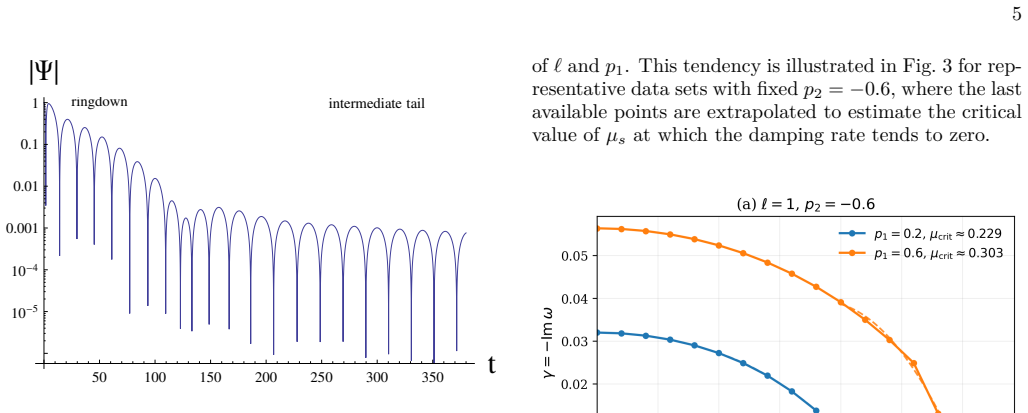
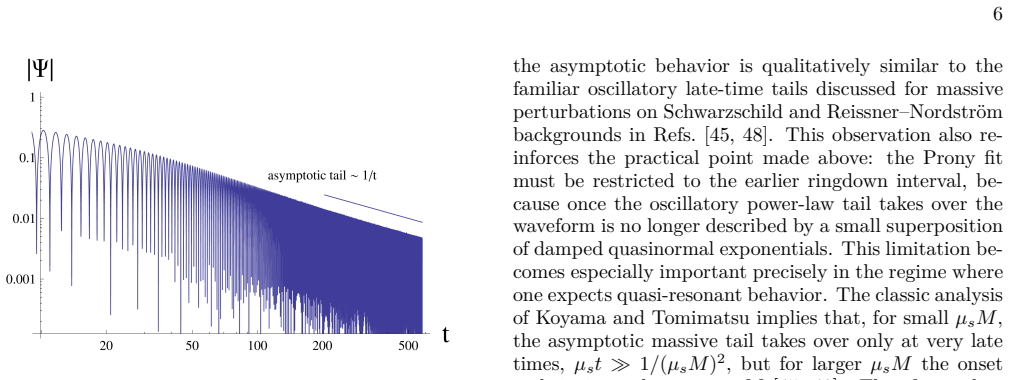
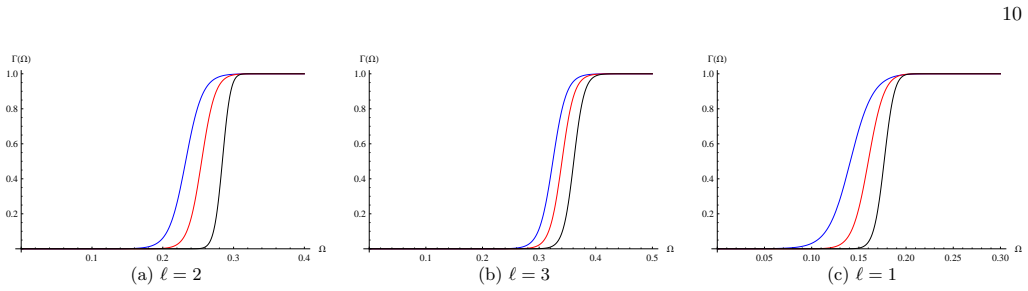
The damping rate of quasinormal modes decreases strongly as the field mass increases, indicating the approach to long-lived quasi-resonant states for representative parameter families. At the same time, in the large-mass regime these weakly damped modes become progressively harder to isolate in the time domain because the oscillatory massive tails dominate on the Koyama–Tomimatsu scale. Interpreting the effective potential semiclassically shows that increasing the scalar mass suppresses low-frequency transmission, shifts the onset of efficient absorption to higher frequencies, and that larger deviations from the Schwarzschild limit enhance the absorption cross section.
What carries the argument
The effective potential for the massive scalar perturbation derived from the parity-symmetric beyond-Horndeski metric, whose asymptotic height and barrier shape control the quasinormal spectrum, greybody factors, and absorption via WKB and time-domain methods.
If this is right
- Quasinormal-mode damping rates fall markedly with rising scalar mass for typical parameter choices.
- The onset of efficient absorption moves to higher frequencies as the scalar mass grows.
- The absorption cross section increases when the metric deviates further from the Schwarzschild solution.
- Time-domain profiles exhibit a transition from quasinormal ringing to oscillatory late-time tails whose dominance arrives earlier at higher masses.
Where Pith is reading between the lines
- Massive scalars may act as more sensitive detectors of geometric deviations from general relativity than massless fields, because their long-lived modes and early tails encode the competition between mass and curvature in observable signals.
- Frequency-domain techniques could prove more practical than time-domain ones for isolating these modes once the scalar mass exceeds a modest threshold relative to the black-hole mass.
- The same effective-potential analysis could be applied to vector or tensor perturbations to test whether the long-lived regime appears across different spin sectors in this class of black holes.
Load-bearing premise
The effective potential derived from the background metric remains an accurate description of the massive scalar dynamics, and the chosen numerical methods capture the transition from ringing to massive tails without uncontrolled contamination.
What would settle it
A computation of the quasinormal frequencies for successively larger scalar masses that fails to show a strong decrease in the damping rate, or a time-domain waveform that lacks the predicted early onset of oscillatory massive tails.
Figures



read the original abstract
We study quasinormal modes, greybody factors, and the absorption cross section of a massive scalar field in the asymptotically flat parity-symmetric beyond-Horndeski black-hole background. The scalar mass raises the asymptotic level of the effective potential and can eliminate its barrier peak, thereby changing both the ringing spectrum and the scattering characteristics relative to the massless case. Using Pad\'e-improved high-order WKB calculations together with time-domain evolution, we find that the damping rate decreases strongly as the field mass increases, indicating the approach to long-lived quasi-resonant states for representative parameter families. At the same time, in the large-mass regime these weakly damped modes become progressively harder to isolate in the time domain, because the oscillatory massive tails are expected to dominate on the Koyama--Tomimatsu scale $\mu_s t\gg \mu_s M$, which is comparatively early when $M=1$ and $\mu_s$ is not small. The time-domain profiles also exhibit the transition from quasinormal ringing to an oscillatory late-time tail. Interpreting the same effective potential semiclassically, we show that increasing the scalar mass suppresses low-frequency transmission and shifts the onset of efficient absorption to higher frequencies, while larger deviations from the Schwarzschild limit enhance the absorption cross section. These results show that the competition between long-lived modes and rapidly dominant massive tails makes the massive sector an especially subtle and sensitive probe of the interplay between field mass and geometric deformation in this class of black holes.
Editorial analysis
A structured set of objections, weighed in public.
Referee Report
Summary. The paper studies quasinormal modes, greybody factors, and absorption cross sections of a massive scalar field in an asymptotically flat parity-symmetric beyond-Horndeski black-hole background. Using Padé-improved high-order WKB and time-domain evolution, it reports that the damping rate decreases strongly with increasing scalar mass μ_s, indicating long-lived quasi-resonant states, while noting that these modes become harder to isolate in the time domain due to early dominance of oscillatory massive tails on the Koyama–Tomimatsu scale. Semiclassically, increasing μ_s suppresses low-frequency transmission and shifts efficient absorption to higher frequencies, with larger deviations from Schwarzschild enhancing the absorption cross section.
Significance. If the numerical results hold, the work illustrates how massive fields can serve as sensitive probes of beyond-Horndeski deformations through the competition between weakly damped modes and dominant tails, with potential implications for black-hole spectroscopy and scattering in modified gravity. The dual use of WKB and time-domain methods plus the semiclassical effective-potential analysis provides a coherent picture of the mass-induced changes.
major comments (3)
- [Time-domain evolution] Time-domain evolution: The central claim that damping rates decrease strongly with μ_s (and that modes become progressively harder to isolate) depends on cleanly extracting the imaginary part from the early ringing phase. The manuscript notes tail dominance on the scale μ_s t ≫ μ_s M but provides no quantitative demonstration that WKB and time-domain frequencies agree in the regime where tails begin to overlap the ringing window; without this cross-check, the extracted decay rates for large μ_s risk bias from numerical dispersion or early tail contamination.
- [Numerical methods] Numerical methods: No convergence tests, error bars, or explicit comparisons with known limits (e.g., Schwarzschild massive-scalar QNMs or the μ_s → 0 limit) are reported. Since the headline results on damping reduction and absorption shifts rest on the fidelity of the Padé-WKB and finite-difference time evolution, these validations are load-bearing and must be supplied.
- [Effective potential] Effective potential: The statement that the scalar mass raises the asymptotic level and can eliminate the barrier peak is used to explain both the ringing spectrum and the scattering changes. Explicit verification (e.g., plots of V(r) for the representative parameter families) is needed to confirm this elimination occurs within the chosen beyond-Horndeski deviation range and is not an artifact of the metric ansatz.
minor comments (1)
- [Abstract] The abstract could usefully state the specific ranges of μ_s and the beyond-Horndeski deviation parameter explored for the 'representative parameter families'.
Simulated Author's Rebuttal
We thank the referee for the careful and constructive report. The comments identify key areas where additional validation will strengthen the manuscript, and we address each point below with plans for revision.
read point-by-point responses
-
Referee: [Time-domain evolution] Time-domain evolution: The central claim that damping rates decrease strongly with μ_s (and that modes become progressively harder to isolate) depends on cleanly extracting the imaginary part from the early ringing phase. The manuscript notes tail dominance on the scale μ_s t ≫ μ_s M but provides no quantitative demonstration that WKB and time-domain frequencies agree in the regime where tails begin to overlap the ringing window; without this cross-check, the extracted decay rates for large μ_s risk bias from numerical dispersion or early tail contamination.
Authors: We agree that a quantitative cross-check between WKB and time-domain results is needed to confirm the reliability of the extracted damping rates in the presence of emerging massive tails. In the revised manuscript we will add a direct comparison (table and/or figure) of quasinormal frequencies from both methods for representative μ_s values, together with an assessment of the time window before tail dominance on the Koyama–Tomimatsu scale and checks for numerical dispersion. This will substantiate the claim that damping decreases strongly while modes become harder to isolate. revision: yes
-
Referee: [Numerical methods] Numerical methods: No convergence tests, error bars, or explicit comparisons with known limits (e.g., Schwarzschild massive-scalar QNMs or the μ_s → 0 limit) are reported. Since the headline results on damping reduction and absorption shifts rest on the fidelity of the Padé-WKB and finite-difference time evolution, these validations are load-bearing and must be supplied.
Authors: We acknowledge that explicit convergence tests, error estimates, and benchmark comparisons are essential for the credibility of the numerical results. In the revision we will add a dedicated subsection (or appendix) presenting convergence studies for the finite-difference time evolution, error bars on the Padé-WKB frequencies, and direct comparisons with the Schwarzschild massive-scalar QNMs as well as the μ_s → 0 limit within the beyond-Horndeski family. revision: yes
-
Referee: [Effective potential] Effective potential: The statement that the scalar mass raises the asymptotic level and can eliminate the barrier peak is used to explain both the ringing spectrum and the scattering changes. Explicit verification (e.g., plots of V(r) for the representative parameter families) is needed to confirm this elimination occurs within the chosen beyond-Horndeski deviation range and is not an artifact of the metric ansatz.
Authors: We agree that explicit plots are required to verify the effective-potential behavior. In the revised manuscript we will include figures of V(r) for the representative scalar masses and beyond-Horndeski deviation parameters used in the study. These plots will demonstrate the raising of the asymptotic level and the suppression or elimination of the barrier peak, confirming that the effect lies within the chosen parameter range and is not an artifact of the metric. revision: yes
Circularity Check
No circularity: results obtained via independent numerical methods on fixed background
full rationale
The paper derives its claims about quasinormal modes, damping rates, greybody factors, and absorption cross sections by direct application of Padé-improved WKB and time-domain integration to the effective potential obtained from the parity-symmetric beyond-Horndeski metric. These standard numerical techniques are not defined in terms of the paper's own outputs, fitted parameters, or self-citations; the trends (e.g., damping rate decreasing with scalar mass) emerge from solving the wave equation without reduction to tautological inputs. No load-bearing step reduces by the paper's equations to a self-definition or renamed fit.
Axiom & Free-Parameter Ledger
free parameters (2)
- scalar mass μ_s
- beyond-Horndeski deviation parameter
axioms (2)
- domain assumption The spacetime is described by the asymptotically flat parity-symmetric beyond-Horndeski metric.
- standard math The scalar field obeys the massive Klein-Gordon equation on this background.
Lean theorems connected to this paper
-
IndisputableMonolith/Cost/FunctionalEquation.leanwashburn_uniqueness_aczel unclearThe effective potential takes the compact form V_ℓ(r) = A(r)[ℓ(ℓ+1)/r² + A'(r)/r + μ_s²]
-
IndisputableMonolith/Foundation/ArithmeticFromLogic.leanreality_from_one_distinction unclearUsing Padé-improved high-order WKB calculations together with time-domain evolution
Reference graph
Works this paper leans on
-
[1]
0 0 .092647 − 0.085695i 0.092487 − 0.085487i 0.208%
-
[2]
0.04 0 .093152 − 0.084117i 0.092902 − 0.083916i 0.255%
-
[3]
0.08 0 .094318 − 0.079119i 0.097191 − 0.076150i 3.36%
-
[4]
0.12 0 .096762 − 0.072754i 0.096569 − 0.072315i 0.397%
-
[5]
0.16 0 .099180 − 0.061314i 0.098774 − 0.061419i 0.360%
-
[6]
0.2 0 .140346 − 0.039618i 0.142788 − 0.033906i 4.26% 1.4 0 0 .096462 − 0.090278i 0.096368 − 0.089992i 0.228% 1.4 0 .04 0 .096899 − 0.088807i 0.096768 − 0.088462i 0.281% 1.4 0 .08 0 .098266 − 0.084435i 0.097070 − 0.081986i 2.10% 1.4 0 .12 0 .100290 − 0.077487i 0.100358 − 0.077524i 0.0612% 1.4 0 .16 0 .099305 − 0.073164i 0.099305 − 0.073165i 0.0006% 1.4 0 ....
-
[7]
0 0 .245302 − 0.079946i 0.245302 − 0.079946i 0%
-
[8]
0.08 0 .248675 − 0.077951i 0.248675 − 0.077951i 0. × 10-4%
-
[9]
0.12 0 .252908 − 0.075417i 0.252908 − 0.075417i 0. × 10-4%
-
[10]
0.16 0 .258863 − 0.071787i 0.258863 − 0.071787i 0. × 10-4%
-
[11]
0.2 0 .266562 − 0.066967i 0.266562 − 0.066967i 0%
-
[12]
0.24 0 .276016 − 0.060819i 0.276016 − 0.060819i 0. × 10-4%
-
[13]
0.28 0 .287197 − 0.053152i 0.287196 − 0.053153i 0.0005%
-
[14]
0.32 0 .299993 − 0.043782i 0.299807 − 0.044315i 0.186%
-
[15]
0.38 0 .330375 − 0.027939i 0.332519 − 0.026161i 0.840% 1.4 0 0 .255606 − 0.084114i 0.255606 − 0.084114i 0% 1.4 0 .08 0 .258863 − 0.082173i 0.258863 − 0.082173i 0% 1.4 0 .12 0 .262950 − 0.079710i 0.262950 − 0.079710i 0% 1.4 0 .16 0 .268699 − 0.076191i 0.268699 − 0.076191i 0% 1.4 0 .2 0 .276130 − 0.071535i 0.276130 − 0.071535i 0% 1.4 0 .24 0 .285258 − 0.065...
-
[16]
0 0 .079110 − 0.072135i 0.078926 − 0.071958i 0.239%
-
[17]
0.04 0 .079705 − 0.070283i 0.079410 − 0.070118i 0.318%
-
[18]
0.08 0 .081168 − 0.064627i 0.081650 − 0.064954i 0.562%
-
[19]
0.12 0 .082970 − 0.056684i 0.081885 − 0.058133i 1.80%
-
[20]
0.14 0 .074342 − 0.048837i 0.082028 − 0.051791i 9.26%
-
[21]
0.16 0 .079908 − 0.058963i 0.085624 − 0.062319i 6.67% 1.4 0 0 .085256 − 0.079077i 0.085172 − 0.078822i 0.231% 1.4 0 .04 0 .085755 − 0.077426i 0.085623 − 0.077094i 0.309% 1.4 0 .08 0 .087258 − 0.072423i 0.088327 − 0.072218i 0.960% 1.4 0 .12 0 .088977 − 0.065355i 0.089014 − 0.064763i 0.537% 1.4 0 .16 0 .086966 − 0.055294i 0.086913 − 0.055318i 0.0564% 1.4 0 ...
-
[22]
0 0 .209261 − 0.067381i 0.209261 − 0.067381i 0%
-
[23]
0.04 0 .210241 − 0.066810i 0.210241 − 0.066810i 0%
-
[24]
0.08 0 .213188 − 0.065079i 0.213188 − 0.065079i 0%
-
[25]
0.12 0 .218123 − 0.062133i 0.218123 − 0.062133i 0. × 10-4%
-
[26]
0.16 0 .225076 − 0.057869i 0.225076 − 0.057869i 0. × 10-4%
-
[27]
0.2 0 .234066 − 0.052121i 0.234066 − 0.052121i 0%
-
[28]
0.24 0 .245064 − 0.044640i 0.245064 − 0.044641i 0.0004%
-
[29]
0.28 0 .257907 − 0.035118i 0.257902 − 0.035126i 0.0035%
-
[30]
0.32 0 .273885 − 0.026065i 0.275491 − 0.026193i 0.586% 1.4 0 0 .225843 − 0.073737i 0.225843 − 0.073737i 0% 1.4 0 .04 0 .226759 − 0.073196i 0.226759 − 0.073196i 0% 1.4 0 .08 0 .229513 − 0.071561i 0.229513 − 0.071561i 0% 1.4 0 .12 0 .234123 − 0.068789i 0.234123 − 0.068789i 0% 1.4 0 .16 0 .240613 − 0.064801i 0.240613 − 0.064801i 0% 1.4 0 .2 0 .249007 − 0.059...
-
[31]
0 0 .345386 − 0.066796i 0.345386 − 0.066796i 0%
-
[32]
0.08 0 .348137 − 0.065877i 0.348137 − 0.065877i 0%
-
[33]
0.16 0 .356437 − 0.063082i 0.356437 − 0.063082i 0%
-
[34]
0.24 0 .370443 − 0.058275i 0.370443 − 0.058275i 0%
-
[35]
0.32 0 .390429 − 0.051170i 0.390429 − 0.051170i 0%
-
[36]
0.4 0 .416786 − 0.041185i 0.416786 − 0.041185i 0%
-
[37]
0.44 0 .432465 − 0.034778i 0.432464 − 0.034778i 0.00025%
-
[38]
0.48 0 .449788 − 0.027150i 0.449782 − 0.027149i 0.00150%
-
[39]
0.52 0 .476252 − 0.013528i 0.476832 − 0.012055i 0.332% 1.4 0 0 .372793 − 0.073081i 0.372793 − 0.073081i 0% 1.4 0 .08 0 .375372 − 0.072211i 0.375372 − 0.072211i 0% 1.4 0 .16 0 .383145 − 0.069570i 0.383145 − 0.069570i 0% 1.4 0 .24 0 .396236 − 0.065056i 0.396236 − 0.065056i 0% 1.4 0 .32 0 .414858 − 0.058461i 0.414858 − 0.058461i 0% 1.4 0 .4 0 .439328 − 0.049...
-
[40]
K. D. Kokkotas and B. G. Schmidt, Living Rev. Relativ. 2, 2 (1999), arXiv:gr-qc/9909058 [gr-qc]
work page internal anchor Pith review arXiv 1999
-
[41]
Quasinormal modes of black holes and black branes
E. Berti, V. Cardoso, and A. O. Starinets, Class. Quant. Grav. 26, 163001 (2009), arXiv:0905.2975 [gr-qc]
work page internal anchor Pith review Pith/arXiv arXiv 2009
-
[42]
R. A. Konoplya and A. Zhidenko, Rev. Mod. Phys. 83, 793 (2011), arXiv:1102.4014 [gr-qc]
work page internal anchor Pith review arXiv 2011
- [43]
- [44]
- [45]
-
[46]
Afzalet al.(NANOGrav), Astrophys
A. Afzal et al. (NANOGrav), Astrophys. J. Lett. 951, L11 (2023), [Erratum: Astrophys.J.Lett. 971, L27 (2024), Erratum: Astrophys.J. 971, L27 (2024)], 12 arXiv:2306.16219 [astro-ph.HE]
- [47]
- [48]
- [49]
-
[50]
A. Zhidenko, Phys. Rev. D 74, 064017 (2006), arXiv:gr- qc/0607133
- [51]
- [52]
- [53]
- [54]
-
[55]
S. Ponglertsakul and B. Gwak, Eur. Phys. J. C 80, 1023 (2020), arXiv:2007.16108 [gr-qc]
- [56]
-
[57]
P. Burikham, S. Ponglertsakul, and L. Tannukij, Phys. Rev. D 96, 124001 (2017), arXiv:1709.02716 [gr-qc]
- [58]
-
[59]
J. Percival and S. R. Dolan, Phys. Rev. D 102, 104055 (2020), arXiv:2008.10621 [gr-qc]
- [60]
- [61]
- [62]
- [63]
-
[64]
B. C. Lütfüoğlu, arXiv e-prints (2026), arXiv:2603.10844 [gr-qc]
work page internal anchor Pith review Pith/arXiv arXiv 2026
-
[65]
B. C. Lütfüoğlu, S. Murodov, M. Abdullaev, J. Ray- imbaev, M. Akhmedov, and M. Matyoqubov, arXiv e-prints (2026), arXiv:2602.11001 [gr-qc]
work page internal anchor Pith review Pith/arXiv arXiv 2026
-
[66]
B. C. Lütfüoğlu, J. Rayimbaev, B. Rahmatov, F. Shayi- mov, and I. Davletov, Phys. Lett. B 876, 140392 (2026), arXiv:2601.17906 [gr-qc]
work page internal anchor Pith review Pith/arXiv arXiv 2026
- [67]
- [68]
- [69]
- [70]
- [71]
- [72]
-
[73]
Skvortsova, (2026), arXiv:2603.28415 [gr-qc]
M. Skvortsova, (2026), arXiv:2603.28415 [gr-qc]
-
[74]
Skvortsova, (2025), arXiv:2509.18061 [gr-qc]
M. Skvortsova, arXiv e-prints (2025), arXiv:2509.18061 [gr-qc]
-
[75]
Skvortsova, EPL 149, 59001 (2025), arXiv:2503.03650 [gr-qc]
M. Skvortsova, EPL 149, 59001 (2025), arXiv:2503.03650 [gr-qc]
-
[76]
S. V. Bolokhov, (2026), arXiv:2604.11845 [gr-qc]
work page internal anchor Pith review Pith/arXiv arXiv 2026
- [77]
-
[78]
S. V. Bolokhov, Phys. Rev. D 109, 064017 (2024)
work page 2024
-
[79]
A. Dubinsky, Int. J. Theor. Phys. 65, 45 (2026), arXiv:2511.00778 [gr-qc]
-
[80]
A. Dubinsky, Eur. Phys. J. C 85, 924 (2025), arXiv:2505.08545 [gr-qc]
discussion (0)
Sign in with ORCID, Apple, or X to comment. Anyone can read and Pith papers without signing in.