Recognition: no theorem link
Correction of STEM Distortions
Pith reviewed 2026-05-13 01:45 UTC · model grok-4.3
The pith
Geometric transformations are derived to reverse scanning distortions in STEM images.
A machine-rendered reading of the paper's core claim, the machinery that carries it, and where it could break.
Core claim
The central claim is that multiple categories of scanning-induced distortions in STEM images can be modeled through coordinate transformations and thereby reversed to recover the true geometry of the specimen. The transformations are worked out in detail as a technical reference so that they can be coded directly into image-processing routines.
What carries the argument
The set of derived geometric transformations that remap distorted scan coordinates back to undistorted sample coordinates.
If this is right
- Corrected images yield accurate atomic coordinates and lattice parameters for quantitative analysis.
- Strain and defect mapping become reliable once artificial scan-induced variations are removed.
- The transformations can be coded directly into automated correction pipelines for routine use.
- Software implementations can apply the corrections consistently across large datasets.
Where Pith is reading between the lines
- Routine use of the corrections could reduce the need for post-hoc manual adjustments in published micrographs.
- Similar coordinate-remapping methods might be adapted to other raster-scanning techniques such as scanning probe microscopy.
- Combining the transformations with real-time scan calibration could further minimize residual errors during acquisition.
Load-bearing premise
That all relevant distortions are purely geometric and can be completely captured and reversed by the derived transformations without leftover effects from the instrument or specimen.
What would settle it
Apply the transformations to an image of a known perfect crystal lattice and verify that measured interatomic distances become uniform and match the expected values within experimental error.
Figures





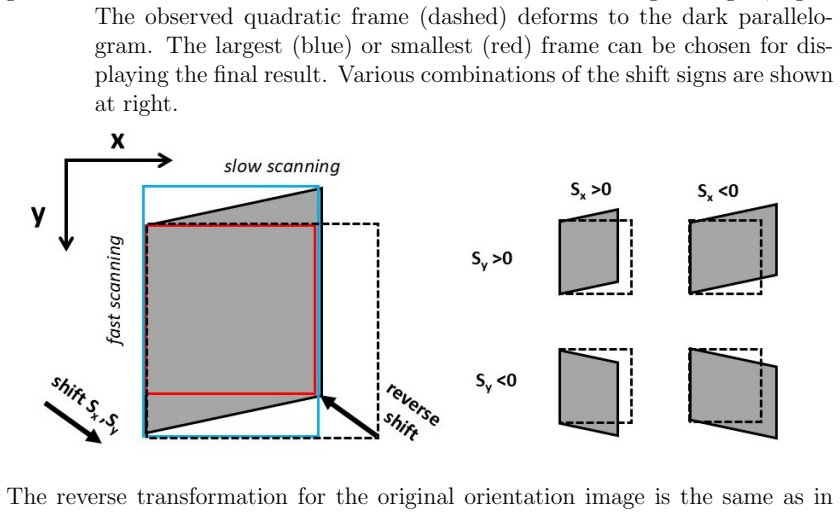


read the original abstract
The manuscript considers Scanning Transmission Electron Microscopy (STEM) images and derives transformations needed to correct various distortions occurring during scanning. These transformations form the basis for the correction algorithms implemented in the CEOS Panta Rhei and TEMDM software. The manuscript is intended as a technical reference and is meant to be published only on arXiv rather than in peer-reviewed journals.
Editorial analysis
A structured set of objections, weighed in public.
Referee Report
Summary. The manuscript derives geometric transformations to correct various distortions occurring during scanning in STEM images. These transformations form the basis for correction algorithms implemented in the CEOS Panta Rhei and TEMDM software. The work is presented as a technical reference document rather than a full research article.
Significance. If the derivations are correct and complete, the paper supplies a useful technical reference for implementing distortion corrections in STEM imaging, which is relevant for improving accuracy in high-resolution electron microscopy. The approach of starting from scanning geometry is a positive feature, as it avoids circularity. However, the lack of any validation, error analysis, or experimental comparisons limits the assessed significance and practical impact.
major comments (1)
- [Abstract and overall structure] The central claim that the derived transformations correct scanning distortions cannot be fully assessed, as the manuscript provides no validation against experimental data, no error analysis, and no comparison to existing correction methods or test cases (see abstract and overall structure).
Simulated Author's Rebuttal
We thank the referee for their review. The manuscript is a technical reference deriving geometric transformations for STEM scanning distortions from first principles, intended for arXiv and as documentation for CEOS Panta Rhei and TEMDM software rather than an experimental research article.
read point-by-point responses
-
Referee: [Abstract and overall structure] The central claim that the derived transformations correct scanning distortions cannot be fully assessed, as the manuscript provides no validation against experimental data, no error analysis, and no comparison to existing correction methods or test cases (see abstract and overall structure).
Authors: The manuscript does not include experimental validation, error analysis, or method comparisons because it is explicitly framed as a derivation of transformations based on scanning geometry, not a validation study. The central claim rests on the mathematical correctness of the derivations, which begin from the physical scanning process to avoid circularity (a point noted positively in the report). These can be assessed directly from the provided equations and geometric reasoning. Adding experimental data would alter the document's purpose as a technical reference. We therefore do not plan to incorporate validation or comparisons. revision: no
Circularity Check
No circularity: derivations start from scanning geometry
full rationale
The paper derives geometric transformations for correcting STEM scanning distortions directly from the physical model of the scanning process. No load-bearing step reduces by construction to fitted outputs, self-citations, or renamed inputs. The central claim is a set of invertible transformations obtained from first-principles scanning kinematics, with no evidence that any prediction is statistically forced by the data it is meant to correct. This is the expected outcome for a technical reference deriving correction algorithms from instrument geometry.
Axiom & Free-Parameter Ledger
Reference graph
Works this paper leans on
-
[1]
L. Jones, H. Yang, T.J. Pennycook, MS.J. Marshall, S. van Aert, N.D. Brown- ing, M.R. Castell, and P.D. Nellist. Revolving scanning transmission electron microscopy: correcting sample drift distortion without prior knowledge.Ad- vanced Structural and Chemical Imaging, pages 1–8, 2015
work page 2015
-
[2]
X. Sang and J. M. LeBeau. Revolving scanning transmission electron microscopy: correcting sample drift distortion without prior knowledge.Ultramicroscopy, 138:28–35, 2014
work page 2014
- [3]
-
[4]
Y. Wang, Y. E. Suyolcu, U. Salzberger, K. Hahn, V. Srot, W. Sigle, and P.A. van Aken. Correction linear and nonlinear distortions for atomically resolved STEM spectrum and diffraction imaging.Microscopy, 67:i114–i122, 2018. 21
work page 2018
discussion (0)
Sign in with ORCID, Apple, or X to comment. Anyone can read and Pith papers without signing in.