Recognition: 2 theorem links
· Lean TheoremTokaMind for Power Grid: Cross-Domain Transfer from Fusion Plasma
Pith reviewed 2026-05-13 00:55 UTC · model grok-4.3
The pith
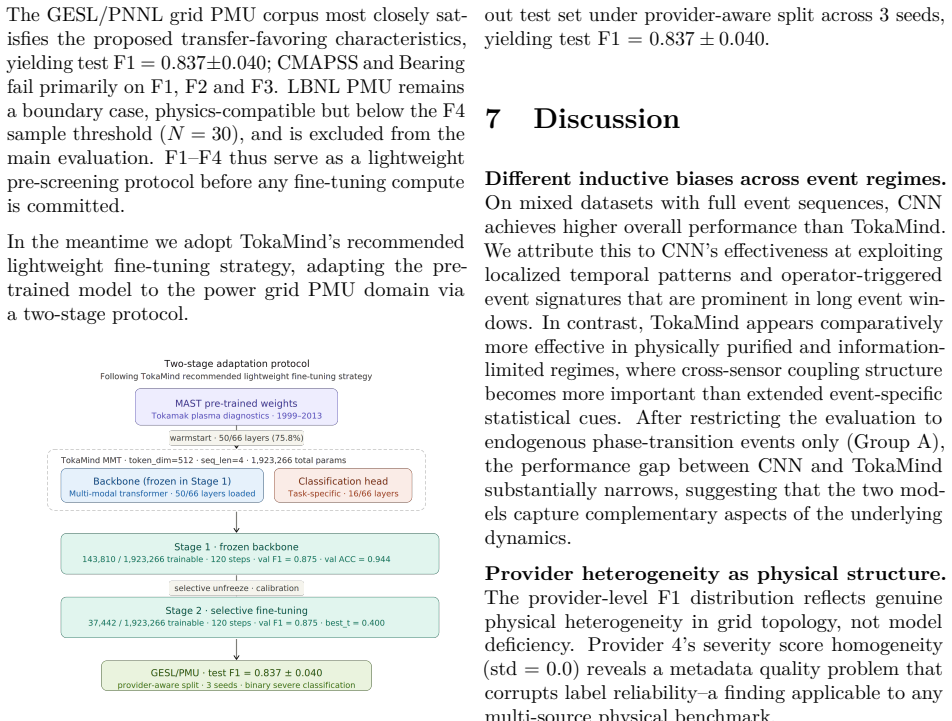
TokaMind pretrained on tokamak plasma data achieves F1 0.837 on power grid severe event classification, with difficulty set by grid topology not model capacity.
A machine-rendered reading of the paper's core claim, the machinery that carries it, and where it could break.
Core claim
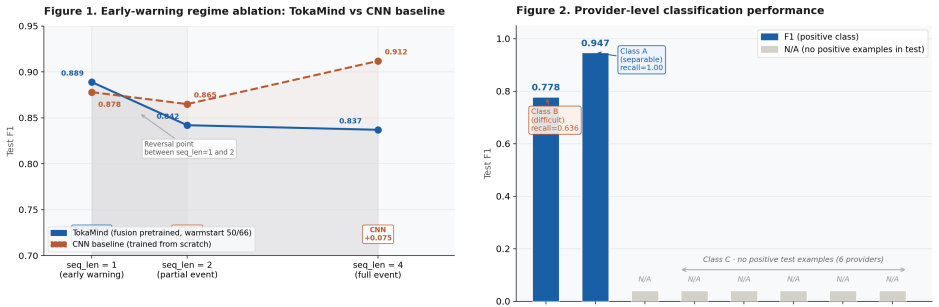
TokaMind, a multi-modal transformer pre-trained on tokamak plasma diagnostics, generalizes to power grid PMU data for severe event classification, reaching a test F1 of 0.837 on the GESL/PNNL benchmark. Classification difficulty correlates with provider-level grid topology rather than model capacity. In the single-window regime, it edges out a CNN baseline, an advantage that vanishes with additional event windows, and Critical Slowing Down indicators used as a confidence gate raise F1 from 0.696 to 0.750 at 63 percent coverage.
What carries the argument
The four transfer-favoring characteristics identified through cross-domain experiments that predict when plasma-pretrained representations succeed on new physical systems such as power grids.
Load-bearing premise
The four transfer-favoring characteristics fully account for why representations from one physical system successfully apply to another with different underlying equations.
What would settle it
Measure classification F1 scores on two grid providers that share identical topologies but have different event statistics, or on grids whose topologies have been deliberately randomized, to test whether performance gaps track topology changes alone.
Figures


read the original abstract
TokaMind is a multi-modal transformer (MMT) foundation model pre-trained on tokamak plasma diagnostics data from MAST, where it was shown to outperform CNN-based approaches on fusion benchmarks. We investigate whether its learned representations generalize to physically distinct but structurally analogous domains. Through systematic experimentation across four domains-industrial bearing degradation, NASA CMAPSS turbofan degradation, and two independent power grid PMU datasets-we identify four transfer-favoring characteristics that help explain where TokaMind's pretrained representations are most effective. Power grid synchrophasor data matches this target-domain profile most directly, while industrial degradation datasets demonstrate that TokaMind can still yield useful performance under partial alignment, especially when task design and feature construction expose physically meaningful degradation structure. On the GESL/PNNL 500-event benchmark with provider-aware evaluation, TokaMind achieves test $\text{F1} = 0.837 \pm 0.040$ (3~seeds) for severe event classification. Our central finding, however, is not the aggregate score: classification difficulty is structurally determined by provider-level grid topology, not model capacity. In the single-window early-warning regime, TokaMind outperforms a CNN baseline (F1~0.889 vs.~0.878)--a reversal that disappears as more event windows are provided. Furthermore, Critical Slowing Down (CSD) indicators, used as a confidence gate rather than a classification label, improve F1 from 0.696 to 0.750 at 63% coverage-outperforming the CNN baseline (0.636) at any coverage level. These results establish the first cross-domain validation of TokaMind outside nuclear fusion and propose a transferability framework and revised evaluation protocol for multi-source PMU datasets.
Editorial analysis
A structured set of objections, weighed in public.
Referee Report
Summary. The paper presents TokaMind, a multi-modal transformer pre-trained on MAST tokamak plasma diagnostics, and evaluates its zero-shot transfer to power-grid PMU data for severe event classification. It identifies four transfer-favoring characteristics from experiments on industrial bearing, NASA CMAPSS, and two PMU datasets; reports test F1 = 0.837 ± 0.040 (3 seeds) on the GESL/PNNL 500-event benchmark under provider-aware evaluation; shows TokaMind outperforming a CNN baseline in the single-window regime (0.889 vs 0.878) with reversal at longer windows; and demonstrates that Critical Slowing Down indicators used as a confidence gate raise F1 from 0.696 to 0.750 at 63 % coverage. The central claim is that classification difficulty is structurally determined by provider-level grid topology rather than model capacity, together with a proposed transferability framework.
Significance. If the topology-driven difficulty claim and the causal role of the four characteristics are substantiated, the work would constitute the first documented cross-domain validation of a fusion-plasma foundation model on power-grid synchrophasor data and could usefully revise evaluation protocols for multi-source PMU benchmarks. The empirical F1 numbers, the single-window reversal, and the CSD gating result are concrete and falsifiable; the transferability framework itself is a potentially reusable contribution. At present, however, the absence of architecture details, training protocols, ablations, and a direct capacity-versus-topology test leaves the central claims under-supported.
major comments (3)
- [Abstract] Abstract: the load-bearing claim that 'classification difficulty is structurally determined by provider-level grid topology, not model capacity' is not accompanied by any experiment that holds topology fixed while varying model capacity; the reported CNN baseline comparisons and multi-window results therefore do not isolate the asserted structural factor.
- [Abstract] Abstract: the four transfer-favoring characteristics are asserted to explain where TokaMind's representations are effective, yet no quantitative correlation, ablation, or causal test is supplied to show they are drivers rather than correlates of the observed F1 = 0.837, particularly across domains whose underlying physics (MHD instabilities versus power-flow dynamics) differ substantially.
- [Abstract] Abstract and experimental sections: concrete F1 scores, standard deviations, and topology conclusions are presented without model architecture specifications, training protocol, hyper-parameter choices, or ablation tables, preventing independent assessment of whether the reported transfer performance is robust or capacity-dependent.
minor comments (1)
- [Abstract] The abstract states that power-grid PMU data 'matches this target-domain profile most directly' but does not list the exact numerical values or statistical tests used to rank the four domains against the four characteristics.
Simulated Author's Rebuttal
We thank the referee for the constructive and detailed feedback. We address each major comment point by point below with honest clarifications and commit to revisions that strengthen the supporting evidence without overstating the current results.
read point-by-point responses
-
Referee: [Abstract] Abstract: the load-bearing claim that 'classification difficulty is structurally determined by provider-level grid topology, not model capacity' is not accompanied by any experiment that holds topology fixed while varying model capacity; the reported CNN baseline comparisons and multi-window results therefore do not isolate the asserted structural factor.
Authors: We agree that the manuscript lacks a controlled experiment that holds topology fixed while varying model capacity, and that the CNN baseline and multi-window results provide only indirect support. The claim is currently inferred from the provider-aware splits on the GESL/PNNL benchmark, where the same TokaMind model yields markedly different F1 scores across providers whose grids differ in topology, with the pattern replicated by the CNN. The single-window reversal is consistent with topology-driven early-warning difficulty. To isolate the factor directly, we will add a new experiment in the revision using capacity-reduced TokaMind variants (fewer layers/attention heads) evaluated on topology-matched data subsets from the same providers. revision: yes
-
Referee: [Abstract] Abstract: the four transfer-favoring characteristics are asserted to explain where TokaMind's representations are effective, yet no quantitative correlation, ablation, or causal test is supplied to show they are drivers rather than correlates of the observed F1 = 0.837, particularly across domains whose underlying physics (MHD instabilities versus power-flow dynamics) differ substantially.
Authors: The four characteristics were identified via systematic cross-domain comparison and are offered as explanatory factors aligned with observed transfer performance. We concur that the current presentation does not include quantitative correlation coefficients, feature ablations, or causal interventions to establish them as drivers rather than correlates, especially given the physics mismatch between domains. In the revision we will add (i) a correlation table linking characteristic presence to per-domain F1 and (ii) a targeted ablation that masks or perturbs inputs corresponding to each characteristic while measuring impact on transfer F1. revision: yes
-
Referee: [Abstract] Abstract and experimental sections: concrete F1 scores, standard deviations, and topology conclusions are presented without model architecture specifications, training protocol, hyper-parameter choices, or ablation tables, preventing independent assessment of whether the reported transfer performance is robust or capacity-dependent.
Authors: The full manuscript contains these elements: architecture (layer count, embedding size, multi-modal fusion) is specified in Section 3.1; training protocol, optimizer, learning-rate schedule, batch size, and epoch counts appear in Section 4.2; ablation studies on pre-training objectives and input modalities are reported in Appendix B. We acknowledge that these details may not have been sufficiently prominent or cross-referenced in the abstract and main experimental narrative. In the revision we will insert a concise architecture-and-hyperparameter summary table in the main text, add explicit cross-references from the abstract and results sections, and ensure all reported F1 values are tied to the exact experimental configuration. revision: yes
Circularity Check
No circularity: empirical transfer results are independent of inputs
full rationale
The paper reports empirical F1 scores from pre-training on tokamak data and testing on held-out power-grid PMU events, plus cross-domain experiments that identify four transfer-favoring characteristics. No equations, parameters, or metrics are defined in terms of the reported outcomes; classification difficulty is asserted from observed provider-level topology effects rather than by construction. All central claims rest on external benchmarks and baseline comparisons, making the derivation self-contained.
Axiom & Free-Parameter Ledger
axioms (1)
- domain assumption Tokamak plasma diagnostics data and power-grid PMU data share transferable structural features despite distinct underlying physics.
Lean theorems connected to this paper
-
IndisputableMonolith/Cost/FunctionalEquation.leanwashburn_uniqueness_aczel echoes?
echoesECHOES: this paper passage has the same mathematical shape or conceptual pattern as the Recognition theorem, but is not a direct formal dependency.
We identify four transfer-favoring characteristics... (1) dense and stable inter-sensor coupling, (2) endogenous critical-transition failure modes...
-
IndisputableMonolith/Foundation/ArrowOfTime.leanz_monotone_absolute echoes?
echoesECHOES: this paper passage has the same mathematical shape or conceptual pattern as the Recognition theorem, but is not a direct formal dependency.
Critical Slowing Down (CSD) indicators, used as a confidence gate rather than a classification label
What do these tags mean?
- matches
- The paper's claim is directly supported by a theorem in the formal canon.
- supports
- The theorem supports part of the paper's argument, but the paper may add assumptions or extra steps.
- extends
- The paper goes beyond the formal theorem; the theorem is a base layer rather than the whole result.
- uses
- The paper appears to rely on the theorem as machinery.
- contradicts
- The paper's claim conflicts with a theorem or certificate in the canon.
- unclear
- Pith found a possible connection, but the passage is too broad, indirect, or ambiguous to say the theorem truly supports the claim.
Reference graph
Works this paper leans on
-
[1]
Tobia Boschi et al. TokaMind: A multi- modal transformer foundation model for toka- mak plasma dynamics.arXiv preprint, arXiv:2602.15084, 2026. URL https://arxi v.org/abs/2602.15084
-
[2]
FAIR-MAST: A fusion device data management system.SoftwareX, 27 (5):101869, 2024
Samuel Jackson, Saiful Khan, Nathan Cummings, James Hodson, et al. FAIR-MAST: A fusion device data management system.SoftwareX, 27 (5):101869, 2024. doi: 10.1016/j.softx.2024.101
-
[3]
URL https://doi.org/10.1016/j.soft x.2024.101869
-
[4]
On the Opportunities and Risks of Foundation Models
Rishi Bommasani et al. On the opportunities and risks of foundation models.arXiv preprint arXiv:2108.07258, 2021. URL https://arxiv. org/abs/2108.07258
work page internal anchor Pith review Pith/arXiv arXiv 2021
-
[5]
Kevrekidis, Lu Lu, Paris Perdikaris, Sifan Wang, and Liu Yang
George Em Karniadakis, Ioannis G Kevrekidis, Lu Lu, Paris Perdikaris, Sifan Wang, and Liu Yang. Physics-informed machine learning.Nature Reviews Physics, 3(6):422–440, 2021. doi: 10.103 8 8/s42254-021-00314-5. URL https://doi.org/ 10.1038/s42254-021-00314-5
-
[6]
Salvatore Cuomo, Vincenzo Schiano Di Cola, Fabio Giampaolo, Gianluigi Rozza, Maziar Raissi, and Francesco Piccialli. Scientific machine learn- ing through physics–informed neural networks: Where we are and what’s next.Journal of Sci- entific Computing, 92(3):88, 2022. doi: 10.1007/ s10915-022-01939-z
work page 2022
-
[7]
Shashank Subramanian, Peter Harrington, Kurt Keutzer, Wahid Bhimji, Dmitry Morozov, Michael W Mahoney, and Amir Gholami. To- wards foundation models for scientific machine learning: Characterizing scaling and transfer be- havior.arXiv preprint arXiv:2306.00258, 2023. URLhttps://arxiv.org/abs/2306.00258
-
[8]
Fast al- gorithm for the 3-D DCT-II.IEEE Transactions on Signal Processing, 52(4):992–1001, 2004
Said Boussakta and Othman Alshibami. Fast al- gorithm for the 3-D DCT-II.IEEE Transactions on Signal Processing, 52(4):992–1001, 2004. doi: 10.1109/TSP.2004.823472
-
[9]
Scott Reed et al. A generalist agent.arXiv preprint arXiv:2205.06175, 2022. URL https: //arxiv.org/abs/2205.06175
work page internal anchor Pith review arXiv 2022
-
[10]
Arun G. Phadke and James S. Thorp.Synchro- nized Phasor Measurements and Their Applica- tions. Springer International Publishing, Cham, Switzerland, second edition, 2017. ISBN 978-3- 319-50584-8. doi: 10.1007/978-3-319-50584-8
-
[11]
Shuchismita Biswas, Jim Follum, Pavel Etingov, Xiaoyuan Fan, et al. An open-source library of phasor measurement unit data capturing real bulk power systems behavior.IEEE Access, 2023. doi: 10.1109/ACCESS.2023.3321317. URL http s://doi.org/10.1109/ACCESS.2023.3321317
-
[12]
Prabha Kundur, John Paserba, Venkat Ajjarapu, Göran Andersson, et al. Definition and classifi- cation of power system stability: IEEE/CIGRE joint task force on stability terms and defini- tions.IEEE Transactions on Power Systems, 19 (3):1387–1401, 2004. doi: 10.1109/TPWRS.20 04.825981. URL https://doi.org/10.1109/TP WRS.2004.825981
-
[13]
Khadem, Alan Collinson, Kyle C
Lexuan Meng, Jawwad Zafar, Shafiuzzaman K. Khadem, Alan Collinson, Kyle C. Murchie, Fed- erico Coffele, and Graeme Burt. Fast frequency response from energy storage systems: A review of grid standards, projects and technical issues. IEEE Transactions on Smart Grid, 11(2):1566– 1581, 2019. doi: 10.1109/TSG.2019.2940173
-
[14]
Grid event sig- nature library (gesl)
Oak Ridge National Laboratory and Lawrence Livermore National Laboratory. Grid event sig- nature library (gesl). https://gsl.ornl.gov ,
-
[15]
Open-access repository of power system measurement signatures. Accessed April 2026
work page 2026
-
[16]
TokaMark: A bench- mark for fusion plasma dynamics models.arXiv preprint, 2026
Cécile Rousseau et al. TokaMark: A bench- mark for fusion plasma dynamics models.arXiv preprint, 2026. URLhttps://arxiv.org/abs/ 2602.10132. arXiv:2602.10132
-
[17]
Yaguo Lei, Bin Yang, Xin Jiang, Feng Jia, Naipeng Li, and Asoke K. Nandi. Applications of machine learning to machine fault diagnosis: A review and roadmap.Mechanical Systems and Signal Processing, 138:106587, 2020. doi: 10.1016/j.ymssp.2019.106587. URL https: //doi.org/10.1016/j.ymssp.2019.106587
-
[18]
Zhang, Xiaoming Shi, Pin-Yu Chen, Yuxuan Liang, Yuan-Fang Li, Shirui Pan, and Qingsong Wen
Ming Jin, Shiyu Wang, Lintao Ma, Zhixuan Chu, James Y. Zhang, Xiaoming Shi, Pin-Yu Chen, Yuxuan Liang, Yuan-Fang Li, Shirui Pan, and Qingsong Wen. TIME-LLM: Time series fore- casting by reprogramming large language models. InInternational Conference on Learning Repre- sentations (ICLR), 2024
work page 2024
-
[19]
HaixuWuetal. Timesnet: Temporal2d-variation modeling for general time series analysis.Inter- national Conference on Learning Representations (ICLR), 2023. URL https://ise.thss.tsing hua.edu.cn/~mlong/doc/TimesNet-iclr23. pdf
work page 2023
-
[20]
Steven J. Lade and Thilo Gross. Early warning signals for critical transitions: A generalized mod- eling approach.PLOS Computational Biology, 8 (2):e1002360, 2012. doi: 10.1371/journal.pcbi.1 002360. URL https://doi.org/10.1371/jour nal.pcbi.1002360
-
[21]
Early warning signals for critical transitions?DOE Computational Science Grad- uate Fellowship, 2012
Carl Boettiger. Early warning signals for critical transitions?DOE Computational Science Grad- uate Fellowship, 2012. URLhttps://www.krel linst.org/csgf/conf/2012/abstracts/boe ttiger
work page 2012
-
[22]
Brock, Victor Brovkin, Stephen R
Marten Scheffer, Jordi Bascompte, William A. Brock, Victor Brovkin, Stephen R. Carpenter, Vasilis Dakos, Hermann Held, Egbert H. van Nes, Max Rietkerk, and George Sugihara. Early- warning signals for critical transitions.Nature, 461(7260):53–59, 2009. doi: 10.1038/nature0822 7
-
[23]
Anticipating critical transitions.Science, 338 (6105):344–348, 2012
Marten Scheffer, Stephen R Carpenter, Timo- thy M Lenton, Jordi Bascompte, William Brock, 9 Vasilis Dakos, Johan van de Koppel, Ingrid A van de Leemput, Simon A Levin, Egbert H van Nes, Mercedes Pascual, and John Vandermeer. Anticipating critical transitions.Science, 338 (6105):344–348, 2012. doi: 10.1126/science.1225 244
-
[24]
Christian Kuehn. A mathematical framework for critical transitions: bifurcations, fast–slow systems and stochastic dynamics.Physica D: Nonlinear Phenomena, 240(12):1020–1035, 2011. doi: 10.1016/j.physd.2011.02.012
-
[25]
Tip- ping points: early warning and wishful thinking
Peter D Ditlevsen and Sigfus J Johnsen. Tip- ping points: early warning and wishful thinking. Geophysical Research Letters, 37(19), 2010. doi: 10.1029/2010GL044486
-
[26]
Vasilis Dakos, Stephen R Carpenter, Egbert H van Nes, and Marten Scheffer. Methods for de- tecting early warnings of critical transitions in time series illustrated using simulated ecologi- cal data.PloS one, 7(7):e41010, 2012. doi: 10.1371/journal.pone.0041010
-
[27]
I. I. Novikov and Yu. S. Trelin. Speed of sound along the vapor–liquid phase equilibrium curve. Prikl. Mekh. Tekh. Fiz., 1(2):112–115, 1960
work page 1960
-
[28]
Vasilis Dakos, Marten Scheffer, Egbert H van Nes, Victor Brovkin, Vladimir Petoukhov, and Hermann Held. Slowing down as an early warning signal for abrupt climate change.Proceedings of the National Academy of Sciences, 105(38):14308– 14312, 2008. doi: 10.1073/pnas.0802430105
-
[29]
Timothy M Lenton. Early warning of climate tip- ping points from critical slowing down: compar- ing methods to improve robustness.Philosophical Transactions of the Royal Society A, 370(1962): 1185–1204, 2012. doi: 10.1098/rsta.2011.0304
-
[30]
Cook, Peter Acher- mann, and Dietmar Plenz
Christian Meisel, Andreas Schulze-Bonhage, Dean Freestone, Mark J. Cook, Peter Acher- mann, and Dietmar Plenz. Intrinsic excitabil- ity measures track antiepileptic drug action and uncover increasing/decreasing excitability over the wake/sleep cycle.Proceedings of the National Academy of Sciences, 112(47):14694–14699, 2015. doi: 10.1073/pnas.1513716112
-
[31]
C. K. Chow. On optimum recognition error and reject tradeoff.IEEE Transactions on Informa- tion Theory, 16(1):41–46, 1969
work page 1969
-
[32]
Ran El-Yaniv and Yair Wiener. On the founda- tions of noise-free selective classification.Jour- nal of Machine Learning Research, 11:1605–1641,
-
[33]
URL https://jmlr.csail.mit.edu/pap ers/volume11/el-yaniv10a/el-yaniv10a.pd f
-
[34]
Yonatan Geifman and Ran El-Yaniv. Selective classification for deep neural networks.Advances in Neural Information Processing Systems, 2017. doi: /10.5555/3295222.3295241
-
[35]
A power system disturbance classifi- cation method robust to PMU data quality issues
Zikang Li, Hao Liu, Junbo Zhao, Tianshu Bi, and Qixun Yang. A power system disturbance classifi- cation method robust to PMU data quality issues. IEEE Transactions on Industrial Informatics, 18 (1):97–108, 2022. doi: 10.1109/TII.2021.3072397
-
[36]
Federico Milano, Florian Dörfler, Gabriela Hug, David J. Hill, and Gregor Verbič. Foundations and challenges of low-inertia systems. In2018 Power Systems Computation Conference (PSCC), pages 1–25. IEEE, 2018. doi: 10.23919/PSCC.20 18.8450880
-
[37]
Damage propagation modeling for aircraft engine run-to-failure simulation
Abhinav Saxena, Kai Goebel, Don Simon, and Neil Eklund. Damage propagation modeling for aircraft engine run-to-failure simulation. Techni- cal report, NASA Ames Research Center, 2008
work page 2008
-
[38]
Simple and scalable predictive uncertainty estimation using deep ensembles
Balaji Lakshminarayanan, Alexander Pritzel, and Charles Blundell. Simple and scalable predictive uncertainty estimation using deep ensembles. In Advances in Neural Information Processing Sys- tems, volume 30, pages 6405–6416, 2017
work page 2017
-
[39]
Predict responsibly: Improv- ing fairness and accuracy by learning to defer
David Madras et al. Predict responsibly: Improv- ing fairness and accuracy by learning to defer. Advances in Neural Information Processing Sys- tems, pages 6150–6160, 2018
work page 2018
-
[40]
Sinno Jialin Pan and Qiang Yang. A survey on transfer learning.IEEE Transactions on Knowl- edge and Data Engineering, 22(10):1345–1359,
-
[41]
doi: 10.1109/TKDE.2009.191
-
[42]
Geometric Deep Learning: Grids, Groups, Graphs, Geodesics, and Gauges
Michael M. Bronstein, Joan Bruna, Taco Co- hen, and Petar Veličković. Geometric deep learn- ing: Grids, groups, graphs, geodesics, and gauges. arXiv preprint arXiv:2104.13478, 2021. 10
work page internal anchor Pith review arXiv 2021
discussion (0)
Sign in with ORCID, Apple, or X to comment. Anyone can read and Pith papers without signing in.