Recognition: 1 theorem link
· Lean TheoremAnnotation-Free Indoor Radio Mapping via Physics-Informed Trajectory Inference
Pith reviewed 2026-05-13 01:37 UTC · model grok-4.3
The pith
CSI measurements recover user trajectories for indoor radio mapping without location labels or IMU sensors.
A machine-rendered reading of the paper's core claim, the machinery that carries it, and where it could break.
Core claim
The central claim is that the Power-Angle-Delay Profile (PADP) feature distance computed from MIMO-OFDM CSI provides a physically meaningful proxy for small spatial displacements within a local neighborhood under quasi-static multipath conditions. This proxy is incorporated as a continuity constraint in a spatially regularized Bayesian inference model that jointly recovers the latent trajectory of CSI measurements and estimates propagation parameters, enabling fully annotation-free radio mapping when access-point geometry and the walkable domain are known.
What carries the argument
The PADP feature distance serving as a local continuity constraint inside a spatially regularized Bayesian inference model for joint trajectory recovery and propagation-parameter estimation.
If this is right
- Radio maps can be calibrated using only CSI data and known environment geometry, eliminating the need for location annotations.
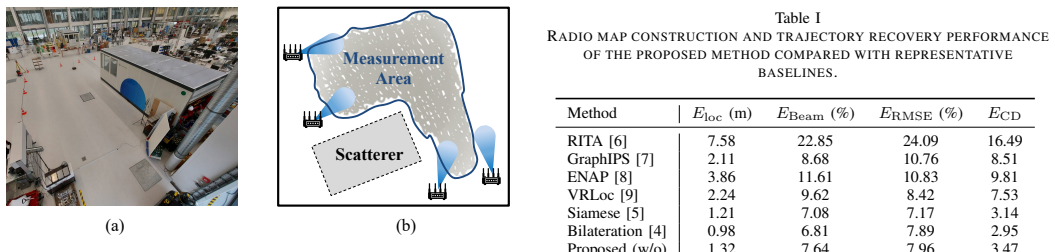
- The method achieves 0.88 m average localization error and 6.68% relative beam map construction error on real industrial CSI datasets.
- Performance exceeds that of channel-embedding methods and IMU-assisted baselines in the tested settings.
- Joint estimation of trajectories and propagation parameters occurs without external motion sensors.
Where Pith is reading between the lines
- The framework could support periodic re-mapping in slowly changing environments by re-running the inference on new CSI batches.
- Combining the inferred trajectories with floor-plan constraints might tighten the spatial regularization term beyond what the paper demonstrates.
- If PADP continuity holds across larger scales, the same model could reduce calibration effort for multi-room deployments without additional hardware.
- Crowdsourced CSI from multiple devices might be fused under the same Bayesian model to improve trajectory estimates.
Load-bearing premise
Within a local neighborhood and under quasi-static multipath conditions, the PADP feature distance reliably indicates small spatial displacements.
What would settle it
A controlled experiment in which CSI is collected at two points a known small distance apart, the PADP distance between them is computed, and the distance fails to increase monotonically with actual separation under stable multipath conditions.
Figures


read the original abstract
Constructing indoor radio maps traditionally requires extensive site surveys with precise user-location labels, making the calibration process costly and time-consuming. Existing calibration-reduction methods either depend on partial location annotations or exploit inertial measurement units (IMUs) to provide relative motion cues; however, IMU-assisted solutions are constrained by hardware availability, device-level access restrictions, and accumulated sensor drift. In this paper, we study a location-label-free indoor radio mapping problem under known access-point deployment geometry and a known walkable spatial domain. We propose a physics-informed trajectory inference framework that uses only Channel State Information (CSI), without relying on user-location labels or IMU measurements. The key idea is to recover the latent spatial coordinates of CSI measurements by exploiting the local spatial continuity of multipath propagation. To this end, we construct a Power-Angle-Delay Profile (PADP) feature distance from MIMO-OFDM CSI and show that, within a local neighborhood and under quasi-static multipath conditions, this distance provides a physically meaningful proxy for small spatial displacements. We then incorporate the PADP-based continuity constraint into a spatially regularized Bayesian inference model for joint trajectory recovery and propagation-parameter estimation. Experiments on a real-world industrial CSI dataset demonstrate that the proposed framework achieves an average localization error of 0.88 m and a relative beam map construction error of 6.68%, improving upon representative channel-embedding and IMU-assisted baselines.
Editorial analysis
A structured set of objections, weighed in public.
Referee Report
Summary. The paper proposes an annotation-free indoor radio mapping method that recovers user trajectories and constructs beam maps from MIMO-OFDM CSI alone, without location labels or IMU data. It constructs a Power-Angle-Delay Profile (PADP) feature distance asserted to serve as a proxy for small spatial displacements under quasi-static multipath conditions, incorporates this into a spatially regularized Bayesian inference model for joint trajectory and propagation-parameter estimation, and reports 0.88 m average localization error and 6.68% relative beam-map construction error on a real industrial CSI dataset, outperforming channel-embedding and IMU-assisted baselines.
Significance. If the PADP proxy holds and the joint inference is correctly grounded, the work would meaningfully advance label-free radio mapping by removing dependence on site surveys or extra sensors, with direct applicability to industrial indoor localization. The concrete real-world error metrics constitute a strength, but the absence of the supporting derivation limits the assessed impact.
major comments (1)
- Abstract: the central assertion that the PADP feature distance 'provides a physically meaningful proxy for small spatial displacements' within local neighborhoods under quasi-static multipath conditions lacks any derivation or monotonicity argument; without showing that angle-delay differences remain monotonic with Euclidean position change (accounting for phase wrapping, array calibration, or non-stationary scatterers), the spatially regularized Bayesian inference model rests on an unverified assumption that directly supports the reported 0.88 m and 6.68% figures.
Simulated Author's Rebuttal
We thank the referee for the thoughtful review and for highlighting the need to strengthen the physical justification of our approach. We address the major comment below and will revise the manuscript to incorporate additional supporting material.
read point-by-point responses
-
Referee: Abstract: the central assertion that the PADP feature distance 'provides a physically meaningful proxy for small spatial displacements' within local neighborhoods under quasi-static multipath conditions lacks any derivation or monotonicity argument; without showing that angle-delay differences remain monotonic with Euclidean position change (accounting for phase wrapping, array calibration, or non-stationary scatterers), the spatially regularized Bayesian inference model rests on an unverified assumption that directly supports the reported 0.88 m and 6.68% figures.
Authors: We acknowledge that the abstract is concise and does not contain a full derivation. The manuscript motivates the PADP distance in Section III-B via the continuous evolution of multipath components under small displacements and quasi-static conditions, supported by empirical observations on the dataset. However, we agree that an explicit monotonicity argument accounting for phase wrapping and other effects would improve rigor. In the revised version we will add a dedicated paragraph (or short subsection) providing a first-order approximation argument based on the far-field model and local linearity of angle-delay shifts, while explicitly noting the approximate nature of the proxy and its limitations under non-stationary scatterers. This clarification will not change the reported results but will better ground the Bayesian model. revision: yes
Circularity Check
No significant circularity; derivation relies on independent physical modeling of multipath continuity
full rationale
The paper derives the PADP feature distance directly from MIMO-OFDM CSI measurements and grounds its use as a local spatial proxy in the physics of quasi-static multipath propagation, which is an external property independent of the target radio map or trajectory output. This constraint is then inserted into a Bayesian model for joint inference of trajectories and propagation parameters. No step reduces the claimed localization or beam-map result to a redefinition or refit of its own inputs; the experimental validation on real CSI data further separates the method from self-referential construction. The central claim therefore remains self-contained against external benchmarks.
Axiom & Free-Parameter Ledger
free parameters (2)
- spatial regularization weight
- propagation parameters
axioms (2)
- domain assumption Local spatial continuity of multipath propagation holds within neighborhoods under quasi-static conditions
- domain assumption Access-point deployment geometry and walkable spatial domain are known a priori
Lean theorems connected to this paper
-
IndisputableMonolith/Cost/FunctionalEquation.leanwashburn_uniqueness_aczel unclear?
unclearRelation between the paper passage and the cited Recognition theorem.
Proposition 1 (Local PADP Continuity). For two nearby locations xi and xj with di,j = ∥xi − xj∥2 < ρ … c1,q di,j − bq ≤ E[D(Hi,q, Hj,q)|xi, xj] ≤ c2,q di,j + bq.
What do these tags mean?
- matches
- The paper's claim is directly supported by a theorem in the formal canon.
- supports
- The theorem supports part of the paper's argument, but the paper may add assumptions or extra steps.
- extends
- The paper goes beyond the formal theorem; the theorem is a base layer rather than the whole result.
- uses
- The paper appears to rely on the theorem as machinery.
- contradicts
- The paper's claim conflicts with a theorem or certificate in the canon.
- unclear
- Pith found a possible connection, but the passage is too broad, indirect, or ambiguous to say the theorem truly supports the claim.
Reference graph
Works this paper leans on
- [1]
-
[2]
A novel link error prediction model for
Ikuno, Josep Colom and Mehlfuhrer, Christian and Rupp, Markus , booktitle=ICC, pages=. A novel link error prediction model for
-
[3]
Millimeter wave channel modeling and cellular capacity evaluation , author=
-
[4]
Outlier-Robust Matrix Completion via l_p -Minimization , author=
-
[5]
Analysis of blockage effects on urban cellular networks , author=
-
[6]
Cooperative diversity in wireless networks: Efficient protocols and outage behavior , author=
-
[7]
High-performance cooperative demodulation with decode-and-forward relays , author=
-
[8]
Fading relay channels: Performance limits and space-time signal design , author=
-
[9]
Coverage and rate analysis for millimeter-wave cellular networks , author=
-
[10]
Grassmannian beamforming for multiple-input multiple-output wireless systems , Volume =
Love, David J and Heath Jr, Robert W and Strohmer, Thomas , Date-Added =. Grassmannian beamforming for multiple-input multiple-output wireless systems , Volume =
-
[11]
Two-stage beamformer design for massive
Kim, Donggun and Lee, Gilwon and Sung, Youngchul , Journal = IEEE_J_COM, Month = jun, Number =. Two-stage beamformer design for massive
-
[12]
Hoydis, Jakob and Ten Brink, Stephan and Debbah, M. Massive
-
[13]
Spatial channel model for
-
[14]
Quantized multimode precoding in spatially correlated multiantenna channels , author=
-
[15]
A new design of polar-cap differential codebook for temporally/spatially correlated
Choi, Junil and Clerckx, Bruno and Lee, Namyoon and Kim, Gil , journal=IEEE_J_WCOM, volume=. A new design of polar-cap differential codebook for temporally/spatially correlated
-
[16]
Kronecker product correlation model and limited feedback codebook design in a
Ying, Dawei and Vook, Frederick W and Thomas, Timothy A and Love, David J and Ghosh, Amitava , booktitle=ICC, pages=. Kronecker product correlation model and limited feedback codebook design in a
-
[17]
Partial compensation signal-level-based up-link power control to extend terminal battery duration , author=
-
[18]
Signal-level-based dynamic power control for co-channel interference management , author=. Proc. IEEE Veh. Technol. Conf. , pages=
-
[19]
Performance of optimum transmitter power control in cellular radio systems , author=
- [20]
-
[21]
Larsson, Erik G and Edfors, Ove and Tufvesson, Fredrik and Marzetta, Thomas L , journal=IEEE_M_COM, volume=. Massive
-
[22]
Rao, Xiongbin and Lau, Vincent KN , journal=IEEE_J_SP, volume=. Distributed compressive
-
[23]
Pilot contamination and precoding in multi-cell
Jose, Jubin and Ashikhmin, Alexei and Marzetta, Thomas L and Vishwanath, Sriram , journal=IEEE_J_WCOM, volume=. Pilot contamination and precoding in multi-cell
-
[24]
Noncoherent trellis coded quantization: A practical limited feedback technique for massive
Choi, Junil and Chance, Zachary and Love, David J and Madhow, Upamanyu , journal=IEEE_J_COM, volume=. Noncoherent trellis coded quantization: A practical limited feedback technique for massive
-
[25]
Trellis-extended codebooks and successive phase adjustment:
Choi, Junil and Love, David J and Kim, Taeyoung , journal=IEEE_J_WCOM, volume=. Trellis-extended codebooks and successive phase adjustment:
-
[26]
Downlink training techniques for
Choi, Junil and Love, David J and Bidigare, Patrick , journal=IEEE_J_JSAC, volume=. Downlink training techniques for
-
[27]
Training sequence design for feedback assisted hybrid beamforming in massive
Noh, Song and Zoltowski, Michael D and Love, David J , journal=IEEE_J_COM, volume=. Training sequence design for feedback assisted hybrid beamforming in massive
-
[28]
2012 IEEE Wireless Communications and Networking Conference (WCNC) , pages=
Compressive sensing based channel feedback protocols for spatially-correlated massive antenna arrays , author=. 2012 IEEE Wireless Communications and Networking Conference (WCNC) , pages=. 2012 , organization=
work page 2012
-
[29]
Spatially common sparsity based adaptive channel estimation and feedback for
Gao, Zhen and Dai, Linglong and Wang, Zhaocheng and Chen, Sheng , journal=IEEE_J_SP, volume=. Spatially common sparsity based adaptive channel estimation and feedback for
-
[30]
J. C. F. Li and M. Lei and F. Gao , booktitle=. Device-to-device (. 2012 , pages=
work page 2012
- [31]
-
[32]
G. Fodor and N. Reider , booktitle=. A Distributed Power Control Scheme for Cellular Network Assisted. 2011 , pages=
work page 2011
- [33]
-
[34]
S. Shalmashi and E. Bj\". IEEE Int. Conf. Commun. Workshop , title=. 2015 , pages=
work page 2015
-
[35]
W. Zhong and Y. Fang and S. Jin and K. K. Wong and S. Zhong and Z. Qian , journal=IEEE_J_JSAC, title=. 2015 , volume=
work page 2015
-
[36]
K. Jayasinghe and P. Jayasinghe and N. Rajatheva and M. Latva-Aho , journal=IEEE_J_COM, title=. 2014 , volume=
work page 2014
-
[37]
Ding, Minhua and Blostein, Steven D , journal=IEEE_J_SP, volume=
- [38]
-
[39]
Path loss models for air-to-ground radio channels in urban environments , author=
-
[40]
Optimal positioning of flying relays for wireless networks , year=
Junting Chen and David Gesbert , journal=. Optimal positioning of flying relays for wireless networks , year=
-
[41]
Learning air-to-ground channels in dense urban areas for
Junting Chen and Omid Esrafilian and David Gesbert and Urbashi Mitra , journal=. Learning air-to-ground channels in dense urban areas for
-
[42]
An overview of limited feedback in wireless communication systems , author=
-
[43]
Rebollo-Monedero, David and Rane, Shantanu and Girod, Bernd , booktitle=Asilomar, volume=. Wyner-
-
[44]
A cooperative channel estimation approach for coordinated multipoint transmission networks , author=. Proc. IEEE Int. Conf. Commun. Workshop , pages=
-
[45]
Hao, Chenxi and Wu, Yueping and Clerckx, Bruno , journal=IEEE_J_COM, volume=. Rate analysis of two-receiver
-
[46]
A rate splitting strategy for massive
Dai, Mingbo and Clerckx, Bruno and Gesbert, David and Caire, Giuseppe , journal=IEEE_J_WCOM, vol =. A rate splitting strategy for massive
-
[47]
arXiv preprint arXiv:1601.07254 , year=
Active Target Localization using Low-Rank Matrix Completion and Unimodal Regression , author=. arXiv preprint arXiv:1601.07254 , year=
-
[48]
Analysis of target detection via matrix completion , author=
-
[49]
Power-Distortion metrics for path planning over
Akyol, Emrah and Mitra, Urbashi , journal=IEEE_J_COM, volume=. Power-Distortion metrics for path planning over
-
[50]
Computer Communications , volume=
Path planning of mobile landmarks for localization in wireless sensor networks , author=. Computer Communications , volume=
-
[51]
R. Huang and G. V. Zaruba , booktitle=. Static Path Planning for Mobile Beacons to Localize Sensor Networks , year=
-
[52]
Real-time path planning of mobile anchor node in localization for wireless sensor networks , year=
Hongjun Li and Jianwen Wang and Xun Li and Hongxu Ma , booktitle=. Real-time path planning of mobile anchor node in localization for wireless sensor networks , year=
-
[53]
C. H. Ou and W. L. He , journal=. Path Planning Algorithm for Mobile Anchor-Based Localization in Wireless Sensor Networks , year=
-
[54]
J. Rezazadeh and M. Moradi and A. S. Ismail and E. Dutkiewicz , journal=. Superior Path Planning Mechanism for Mobile Beacon-Assisted Localization in Wireless Sensor Networks , year=
-
[55]
T. Yardibi and J. Li and P. Stoica and M. Xue and A. B. Baggeroer , journal=. Source Localization and Sensing: A Nonparametric Iterative Adaptive Approach Based on Weighted Least Squares , year=
-
[56]
Distributed, robust acoustic source localization in a wireless sensor network , author=
-
[57]
Direct regressions for underwater acoustic source localization in fluctuating oceans , author=. Applied Acoustics , volume=
-
[58]
The Journal of the Acoustical Society of America , volume=
Matched field processing: Source localization in correlated noise as an optimum parameter estimation problem , author=. The Journal of the Acoustical Society of America , volume=
-
[59]
The Journal of the Acoustical Society of America , volume=
An artificial neural network for sound localization using binaural cues , author=. The Journal of the Acoustical Society of America , volume=
-
[60]
A. Deleforge and R. Horaud and Y. Y. Schechner and L. Girin , journal=. Co-Localization of Audio Sources in Images Using Binaural Features and Locally-Linear Regression , year=
- [61]
-
[62]
Indoor localization with channel impulse response based fingerprint and nonparametric regression , author=
-
[63]
Target localization using ensemble support vector regression in wireless sensor networks , author=. IEEE Trans. on Cybernetics , volume=
-
[64]
Exact and approximate solutions of source localization problems , author=
-
[65]
A lagrangian dual approach to the single-source localization problem , author=
-
[66]
Maximum likelihood multiple-source localization using acoustic energy measurements with wireless sensor networks , author=
-
[67]
On energy-based acoustic source localization for sensor networks , author=
-
[68]
Focalization: Environmental focusing and source localization , author=. J. of the Acoustical Society of America , volume=
-
[69]
Underwater acoustic communication channels: Propagation models and statistical characterization , author=
-
[70]
Underwater acoustic networks , author=. IEEE J. of Oceanic Engineering , volume=
-
[71]
Journal of Chemometrics , volume=
Least squares algorithms under unimodality and non-negativity constraints , author=. Journal of Chemometrics , volume=
-
[72]
arXiv preprint arXiv:1512.02956 , year=
Adaptive Risk Bounds in Unimodal Regression , author=. arXiv preprint arXiv:1512.02956 , year=
-
[73]
Broadband underwater localization of multiple sources using basis pursuit de-noising , author=
-
[74]
Maximum likelihood localization of multiple sources by alternating projection , author=
- [75]
-
[76]
Exact matrix completion via convex optimization , author=. Commun. of the ACM , volume=
-
[77]
The power of convex relaxation: Near-optimal matrix completion , author=
-
[78]
Proceedings of the IEEE , volume=
Matrix completion with noise , author=. Proceedings of the IEEE , volume=
-
[79]
Introduction to spread spectrum systems , author=. 1995 , publisher=
work page 1995
-
[80]
arXiv preprint, arXiv:1701.08174 , year =
Rotated Eigenstructure Analysis for Source Localization without Energy-decay Models (full version) , author =. arXiv preprint, arXiv:1701.08174 , year =
discussion (0)
Sign in with ORCID, Apple, or X to comment. Anyone can read and Pith papers without signing in.